
How long have you been working on your current game? 6 months? A year? 5 years? Meccha Chameleon took 2 months to develop. It’s not the only game to be successful with a short development time. As a game developer, how does that make you feel? Is there anything to learn from it?
I decided I wanted to dig into the data to determine how long indie game developers are spending on their games, and if more time spent developing a game leads to more success.
Over the next couple of weeks, I’m going to be evaluating this primarily from a business/financial perspective. I understand there’s more to it than that from a creative perspective. What I’m certainly not saying is that you should try to put out a bunch of junk games as fast as you can hoping to get a hit. For one thing, that’s not a good business practice anyway.
What I’m hoping to do is discover a basic framework for making games with shorter development times in genres that have proven to be successful. I realize this is not the only way to be successful as a game dev, but I think for newer solo devs and small studios this is the safest way to build your business to mitigate risk and hopefully be able to pursue making games full-time.
To some degree, the idea of making smaller games is common sense for small teams. People talk about it all the time. I think many devs plan to keep their development time short and scope small when they start, but it slowly creeps over time. They accept the creep, telling themselves that the larger scope will make it more successful.
I’m going to try to use data to demonstrate that it is absolutely vital that you keep your development time short, especially early in your career.
I decided the best way to start was to figure out how many developers release games on Steam and how long they spend making them. The chart below shows the number of total games released on Steam along with the number of developers that have released at least one game.
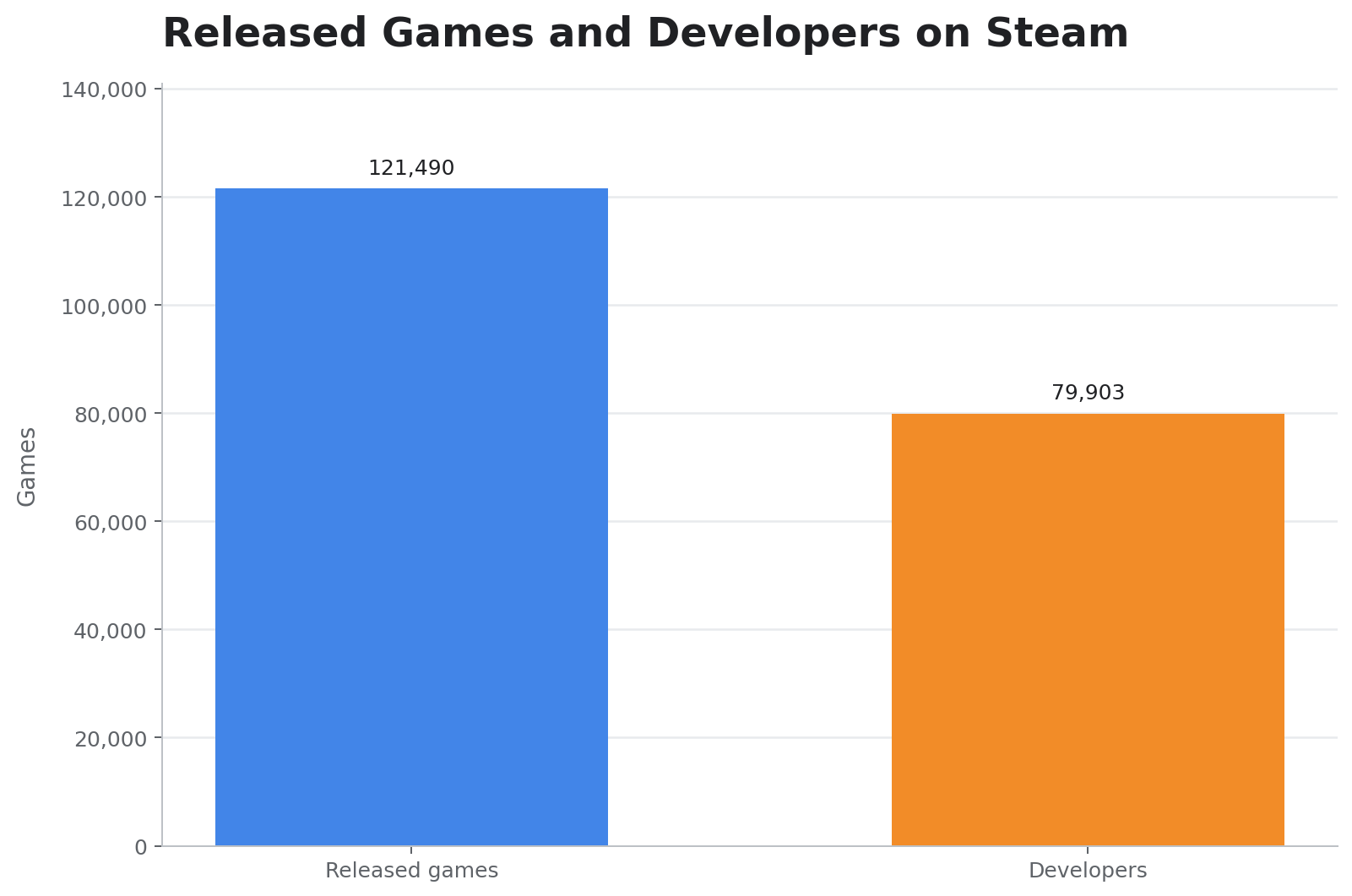
At the time this data was pulled there were 121,490 games on Steam, released by 79,903 developers. It doesn’t take complex math to see that most devs don’t release more than one game. That’s an average of 1.5 games per studio, but we know that many studios release a lot of games which skews the average.
I wanted to dig into this a little further. How many of these developers actually released more than one game? The chart below shows the number of developers that have released only one game on Steam, and how many have released more than one.
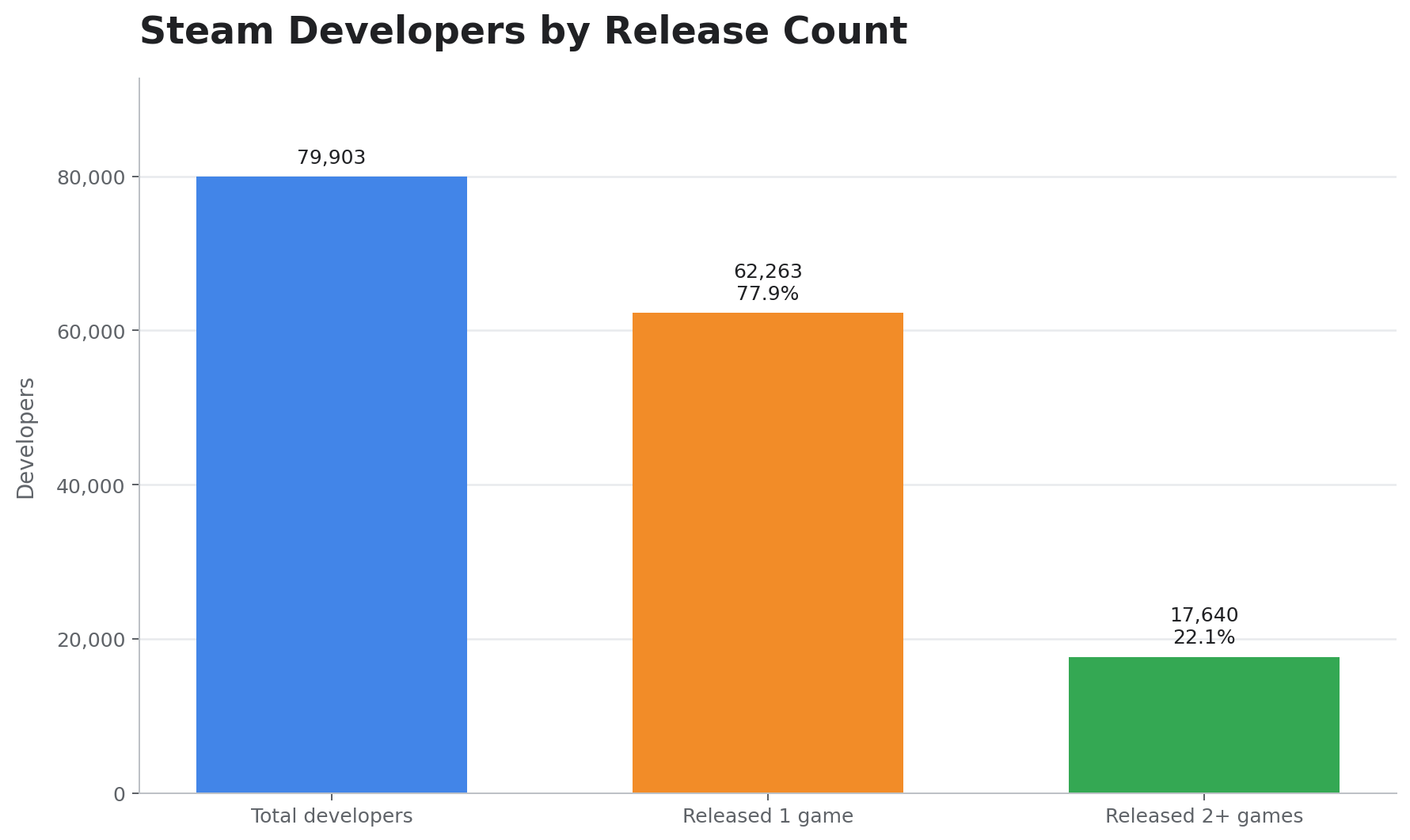
This is staggering. 78% percent of devs only release one game and then stop. Is that because they all became millionaires and didn’t need to make another game? I doubt it. My theory is that many spend too long on their game before releasing it. Multiple years in many cases. Then, it doesn’t do as well as they hoped, so they give up on their dream. Who wants to spend years on another game that’s a flop?
But, that may not be the case for all these devs. As I dug through my data and looked at some of these games with no or low reviews, I realized there’s a lot of strange stuff on Steam. A lot of them don’t even appear to be games. I think it’s important to try and filter that out, because it’s not a good representation of most game devs.
I decided to filter out any developer who never had a game reach 10 reviews. They may have released only one game or multiple games, but if none of their games ever reached 10 reviews, I excluded them. Why 10 reviews? Steam seems to use this as the “sludge” marker. If a game doesn’t have 10 reviews, Steam doesn’t give it any visibility at all. That’s why it’s important to hit that mark as quickly as you can when you launch. If 10 reviews is a good enough marker for Steam, it’s good enough for me. This is reflected in the next chart.
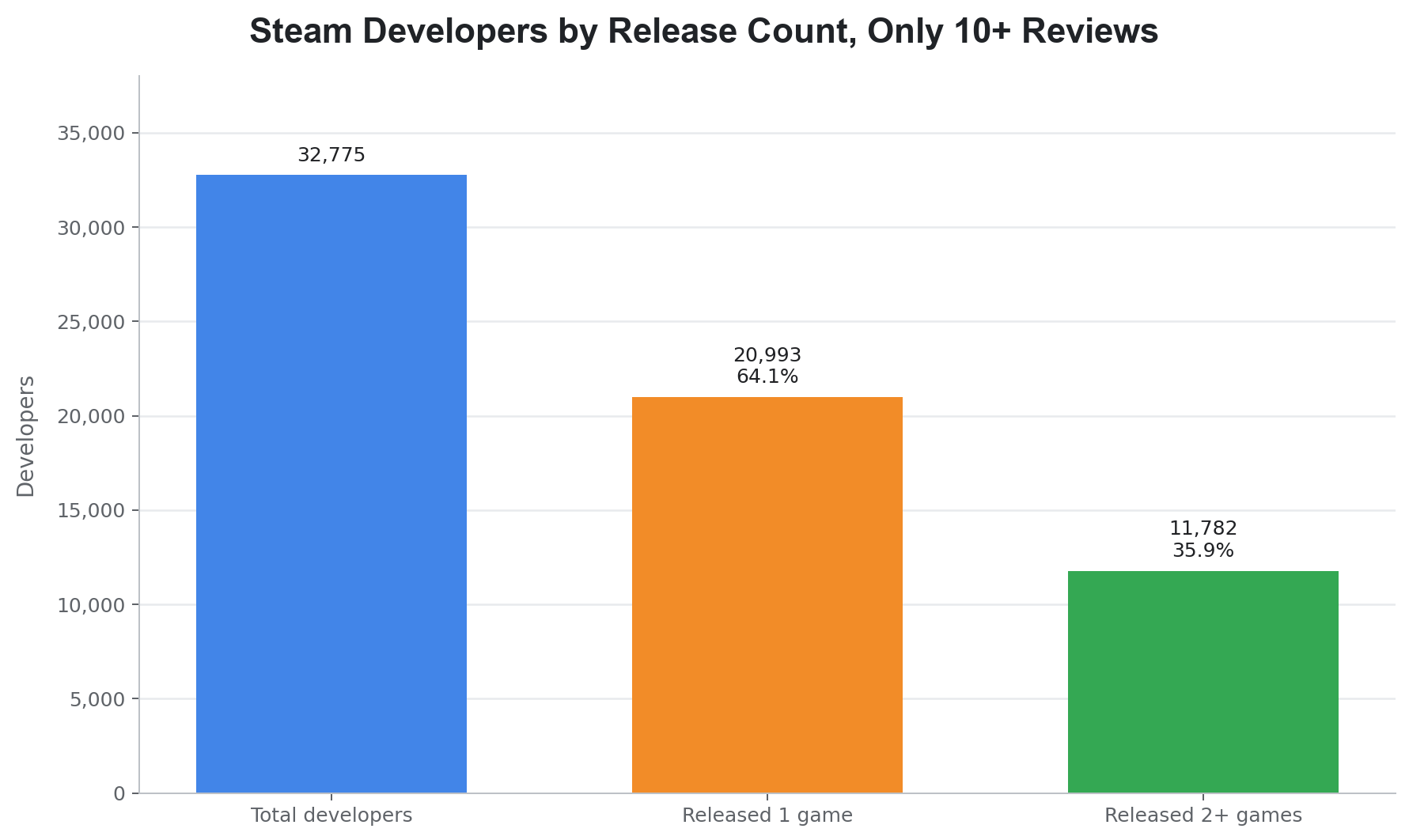
Notice that there are now only 32,775 developers, that’s less than half the original. 64% of these developers stopped at one game, with 36% releasing more than one. That is a little better, but still a lot of one-time devs. My goal is to figure out how we can get more devs releasing more than one game. It’s the only way to make it as an indie dev long term. My guess is it’s going to mean making smaller games.
But let’s finish by taking a closer look at the devs who released more than one game. I want to figure out how long these games are actually taking to make. From my data, there is no way for me to know how long someone’s first game took to make because I don’t know when they started developing it. But if I look at the time between releases for devs who released more than one game, I can get an idea of how long it’s taking them to make them. That is shown in the last chart below.
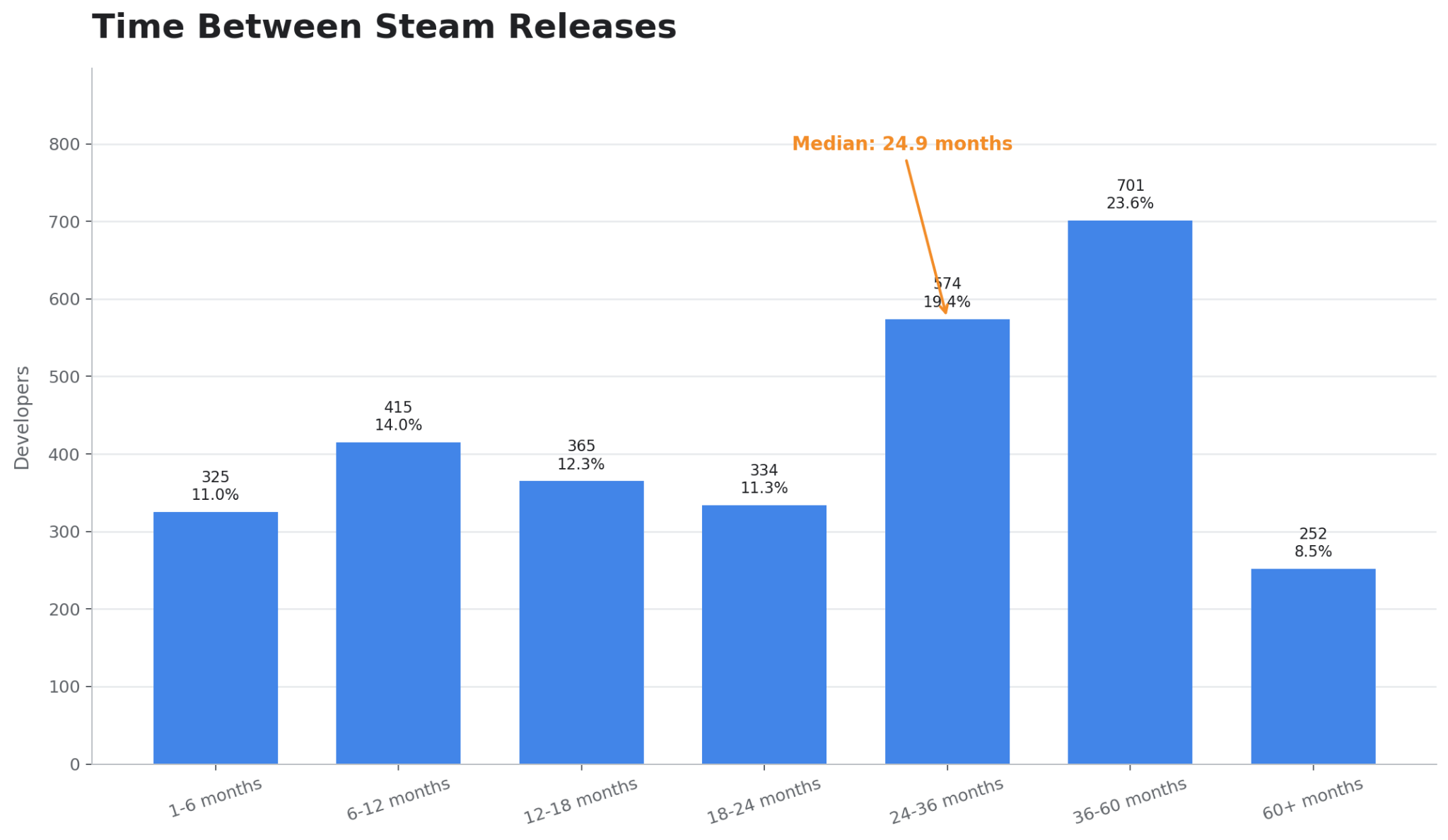
For this chart I decided to narrow it down a little further because I’m going to be analyzing this data further in the coming weeks. This chart shows the time between Steam game releases split into different timeframe buckets. I excluded games with less than 10 reviews, less than 1 month between releases, and any game released before 2022. The reason for this is I’m going to look at revenue in my next article, and I didn’t want the Covid gaming boom to make numbers look too optimistic. I felt like using 2022 and later gives us a more realistic idea of what to expect when releasing a game. This left 2,966 developers.
This chart displays the median development time per developer, not per game, to account for developers who release tons of “games.” There are a fair number of those.
The overall median development time is about 2 years, with many games taking 3, 4, and even 5+ years to complete. You may or may not be surprised by this. This is among developers who have released more than one game and, therefore, can presumably release games faster than a brand new dev. It also has survivorship bias, because it doesn’t account for devs who quit after their first game. I would bet if we were able to account for those confounders, the median would be even longer.
You may hear a 2-year development time and think it’s short, but I think it’s entirely too long for most devs. For a studio that has released multiple successful games and has a lot of experience, 2 years makes sense. For new devs or small studios who haven’t released a game, or at least not a successful one, this is too long.
There is so much you learn about development and marketing by going through the whole process of releasing a game on Steam. You sharpen your skills by doing it again and again and again. There are game genres you could choose where it would be reasonable to have released 2 to 4 games in 2 years. Maybe you don’t make a million dollars on them, but you start with a good foundation to build a back catalog and hone your skills.
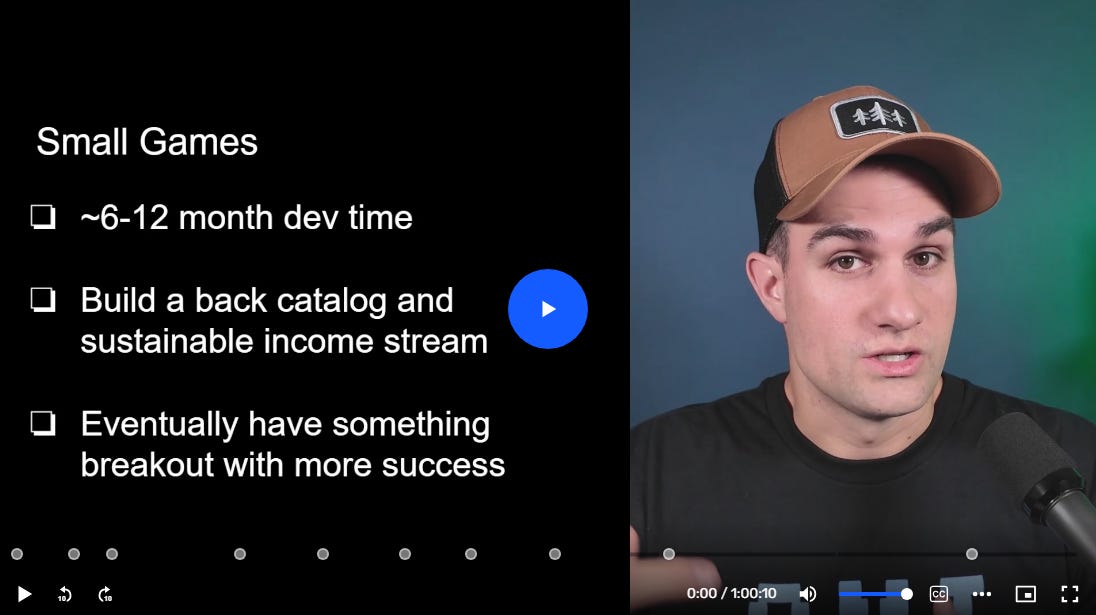
The data is telling me that the sweet spot is focusing on games that you can complete in 6 to 12 months. I’ll share more detail on that data in my next article. For now, don’t be a part of the 64% that quit after their first game. Focus on making small games and be a part of the 36% that release more than one game.
I made a video talking through this. It also gives a sneak peek into what I’ll be talking about in the next article.
Comments
Nothing yet. Say the first thing.
Sign in to join the conversation.