
Next Fest has come to an end. This installment included a ton of fun indie demos, including some very notable ones like Jonathan Blow’s Order of the Sinking Star.
But these are the top performers by wishlists gained based on my estimates.
Echoes of Aincrad → 167,008 (wishlists gained)
Dust Front RTS → 158,768
Mistfall Hunter → 158,672
IRON NEST: Heavy Turret Simulator → 144,544
OVER SAND → 102,432
The Mound: Omen of Cthulhu → 86,816
Nightwater → 85,254
XenoFeels → 84,304
EMPULSE → 77,472
Embers of the Uncrowned → 68,448
I find the presence of two different military simulation games on the list quite interesting. But otherwise, all the games are spot on in genres that Steam players traditionally favor.
Today, I’m taking a closer look at all the Next Fest data I obtained to answer questions like, how many wishlists should I have before Next Fest? Should I have a separate demo page? How predictive is peak CCU? Does wishlist velocity before the event matter?
Next Fest is an important piece to your marketing puzzle, but it certainly isn’t the most important. It hopefully isn’t even the most important festival your game will participate in. But, it is one thing that other festivals are not - guaranteed. It is something you can count on, so why not make the most of it?
It’s important to evaluate Next Fest to learn how you can get the most out of it when your game is in it. But I think it may be more important to analyze Next Fest throughout development to get a sense for the direction Steam games and players’ interests are moving. This can help inform your current project, or help you come up with an idea for your next game.
For this Next Fest, I pulled data on every participating demo every day of the event, as well as 2 weeks before and after. Specifically, I tracked base game follower counts, demo review numbers, and CCU throughout the day. My hope was to use this Next Fest to start validating my own performance markers to help you estimate how your game may perform or compare performance against others.
CosmoNode brings procedural mesh generation into Unity. Inspired by Blender and Houdini, built for game developers.
It enables developers to create, modify, and process meshes via an intuitive visual graph, bringing a flexible, non-destructive geometry pipeline directly into Unity with full runtime support for dynamic, on-the-fly generation.
Get Started with Tutorials & Examples
One note, after evaluating survey data and publicly confirmed wishlist totals, I adjusted my normal follower-to-wishlist ratio for estimates during Next Fest. The ratio seems to be higher: more wishlists per follower. The more wishlists obtained during Next Fest, the higher the ratio goes. I believe this is due to two things: players tend to wishlist more games than normal during Next Fest, so they may be less likely to follow them as well. More importantly, Steam makes it much easier to wishlist games on the Next Fest page.
While scrolling, players can click a single button to wishlist a game without even clicking into the store page. I imagine a lot of players use this as a “this seems cool, I’ll check it out later” instead of a “wow, I really want to buy this.” Does that mean Next Fest wishlists won’t convert as well after launch? Maybe, but it’s hard to quantify and certainly not worth worrying about. These are still wishlists you want.
The first data point I want to evaluate is how important your baseline wishlist count is going into Next Fest. I started by taking a look at how many games reached certain wishlist thresholds before the start. The table below shows the number of games split into different wishlist “buckets.” Note that throughout these charts there were about 279 games I was unable to obtain wishlist estimates for, usually because of a mature content gate, and they are excluded.
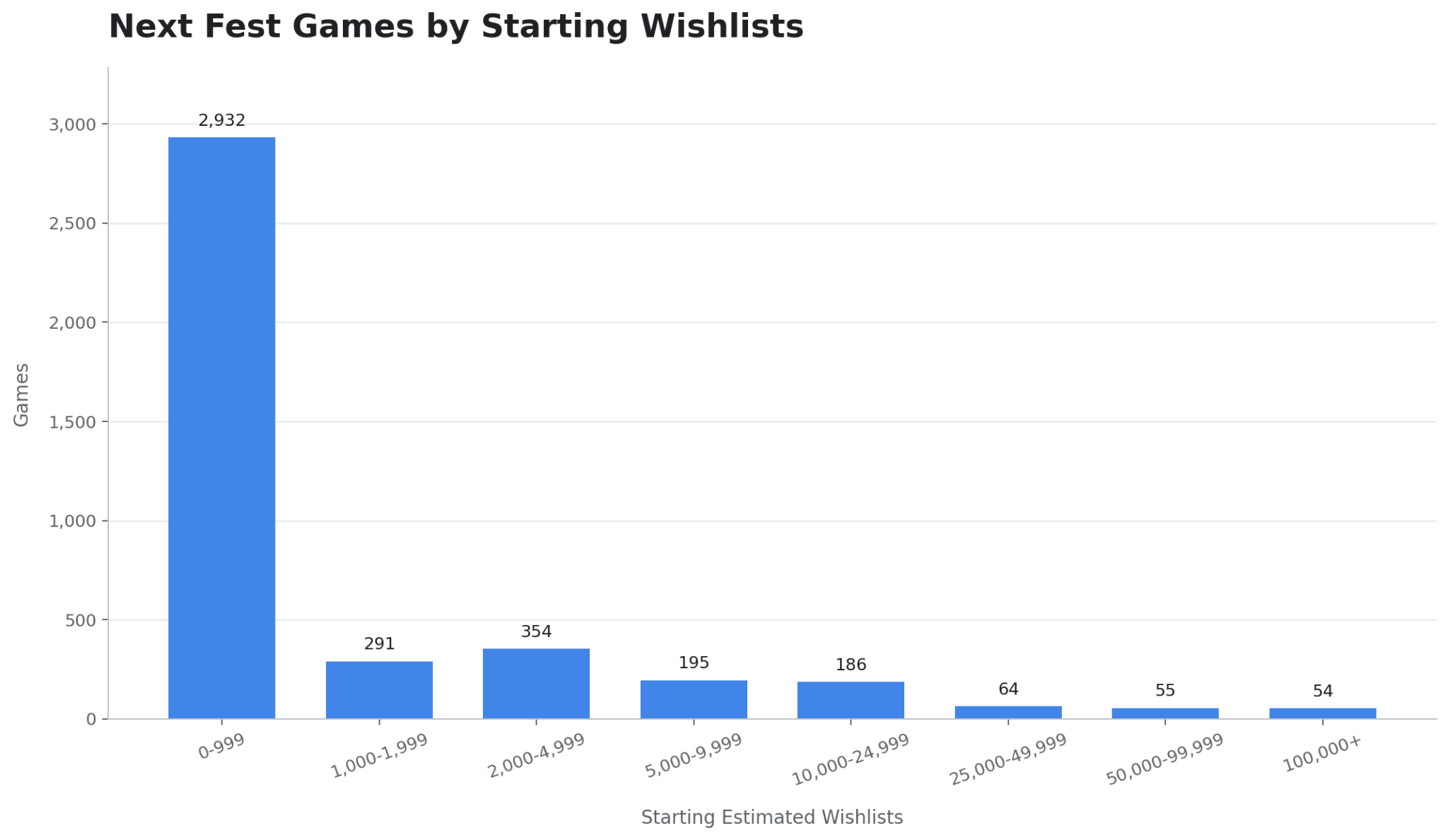
Not surprisingly, most games fall into the 0-999 wishlist bucket. This accounts for the majority of games participating in Next Fest. A large portion of them aren’t particularly serious games and have virtually no wishlists. These will certainly bring down the median wishlists gained for that bucket, so keep that in mind.
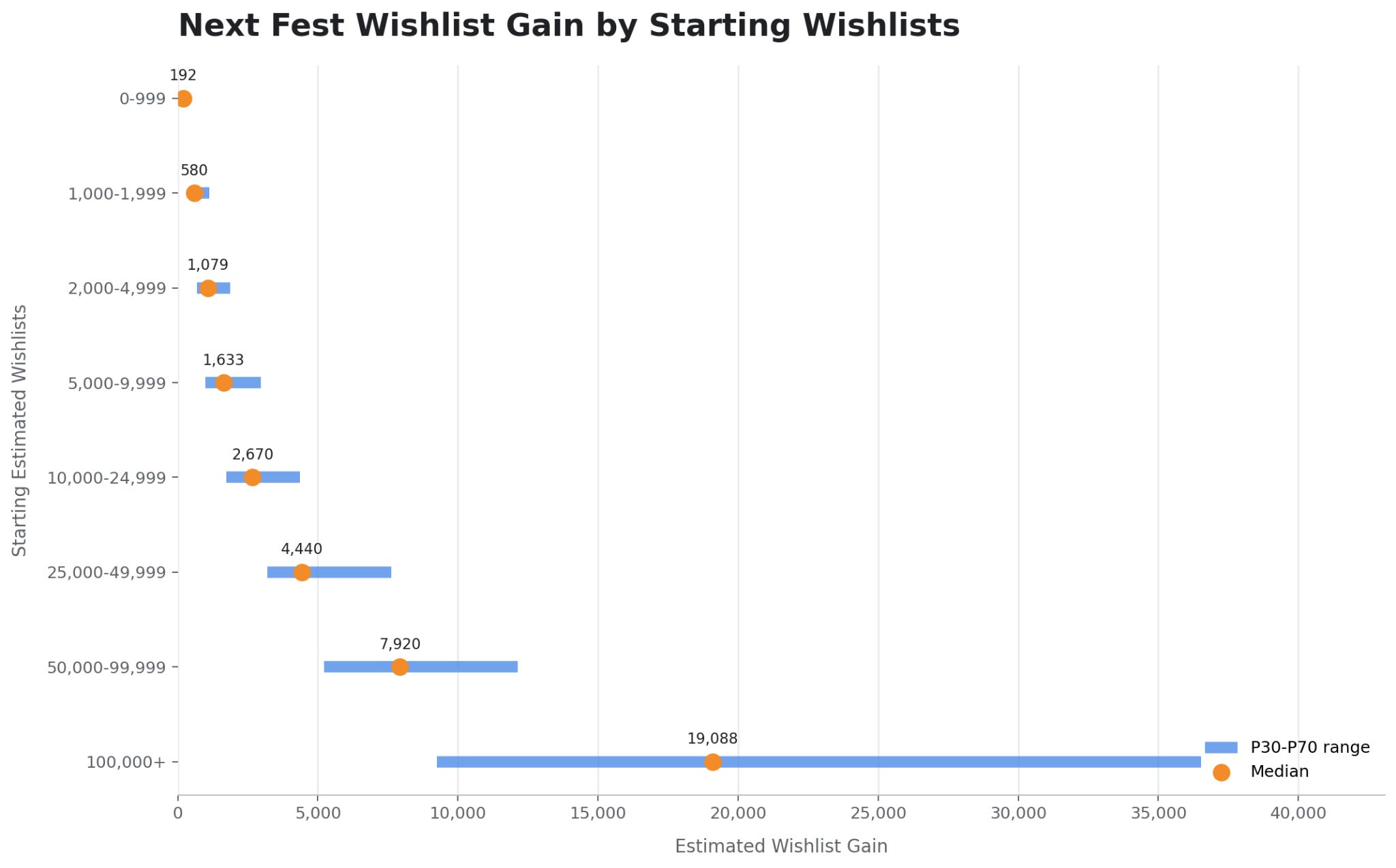
The chart below shows the median wishlists gained based on how many wishlists a game had entering Next Fest. It also shows a range between the 30th and 70th percentiles.
Here is that same data in a table for easier readability:
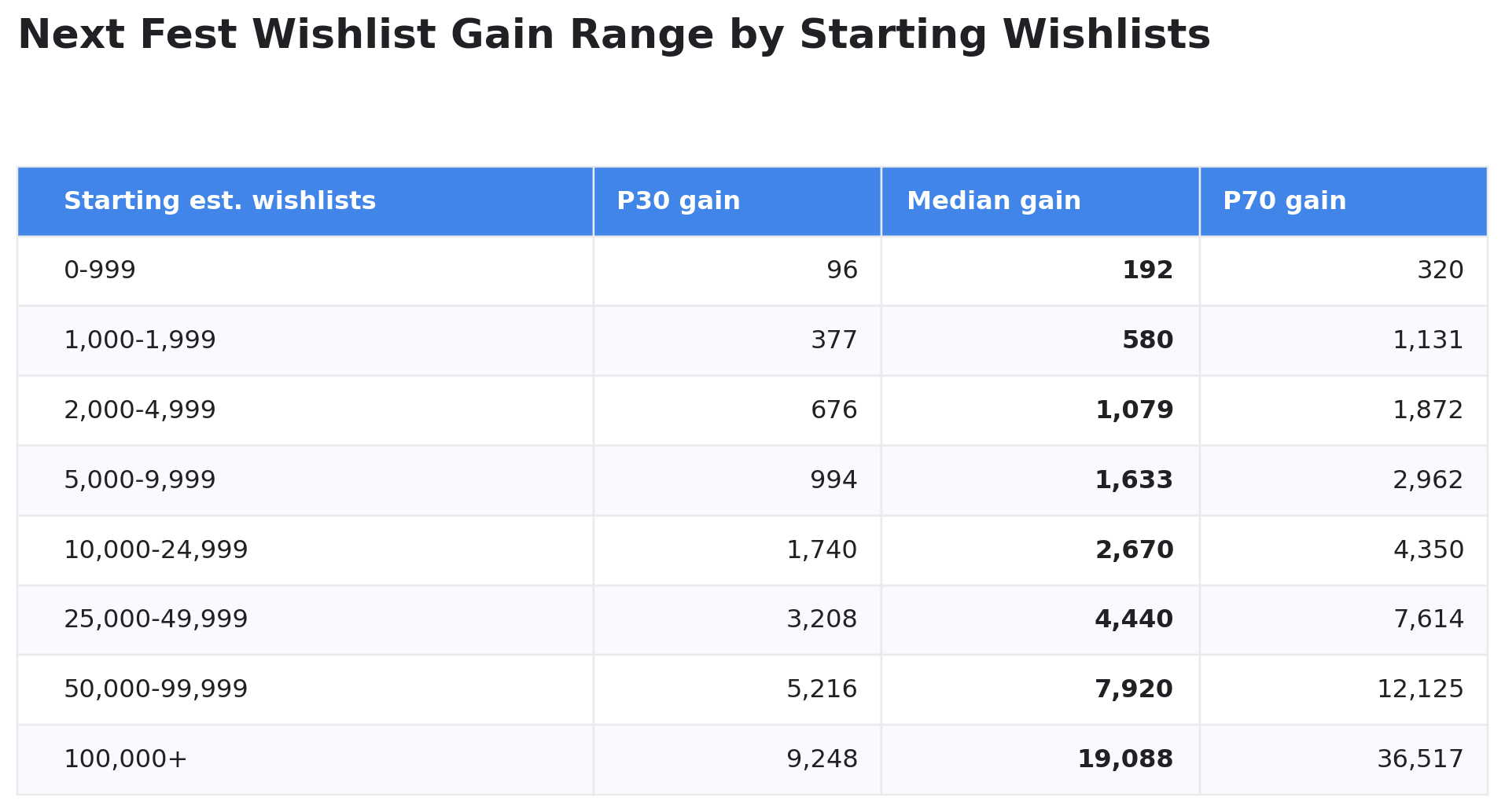
This data seems to support the findings of Chris Z with How To Market a Game, that you need at least 2,000 wishlists to get much out of Next Fest. Notice the 2,000 - 5,000 wishlist bucket are the first with a median wishlist gain greater than 1,000.
Although, I think it’s relative. If someone struggled to get wishlists throughout development, entered Next Fest with 1,000 wishlists, and gained 500 that is a 50% increase. They would probably consider that significant. It also depends on the developer’s goals. If this is their first game, or better yet, just a “small” game with a short development time, an extra 500 wishlists would be great. On a $15 game, that could be more than $1,000 in week 1 sales. I agree that 2,000 wishlists is likely the threshold for seeing a 1,000 wishlist gain from Next Fest, but almost any serious game will see some benefit from it.
So what about wishlist velocity? Is it better to do a big marketing push right before Next Fest or build up wishlists over time?
The table below shows buckets of the number of wishlists gained in the 2 weeks leading up to Next Fest and the median wishlists gained.
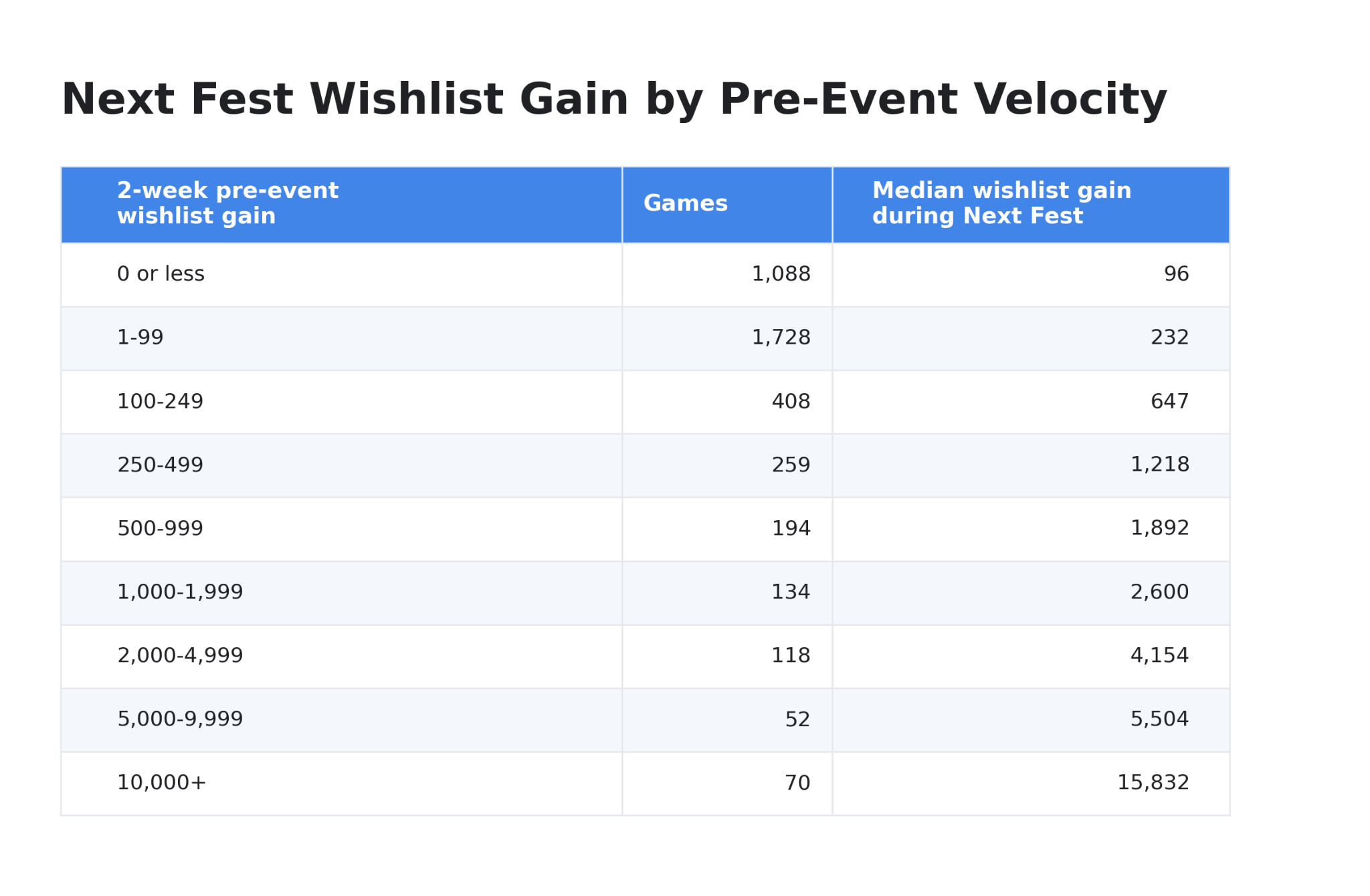
Clearly a higher wishlist velocity is associated with a higher wishlist gain. So should you wait to push your game until just before Next Fest?
I would say no for a few reasons. The primary one is you want to get your demo out nice and early so you can polish it based on reviews, more on that later. But also, a higher baseline wishlist count is more closely correlated with Next Fest wishlist gain than wishlist velocity is. The table below shows a higher correlation for starting wishlists with 3 different statistical models.
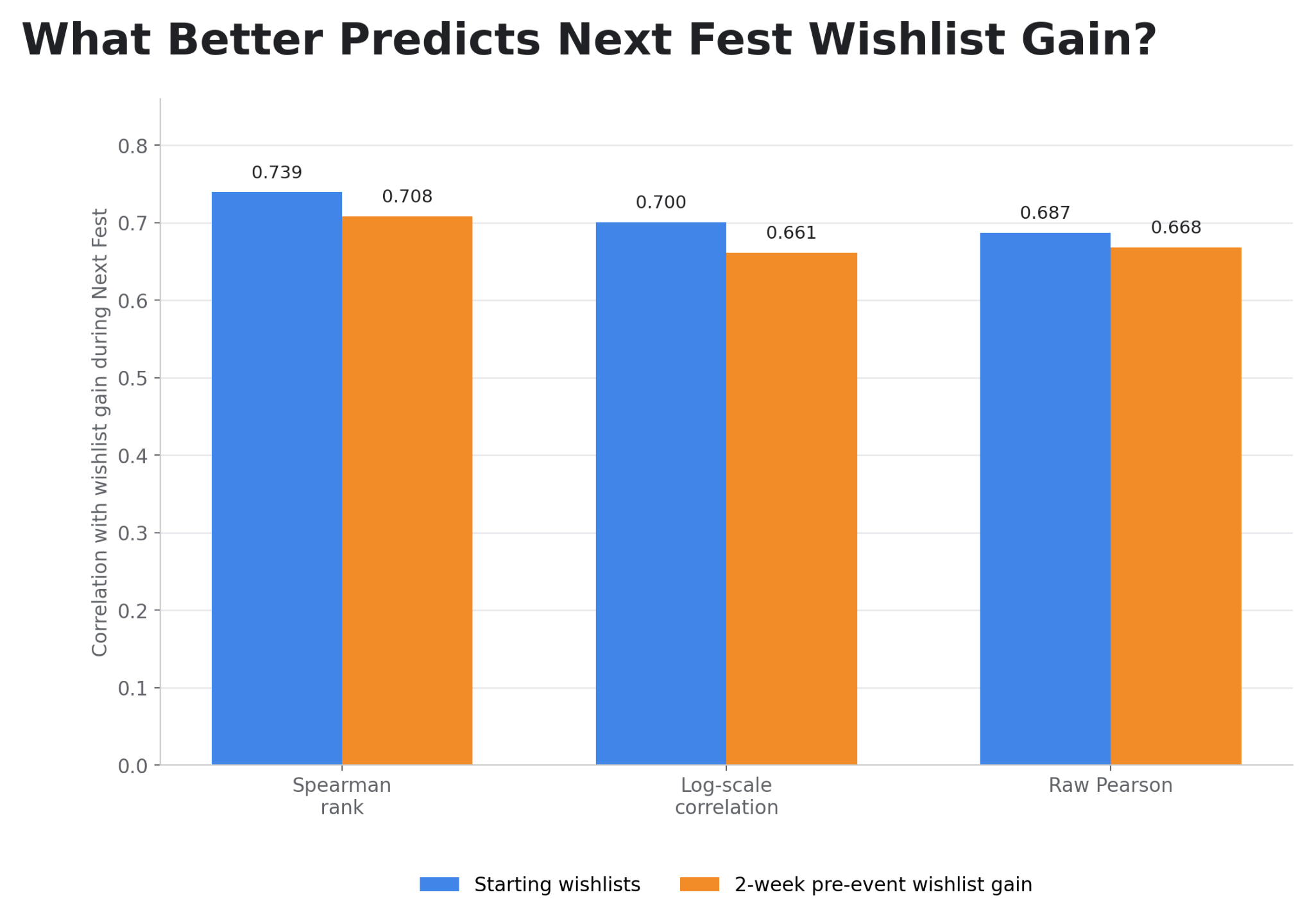
So my suggestion is to focus on building as many wishlists as you can over time, don’t wait. But if you can also generate hype in the 2 weeks leading up to Next Fest, that is even better. If you can’t do one for whatever reason, just do the other. But please please please don’t wait until right before Next Fest to release your demo.
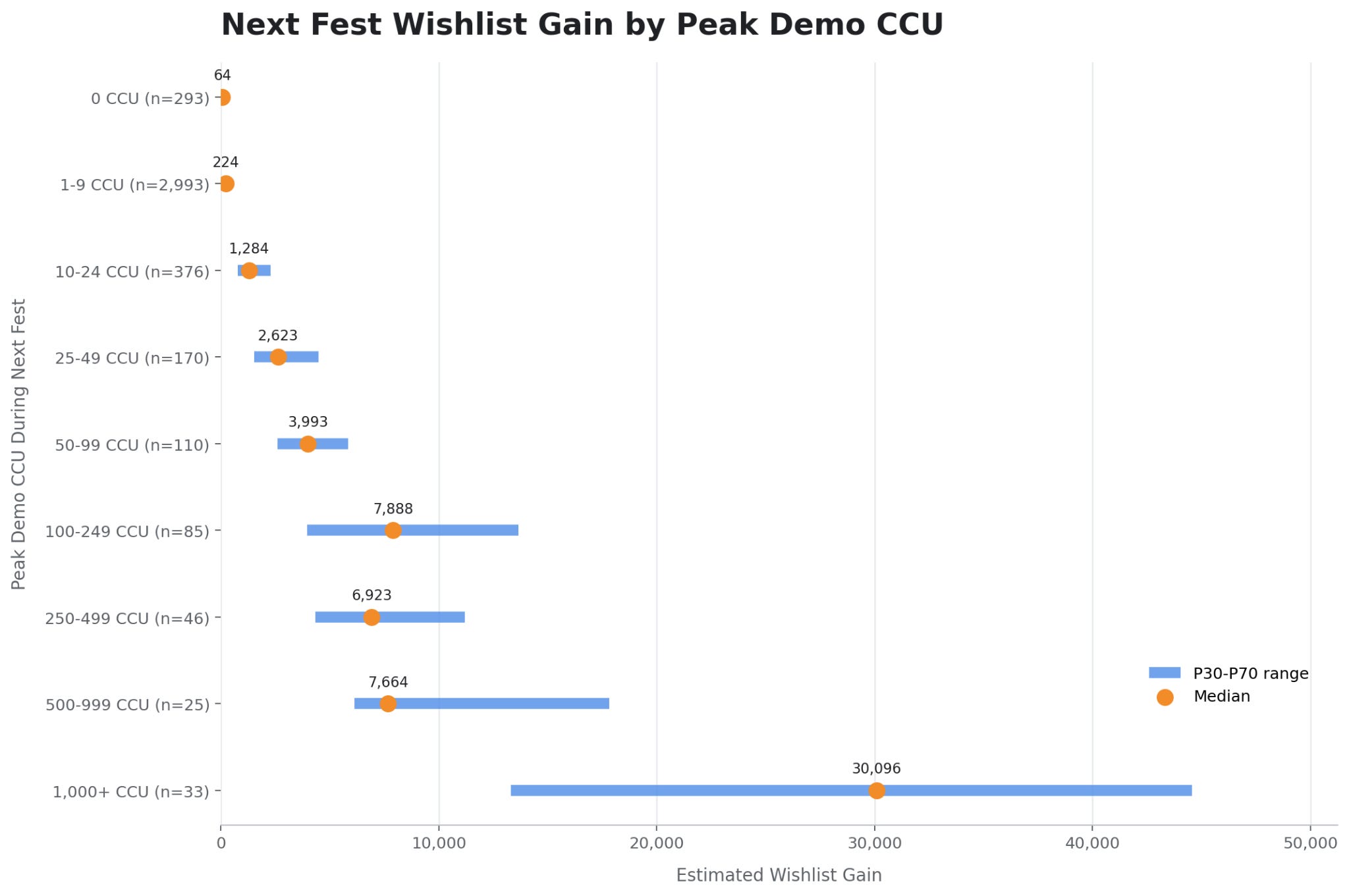
The chart below shows peak CCU (concurrent users) for all Next Fest games during the event. The games are divided into CCU buckets, and it displays the median, 30th and 70th percentiles of wishlists gained based on those buckets.
Here’s that same data in table form:
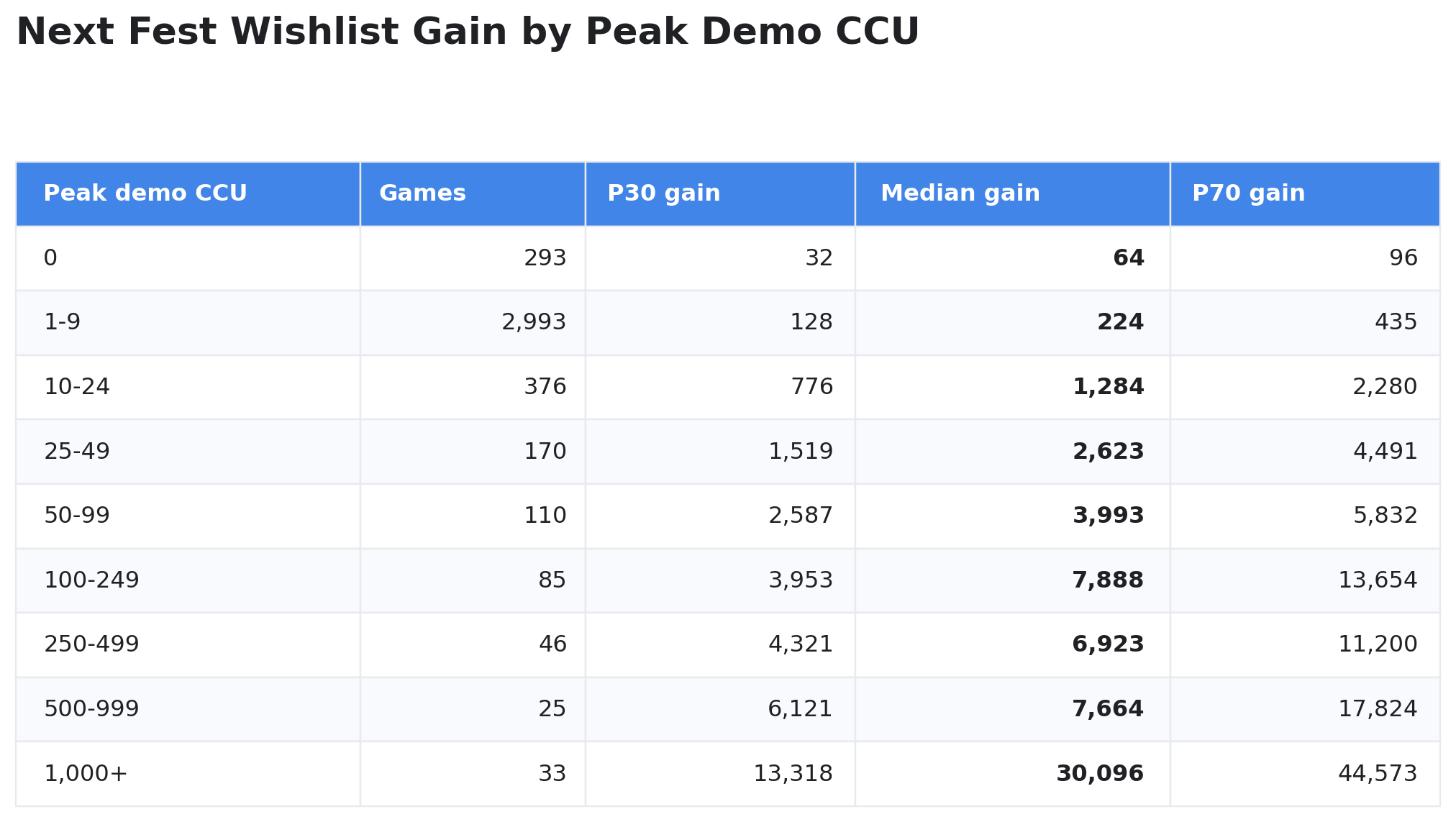
This data is compelling. To me, CCU may be a better performance marker than baseline wishlists. Notice how the majority of games (80% in fact) don’t reach a CCU count of 10. Just by reaching 10 CCU, the median wishlist gain jumps from 224 to 1,284. The 1-9 bucket may be skewed by all the non-serious 1 CCU games where just the developer played it. But I would still suggest using that 10 CCU as a minimum goal to shoot for, similar to having 2,000 wishlists going into the event. It’s a great predictor of performance.
But that is during the event. Is there a way to know how CCU leading up to Next Fest affects performance?
The chart below shows the peak CCU for the Next Fest games in the 14 days before it started.
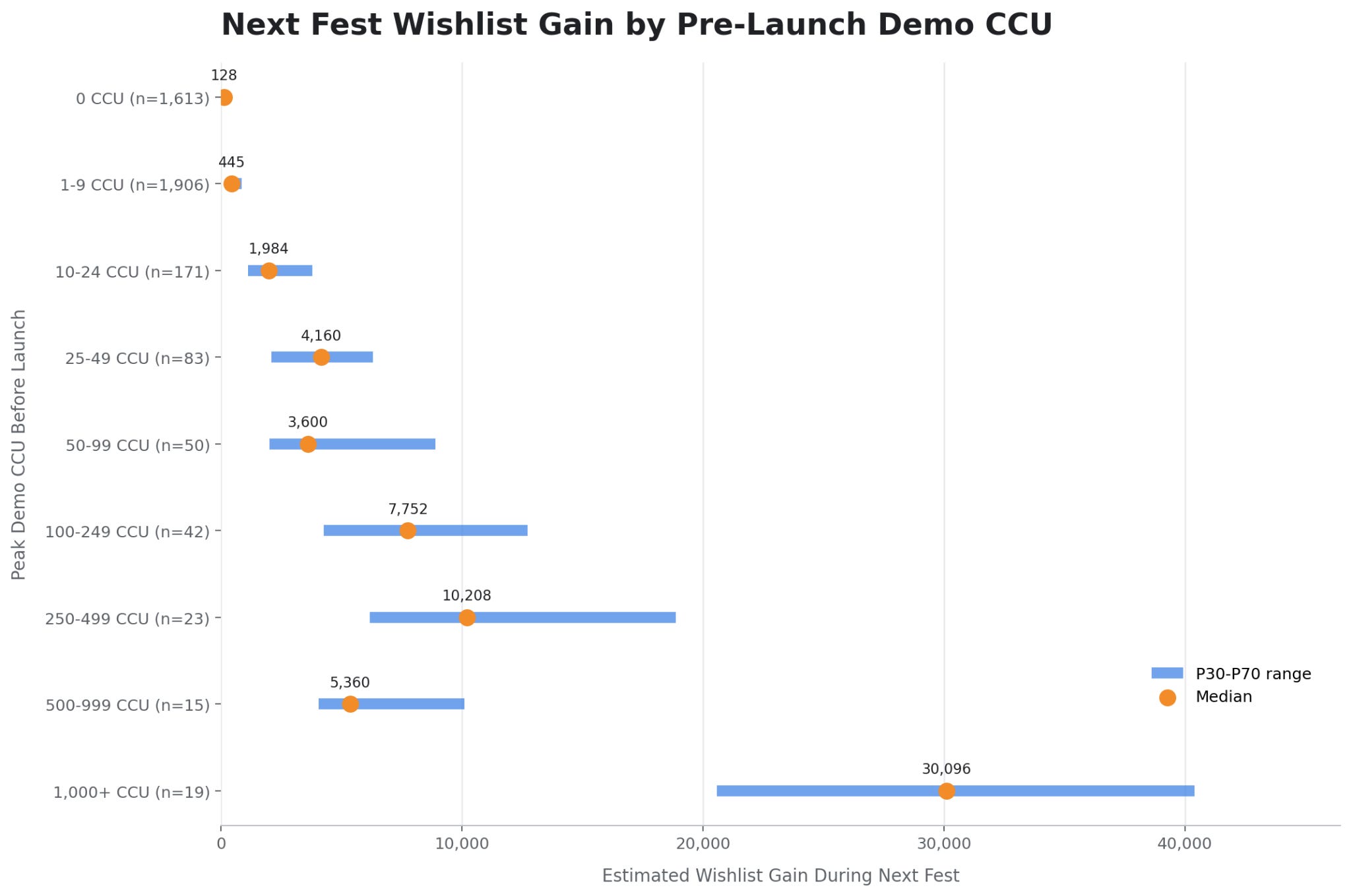
Here is the data in table form:
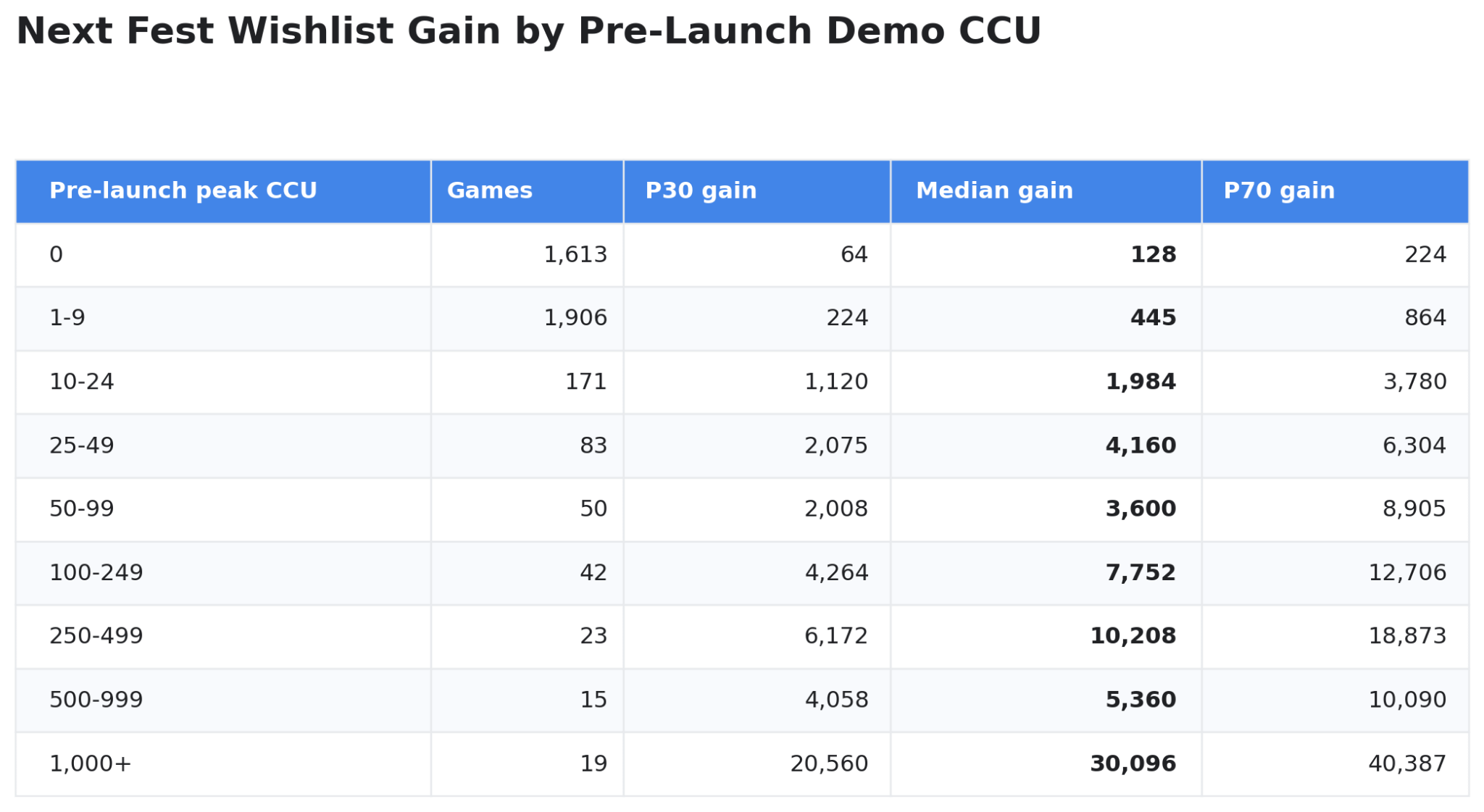
This data is a bit all over the place, that may be because I wasn’t polling CCU constantly during that time, so the peaks may be underestimated in some cases. Regardless, similar to peak CCU during the event, 10 CCU is clearly a significant marker. Most of these games do not reach it, and the games that do have substantially higher median wishlist gains.
I don’t think this is a velocity thing. Artificially ensuring 10 users play your game at the same time a few days before Next Fest is not going to help you. Games that were already doing fairly well naturally had players playing them, so they hit that number. This highlights the importance of getting your demo up early, polishing it, and building a player base well before Next Fest.
Now I’ll tackle the age-old question, to have a separate demo page or not have a separate demo page. I was amazed to see that after rounding the percentage to the nearest whole number it was literally a 50/50 split. The table below shows the number of games that chose to separate their demo page and those that didn’t, as well as some information about wishlists and CCU.
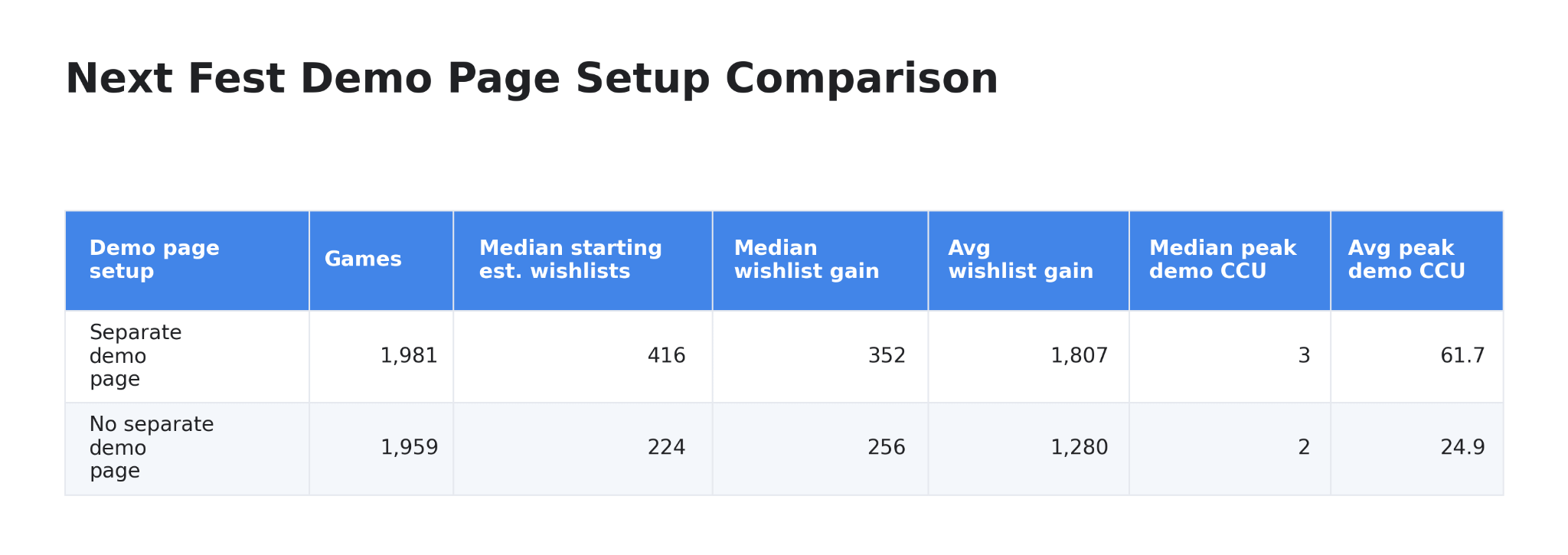
This data leans slightly toward having a separate demo page, but I don’t think it presents a clear winner. The separate demo group did have higher wishlist gains and CCU, but they also had a higher number of baseline wishlists. But my theory is that less serious games are less likely to have a separate demo page and are driving the wishlist and CCU numbers down.
So what if we try filtering out some of those less serious games, does it change the result? The table below shows this same data but with games with less than 2,000 wishlists excluded.
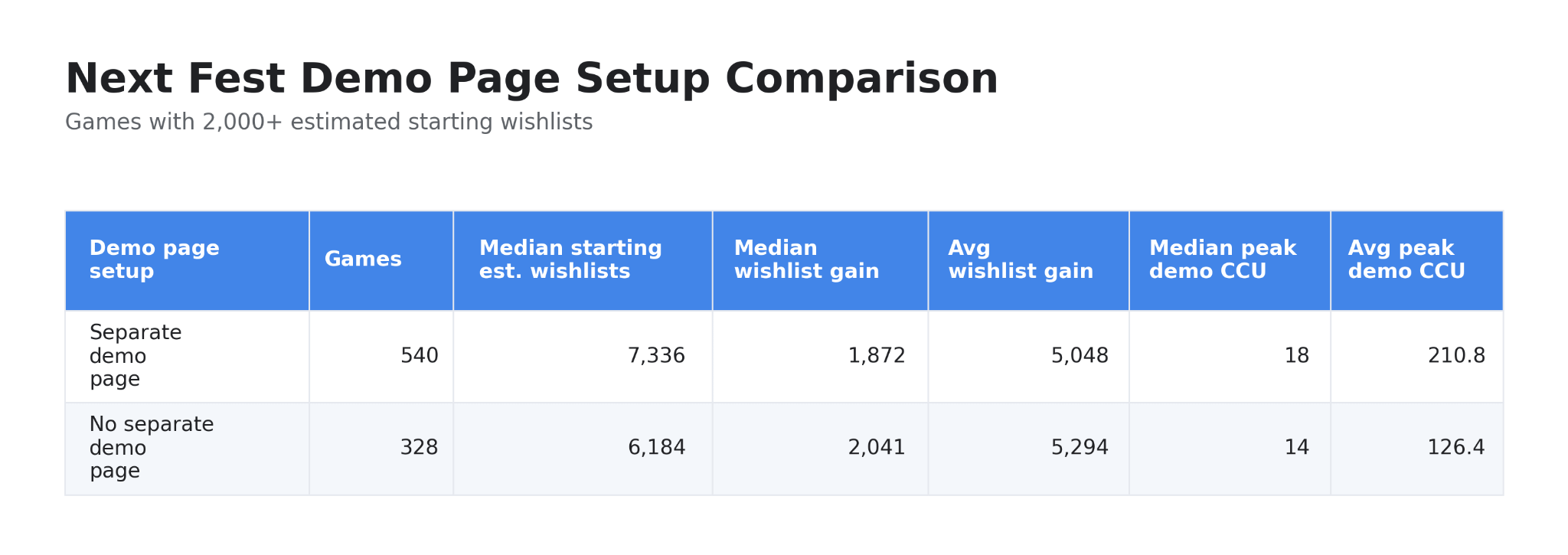
This removes about 3,000 games. As you can see, this brings the results much closer together. My conclusion is that, in terms of wishlists and CCU during Next Fest, it doesn’t matter whether you have a separate demo page or not.
Even still, I strongly recommend you create a separate demo page, here’s why: reviews. Players can’t review your demo without a separate page. Some of you are probably thinking that is exactly why you don’t want one. But the best thing you can get at this stage is live feedback from Steam players. I know it makes you nervous, and rightly so. You need to go ahead and accept that you’ll get negative reviews, prepare your mind for it. Wouldn’t you rather get those reviews now, fix the issues, and prevent them at launch? You would, I assure you.
Since we’re talking about reviews, let’s look a little closer at those separate demo page games. Does it matter how many reviews they had at the beginning of Next Fest? The chart below shows the wishlist gains for games with separate demo pages separated by how many reviews they had at the start of Next Fest.
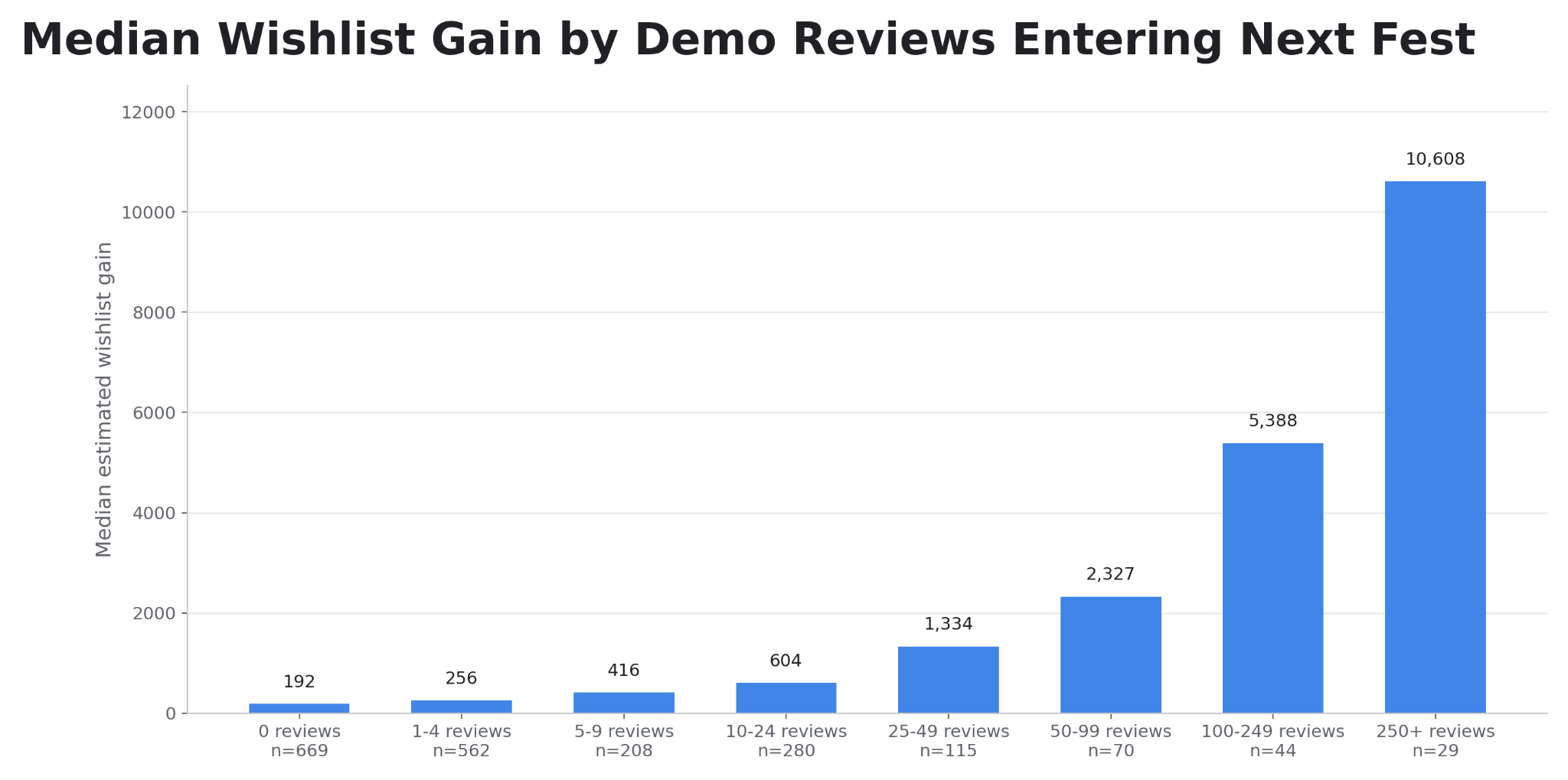
It seems like the clearest jump in wishlists is once a game hits 25 reviews. I think that is a reasonable goal heading into Next Fest. I also took a look at how the number of reviews gained during Next Fest affected wishlist gains. It was a predictable and linear increase, so I won’t bore you with another chart.
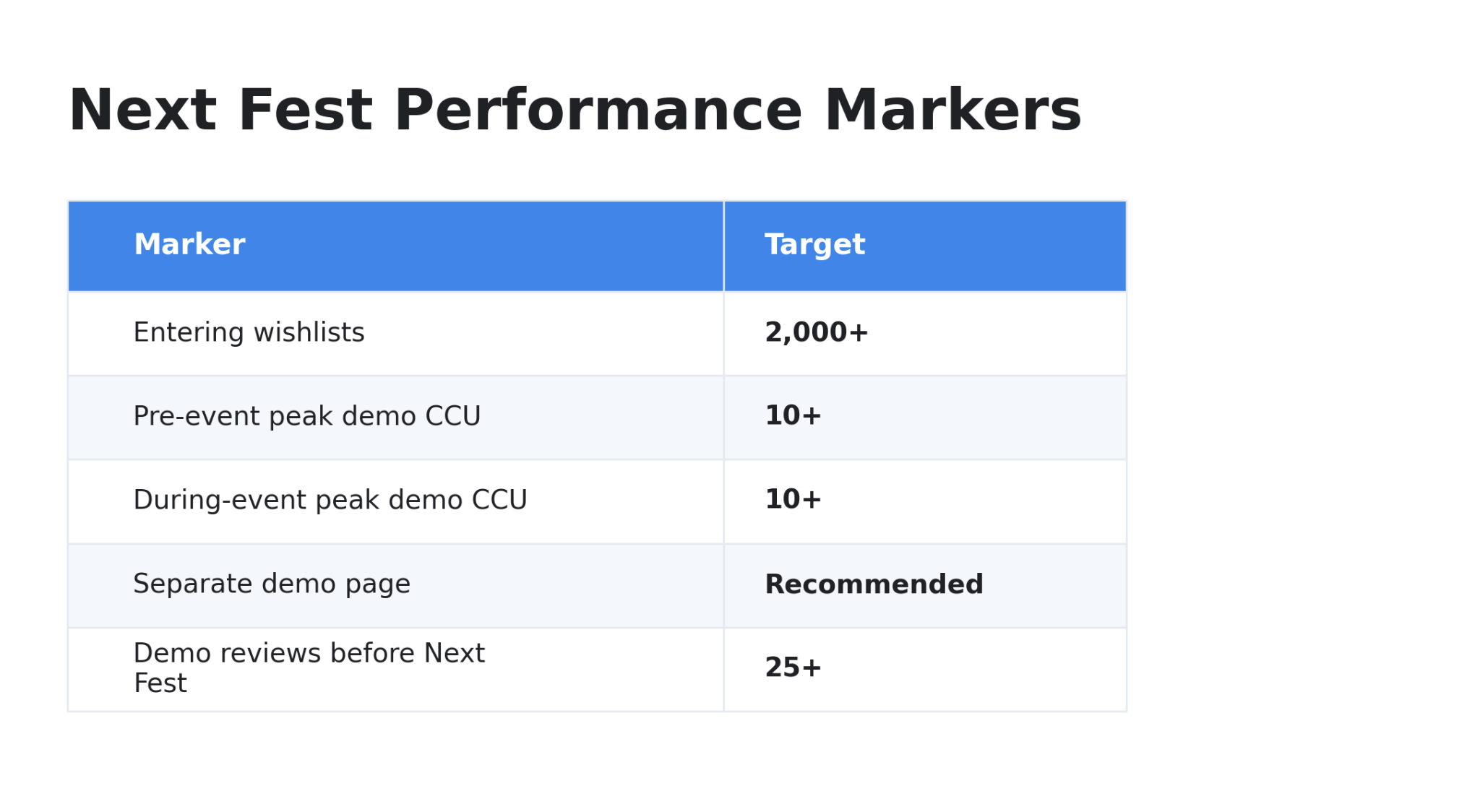
That was a lot of data, so I think this article deserves to end with a summary of what we found. I think a minimum of 2,000 wishlists before entering Next Fest is a good goal. Reaching a peak CCU count of 10 before and during the event is a good sign and I would suggest shooting for that. Lastly, I highly recommend having a separate demo page. It seems that having 25 reviews on your demo before Next Fest starts is also a good indicator. Again, don’t try to artificially hit these performance markers. That doesn’t help you. But if your marketing efforts get you to this point, that’s a good sign.
What the heck, let’s summarize it with one more table. Why not. It’s more fun than a numbered list.
CosmoNode includes a growing library of nodes for geometry generation, mesh processing, colliders, lights, scattering, and more.
Create procedural assets, level-building tools, and runtime geometry workflows, all without writing custom mesh-generation code.
Comments
Nothing yet. Say the first thing.
Sign in to join the conversation.