
One of my favorite game-planning discoveries happened during the 2019 playoffs.
We were preparing for the second round against a really good defense.
They were fast. Physical. They played a 4-2-5, blitzed and stunted a bunch, and had pretty much dominated people all season.
We were primarily a 10 and 11 personnel offense.
And if I’m being truthful, we were worried about the matchup.
They were faster than us, and when we started looking at our base stuff against what they did well, I didn’t love it.
We had 10 or 11 games of film on them, so there was plenty to study.
At some point on Monday or Tuesday, I ended up deep in a game from earlier in their season.
It wasn’t a game we had paid much attention to.
They had won easily.
But something caught my eye.
Their opponent had lined up in an ACE formation with two tight ends a handful of times.
So I started watching those snaps.
Eight of them in total.
And I noticed something.
The defense never really adjusted the box.
They stayed in their normal 4-2 structure.
The offense had created an extra gap and an extra blocker, and the defense was basically content to play the box with six defenders against seven offensive players.
It hadn’t mattered much in that game because the defense was so much better and faster than the team they were playing.
But I didn’t care about the result anymore.
I cared about the structure.
We decided:
We’re getting into that formation and we’re going to make them prove they’ll adjust to it.
We opened the game in it.
They didn’t adjust.
So we ran right at them.
And kept running at them the whole game.
We ended up mauling them most of the night and won the playoff game 53-39.
I still remember how good that discovery felt.
Not because we had invented some brilliant new play.
We hadn’t.
We found eight snaps buried inside an otherwise irrelevant game from early in the season and asked why the defense was lining up that way.
That little piece of information changed how we approached one of the biggest games of our season.
The answer you’re looking for might be buried in a game you almost didn’t watch.
That’s why I love game planning.
There isn’t a magic spreadsheet that tells you exactly what to call Friday night.
It’s film.
Data.
Questions.
Rabbit holes.
And a whole lot of nerd work. I love the nerd work.
Here’s how we try to turn all of it into an actual offensive game plan.
The first thing we do is tag the basic information we know we’re going to need.
We split the work up as a staff.
For us, that normally includes:
Quarter
Down and distance
Hash
Offensive formation
Motion
Play type
Offensive play
Result
Gain/loss
Explosive plays
Defensive front
Stunt
Blitz
Coverage
Notes
The notes column is important.
That’s where we can add anything that doesn’t fit neatly into a category but may matter later.
The point of charting all of this isn’t just to collect information.
Eventually, the information has to help us make decisions.
We’ll use it to build cutups, find tendencies, study situations, and eventually start constructing the call sheet.
But once the basic data is there, I want to stop looking at columns for a while.
I want to watch football.
I usually start by watching their most recent game all the way through.
Not just the defense.
I’ll watch offense, defense, and special teams.
I want to understand the game itself.
How did it flow?
How did they respond when something went wrong?
Did their philosophy change based on score or situation?
Did anything jump out that I wouldn’t necessarily catch from a tendency report?
If something catches my attention, I’ll write down the play number and come back to it later.
There is a lot of value in data.
But sometimes you need to stop sorting football into categories and just watch the damn game.
Once I’ve got a feel for who they are, the fun starts.
We build cutups of formations and plays that we run and study how the opponent defended them.
We’ll also build cutups of:
Runs of 5+ yards
and
Passes of 10+ yards
But I’m not satisfied knowing somebody ran Power for 14 yards.
I want to know:
Why did it work?
Maybe the defensive tackle got driven seven yards off the football.
Maybe the linebacker fit the play incorrectly.
Maybe the offense created a numbers advantage.
Maybe the formation caused a bad alignment.
Or maybe the offense got lucky and a player turned a bad play into a great result.
Those are not the same thing.
I don’t want to know what worked against them. I want to know WHY it worked against them.
Because if I understand why it worked, I can start figuring out whether we can recreate it.
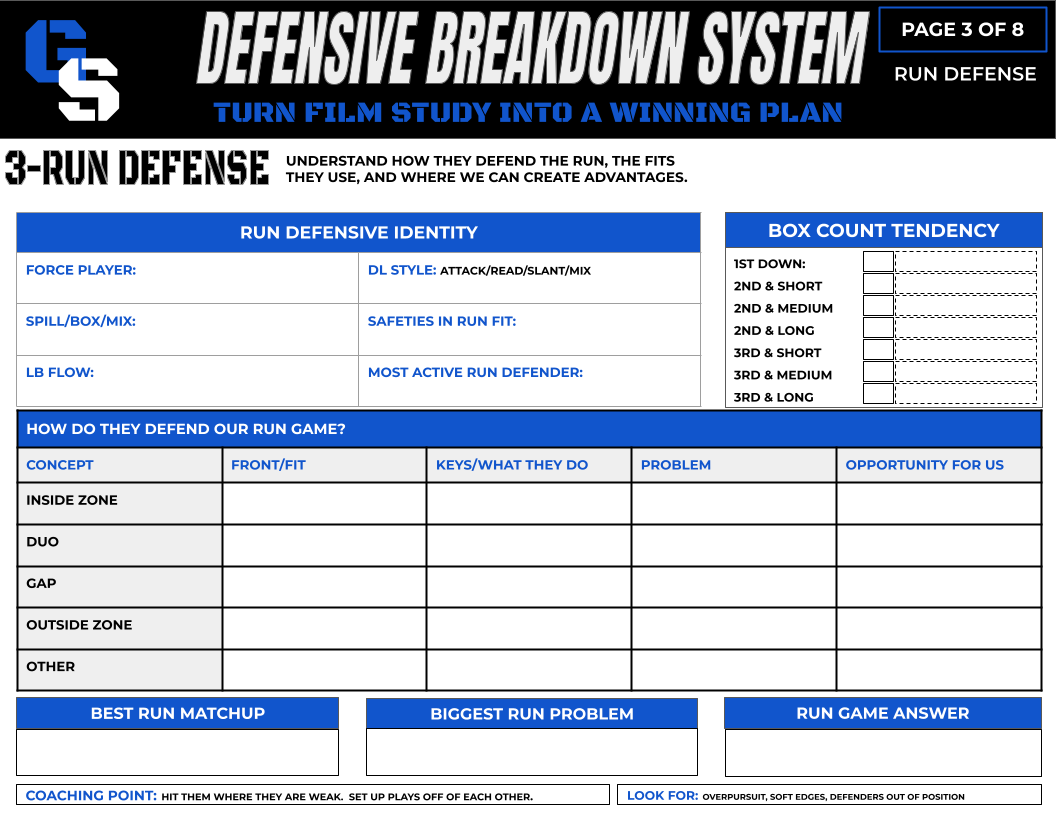
Later that night, I’ll start breaking down individual defenders.
I’ll watch a full game focusing almost entirely on the defensive line.
Then I’ll do the same thing with the linebackers.
Our QB and WR coach will do similar work on the secondary.
I’m looking for:
Strengths.
Weaknesses.
Technique.
Effort.
Who can we block?
Who creates problems?
Who doesn’t tackle well?
Who gets tired?
Who struggles changing direction?
Football isn’t played against a front drawn on a whiteboard.
It’s played against people.
Sometimes knowing that a 3-technique struggles moving to his left is more useful than knowing that the defense plays a four-man front 70% of the time.
This is probably my favorite part.
Something catches my attention and I chase it.
Maybe I think:
That defensive tackle doesn’t handle down blocks well.
Okay.
Now prove it.
I’ll start watching more snaps.
Again.
Again.
Again.
Does it hold up?
Can I find times where it doesn’t?
Can we force him to do the thing he doesn’t do well?
Sometimes the rabbit hole leads somewhere useful.
Sometimes I waste 30 minutes and find absolutely nothing.
That’s okay.
I’m not trying to prove that my first thought was right.
I’m trying to find something we can use.
And that 2019 playoff game is exactly why I keep doing it.
The answer was sitting inside eight snaps from a game we almost ignored.
At some point, you have to move beyond just watching.
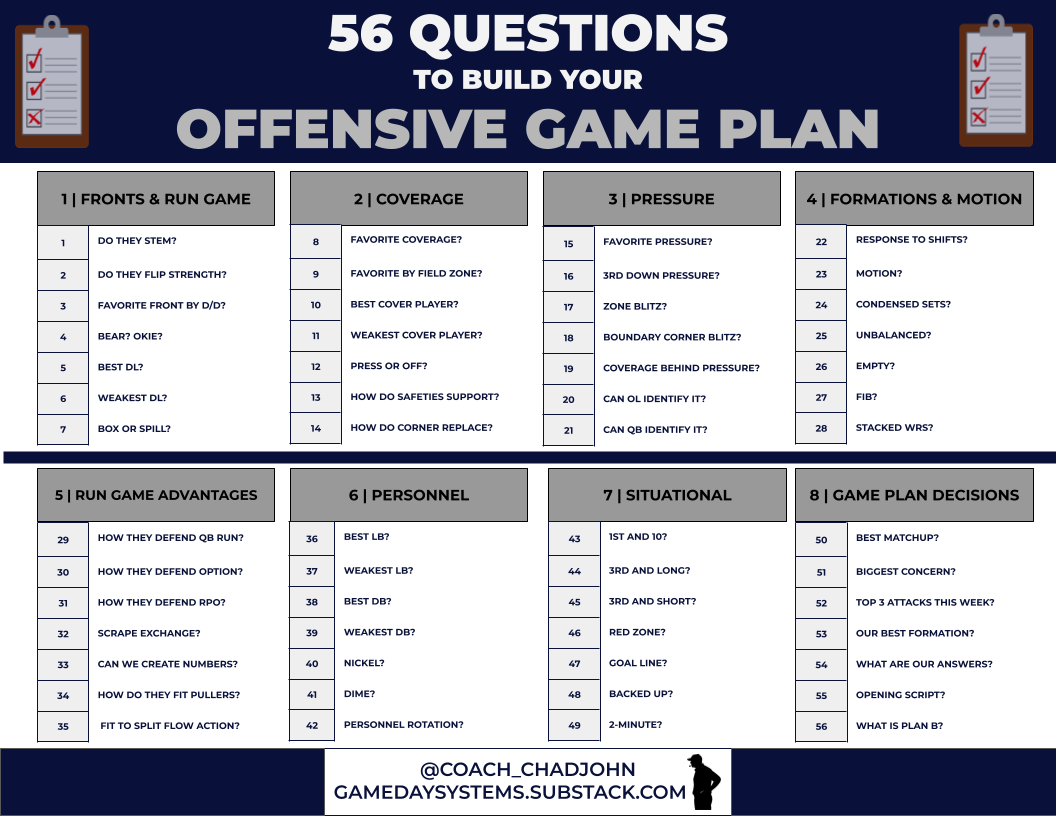
That’s where we’ll pull out our 56 Questions to Build Your Offensive Game Plan.
We split them up as a staff and start digging.
Fronts.
Coverage.
Pressure.
Formation adjustments.
Personnel.
Run-game advantages.
Situational football.
Best matchups.
Biggest concerns.
Opening script.
Plan B.
The point isn’t to have 56 brilliant answers.
The point is to force ourselves to think through the things that could matter before Friday night.
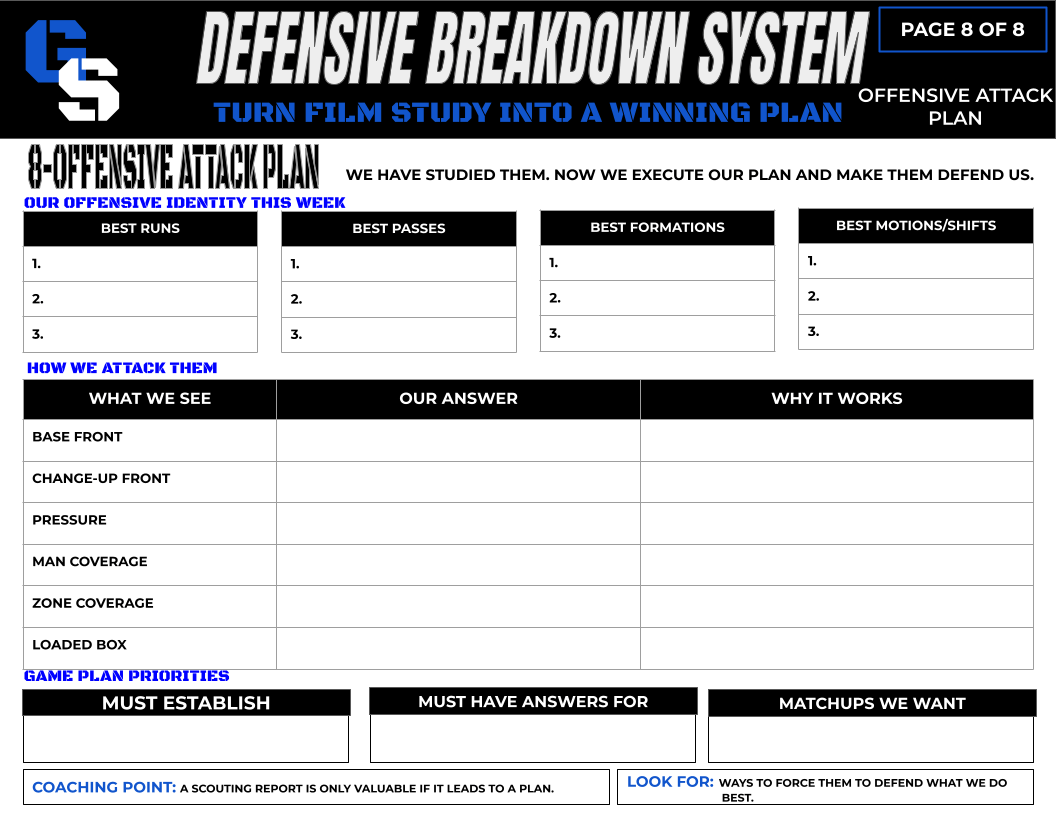
Eventually, all of the data and film study has to get reduced.
That’s the hard part.
You can spend all weekend finding things.
But Friday night you need answers.
We draw our formations on the board and talk through how we think the defense will align.
We draw their pressures.
We talk about how those pressures can hurt us.
Then we talk about how we can exploit them.
We start filling in:
Best runs
Best passes
Best formations
Best motions
Matchups we want
Problems we must solve
Answers for pressure
Answers for loaded boxes
Situational calls
At some point, scouting has to become strategy.
Monday is our initial plan day.
By then, I want us to have a pretty good idea of:
What they do.
Why they do it.
What has worked against them.
What we like from our own offense against their structure.
That last part matters.
I don’t want to watch another team hit a big play and suddenly start building their offense.
Our game plan still has to be our offense.
We’ll look at plays we already run that other teams have had success with.
We’ll also look at things we naturally like against their fronts and coverages.
Monday is also when we begin pulling situational data.
Our Monday practice emphasizes first down and short yardage, so we need to know their base defensive structure and their short-yardage look.
The plan doesn’t have to be finished.
But by the end of Monday, there needs to be an outline.
We need an initial idea of how we want to attack them.
We try to have our first five plays ready by Sunday night or Monday morning.
Why?
Because I want to practice them.
A lot.
We’ll rep those plays throughout the week.
Then we usually add another two or three plays to the script each day.
By Friday night, those calls should feel familiar.
We’re not hoping the kids can execute them.
They’ve already practiced them repeatedly.
Some of those calls may be designed to attack something we found.
Some may be designed to gather information.
Some may simply be our best stuff.
But the important part is that the players have confidence in them because they have repped them during the week.
By Tuesday, I usually have a pretty damn good bead on the opponent.
Tuesday is where the plan starts getting much more concrete.
We work:
Second down
Backed up
Goal line
I’ll also glance at our own self-scout.
That matters because while I’m spending all this time figuring out what I know about them, I also need to ask:
What do THEY know about us?
But Tuesday has another purpose for us.
It’s the deadline.
Tuesday is the final day that we add any new or different offensive concepts.
And I stick to that.
Sometimes that means there may be a few extra “worksheets” getting done in class that day because I’m busy watching film.
But once Tuesday practice is over, we are done adding offense.
I may find something Wednesday.
I may find something Thursday.
I may find something Friday afternoon.
That doesn’t mean I need to install another play.
I never stop learning about the opponent. But at some point, I have to stop changing our offense.
For us, that’s Tuesday.
Wednesday is focused heavily on:
Third down
and
Two-minute
I also study third down, fourth down, and goal line especially hard that day.
At this point, I’m looking for confirmation.
What have we already seen?
Does it continue to hold true?
Are there any tells or tendencies that may help me call the game?
Maybe I notice that their best defensive end’s production drops significantly in the fourth quarter.
Now I’m thinking:
Maybe we need to use more tempo late.
Maybe I discover their left corner is a terrible tackler.
Now I’m thinking:
How do I make that kid tackle our best player?
That doesn’t mean we install a new offense Wednesday afternoon.
It means we learn how to use the offense we already have more intelligently.
Early in the week, everything looks possible.
You see plays you like.
Formations you like.
Interesting matchups.
Something another team ran.
A play you haven’t called in three weeks suddenly looks really good against this defense.
It’s easy to keep adding.
I think good game planning eventually becomes the opposite.
You eliminate.
By Friday, I want a small menu.
What are our best runs?
What are our best passes?
What formations give them problems?
What motions help us?
Who do we want to attack?
What are the calls we trust in the situations that will decide the game?
That’s the game plan.
If we didn’t rep something during the week, I generally don’t want it on the call sheet.
Could we run it if we absolutely had to?
Sure.
But I don’t want to.
I’d rather call something our kids have practiced than impress myself with something I drew up Thursday night.
Even though we stop adding offense after Tuesday, I never stop watching.
I watch a lot of film on Friday.
Probably more than some people would think is necessary.
I’ll look at defensive linemen’s feet.
Their hands.
Stances.
Substitution rotations.
Personnel packages.
Anything I might have missed.
I never want to feel like we got outcoached because there was something sitting on film that I could have found.
I want to know the defense better than the defensive coordinator knows his own defense.
And I firmly believe you can always find something on an opponent.
Every time you watch.
It doesn’t have to be some huge tendency.
Sometimes it’s the smallest detail.
But the smallest detail can help you call the game.
If I find something that can help our players, I’ll tell them.
But I’m careful.
There’s a point where giving a player more information stops making him more prepared.
It makes him think.
And on Friday night, I don’t want our players thinking.
I want them playing.
Before game day, I want to make sure we’ve thought through the situations that could decide the game.
Short yardage.
Goal line.
Backed up.
Two-minute.
Four-minute.
Fourth down.
Coming out.
Emergency situations.
Special calls.
Best runs.
Best passes.
Where we want the football.
Where we don’t want the football.
Game planning isn’t only about finding the perfect first-down call.
Sometimes the game is decided because you already know exactly what you want to do when it becomes 4th-and-2 with four minutes left.
Those decisions are a lot easier to make during the week than they are with the clock running and everybody screaming on Friday night.
You can tag every snap.
Build beautiful tendency reports.
Know every coverage percentage.
Watch 20 hours of film.
Fill an entire whiteboard.
None of it matters if Friday night arrives and you still don’t know what you want to call.
That’s ultimately what all of this work is trying to accomplish.
Turn information into answers.
Find out who they are.
Find out what they do.
Find out why other teams have succeeded against them.
Find out where their players struggle.
Understand what they’re likely to do to you.
Then reduce all of that information into a small plan that your players can actually execute.
And then keep watching.
Keep looking.
Keep learning.
Just don’t confuse learning more with adding more.
By Thursday night, the hay should already be in the barn.
Now it’s time to call it.
You probably noticed several of the worksheets and templates throughout this article.
Those aren’t graphics I made just for this post.
They’re actual tools I’ve built for the GameDay Systems Vault to help coaches work through this process each week.
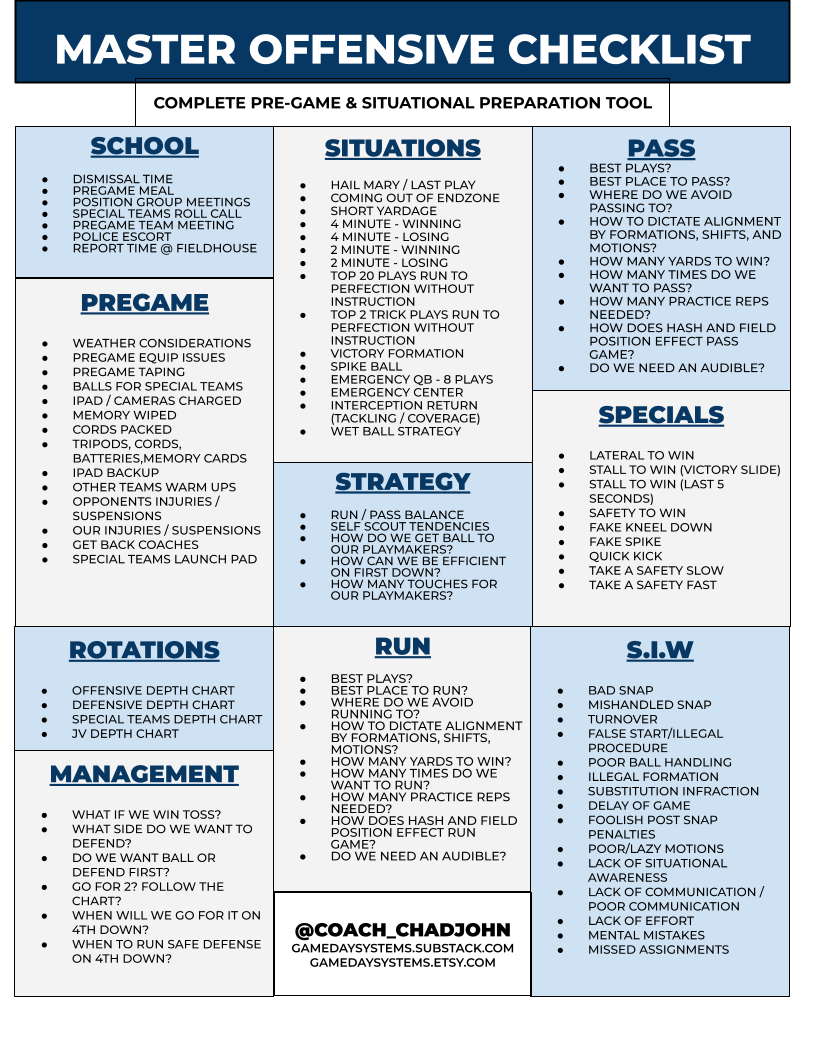
The Vault includes the 56 Questions to Build Your Offensive Game Plan, Defensive Breakdown System, Offensive Attack Plan, Master Offensive Checklist, and other editable game-planning and scouting resources.
My goal with all of them is the same as my goal when I sit down and start watching film:
Take a lot of information and turn it into something useful on Friday night.
Because ultimately, the template doesn’t win the game.
The tendency report doesn’t win the game.
And watching another six hours of film doesn’t win the game.
Finding something that helps your players play faster and gives you a better answer on Friday night might.
No posts
Comments
Nothing yet. Say the first thing.
Sign in to join the conversation.