
Held for the 63rd time in Austin, TX. Trigger for an old acerbic review of The Tao of Pooh.
The how of who Galen Strawson
review of The Tao of Pooh by Benjamin Hoff
The Times Literary Supplement November 26, 1982 (Issue 4156, p. 1307)
“While Eeyore frets ... and Piglet hesitates ... and Rabbit calculates ... and Owl pontificates ... Pooh just is. And that’s the Tao of Pooh. ‘The how of Pooh?’ asked Pooh. ‘The Tao of who? The Tao of Pooh!’”
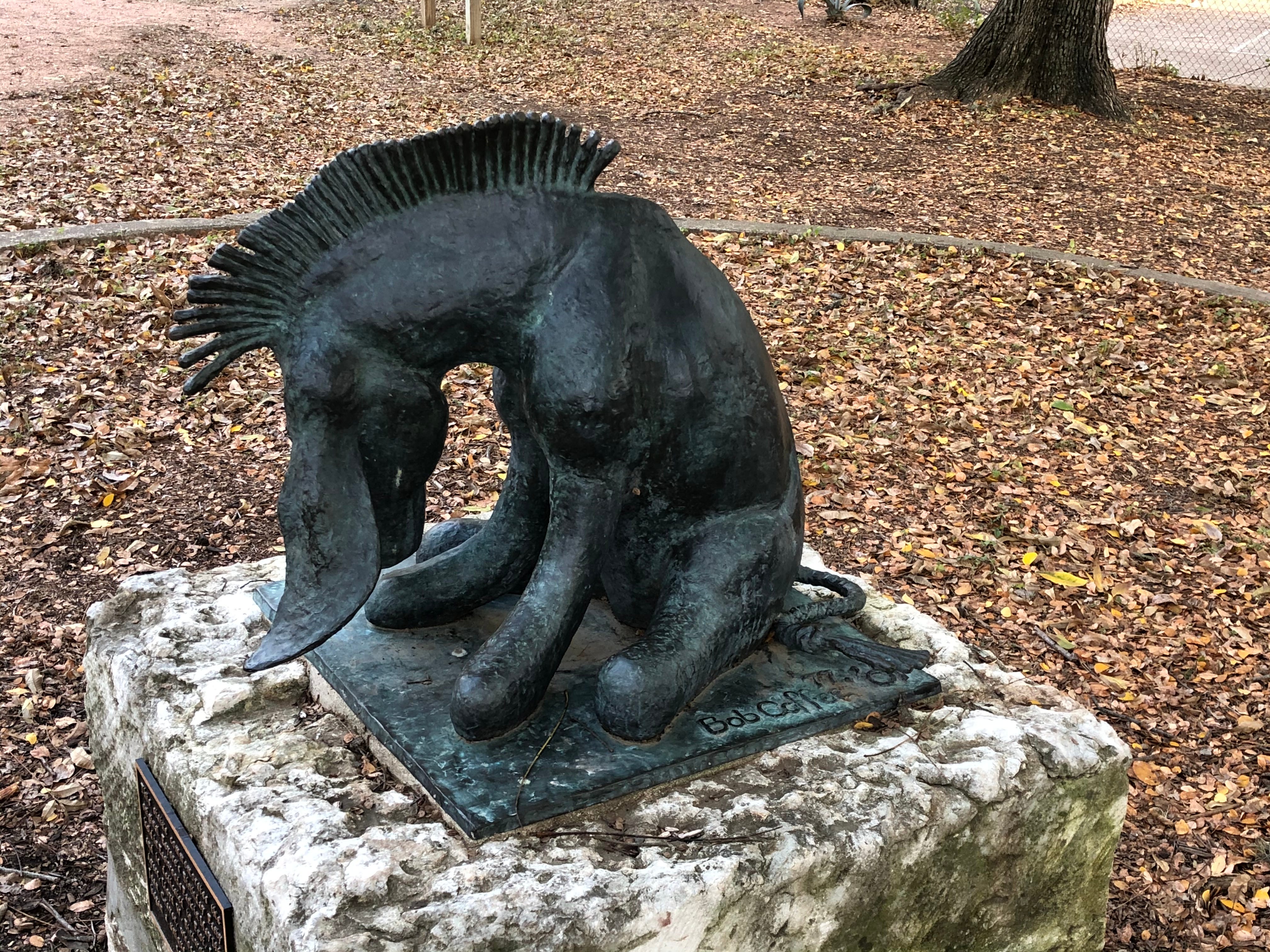
Eeyore, Eastwoods Park, Austin, Texas
The Tao of Pooh is Benjamin Hoff’s idea, and it’s a good idea, but it suffers in the execution. Hoff wants to show that “Pooh’s way is amazingly consistent with the principles of living envisioned long ago by the Chinese founders of Taoism”, but the real lesson of the book is not the intended lesson. The real lesson of the book is contained in the author’s failure to live by the Tao of Pooh in writing The Tao of Pooh. The clumsiness and pomposity of his instructions (“rather than be carried along by circumstances and manipulated by those who can see the weaknesses and behavior tendencies that we ignore, we can work with our own characteristics”, etc.) are fundamentally non-Pooh. So are the repeated unpleasant aspersions cast upon “Abstract Owl, the dried-up Western descendant of the Confucianist Dedicated Scholar” (or “Confusionist, Desiccated Scholar”, as Hoff has Pooh have it), Rabbit (“Clever Rabbit”, whose “little routine is that of knowledge for the sake of Being Clever”), and “Abrasive Eeyore” (“The Eeyore Attitude gets in the way of things like wisdom and happiness”).
“Abrasive Eeyore” is particularly unfair. As we all know, Eeyore has his own wisdom. And it’s clear that Pooh himself doesn’t approve of this sort of thing, even when manipulated in the way he is in Hoff’s own book:
“Owl is about to illustrate the Confusionist, Desiccated Scholar,” I said.
“I see,” said Pooh.
Hoff is far too quick to judge and to condemn. The scorn poured upon the “Brain, the Academician, the dry-as-dust Professor”, the “Clever Mind”, the “Abstract Philosopher”, the “Academic Mortician and his scholarly dissertations”, “Knowledge” (as opposed to Wisdom), “Nearsighted Science that likes to strut around and Act Smart”, and “the Computer” is tiresome, excessive, inappropriate, non-Tao and, again, thoroughly anti-Pooh. It’s far too much like the accumulated bile of someone who has failed to get tenure. And the charm of Poohian Capitalization is lost when put to these unaccustomed uses: it simply gives an additionally unattractive tinge to invective, and an extra degree of Unconvincingness to Hoff’s Key Notions.
What are these? Well, in fact life is so easy it isn’t true. All we have to do is “Enjoy the Process”, be “sensitive to Circumstances”, be “in tune with the Way Things Work”, “Do without Doing”, steer clear of “Brain”, “trust our own Inner Nature” (“in each of us is something Special”), and work with “Things as they Are”. “Just take the path to Nothing, and go Nowhere until you reach it. Because the Enchanted Place is right where you are, and if you’re Friendly With Bears you can find it.”
But Hoff is clearly not In Tune. He is not Going with the Flow, like a good Pooh-stick—or indeed an Eeyore. Instead he’s bossing us all around, and putting down Pooh’s friends. He’s trying to say in words what can only be shown (as Wittgenstein and Lao Tzu would have it). It’s obvious what the right way to write The Tao of Pooh is. You simply take Winnie-the-Pooh and The House at Pooh Corner, you change the titles to The Tao of Pooh, Part One and The Tao of Pooh, Part Two, and you leave everything else exactly as it is.
What we have here, then, is, as Piglet put it, “a Herrible Hoffalump! Hoff, Hoff, a Hellible Horralump!” Hoff just keeps on Hectoring, and it’s Very Heavy Going, despite the borrowed charms of the book—lavish quotation and illustration from A. A. Milne and E. H. Shepard, and some fine fragments from some Chinese (non-bear) Taoists.
Last of all, the whole thing is profoundly and pungently American; which is, again, totally non-Pooh—even if it’s a bit non-Pooh to mention it. (This is an Abrasive Eeyore review.) The Miserable Puritan, the Restless Pioneer, and the Lonely Cowboy are the forebears of today’s sorry society, according to Hoff, and his human (non-bear) heroes are Thomas Edison, Henry David Thoreau and Buckminster Fuller. Which is odd enough if you live near the 100 Aker Wood in a forest under the name of Sanders. But probably this doesn’t matter all that much. It probably doesn’t even matter all that much when Rabbit starts speaking American, because although it’s odder still it’s the sort of thing you can imagine Rabbit thinking of doing. When Pooh starts speaking American, you may find it worrying, or you may just find it bewildering, but you know you can get along with it, because although Pooh’s not that sort of Bear Pooh is Pooh whatever happens. But when Piglet starts speaking American, then you realize that the Whole Thing is plainly ridiculous and, suppressing a hoodling sort of roar, you wonder of this is really a book for the children. And then you realize it probably wasn’t meant to be anyway. “Pooh wants us to know that the words Cottleston Pie are a way of saying Inner Nature.” Tell that to Abrasive Eeyore.
No posts
Comments
Nothing yet. Say the first thing.
Sign in to join the conversation.