
Synexo Group (SYNEXO)
Current price: 0.11 SEK
Enterprise value: 32.5m SEK / $3.5m USD*
Outstanding shares: 368 million*
Insider ownership: 52%
*post-offering closing June 15th.Summary
Synexo is a Nordic BaaS consolidator trading at a $3.5m USD enterprise value and 1.6x pro-forma 2026 cARR, with 75% of the underlying 2026 live ARR guidance already secured through signed contracts. The business generates 100%+ ARR growth, 3% churn, 119% NRR, 66% gross margins, and is run-rate profitable - all running on 3.5 FTEs. Beyond organic growth, the company has 8 acquisition targets in active dialogue with combined revenues of 106m SEK - approximately 11.4x current live ARR - in a fragmented market with 33 identified targets in total. At 1.6x pro-forma 2026 cARR, we believe the current valuation represents an attractive entry point.
Company OverviewSynexo Group is a Nordic BaaS (Backup-as-a-Service) consolidator listed on the Nordic Growth Market in Sweden, formed through a reverse takeover of Sperrung AB in Q3 2025. The company operates two Norwegian backup brands, Backupbuddy and Backupbanken, serving over 1,000 SMB customers primarily in Norway and Sweden, distributed via a network of 60+ IT-service partners. With ARR expected to grow 100%+ this year, ~66% gross margins, a debt-free balance sheet, and run-rate profitability, Synexo offers highly attractive setup. The company is well-positioned to benefit from a structural shift in how companies think about data, driven by stricter regulation, rising cyber threats, and growing geopolitical uncertainty. The group pursues a buy-and-build strategy, combining organic growth with targeted acquisitions of profitable Nordic BaaS and IT-security operators, aiming to consolidate a fragmented market and establish itself as the leading independent data protection platform in the Nordics.
Business Model
It’s important to highlight that Synexo isn’t a software company, even though it has recurring revenues, measures churn, and net retention. Synexo is essentially a managed service partner (MSP) for other MSPs. Synexo does not have its own salesforce, but sells purely through other MSPs who want to use Synexo’s platform, rather than deal with backup and recovery services themselves, since it’s rarely a core offering for them. What the MSP is essentially buying is: A guaranteed, monitored backup service that MSPs can resell without owning the underlying stack. Norwegian-operated infrastructure where data never leaves Nordic jurisdiction. Let’s break that down:
A guaranteed, monitored backup service that MSPs can resell without owning the underlying stack: Synexo does not own its own software. Instead, it licenses backup engines from vendors such as Veeam, Cove, and Ahsay, and packages them into a fully managed service that IT-service partners can white-label and deliver to their own SMB clients. The MSP gets a recurring kickback, a reliable product to put their name on, and critically - a specialist partner that assumes technical responsibility for one of the highest-risk functions in managed IT. If a backup fails or a recovery goes wrong, that is Synexo’s problem to solve, not the MSP’s. The end SMB customer never interacts with Synexo directly. The stickiness of this model is reflected in the numbers; annual churn of approximately 3% and a net revenue retention rate of 119%, meaning existing MSP relationships not only stay, but consistently grow.
Nordic-operated infrastructure where data never leaves Nordic jurisdiction: Synexo stores customer data on servers physically located in Norway and Sweden. This is a meaningful distinction from global platforms such as Kaseya/Datto, whose European infrastructure sits in Iceland, Germany, or Ireland. For Nordic SMBs in regulated industries - healthcare, accounting, legal - data stored on Nordic soil under Nordic law is a compliance requirement, not a preference. This gives MSPs a sovereignty guarantee they can credibly promise their clients, and that global competitors structurally cannot replicate.
Financial Overview
The company breaks down their ARR into “live ARR” and “contracted ARR” (cARR). Live ARR refers to the amount of ARR that is currently being collected from customers, while contracted ARR refers to live ARR + their backlog, which consists of customers that have signed with an MSP to use the Synexo offering, but haven’t migrated onto their service yet. The backlog is expected to materialize on a rolling 12-month basis.
As of their April growth metric update, live ARR was 6.39m SEK (+90% LTM) while cARR sits at 10.65m SEK. Churn (3.1%) and NRR (119%) were in line with the full year expectation. Gross margin sits at 66%, while management believes full year gross margin will be >70%. The company has guided 2026 organic growth targets of: live ARR of >12m SEK, of which 75% is already secured through signed but not yet live contracts, and cARR of >18m SEK. The company also disclosed in their Q1 report that signed run-rate cash-EBITDA is currently at 2.2m SEK (20% EBITDA margin). With a breakeven ARR level of 6.7m SEK, a negligible gap from current live ARR of 6.39m SEK, management expects to reach profitability by the end of Q2. Synexo runs on only 3.5 FTEs across the entire group, capable of handling >5x higher ARR without materially scaling opex, suggesting significant operating leverage embedded in the business model.
M&A, The Balance Sheet, and Dilution
Synexo has a clearly stated buy-and-build strategy in addition to their organic growth initiatives. Given the short company history, there hasn’t been much M&A activity, but the company recently signed a SPA with Deploi, a Norwegian cloud and hosting provider offering virtual servers and data center capacity from its own infrastructure across two locations in Oslo. Deploi ended 2025 with an ARR of NOK 2.9M, growing 30% year-on-year, and a positive EBITDA. The transaction values Deploi at NOK 3.5M, including a NOK 1M earn-out, implying 1.2x ARR and 3.7x EBITDA post-synergies - a highly attractive entry multiple. Beyond the ARR addition, Deploi brings two strategically relevant assets: its own Norwegian-operated infrastructure, which strengthens Synexo’s sovereignty story, and its founder Martin Johansen, a PhD computer scientist who joins the group as CTO. The acquisition closes June 1st and will be immediately accretive, boosting live ARR to 9.29m SEK.
In terms of the balance sheet it is relatively straightforward. No debt, and as of Q1, 1.4m SEK in cash, which is sufficient for operations and runway to profitability, but not enough to execute on the M&A strategy.
That brings us to dilution. While insiders are incentivized to keep dilution to a minimum, with an active buy-and-build strategy there is bound to be dilution. On April 21st, the company announced a rights issue of 4.4m SEK at 0.15 SEK/share, representing a 36% premium to the share price at the time of announcement. It was also disclosed that insiders would cover 34% of the issuance, with the CEO covering 10%. A month later, on May 20th, the company announced that the raise had been covered ahead of the AGM, securing 5.6m SEK in total, of which approximately 1.5m SEK came from insiders, with the remainder from external professional investors including Tigerstaden AS (a very well-known Norwegian investor). The total offering size was subsequently increased to a maximum of 6.5m SEK. After the raise, they will have a fairly flexible balance sheet which allows for more M&A and a comfortable runway, all raised at a 36% premium and a post-offering EV/live ARR multiple of 7.4x. Additionally, in their Q1 report the company disclosed that they have 33 active targets in their M&A pipeline, are in direct dialogue with 8 of them whose combined revenue is 106m SEK. To put that in context, SEK 106M in combined revenue across active dialogue targets represents approximately 11.4x Synexo’s current live ARR - underscoring both the fragmentation of the Nordic market and the scale of the consolidation opportunity ahead.
While this is only one deal, it shows that 1) management wants to dilute as little as possible, and will only do so at attractive multiples 2) if they can buy more targets at similar multiples to Deploi, then their acquisitions should be highly accretive.
Management
There’s not too much to say about management. They haven’t executed a roll-up strategy like this before and will have a lot to prove. With that being said, in meeting with the CEO (Sindre) he was not promotional, understood the market, and had a clear view on capital allocation. The recent addition of Martin Johansen as CTO, following the Deploi acquisition, adds technical depth that the group previously lacked. They still have a lot to prove in terms of execution, which is something they are aware of.
Market Opportunity
The global BaaS market was valued at USD 8.34 billion in 2025 and is expected to reach USD 33.18 billion by 2030, implying a CAGR of approximately 32%. While useful context, the more relevant opportunity for Synexo is closer to home.
Management estimates the Nordic market at approximately SEK 2.8 billion, with an internal market - resellers they already know, many expressing interest in switching supplier - of SEK 46 million. With live ARR of SEK 6.39 million, Synexo has captured roughly 14% of that immediately addressable opportunity organically, leaving plenty of runway. The SEK 106 million M&A pipeline sits on top of this as a separate, incremental route to scale through consolidation rather than organic conversion.
The structural tailwind underpinning both is clear. Stricter regulation under GDPR and NIS2, rising cyber threats, and geopolitical uncertainty are accelerating a shift away from dependency on global vendors. Global competitors such as Kaseya and Datto could theoretically rent Nordic datacenter capacity, but as US-incorporated entities they remain subject to US jurisdiction regardless of where data physically sits, a distinction that matters increasingly to compliance-driven Nordic buyers.
Competitive Landscape
Global platforms
The most well-resourced competitors are Kaseya/Datto, Acronis, and Barracuda. All three distribute through MSP partner networks, operate recurring revenue models, and target the same SMB end-customer. Their threat to Synexo’s core positioning is however limited by a structural constraint, as US-incorporated entities: they are subject to US government access requests under the CLOUD Act, meaning US authorities can compel access to customer data regardless of where it is physically stored. For compliance-driven Nordic buyers in healthcare, legal, and accounting, this is a meaningful distinction. Kaseya and Datto’s nearest European infrastructure sits in Iceland and Germany respectively, with no Norwegian or Swedish capacity.
Nordic IT generalists
Atea and Advania are large Nordic IT service companies that offer backup as part of broader managed services contracts. They have deep existing customer relationships with exactly the SMBs Synexo targets, which makes them a distribution risk more than a product risk. However, backup for these companies is a bundled line item, not a core offering - they lack the specialist focus and sovereign infrastructure that defines Synexo’s proposition. Atea and Advania are therefore as likely to be distribution partners as they are competitors.
Nordic niche players
Keepit is the most sophisticated Nordic-born competitor, having raised $90 million in total funding and been named a Leader in the IDC MarketScape for Worldwide SaaS Data Protection in December 2025. Keepit competes with Synexo on SaaS workloads such as Microsoft 365, but targets a larger, more enterprise-oriented customer and lacks Norwegian or Swedish soil infrastructure. Jottacloud stores data on Norwegian soil and operates its own infrastructure, but is positioned as a consumer and prosumer product rather than a managed B2B service. KeepItSafe operates across the Nordics but is owned by US-listed j2 Global, undermining its sovereignty credentials in the same way as the global platforms.
Valuation
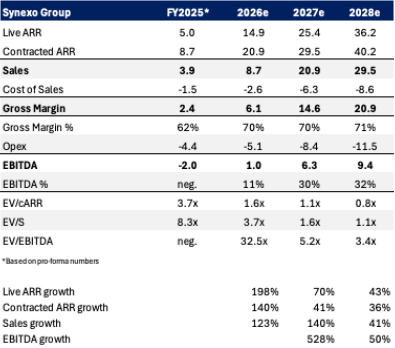
The numbers below are post-offering and include the ARR from the Deploi acquisition, given that the SPA is signed and it should close in a few days. Other assumptions are:
· Taking management’s guidance for 2026 at face value, given that 75% of the live ARR guide is already secured through signed contracts
· Only adding Deploi’s ARR, not any other M&A - though I expect more M&A by EOY
· Gross margin moving to the guided 70%
· Reaching the guided 30%+ EBITDA margin by 2027
· The backlog being converted in 12 months after signing
Note that these are conservative numbers compared to the “illustrative” case management has for 2027 (see their updated investor presentation). Adding M&A, they expect cARR of 60.8m SEK by the end of 2027, compared to the 29.5m SEK used below. That scenario would result in more dilution, even if they get access to debt, so I haven’t modeled it, but kept it conservative looking at organic growth only.
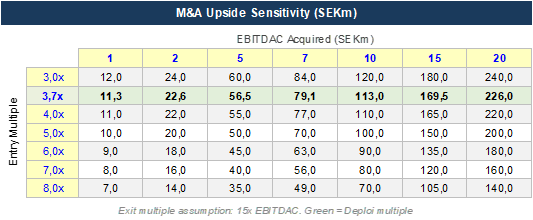
The table below illustrates the value creation potential from Synexo’s M&A strategy, assuming a 15x EV/EBITDAC exit multiple - consistent with Nordic SaaS peer trading multiples. Using the Deploi acquisition as an example, we can see that at a 15x EV/EBITDAC multiple, the acquisition would give a 11.3m SEK uplift to EV.
RisksManagement and execution risk
Management has not previously executed a buy-and-build strategy of this nature, and will have a lot to prove. Mitigant: None in terms of track record. However, early capital allocation decisions; acquiring Deploi at 1.2x ARR with insider participation in the subsequent rights issue, suggest the right instincts are in place. Execution over the next 12-18 months will be the real test.
Business model
Synexo doesn’t have its own software or product, but rather sells packaged off-the-shelf software and provides data storage at Norwegian and Swedish data centers, where they rent capacity. This could result in the underlying software and/or data center companies raising their prices which will compress the margin for Synexo, or they can develop their software such that it’s easier for SMBs to do themselves. Mitigant: Most of Synexo’s customers are on rolling 12-month contracts, giving the company the ability to pass through cost increases at renewal. As ARR scales, Synexo’s negotiating leverage with underlying software and infrastructure vendors increases, providing a natural hedge against margin compression over time. On the self-serve risk, the managed service value Synexo provides goes beyond software configuration; compliance responsibility, local support, and data sovereignty guarantees cannot be replicated by software automation alone. More fundamentally, SMBs that outsource backup today do so because they don’t want to own the responsibility - not because they lack the tools. Even as Microsoft’s native backup capabilities improve, the willingness of an SMB to self-manage a business-critical function is unlikely to increase materially. The managed service model is a preference, not just a technical necessity.
Dilution
With a debt-free balance sheet and an active acquisition pipeline, further equity raises are likely. While management has demonstrated a willingness to raise at premiums and with meaningful insider participation, dilution remains a structural feature of the buy-and-build model at this stage. Mitigant: The sample size is small, but in the one offering we’ve seen thus far, management raised at a premium to the current share price, and didn’t raise more than needed. If EBITDA scales as modelled, debt financing becomes an increasingly viable alternative to equity for future acquisitions.
Competition
See the competitive landscape section.
No posts
Comments
Nothing yet. Say the first thing.
Sign in to join the conversation.