
First off, I want to give credit to Adu Subramanian (@AduSubramanian on Twitter), for showing me this idea and contributing in researching and writing this analysis. Check out his Substack: adus.substack.com
Liquidia Corp (LQDA)
Price: $5
Shares Outstanding: 64M
Market Cap: $320M
Cash: $70M (Only used 70% of cash balance – not profitable)
LT Debt: $24M
EV: $274M
TL;DR
The complicated nature of this special situation resulted in this analysis being longer than my normal posts. Therefore I wanted to include a quick summary of the analysis. While this situation is inherently complicated, the thesis itself is fairly straight forward. Liquidia is currently in a Hatch-Waxman litigation after their competitor, United Therapeutics, filed a lawsuit against them in 2020, claiming that Liquidia was infringing on three of their patents. In 2021, Liquidia received tentative FDA approval for their product Yutrepia, pending the outcome of the patent dispute. Roughly two years later, we are now close to the dispute being resolved, with the decision expected to be handed down between August and the end of October. While it’s difficult to probability weigh the outcome, I do believe Liquidia will receive a favorable court ruling and will therefore be able to launch Yutrepia in 4Q2022.
Both Liquidia and United are focused on pulmonary arterial hypertension (PAH). United pretty much has a monopoly on PAH (group 1) patients & PH-ILD (group 3) patients, and Liquidia is now looking to enter this market with their new product Yutrepia. United’s product, Tyvaso, did 607M in revenue in 2021, and looks to do roughly 800M this year.
That’s revenue from group 1 and group 3 combined. The TAM for group 1 and 3 combined, is roughly 5.3B – a massive market. Liquidia also has the superior product, and so they could possibly take significant market share from United. Given Liquidia’s 320M market cap, and them possibly entering a 5.3B market with the superior product, a favorable decision by the district court could result in a significant rerating of the company. Overall, I believe this situation offers a very attractive risk/reward profile at the current price.
Brief Business Overview
Liquidia Corp is a biopharmaceutical company focused on pulmonary arterial hypertension (PAH). PAH is a rare, chronic, progressive disease caused by hardening and narrowing of the pulmonary arteries that can lead to right heart failure and eventually death, with an estimated prevalence in the United States of approximately 30,000 patients. The company’s proprietary PRINT engineering technology allows them to engineer and manufacture highly uniform drug particles with precise control over the size, three-dimensional geometric shape and chemical composition of the particles. As a result, the company has been able to develop their main drug candidate Yutrepia (treprostinil) inhalation powder, which is an inhaled dry powder formulation of treprostinil delivered through a proven, convenient, palm-sized device.
The company also has a commercially approved product named Treprostinil Injection. The Liquidia PAH subsidiary (formerly RareGen) commercializes generic Treprostinil Injection in a partnership with Sandoz. Treprostinil Injection is most likely nothing more than a $15-25M revenue product at 80% gross margin. In other words, it might provide some flexibility in terms of near term capital needs, but nothing more.
The PAH market currently has one dominant player, Liquidia’s only competitor - United Therapeutics (UTHR). UTHR sells Tyvaso, a nebulized form of treprostinil along with a few other versions of the same drug which are administered via infusion. Tyvaso did 607M in revenue in 2021 and looks to be doing 800M in 2022. That’s for group 1 and group 3 patients combined. As mentioned above, Liquidia's drug, Yutrepia, is an inhaled version of treprostinil targeting Tyvaso's current market. An inhaled version of treprostinil is better than a nebulized version - nebulized treprostinil requires a clunky device with 10-13 parts while inhaled treprostinil only requires an inhaler. That’s why UTHR is coming out with their own inhaled product, Tyvaso DPI, through a partnership with MannKind Corporation.
Timeline And Development of The Lawsuit
On June 5th, 2020, Liquidia’s only competitor – United Therapeutics Corporation – filed a lawsuit against Liquidia for infringement of U.S. Patent Nos. 9,604,901 (the '901 patent) and 9,593,066 (the '066 patent) relating to United Therapeutics' product Tyvaso (treprostinil) Inhalation Solution. The lawsuit came as a result of Liquidia filing their NDA for the approval of LIQ861 – now known as Yutrepia. Upon initiation of the lawsuit, the FDA triggered a statutory regulatory stay on the final approval of Yutrepia until October 27, 2022, or earlier resolution or settlement of the ongoing litigation.
On July 24th, 2020, UTHR filed an amended complaint asserting infringement of U.S. Patent No. 10,716,793 (‘793) in addition to the already asserted infringement of U.S. Patent Nos. ’901 and ’066. However, the ‘793 patent was not subject to the FDA’s regulatory stay because it was not listed in the Orange Book for Tyvaso when Liquidia submitted the NDA for Yutrepia.
In October, 2020, LQDA provided an update on the U.S. Patent Trial and Appeal Board Decision on Inter Partes Review (IPR) of two of United’s Tyvaso patents. The update explained how PTAB had instituted IPR on patent ‘901, but denied institution on patent ‘066. This update meant that the 30 month stay would still be in effect, and that LQDA would have to argue invalidity and non-infringement in the district court regarding patent ‘066.
I wanted to briefly explain the difference between the district court, where the trial was held, and the PTAB, as they do two different things. The PTAB IPR is filed by LQDA to review patentability of claims in the patent, while cases filed by UTHR go to the district court to argue LQDA infringes (though LQDA can either argue invalidity or non-infringement as defense). For the PTAB to review a patent, one or more claims have to be unpatentable.
Fast forward to August 2021, the PTAB instituted an IPR proceeding against the ‘793 patent. A couple of months later, in October 2021, the PTAB ruled in Liquidia’s favor in the IPR proceeding against the ‘901 patent. In its ruling, the PTAB found that seven of the nine claims were unpatentable. Only the narrower dependent claims 6 and 7 remain, both of which require actual storage at ambient temperature of treprostinil sodium.
On November 5, 2021, the FDA issued a tentative approval for Yutrepia (treprostinil) inhalation powder, which is indicated for the treatment of pulmonary arterial hypertension (PAH) to improve exercise ability in adult patients with New York Heart Association (NYHA) Functional Class II-III symptoms. What this means is that if the PTAB and/or the district court rules in Liquidia’s favor, the approval will no longer be tentative, and they can launch Yutrepia right away.
December 2021: The Court grants LQDA leave to file a motion for summary judgment of invalidity of the ‘066 and ‘901 patents due to collateral estoppel. Trial in the Hatch-Waxman litigation is scheduled for March 28-30, 2022. Later that month, on December 29th, UTHR filed a stipulation of partial judgment with respect to the ‘901 patent. Under the stipulation of partial judgment, UTHR agreed to the entry of judgment of Liquidia’s non-infringement of the ’901 patent based on the Court’s construction of certain terms in the patent. With this stipulation of partial judgment, only the ‘066 patent would serve as a basis for the on-going regulatory stay for final approval of Yutrepia (treprostinil) inhalation powder by the FDA.
That brings us to July 22nd, 2022, the PTAB rules in Liquidia’s favor in IPR proceeding against patent ‘793. In its ruling, the PTAB found that, based on the preponderance of the evidence, all the claims of the ’793 patent have been shown to be unpatentable.
Other Background Information
CEO and Management: LQDA’s current CEO, Roger Jeffs, is the former president and co-CEO of Liquidia’s only competitor – United Therapeutics Corporation. My understanding is that he was the scientific co-founder of UTHR, while Martine Rothblatt (UTHR current CEO) ran the business side. In 2016, Jeffs retired from UTHR having built and worked for the company for 18 years. In November 2020 he joined the board of LQDA and in January of 2022 he became the CEO of LQDA. In other words, Liquidia’s CEO built their only competitor and is clearly an industry veteran. One could argue that Jeffs knows the PAH market as well as anyone. He chose to join the only direct competitor of his former company. That’s interesting.
Jeffs isn’t the only former UTHR employee. Scott Moomaw, Liquidia’s Senior VP Commercial, was the VP of Marketing at UTHR for 5 years, responsible for Remodulin, Tyvaso & Orenitram. He also co-founded RareGen as COO, launching generic Treprostinil Injection. Matt Snow, VP of National sales, is a former UTHR commercial leader who had multiple roles in sales leadership and training.
Insider Buying: After the trial in the Hatch-Waxman litigation which was March 28-30, 2022, there was a flurry of open market buys by insiders. Nine buys from various insiders between April and May to be exact. Those transactions amounted to approximately $12.85M worth of insider buying. In addition, the company did a $53.7M public offering in April (after the trial), where company insiders bought 19% of the offering. That’s roughly $10.2M. So if you add the up the open market buys and insider participation in the public offering, insiders have bought approximately $23M worth of Liquidia shares after the trial. Again, that’s interesting.
Is UTHR delaying the inevitable? One could argue UTHR filed the suit simply to delay LQDA's launch. What gives this argument some weight is the fact that UTHR spent 100M on a voucher to speed up the FDA approval of Tyvaso DPI by 4 months. In addition, UTHR filed a similar suit against SteadyMed back in 2017 before eventually acquiring them after losing the suit. Side note: UTHR acquired SteadyMed for 216M at a point where SteadyMed had no approved products and was still in Phase 3 trials. Liquidia’s current market cap – 320M. And so not only has UTHR shown a clear desire to be first to market through their 100M voucher, but they’ve also lost a similar suit before. Connecting the dots suggests that all UTHR wants is to delay the inevitable.
One last tidbit to note is that LQDA received a licensing offer prior to approval from a larger company. It’s unknown which company the licensing offer came from, some speculate that it was UTHR, but I haven’t been able to find any evidence to prove that. Either way – interesting.
A Closer Look At The Trial
Alright, so the situation has been explained and we’ve gone through some other interesting information. But what really matters in this situation is the likelihood of Liquidia winning the trial in the Hatch-Waxman litigation. Now, I’m not a lawyer of any kind and this is simply my understanding/opinion of the case, so please keep that in mind when reading the discussion below. Don’t take my word for any of this and please do your own due diligence.
With that being said, I’ll be discussing the situation around patent ‘793 and ‘066. Liquidia has already won on patent ‘901, so I will not be discussing that patent.
Patent ‘793
As mentioned above, the PTAB already ruled in Liquidia’s favor in the IPR proceeding of patent ‘793. The PTAB found that the ’793 patent was unpatentable. However, ‘793 is still part of the lawsuit and so district court Judge Richard Andrews will rule on if he believes the patent is valid and if Liquidia infringes.
How validity and infringement works, is that if the Judge finds the patent invalid, then infringement doesn’t matter because the patent has been invalidated anyway. But, if the Judge finds the patent valid, then it all depends on if the Judge finds infringement or noninfringement. So a patent can be valid but still be ruled against if the Judge finds noninfringement.
This is where things get a bit complicated. There is estoppel with the IPR and the trial – meaning that Liquidia is not supposed to make the same argument in the IPR and in the trial. In the IPR, Liquidia got the patent invalidated based on obviousness grounds – using their strongest argument for invalidity. In the trial, Liquidia is arguing that the ‘793 patent is invalid based on failure to meet the written description requirement and failure to prove enablement – a much weaker argument. One expert I saw weighing in on the case, believed that because of the weaker argument, the Judge would find ‘793 valid and infringed. In other words, he believed the Judge would rule against Liquidia. I want to be very careful arguing against an expert, especially since I’m as far from on expert on this topic as one can be. But there’s a couple of reason I believe he’s wrong (I know, the hubris on this guy).
Firstly, Judge Andrews, according to the pre-trial transcripts, said he had zero interest in racing the PTAB to a decision on ‘793. This implies that the PTAB ruling should affect how Judge Andrews rules on ‘793. Tied to this, is the fact that if Judge Andrews finds infringement for ‘793, it would go to the court of appeals, where there’s a 98% chance that the PTAB’s decision would be upheld. It would result in a 12 month delay for Liquidia as the case is processed in the court of appeals, but the patent would still be invalidated in the end.
What does this mean? It means that because of the PTAB’s ruling, patent ‘793 is dead with a 98% probability. Judge Andrews knows this and he’s now been able to read PTAB’s ruling. So why would Judge Andrews want to wait for PTAB’s decision, only to go against it later, and knowing that PTAB’s ruling will be upheld in the court of appeals anyway? That doesn’t make sense for Judge Andrews to do. But again, I don’t know how all this works in terms of the law. But my best guess is that Judge Andrews either invalidates ‘793 outright or he postpones his ruling pending the PTAB decision appeal. That means he’ll let the court of appeals make the decision and he never has to rule on ‘793. And since patent ‘793 isn’t part of the 30 month regulatory stay, Liquidia could launch at risk as long as patent ‘066 is invalided and/or non-infringed.
All this to say, I think it’s safe to assume that the ‘793 patent is dead, but there’s uncertainty around whether or not a 12 month delay will be imposed on Liquidia’s launch. I tend to lean towards them not being delayed, but it’s hard to probability weigh the outcome. Either way, if ‘066 is invalided, which we’ll get to in the next paragraph, the launch is pretty much a certainty as patent ‘793 is dead.
Patent ‘066
Now here’s the most complicated, and most important, patent decision for this whole situation. Patent ‘066 is a product by process patent and have nine claims. However, only two of the claims are independent (1 & 8), and so those are the only claims that really matter. Also, it’s important to understand that for a product by process patent to be valid, a new product has to be produced. If the product is same or obvious from a product of prior art, then the claim is unpatentable.
Let’s look at claim 1 first. Claim 1 explains how a starting batch treprostinil goes through a series of steps to get to the final composition, which then has a level of impurities which is lower than a starting batch. This awfully similar to claim 1 in patent ‘393, which is the patent used in UTHR’s case against SteadyMed in which they lost.
Liquidia’s argument for why claim 1 should be invalidated revolves around a document called Moriarty 2004. UTHR has been making treprostinil for decades. They had a product called remodulin, a solution of treprostinil that you administer intravenously or subcutaneously. It treated pulmonary hypertension but it's just a different route of administration. They made that treprostinil starting in the 2000s using a process developed by professor Dr. Robert Moriarty. Dr. Robert Moriarty was hired by UTHR to find a better synthesis process for their product for Remodulin, and he published it. The way the process works is that you take benzidine triol, alkylate it, conduct the hydrolysis step, and you end up with treprostinil, and the purity of this treprostinil is 99.7 percent. This is how UTHR made treprostinil in their Chicago plant in the early 2000s.
In 2006-2007, UTHR moved their treprostinil manufacturing facility from Chicago to Silver Spring, Maryland, and when they did that, they did two things. They added a salt step, adding a base to make a treprostinil salt, and specifically treprostinil diethanolamine, and they removed column chromatography, a purification step in the intermediate. The reason why they did that is because Silver Spring, Maryland, has different environmental concerns than Chicago, Illinois, so they had to take that into consideration and try to remove some solvents that they used that might be carcinogenic.
Alright, so with that, what Liquidia is arguing is that the treprostinil made at the Silver Spring plant is identical to the treprostinil made at the Chicago plant. Meaning that there’s no structural and functional difference. They are also arguing that when UTHR presented the Silver Spring process to the FDA, they did not tell the FDA “our product is now more pure.” UTHR did not say our product is more safe. They did not say “our product is less toxic.” In fact, they told the FDA that the purity using this '066 process is of equivalent to the purity of the Moriarty process. And since Moriarty 2004 disclosed the process of making treprostinil at the Chicago plant publicly, claim 1 is invalid.
United’s argument is that the Silver Spring process does in fact make the treprostinil more pure, and it is therefore structurally and functionally different, and so Moriarty 2004 does not invalidate claim 1 and that LQDA infringes. I don’t want to seem too biased by making the paragraph on United’s counterargument so short, but they are basically just saying the opposite of Liquidia, making the argument that the additional steps in the Silver Spring process does make the treprostinil more pure.
From reading the trial transcripts and talking to some experts, I believe Liquidia has the strongest argument here and will invalidate claim 1. This is also backed by the fact that claim 1 is very similar to claim 1 in ‘393, which we know was invalided by the court in the SteadyMed case. Here’s a paragraph from the SteadyMed case, you can see how it pretty much explains what Liquidia is now arguing:
“Based on the entire record before us, we find that the process steps recited in the challenged claims do not impart structural or functional differences to the claimed product, and, therefore, conclude that those process steps are not entitled to patentable weight. Instead, we find that the evidence of record supports a finding that treprostinil produced according to Phares has the same, or better, overall purity and purity profile than treprostinil produced according to the process recited in the ’393 patent. We further find that, to the extent they exist at all, any purity differences between treprostinil produced by prior art methods and that produced according to the process recited in the ’393 patent are attributable to inter-batch variability in impurity profiles, as well as variations in reagents, solvents, and reaction conditions, and are not indicative of structural or functional differences imparted by performing the steps recited in the challenged claims of the ’393 patent.”
On to claim 8, which is about storage. This is a fairly easy claim and argument to understand, but more difficult to reach a conclusion (in my non-law opinion). Claim 8, according to patent ‘066, is a method of preparing a pharmaceutical product from a pharmaceutical batch. Now, claim 8 is very specific in that it requires a pharmaceutical batch salt of treprostinil to be stored at ambient temperature. As a result of the specificity of the claim, Liquidia has arguably been able to design a workaround. They state that their product is stored at -2 to -8 degrees Celsius and has designed all their processes to require the product to be stored at those temperatures. Therefore, they are not infringing on claim 8 that covers treprostinil being stored at ambient temperature.
United’s argument is that they found three batches during discovery that was stored at ambient temperatures. Liquidia quickly disclosed that these batches were only used for R&D once it was discovered that they had been stored at ambient temperatures – meaning if a batch is accidentally stored at ambient temp, Liquidia won’t sell that product. This opens up the argument for United to claim that Liquidia’s product is stable at ambient temp, and that chilling the product is just a way of evading claim 8. One expert said that while that might be true, the law does not prohibit Liquidia from doing that, i.e., that is a legitimate way of making sure they do not infringe on claim 8. United then tried to motion to shift the burden of proof onto Liquidia pre-trial, in which Judge Andrews responded by saying the only reason United was doing that was because they were having a hard time proving infringement, and so he rejected the motion. Not a great sign for United.
A second argument by United is that Liquidia’s treprostinil is stored at ambient temp at various stages during the manufacturing process. This argument becomes a matter of definition. The PTAB’s definition of storage is that the product has to be stored for a minimum of three months for it to be defined as “storage”. That doesn’t mean that the court has to define it that way. United argued that treprostinil was stored for hours and sometimes days during Liquidia’s manufacturing process, with the longest period being 30 days. Hence, they were storing the product at ambient temps. Liquidia’s counterargument was that simply keeping the product at ambient temp during the manufacturing process, for shorter than the amount of time required by the PTAB’s definition of storage, does not qualify as storage. They compared it to taking a carton of milk out of the fridge, putting it on the counter while you get your bowl and your cereal, before putting it back in the fridge after pouring the milk. You’re not storing the milk on the counter just because you placed it there while preparing your cereal. You’re storing the milk in the fridge. All to say, Liquidia isn’t storing their product at ambient temps when they are manufacturing the product. They are storing it at chilled temperatures.
Now, I don’t how much weight that milk argument will have in court, but I think the “storing during manufacturing” argument by United is a stretch. If you then add the workaround Liquidia is legally entitled to do, and Judge Andrews words pre-trial, I think claim 8 is ruled non-infringement.
After all that, I try to arrive at a conclusion. I have heard several people say that experts are on both sides of the aisle on this one. Given that I’m not a lawyer and have never studied law, I do struggle to arrive at a super confident conclusion. But with ‘793 being dead, it all comes down to ‘066. And frankly, given that claim 1 has more or less been invalidated by the SteadyMed case already, and given Liquidia’s legitimate workaround and Judge Andrews words pre-trial regarding claim 8, I do believe patent ‘066 will be both invalidated (claim 1) and found non-infringed (claim 8). Resulting in Liquidia winning ‘066 and getting to launch Yutrepia. Whether or not they are forced to wait 12 months because of the ‘793, I’m having a difficult time reaching a conclusion on, though I tend to lean towards them not having to wait for the court of appeals. But I don’t think whether or not they have to wait 12 months is important to the thesis. The important thing is whether or not they get to launch Yutrepia in 2022/23.
Products, Sales, and Valuation
So, assuming that Yutrepia gets launched either in Q4 2022 or Q4 2023, it becomes relevant to compare Yutrepia and Tyvaso DPI, look at the sales potential, and lastly what that all means for the valuation of Liquidia.
In terms of the two products, Yutrepia is likely superior over Tyvaso DPI. With Yutrepia the dosing can exceed 100 micrograms, while Tyvaso’s dosing is only 72 micrograms. The highest dose of Yutrepia disclosed publicly so far in PAH patients is the equivalent of 24 nebulized Tyvaso breaths per session, or more than 2x the highest dose indicated in Tyvaso DPI’s label. The higher drug exposure in patients - because of the higher dosing - might result in improved efficacy as well. This theory is backed by the fact that a past registry study showed that higher Tyvaso exposure is consistently associated with better patient outcomes including survival. Liquidia now has the patent on dosing between 100 and 300 micrograms as well. Despite the higher dosing, Yutrepia has less AEs (56% vs 80%), though these AEs are mostly minor ones like coughing. Lastly, one could argue that the device that is used to administer Yutrepia is better than the device used to administer Tyvaso DPI. As a final product, Yutrepia can be stored at room temperature while Tyvaso DPI requires refrigeration. Also, Yutrepia does not need to be inhaled upright and steady through inhalation like Tyvaso DPI does. In conclusion, Yutrepia seems to be the better product when looking at several factors.
Tyvaso will do roughly 800M in revenue for United in 2022 (607M in 2021). This is revenue from both group 1 and group 3 patients. However, United’s Tyvaso received approval for group 3 patients as recent as in April 2021, and so they haven’t had much time on the market for that patient group. It’s worth noting that Liquidia believes that with earlier use and longer retention they can grow the group 1 patient base from 3K to 6K. In May 2022, when Tyvaso DPI was approved to treat group 1 PH patients, it was also approved for PH-ILD patients (group 3). Group 3 has a patient population of roughly 30K patients, and so it increase the patient base, and also the revenue potential, drastically. Tyvaso and Tyvaso DPI is the only approved products to treat PH-ILD patients, and Yutrepia will most likely be approved in 2024.
Doing a simple calculation of drug price x amount of patients (160K x 33K), you get a 5.3B in total addressable market - assuming no expansion of group 1 patient base. That’s massive, and there’s really only one competitor in this market, and that competitor has the inferior product. If you assume Liquidia does not receive label expansion to treat group 3 patients in 2024, then their total addressable market is probably between 500M-1B (3-6K x 160K). United did 483M in revenue from group 1 in 2020, but if Liquidia is successful in increasing the patient base from 3K to 6K, they could double the TAM. So while the revenue potential is still big if they are only able to get approval for group 1, getting group 3 approval is a gamechanger.
But it’s not that easy. The current patient population is on nebulized Tyvaso, and so one must estimate the conversion rate. Meaning, how many of the patients currently on nebulized Tyvaso, will convert to using the inhaled product, whether that’s Yutrepia or Tyvaso DPI. That’s not easy to estimate. United has recently been downplaying the conversion, stating that it’s most likely going to be a 50/50 split between nebulized and inhaled. There’s a couple of reasons why United might want to downplay the conversion. One is that they might believe Liquidia will enter the market, and so they don’t want to give Liquidia free “hype” about the inhaled potential. Secondly, a higher conversion to inhaled will hurt United’s bottom line as they have a royalty deal with MannKind, and so they won’t make as much per patient as with nebulized. Regardless of that, I don’t think the conversion will 50/50 and that we might see 70-90% of patients switching to inhaled. But again, this is difficult to estimate and has a massive impact on Yutrepia’s revenue potential.
Then we also have to look at market share. While Liquidia only has one competitor, that competitor is the larger company and has a long track record in the PAH market. But, with the better product and possibly better efficacy, Liquidia’s chances of gaining significant market share are favorable. On the recent Q1 earnings call, Roger Jeffs said he estimated that 80-90% of the Tyvaso market would transition to Yutrepia. That would obviously be massive for Liquidia. However, that’s probably more on the optimistic side, and probably shouldn’t be used as a base case. Conservative investors would probably like to use a 50/50 market share split, even though Liquidia’s superior product might suggest that they will eventually acquire the larger market share.
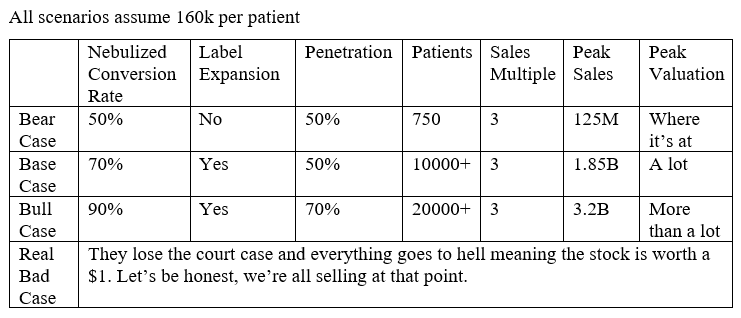
Let’s then look at what all this means for the peak sales potential of Yutrepia. Between all different factors in play - getting group 3 label expansion, conversion rate, and market share split – one will most likely end up with a wide range of what peak sales could be. A super conservative estimate would probably include Liquidia not receiving group 3 label expansion, not expanding group 1 patient base, the conversion rate being 50/50 and the market share being 50/50. That would result in peak sales of 125M for Yutrepia (500M market x 0.5 x 0.5 = 125M). If we then use 3x peak sales as a rule of thumb in terms of valuation, you get a market cap of 375M. For what it’s worth, I think this scenario is highly unlikely, but I wanted to include it for the super conservative investor.
A more appropriate, yet conservative estimate, would probably be around 330M in peak sales. You can plug the assumptions you need to get there yourself. Using the same rule of thumb, 3x peak sales, results in a market cap of 1B. However, I still think this is a bit conservative.
My base case is that they get label expansion in 2024, 70% conversion rate, and a 50/50 market share split with United. Then the math looks like this: 5.3B in TAM x 0.7 x 0.5 = 1.85B in peak sales. If we then use the same rule of thumb, you get a 5.5B market cap. That sounds pretty unrealistic for a company that currently has a market cap of roughly 320M. It’s also why researching this complicated patent litigation has been worth it – the payoff could be massive.
Now, they obviously shouldn’t be priced at 5.5B if they get a favorable ruling in the trial. It will likely take them 6-7 years to reach peak sales. But if one believes in the base case laid out above, one could easily argue that this should be a 1B company at the time of a favorable ruling. That’s an upside of roughly 200% from the current price, or a share price of $15.
So having looked at the potential upside, what about the downside? Well, the worst case scenario is that Judge Andrews validates and/or finds infringement of patent ‘066. That would mean that Yutrepia can’t be launched until 2027/28. At that point, the stock would probably be worth around $1/share. Breaking that down, Liquidia has a commercial product that will most likely do 15-25M/year between 2022 and 2027. Sure they have 100M in cash right now, but they won’t be profitable so you can’t value that cash at face value. Who knows what the burn rate will be in the years between 2022 and 2027, so maybe you don’t have to discount all of the cash. But still, the downside is most likely around 75-80%.
No posts
Comments
Nothing yet. Say the first thing.
Sign in to join the conversation.