
[For the best reading experience, click on the View in Browser link (upper right) in your email client. Some email clients don’t allow you to expand the photos for a closer look.]
I met my friend Carol in the summer of 2009, in a new group called TOWN, which stood for Texas Outdoors Woman Network. This group was a part of Texas Parks and Wildlife, and its mission was “to provide all women the opportunity to experience outdoor activities in a safe, non-threatening, and supportive environment.” It was women teaching and supporting women—how to fish, camp, kayak, paddleboard, hike, hunt, hook up and back up a trailer, identify birds, read a map, do orienteering—just about anything in the outdoors. Well, I loved the sound of that. They were starting a new chapter in Rockport. I attended the inaugural meeting and became a regular in the group.
Carol was also there at the first meeting, and she offered to start a women’s kayaking group. She was a certified kayaking instructor and could teach anyone who was a newbie. That’s me! I thought. I signed up on the spot. Six or seven of us met weekly and she taught us all the basics of kayaking and water safety.
This was something I immediately loved and wanted to do more of. Within a year I’d purchased my own Hobie kayak, and Carol and I had a weekly outing, just the two of us, long after the TOWN group disbanded. My boyfriend Sam also purchased a kayak and it was something we enjoyed doing together.
Kayaking became a regular part of my recreation in Rockport. I never liked being in speedboats, I despised jet skis, and always had some fear of being in deep water because I wasn’t a good swimmer. But for some reason, this I loved. I found it so peaceful to get away from the boom boxes on the beach and move along the water at my own pace. Also, the shallow wetlands in the Rockport area went hand-in-hand with another growing hobby of mine: birdwatching. Being able to quietly paddle along the grasses and reeds and observe the shorebirds up close was a real thrill for me.
The only real challenge of kayaking in Rockport was the constant onshore wind, which was brutal many days. You either quickly built up your upper body strength or you were easily defeated out there.
***
On September 29, 2010, Carol and I arrived for our regular Wednesday kayaking excursion. We drove separately and met at the put-in around 5:30 p.m. That week we were going to explore a place called Lighthouse Lakes near Port Aransas, Texas. Lighthouse Lakes was Texas’ first-ever paddling trail where you can meander through a black mangrove estuary and extensive seagrass flats that have outstanding birdwatching and local fishing. It is named for the historic 1857 Lydia Ann Lighthouse, which can be seen in the distance.
Normally, we couldn’t get far into these wetlands because it was so shallow that our kayaks would bottom out on the oyster beds. If you’ve ever paid good money for a kayak, you know what a painful sound that is, to hear the bottom of your boat scraping and scratching on an oyster bank.
But our area had recently received about 10 inches of rain and the wetland trails had plenty of water for fishing and kayaking boats. When there was enough water, there was a marked water trail to follow, much like a hiking trail only for paddlers. This part of the Gulf Coast is known for its spectacular wildlife, and being September, the northern migratory birds had already started to arrive for winter. So, we had the great good fortune of plenty of water allowing us to get far into the wetlands, lots of exotic shorebirds and migratory birds to spot, and the weather was perfect: warm, dry, and clear skies. We were excited! We planned to paddle in for about an hour until sunset, and then come back out and eat dinner at our favorite burger spot just down the road.
These wetlands are separated from the mainland by a major ship channel called the Gulf Intracoastal Waterway. This waterway is an impressive piece of engineering. It’s a manmade canal that runs 1,300 miles parallel to the shoreline along the entire length of the Gulf Coast, from Brownsville, Texas down at the Mexico border, to St. Marks, Florida. It creates a protected ship channel around the entire Gulf and connects important port cities along the way. We had to watch for ships approaching, then when the coast was clear, paddle like maniacs to cross this waterway at 90 degrees. The bigger ships moved so fast and couldn’t shift direction to avoid a collision nearly as quickly as we could.
Once we were safely across, we entered the wetlands area. It’s like a maze in there, with little finger lakes separated by mounds of thick seagrasses, but no solid ground to beach a kayak or canoe anywhere. You have to paddle in and paddle out; no camping or overnighting is possible. It’s an easy place in which to lose your bearings because all the water trails look the same after a while. Making it more difficult to navigate was the fact that there were only a few cuts through the grasslands to the main ship channel, so you could only enter and exit the wetlands in a few select places.
For an aerial perspective, click the above video to see amazing drone footage of the Lydia Ann Lighthouse and the Lighthouse Lakes Paddling Trail; also overlooks part of the Texas Intracoastal Waterway. This video shows the wetlands and the main waterway better than I could ever describe them. Linked by permission; UAV flyover by Wi1dcard.
There we were, mindlessly weaving in and out of these water trails. I was photographing the Great blue herons and great egrets. We were exclaiming at our good fortune at being able to experience this part of the coast under such perfect conditions. Just enjoying the evening. Carol had her Schnauzer Kamper with her, and I had Rhoda and Frida with me, all three in doggie life vests. Because we were only going to be out an hour or so, we left most of our gear back in our vehicles: our cell phones, the wetlands map, bug spray, extra water, dry clothes and towels, etc. We each had a bottle of water with us, and I had my camera and binoculars.
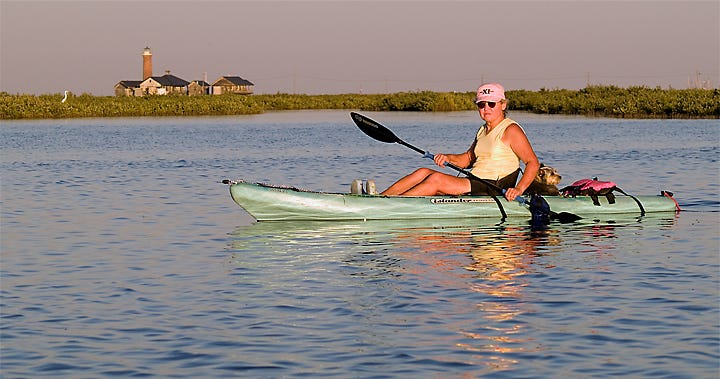
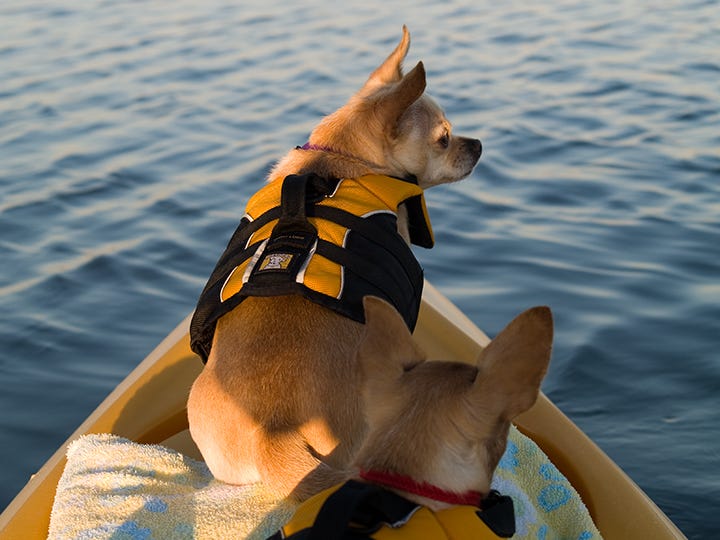
At some point we realized that the sun was starting to set, so we decided it was time to head out. We turned our kayaks around and started to backtrack our movements.
Or so we thought.
In our excitement, we had lost track of which trails and turns we had taken and got totally turned around. Try as we might, we could not find one of the few cuts that would allow us to exit the wetlands, cross back over the ship channel, and get back to the mainland.
Because Carol had been kayak fishing in these waters many times before, I trusted that she had a good sense of where we were. She was in the lead kayak, and I’d hear her shout out, “OK, here we are. This is it, we’re good.” And not 10 seconds later I would hear: “Damn!”
At some point, I realized, Oh my God, she’s lost, too!
Panic started to set in pretty quickly for me, because the sun was below the horizon now, and all we had was its residual glow to navigate by. We started to paddle more and more frantically in every direction, trying to find our way out. All we could see for sure is that we were either moving toward, or away from, that lighthouse. We were getting quickly worn out by all the unexpected paddling, worry, and confusion, and the fact that neither of us had eaten since lunchtime that day.
To our horror, we lost the final glow of daylight. I finally said what needed to be said. “Carol, we are screwed. We are not getting out of here tonight.”
After a brief pause, I watched her shoulders slump as she replied, “You’re right. We are screwed. I’m so sorry.” She felt responsible and mortified, because not only was she the more experienced kayaker, she also was a certified kayak and safety instructor.
Reality slowly sank in for both of us, that we were not getting home that night, and we had to figure out a way to spend the night in those kayaks. In late September, the sun was usually setting between 7:15 and 7:30 p.m., so it must have been around 7:45 p.m. when we finally lost all daylight.
We took inventory of what we had with us and made a game plan. We had: one whistle, my 35-mm camera and flash, binoculars, a bit of rope, about a cup of water each in our bottles, and a towel that my dogs were sitting on, which by now was soaking wet. We came up with one ground rule: we don’t make any move that we don’t both agree on. From here on out we had to operate as a team.
We took the bit of rope she had and tied the back end of her kayak to the front end of mine so we wouldn’t get separated in the night, and we agreed to try to anchor in one place. I said, “Carol, if I learned anything in all my years of being in the Sierra Club, it was this: when you are lost, you park it. Don’t expend your last energy reserves trying to get yourself out of a bind. It’s much harder to find a moving target than a stationary one.” So we tried to anchor ourselves in the mud with our paddles in the largest finger lake we could find, our reasoning being that it would be the most likely place to encounter a fishing boat in the morning.
For about the first 2 hours of darkness, we blew our freaking brains out on that whistle every time we thought we heard a powerboat or an air boat. I remembered that my camera had a strobe effect on the flash, so we also tried signaling with that.
Nothing. No response. No one was coming.
When blowing the whistle was starting to give both of us a headache and we figured it must be close to 10 p.m., we gave up on trying to signal to anyone.
We had broken safety rule no. 1: we had failed to give a “flight plan” to anyone, so no one knew for certain where we were, when we should be expected back, and what to do if we did not return. Carol was single but dating no one and lived alone, so no one would be expecting her home. I lived alone and was dating Sam, and had told him I was going kayaking with Carol, but did I tell him we were going to Lighthouse Lakes? I thought I did. He’d be expecting me to call once I got home, as we got together every night.
I reassured Carol multiple times, “Listen, Sam is going to wonder why I haven’t made it home—why he hasn’t heard from me. We get together every night. He’ll know something’s up. He’ll do something.”
“But,” she asked, “does he know we’re here? At Lighthouse Lakes?”
“I’m pretty sure I told him.” That’s what I told her. But inside, I wasn’t so sure.
We berated ourselves over and over for acting like such amateurs—we knew better than this! We knew what to do, what safety and emergency gear to take with us, how to file a plan with someone, and we ignored it all. We left our cell phones in the car, for God’s sake! After all, we were only going out for an hour or so, right? But complacency got the better of us.
Once I realized we weren’t going anywhere for the night, I told myself, You’re just going to have to suck it up, buttercup. Get through this the best you can. We kept our spirits up during the night by talking nonstop. I suggested a game I reserve for long and boring car trips: you can ask me any question you want and I have to answer honestly. Then I get to ask the same of you. For example:
“What’s the thing you are most proud of?”
“What’s the thing you are most ashamed of?”
“How old were you when you first had sex?”
“How long has it been since you’ve had sex?”
“Have you ever stolen anything?”
“Tell me about an unrequited love.”
“What is your biggest disappointment in life?”
“If you could have a do-over, what would that be?”
“Have you ever had a threesome?”
“Where do you want to travel to before you die?”
When we got tired of talking about ourselves, we moved onto other matters. After all, we had many hours to kill. We discussed the new Obama presidency. We discussed the environmental disaster that had been on everyone’s mind all summer—the Deepwater Horizon well blowout that had been spewing oil nonstop into the Gulf.1 And, “So…what do you think? Did OJ do it?”
We also tried to put a positive spin on the situation, to think about ways in which this could be so much worse (no alligators in these waters! haven’t seen a snake yet! no weirdos out here! at least it’s not storming! neither of us are injured!). We even laughed a lot.
At one point, in a moment of despair, I heard Carol’s voice wail out, “Gail, you’re a scientist, right? How does the moon work?”
I burst out laughing. “What?! Are you fricking kidding me? What do you mean, ‘how does the moon work’?”
“I mean, it’s way up there in the sky, plain as can be. When it’s at a certain point in the sky, can you tell what time it is by the moon? I’m just really wishing I knew what time it is right now.”
I’m still cracking up. “Carol, I have no earthly idea what time it is. It’s been a hell of a long time since I thought about that, but I think you have to know what phase the moon is in, to calculate that. And trust me, I’m no astronomer.”
Eventually, the mosquitos started to attack. As I said earlier, the area had recently received a lot of rain and the mosquitos were ferocious. We were both in sleeveless tops and shorts, so they had lots of munching ground. I had the dog’s wet towel with me and tried to cover my legs with that, but soon I started to shiver and I worried about hypothermia, so I decided letting the mosquitos have their way with me was the lesser of two evils. The dogs were also tormented by the mosquitos. Rhoda and Frida would lunge at them, trying to catch them in their mouths, which made the kayak rock wildly. The only thing that would make this night worse, I thought, was if the dogs cause us to capsize. Keeping them under control was a fight all night long. They too were all wet and starting to shiver, so I had to hold them tightly in my lap so they could get some of my body warmth.
Then, of course, there was that. At some point, we all had to pee. There was no getting around it. What does one do? When you can’t get out of the kayak because there are no landing places and you don’t dare step out anyway because the mud underneath can be treacherous…you just have to go. In your kayak. The worst indignity of all was holding the pups on my lap and all of a sudden realizing, “Oh my God, Carol, Rhoda just peed on me.” When she looked up at me pitifully, it was the only time in my life I couldn’t be mad at her for doing such a thing.
Slowly, finally, we convinced ourselves that the horizon was getting lighter and the sun must be coming up. Carol had been reassuring me all night long, saying “Don’t worry. We will get out of this. There will be fishermen early in the morning. We just have to find that first boat.” Sure enough, she was right. As soon as we had enough light to see by, we started paddling frantically in the direction of the first motorboat we heard, hoping to cross paths with them and get some help. But they kept going without seeing us.
Soon after we saw two kayak fishermen in the distance and signaled them with our whistle and flailing our arms in the air. Obviously, this wasn’t normal behavior for the kayaking set, so they stopped and waited for us to see what was up. When we caught up with them and told them we’d been lost out there all night long, and could they please point us in the direction of one of the main channel cuts, they were incredulous. “All night? No cell phone or GPS? No map? How was that possible?”
Our grim and exhausted faces must have answered their questions, because they quit asking and pointed us toward the direction out. As it turned out, we weren’t that far from the wetlands exit, but in the pitch darkness we just couldn’t see it.
We crossed back over the ship channel and paddled ashore to where our cars were parked. I’ve never been so glad to see a stretch of beach in my entire life. When we tried to stand up and get out of the kayaks, at first we couldn’t straighten our legs and fell back into the water. After about 15 hours in a cramped, sitting position, where we couldn’t stand up or even change positions, our leg muscles seemed to have atrophied.
I staggered around the beach like someone three sheets to the wind as I unloaded my gear and tried to stow my kayak on my car carrier. We met up with some fishermen on the beach just setting out for the day who couldn’t believe what they saw: two women covered in mosquito welts, wild salty hair, reeking of pee, stumbling around, and three frantic dogs. What a sight we must have been! We were so weak that they helped us load our kayaks onto our vehicles and were probably quite worried that we intended to get behind the wheel and drive.
While I was able to drive straight home, get something to eat, take a shower, and get a few hour’s sleep, Carol had a dental appointment down in Mexico that very day, a 3-hour’s drive. I could not persuade her to call and reschedule that appointment. She went home, showered, and hit the highway after the night we’d had. She admitted to me later that she had to pull over a few times as she almost fell asleep at the wheel.
When I got ahold of Sam later that day and told him what happened, he was dumbfounded. As was I, when I found out that he never came over the night before, never called, never had any idea that I didn’t make it home. All out of character for our usual routine. I was half upset with him for not coming to my rescue, knowing full well that he probably had no idea where we were and couldn’t have done anything anyway.
When I asked, “So, what did you think when you didn’t hear from me when I got home?”
He said, “Well, I guess I thought you two went out to dinner afterward like you always do. And got to talking, and it got late. I figured you got home too late and you were too tired to call.”
It sounded so rational, from his point of view. No reason to panic. Sam was the most responsible guy I knew—I knew if he had even a whiff of something being off, he would have jumped into action.
There was just a small part of me that wanted someone to be a little bit worried about me, and not be completely clueless that the night had gone so horribly wrong. Irrational, I knew, but there it was.
Up next: Chapter 15. For Sale, the Third, and Three Losses
To catch up on the backstory of A Buzz Kill Named Harvey, read Art and Artifice: A Memoir—A Story of Love, Deception, and Healing on the Texas Gulf Coast
Comments
Nothing yet. Say the first thing.
Sign in to join the conversation.