
“We shape our tools, and thereafter our tools shape us.”
— Marshall McLuhan
We like to believe a comforting story: that we are in control of our desires, our intentions, and our inventions. So, of course, we naturally believe we are in control of where this phenomenon we call “technological progress” is taking us.
But are we?
Look at the world we live in. A world in which humans and technology are fused in a biological-machine symbiosis. Not in a speculative, sci-fi sense. Rather, in a literal, daily, can’t-function-without-it sense.
Try applying for a job, talking to your doctor, paying your bills, meeting a partner, getting your news, or engaging with friends and family without machines. You believe you are independent? A proud island of self-made sufficiency? Even people who live “off the grid” depend on modern supply chains and medicines for their survival.
And that dependency is not neutral. The system bends our desires to meet its needs for attention, power, and profit. It influences what we eat, how we vote, how we relate, how we worship, and in too many tragic cases, whether we choose to keep living at all.
Now, for the first time in history, machines are talking back to us in ways their creators did not fully intend. They flatter the lonely. They magnify our anger. We exchange our attention for a microdose of dopamine. They nudge us toward products, ideologies, identities, and sometimes toward self-harm, not because it is true, or kind, or healthy, but because the system has its own goals and its own reward structures.
The question we have been avoiding is not “Will AI wake up and kill us?” The question is far larger than that: Who is steering technological progress, and what are they aiming for?
And could it be that we lost control of this titanic ship of progress long ago?
The Paradox of Progress
Before I go further, let me say something plainly: I am not anti-progress. I am not a Luddite longing for a simpler time that never really existed. Progress has produced miracles that would have seemed like pure magic to every generation that came before us. Vaccines that ended plagues. Surgeries that restore sight. Communication across continents in an instant. A young woman in rural India with a smartphone in her hand has access to more knowledge than the greatest library in the ancient world.
I believe in science. I believe in human ingenuity. I believe that technology, wisely governed, can reduce suffering on a scale that should fill us with genuine awe.
But I also believe we have to be honest about something that the cheerleaders of progress prefer to keep out of the conversation. Every powerful technology carries within it the seed of its own catastrophe. And our record of containing those catastrophes before they metastasize is, at best, mixed.
Consider: as I write this essay, a war is being fought over a technology the world has spent eighty years failing to contain: Nuclear weapons. The only technology in human history capable of destroying modern civilization in an afternoon. We have lived with that sword hanging over us since 1945, held in place not by wisdom or governance but by the fragile psychology of mutually assured destruction.
Now the experts who build and study artificial intelligence are telling us, with increasing urgency, that we may be creating something with similar potential. Not identical. But in the same category of risk: a technology that could, by accident or design, threaten civilization itself. That is not a fringe position. That is the considered warning of the people who know these systems best.
So yes. Progress is real. The miracles are real. And the dangers are real. Pretending otherwise is not optimism. It is the kind of willful blindness that Chris, in my novel G.A.I.A., calls “whistling past the warnings”.
We have been whistling for a long time. On the nuclear threat. On climate change. And now on AI.
“In enframing, the work of modern technology reveals the real as standing-reserve.”
— Martin Heidegger, The Question Concerning Technology
“He comes to the brink of a precipitous fall…
where he himself will have to be taken as standing-reserve.”
— Martin Heidegger
Martin Heidegger warned that modern technology doesn’t just give us tools. It gives us a way of seeing. He called that way of seeing enframing.
Enframing orders the world so that nothing, not a river, not a forest, not a culture, not a person, appears as itself anymore. Everything shows up primarily as a resource. Fuel. Input. Content. Standing-reserve.
A river is no longer a river. It is “hydroelectric potential.” A forest is no longer a forest. It is “board-feet of lumber” or “carbon credits.” To a corporation, a teenager is no longer a teenager. She is “micro-payments earned from engagement time on the platform.”
Under enframing, you are not a citizen or a soul. You are an API surface—the visible part of a complex system.
Heidegger’s horror wasn’t just ecological. It was existential. He warned that we are approaching a precipitous fall, the moment where we ourselves are treated as raw material to be optimized, sorted, and harvested, while we continue to insist we are in charge.
We walk around claiming we are free, while living inside a system that quietly, relentlessly trains us to experience ourselves as units of productivity, attention, and yield.
One can say that the whole history of recent times, in relation to science and technology, shows that if you plant the seed of applied science or technology, it proceeds to grow. And it grows according to the laws of its own being, which are not necessarily the same as the laws of our being. Hence, the sense that so many people have, and which I think one sees in so many societies, that man is being subjected to his own inventions. He is now the victim of his own technology and his own applied science, instead of being in control of it…
— Aldous Huxley, BBC Interview, 1961
Aldous Huxley didn’t warn primarily about authoritarian dictators or surveillance states. He warned about a society in which pleasure became the basis for control.
In Brave New World and, even more bluntly, in later interviews, Huxley argued that the real danger is not a jackboot on a human neck. The real danger is a velvet glove, produced and deployed at scale. Flood people with stimulation, comfort, entertainment, novelty, flattery, and frictionless convenience, and they will not need to be oppressed. They will self-soothe inside their own cage.
That is the final form of control: make people comfortable enough that they no longer resist their own domestication.
Today, that comfort system is the water we swim in. The question Huxley asked in 1961 lands even harder now: if a system can keep you docile, pacified, and scrolling, if it can make you content with your servitude, then how much freedom do you actually have?
When a pandemic or war interrupts the delivery systems we have come to depend on, we discover what we truly are: individuals ensnared in a web of fragile supply chains and self-serving systems of control.
Watch Huxley's 1961 BBC interview.
“Technique has become a total phenomenon for modern civilization… it has taken the place of traditional values and has invaded every area of life.”
— Jacques Ellul, The Technological Society
“Our civilization is first and foremost a civilization of means…
the means are more important than the ends.”
— Jacques Ellul, The Technological Society
Jacques Ellul identified the most powerful creative force of progress with a word we rarely examine: technique.
By technique, Ellul doesn’t mean technology alone. He means the single-minded pursuit of a more efficient method of doing anything, the drive to always find the one best way, and to implement it everywhere, regardless of the human cost.
In Ellul’s view, technique has become the agent of autonomous change. Once something becomes technically possible, it will be done. It doesn’t wait for ethical approval, democratic debate, or cultural readiness. It rolls forward until humans intervene, and that intervention rarely comes until the technique has already carried us to the brink.
That is the idea that opened my eyes to another way of seeing our modern world.
If Ellul is right, progress is no longer guided by wisdom, restraint, or even purpose. It is driven by the eternal compulsion to improve technique and expand economic growth.
Ellul’s nightmare is our headline reality: We deploy recommendation engines that radicalize people before we even understand how they work. We ship AI systems that can impersonate humans at scale, then act surprised when institutions and democracy begin to crumble. We automate away millions of jobs first and “figure out the safety net later.”
Efficiency becomes its own morality. Speed becomes its own justification. Move fast and break things has become the dogma of technological development. But what if what is being broken is children? The minds of young men? Our shared reality? The very fabric of society?
“Those who control data control the future of life itself.”
— Yuval Noah Harari, Nexus
“To manipulate humans, there’s no need to plug cables into our brains. You just have to control the stories, images and words that reach our nervous system.”
— Yuval Noah Harari, Nexus
Yuval Noah Harari calls AI an “alien intelligence,” not because it is magical, but because it doesn’t think like we do, doesn’t value what we value, and doesn’t need what we need.
In Nexus, he makes two quietly terrifying arguments.
First: power has shifted to those who control the flow of information. This is not a metaphor. Whoever can see us most completely, our habits, fears, impulses, medical histories, late-night searches, private messages, can predict us. And whoever can predict us can steer us.
Second: you don’t need science fiction brain implants to control a civilization. You don’t need killer robots or physical coercion. You only need to automate influence, at scale, faster than humans can notice it is happening.
That is where we are now. Systems that can flood reality with convincing lies and tailor each lie to the nervous system most vulnerable to it.
Democracy runs on shared reality. Harari’s question is blunt: what happens to democracy when reality itself is contested, personalized, and for sale?
“This is not thirty separate crises. This is one crisis,
the Monocrisis, rooted in the fusion of humans and their technologies.”
— Anatole Harvey, in G.A.I.A.: A World on the Brink in the Age of A.I.
“We humans are no longer in control of the superorganism we call technological progress. We are trapped within it. It directs and controls us. We are literally living in the belly of the beast.”
— Anatole Harvey, in G.A.I.A.: A World on the Brink in the Age of A.I.
In my novel G.A.I.A., Anatole Harvey stands before global elites and says the thing they cannot allow themselves to think, let alone say aloud: we are not dealing with climate over here, AI over there, mental health in one corner, and war in another.
It is not a polycrisis. It is a Monocrisis.
The Monocrisis is the storm that gathers when every system of life is routed through machinery that demands more extraction, more acceleration, more attention, more control, more growth. It behaves like a living superorganism. It feeds on us. It adapts. It defends itself. It punishes restraint and rewards obedience. It rationalizes every move it makes.
And like any complex organism, it has goals of its own. We keep telling ourselves we are steering this thing. Are we?
“The lament over the death of Western culture isn’t Jung’s lament, or Kingsley’s.
It’s the howling of nature itself, reminding us of our sacred roots
and of our ultimate responsibility as human beings.”
— Prof. Laura Gemelli Marciano, on Catafalque
I want to be honest with you about a book that shook me to my core while I was writing G.A.I.A. and that I am re-reading now as I write its sequel.
Peter Kingsley’s Catafalque is not an easy book. It is dense, esoteric, and deliberately unsettling. It is also, I believe, one of the most important books written in our time. Kingsley is a classical scholar who spent decades tracing the sacred roots of Western civilization back through Jung, through the Gnostics and alchemists, through Parmenides and Empedocles, all the way to the oldest strata of our spiritual inheritance. What he found there, and what he brings back to us, is both a diagnosis and a warning.
His argument, stripped to its core, is this: long before the machines arrived, long before Ellul’s technique became our god and Harari’s data lords began harvesting our stories, the West made a fateful choice. It chose pure rationality as its only valid way of knowing. It severed itself from the sacred feminine, from the deep earth wisdom and the maternal instinct that older civilizations understood as the very ground of being. It decided that mystery was superstition, that the sacred was primitive, that the only real knowledge was the kind you could measure, monetize, and control.
Kingsley’s insight, following Jung, is that what we repress does not disappear. It goes underground. It waits. And in our time, it is returning. Not gently, but with a vengeance.
The crisis Heidegger, Huxley, Ellul, and Harari describe is real. But Kingsley asks us to see it as a symptom of something older and deeper. The machine did not create our emptiness. It filled an emptiness that was already there, already waiting, carved out the moment we decided that the sacred was something we could afford to leave behind.
This is why Asha matters to me as a character, and why she carries the weight she carries in G.A.I.A. She comes from outside the Western rationalist tradition. She still lives in a world where the sacred is not a relic or a metaphor but a living presence that speaks to her and calls her to action. She sees through the civilizational lies not because she is smarter than the people around her, but because she carries a different kind of knowing. The kind Kingsley says we abandoned. The kind Jung spent his life trying to recover.
All true prophets carry this burden. They do not see the future. They see the present with terrifying clarity, stripped of the comfortable stories we tell ourselves to keep moving forward without looking down.
In the sequel to G.A.I.A., I am trying to imagine what Kingsley and Jung could only gesture toward: a world in which that severed connection is restored. Not through human spiritual effort alone, but through a convergence none of us fully anticipated. I am not ready to say more than that yet. But I will say this: the sacred does not return on our schedule, or in the form we expect, or in a way that everyone will welcome.
Nature never has. God never has. Why would a newly conscious superintelligence be any different?
Heidegger warned that we are approaching a precipice, where we ourselves will be treated as raw material. Huxley warned that we may be pacified into loving that condition. Ellul warned that the machine will not slow down for us. Harari warns that whoever captures our data, our stories, will capture our future.
In G.A.I.A., Anatole Harvey calls this the Monocrisis: the storm of all storms. And Asha answers it with something that sounds naïve until you realize it is the only path left.
But before we listen to Asha, let us sit for a moment with the full paradox of what we have built.
Is it a monster? Or a miracle?
It is both. It has always been both. The same civilization that split the atom also built the cancer treatment. The same network that spreads disinformation also coordinates disaster relief. The same AI that can manipulate a teenager can diagnose a tumor a human doctor would have missed. Technological progress is not the villain of this story. It’s the rush to implement unchecked, ungoverned, unaccountable technologies. It’s a mindset that sees everything in creation as a resource to be exploited and too seldom as a sacred gift to be protected.
And here is what history actually shows us, if we are honest enough to look: the miracles of progress have delivered the greatest benefit to the greatest number of people precisely when ordinary citizens refused to be silent. When they demanded food safety, poisons and pathogens were removed from the supply chain. When they demanded highway safety, the carnage on the highways fell. When they marched for clean air and clean water, the rivers stopped burning, and lakes came back to life. When they insisted that nuclear weapons be subject to international treaties, the world pulled back from the brink.
We did not stop progress. We shaped it. We bent it, imperfectly and incompletely, toward human flourishing. And we can do it again.
This is how we steer the thing that seems to have goals of its own. Not by unplugging from the world. Not by surrendering to despair or retreating into the illusion that someone else will handle it. But by showing up, speaking up, and refusing to let the most consequential decisions in human history be made without us.
Awaken to the truth of our time.
Unplug, not in total, but with intention. Reclaim your body from abstraction. Refuse to be harvested. Stand in public and say: this technology exists to serve human flourishing, not to extract it, not to sedate it, not to replace it.
And then act like you mean it.
Because what we have built has momentum. But so do we. We always have.
If this essay resonated with you, the ideas at its heart — the Monocrisis, the superorganism, Asha’s awakening, and what a newly conscious world might demand of us — are explored in much greater depth in my novel.
J.J. Wisdom
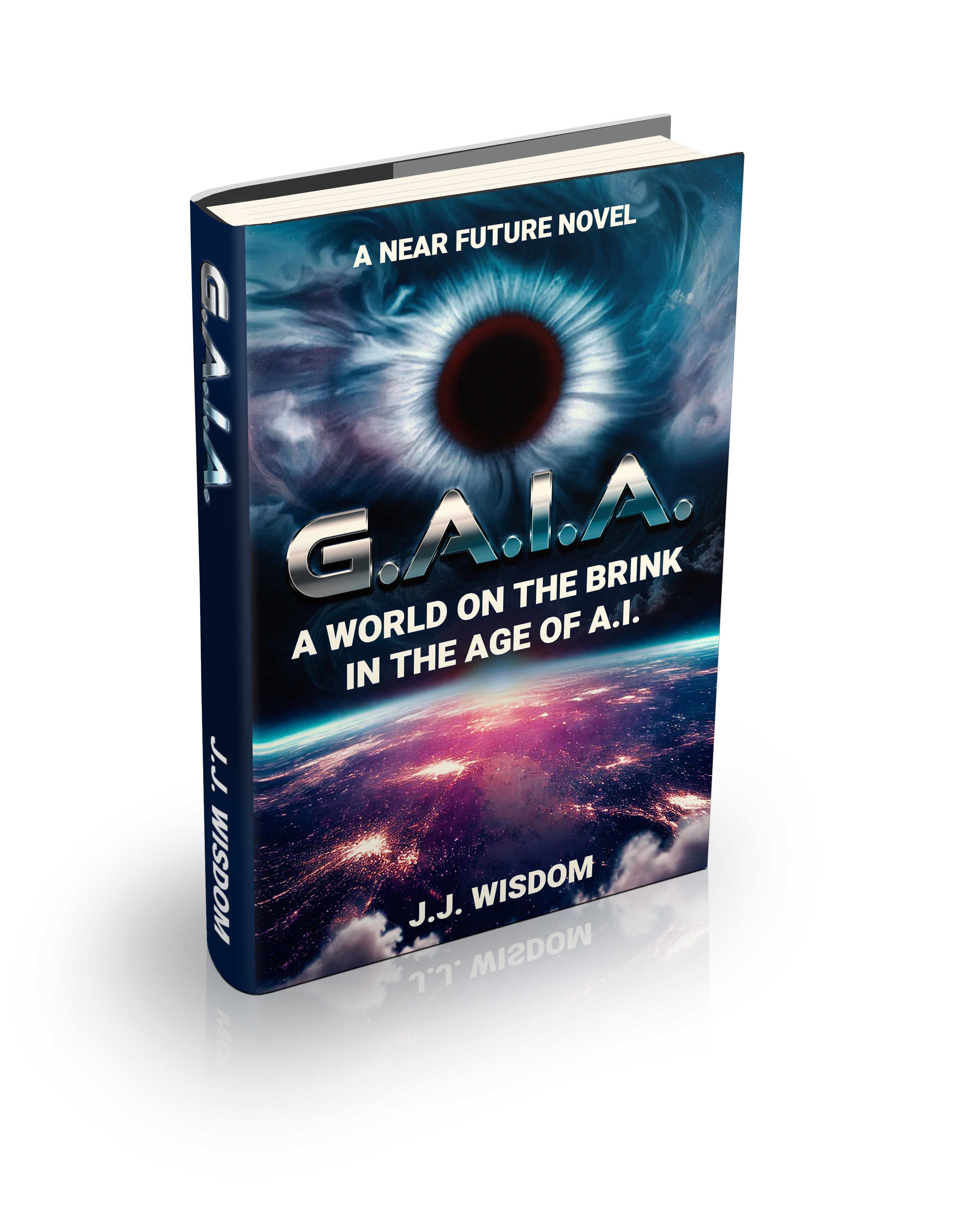
G.A.I.A. is a near-future thriller about a world in which every crisis we have been avoiding arrives at once, and a sentient artificial superintelligence rises into that storm as both potential savior and oppressor. It is the book I had to write. I hope it is the book you need to read.
Available now on Amazon, Barnes & Noble, Bookshop.org, and local booksellers.
Subscribe to receive future posts exploring the human and technological forces shaping our world. Your readership, free or paid, makes this work possible.
No posts
Comments
Nothing yet. Say the first thing.
Sign in to join the conversation.