
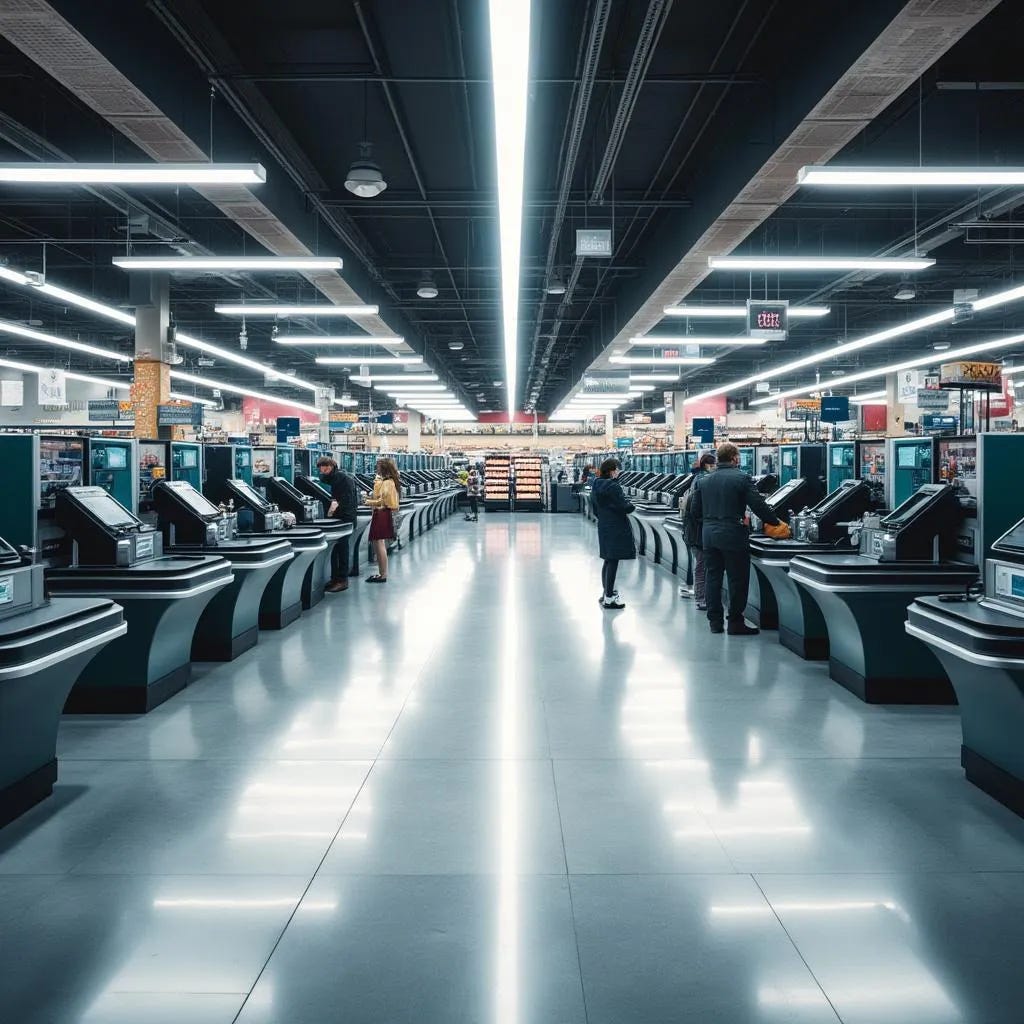
One of my first experiences with self-checkout was in an airport store. I was buying water for a flight. I realized there was no employee at the register. I was supposed to check out myself.
I scanned my bottle. After I did, the register gave me an option to tip. I looked around. Still no one. Was I supposed to tip myself?
Self-checkout is becoming more common in drug stores and supermarkets. Stores urge you so self-checkout to save time wating in line.
Legally Restricting Self-Checkout
A new Massachusetts bill proposes to limit the number of self-checkout stations in every store. The goal is to make sure there are sufficient checkout stations operated by store clerks.
Why? The law’s sponsor, State Senator Paul Feeney, cites two reasons. First, older people find self-checkout difficult and frustrating. Second, preserving the jobs of store clerks whom the self-checkout stations would substitute.
I think this is an innovative and important law. But not just for the reasons cited. I actually think this law is important for an even more crucial reason.
Chipping Further at Human Interactions
Since 2010, we have been spending much more time on screens instead of interacting in person. This was the year smartphones and social media became popular. We started burying our faces in our phones everywhere we went. We became less likely to talk or even notice a person standing next to us in line or on a train.
Self-checkout chips away at another area of human interaction. It further decreases the number of people we see and speak to as we go about our day. Checking out with a cashier requires us to exchange a few words or even a smile. If we self-check-out, we are very likely to go in and out of the store without speaking to anyone.
And, yes, each of these sales’ related interactions is brief. But they add up. These are not deep friendships. They are micro-connections. An eye contact. A “how’s your day?” A moment of human recognition.
The Cost of Loneliness
Losing these interactions one self-checkout at a time makes us lonelier. Loneliness is not just about long-term relationships. It is also about the social isolation and the absence of short-term interactions.
Loneliness extracts a huge toll. The US Surgeon General’s 2023 report about loneliness described the impact on longevity, physical and mental health. Here are some highlights.
· Loneliness increases the risk of premature death by 26%. In fact, lacking social connection can increase the risk for premature death as much as smoking up to 15 cigarettes a day.
· Loneliness increases the risk of disease. For example, a 29% increased risk of heart disease and a 32% increased risk of stroke.
· Loneliness also increases the risk for anxiety, depression, and dementia.
Taking this data into account, the Massachusetts bill is particularly important. By restricting the number of self-checkout stations, it impacts loneliness, which is a public health issue. Importantly, it does so at a time when we can still intervene -- when the window of opportunity to prevent a technology’s use in a certain way is still open.
Right now, most stores still have both options: human cashiers and self-checkout. But the balance is shifting. More self-checkout stations. Fewer staffed lanes. Longer waits if you want a human cashier. We may soon not have a choice.
Kids and the Skill of Casual Interactions
Once again, those who are likely pay the highest price are our children. They already have. Ample data shows the impact of screens, gaming platforms and social media on Generation Z’s mental health. They are also already lonelier than previous generations.
Kids already prefer messaging. They are often uncomfortable with in-person conversations. But what happens if this goes further? If we make a choice that seems casual and efficient? If we shift toward a world where self-check-out dominates?
Kids then have fewer casual interactions. Engaging in these interactions becomes harder and more awkward because they lack practice. They may try to avoid these conversations in other situations. This creates a reinforcing cycle.
Regulating for Human Connection
We create our technologies in our image. We have changed since 2010. Our technologies reflect this change and now take the turn away from human contact a step further.
To stop this before it is too late, we need laws like the Massachusetts bill. This is not about a small thing – how we pay when we finish shopping. It is about a much bigger thing.
To encourage these laws, we need to highlight why they are crucial. This is not just about preserving jobs or helping older people navigate technology. It is about loneliness and public health. Ours, and to a larger extent, our children’s.
No posts
Comments
Nothing yet. Say the first thing.
Sign in to join the conversation.