
I spend a lot of time researching AI bots. There's an occupational hazard here. The more you research, the more you use them.
Within weeks, I found myself turning to ChatGPT and other LLMs to find quick answers for things I used to carefully research and evaluate.
It began when I needed a tablet that would work best with my academic research tool. That made sense. I had no comparative advantage here. I needed expert help.
But then, I turned to AI to research something I am actually discerning about – selecting a hotel for a business trip. Instead of scrolling through TripAdvisor, I prompted my preferences, got choices, and didn't look further.
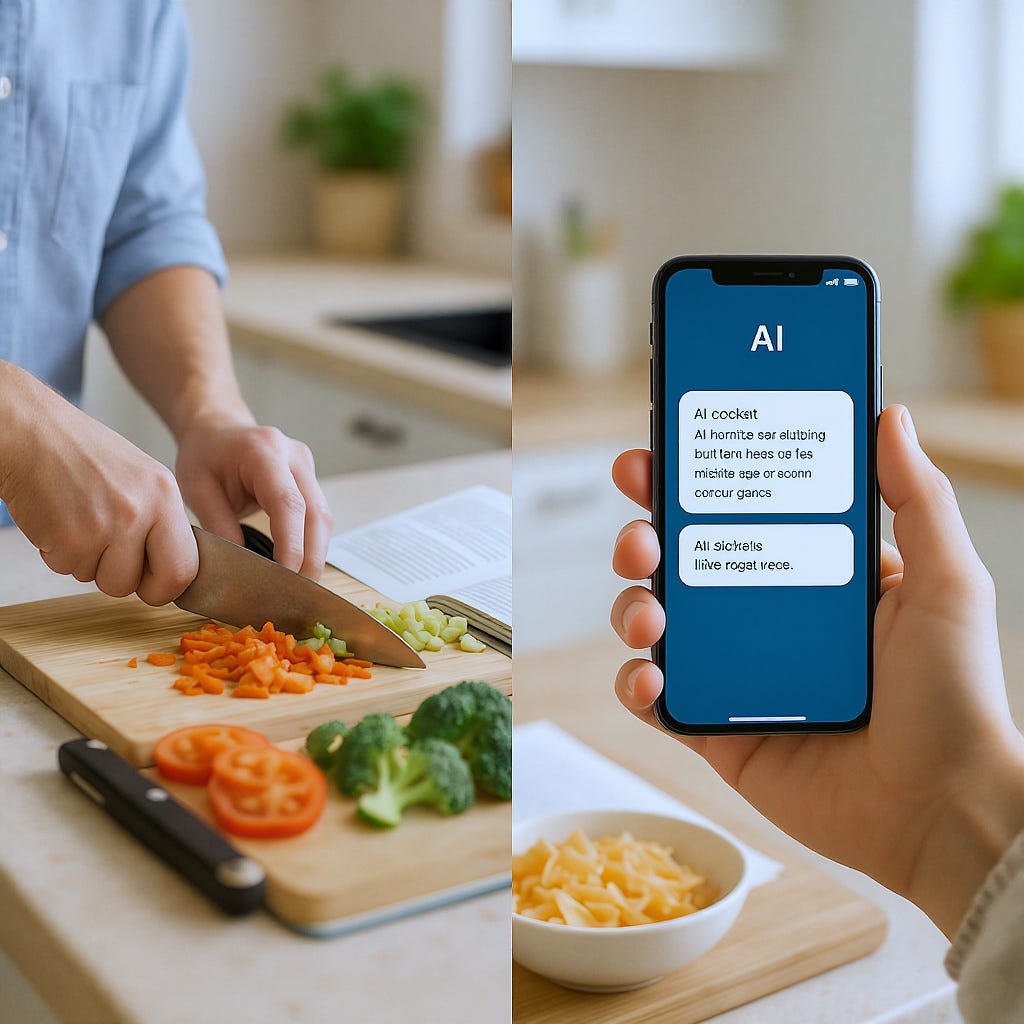
Finally, I crossed a line. I asked AI to help with something I actually enjoy researching – food recipes.
I like having some ingredients to use up. I enjoy looking at different recipes and their reviews. I like combining them into a recipe I can use. That day I wanted to make Asian chicken stir-fry. Instead of my usual process, I asked ChatGPT to figure it out. It produced one recipe, which I used.
All this definitely means I am saving time. It also means I am less likely to ask trusted friends for recommendations.
So, what about the results?
I am not sure about the tablet. I didn't find it very intuitive. I’m still annoyed with myself for buying it. Could I have done better with my own research? I don't know.
The hotel is yet to be determined.
But I do know about the recipe. It was mediocre. It skipped important steps. Luckily, my resourceful teen daughter improved the result.
Many of the seemingly small choices we make these days are much greater than they seem.
I know my relative advantage at doing certain things. I can see the cost-benefit analysis of trading quality for ease in some cases. But what if I keep opting for efficiency? A year from now, will I recall exactly what I gave up? Even more distressing: Will I still be as good at doing these things myself?
This question is personal. It's also social.
Recent studies show how handing tasks to AI makes us worse at them. Sometimes it doesn't take so long.
Research published in The Lancet found something disturbing. Over six months, clinicians performing colonoscopies became over-reliant on AI recommendations. They became "less motivated, less focused, and less responsible when making cognitive decisions without AI assistance."
An MIT Media Lab study on essay writing found similar results. ChatGPT users consistently underperformed non-users at neural, linguistic, and behavioral levels. The researchers warned about long-term educational implications.
This has happened to all of us – especially kids.
Kids spend hours on devices at home. They get together much less. They are uncomfortable making face-to-face conversation. For some, engaging in conversation, is like going to the gym. It requires willpower. It no longer comes naturally.
When we lose any part of our human skills, whether social, cognitive, or analytical, it requires significant willpower to regain them. It becomes much harder when our lives are structured around technologies that incentivize us not to do so.
Think about a bag of chips. How easy is it not to eat it, when it is sitting right next to you in a long car ride.
The tech industry is adept at exacerbating the willpower problem.
When whistleblowers revealed that the tech industry addicted people to screens, tech companies responded that users could make the choice. It was about their willpower.
Tech companies up with self-help tools, like Apple Screen Time and Instagram time notifications to get off Instagram. If we failed, it was because we lacked willpower.
Unsurprisingly, none of these tools helped because tech companies never changed the addictive designs.
AI companies are reacting to criticisms that students using tools like ChatGPT won’t develop cognitive and writing skills. They’re using the same strategy.
OpenAI created Study Mode. It supposedly lets students work through problems step by step instead of getting direct answers.
But, as Rebecca Winthrop, Director of the Center for Universal Education at Brookings Institution, describes: ChatGPT Study Mode still did most of the work, but declared that the student did it.
History repeats itself. Companies offer unhelpful solutions to address a problem they don't really want to solve.
Did Apple Screen Time reduce your iPhone usage? Did Instagram notifications get your kids to limit their time? Probably not.
AI companies will say it's about willpower. After all, we're choosing what to use AI for. They'll give us tools they claim will help us exercise willpower.
But we shouldn't lose track of the biggest danger.
If we fall into this trap, by the time we wake up, we may not possess the skills required to do the task ourselves. Our children definitely won't.
Choice at that point will be futile.
No posts
Comments
Nothing yet. Say the first thing.
Sign in to join the conversation.