
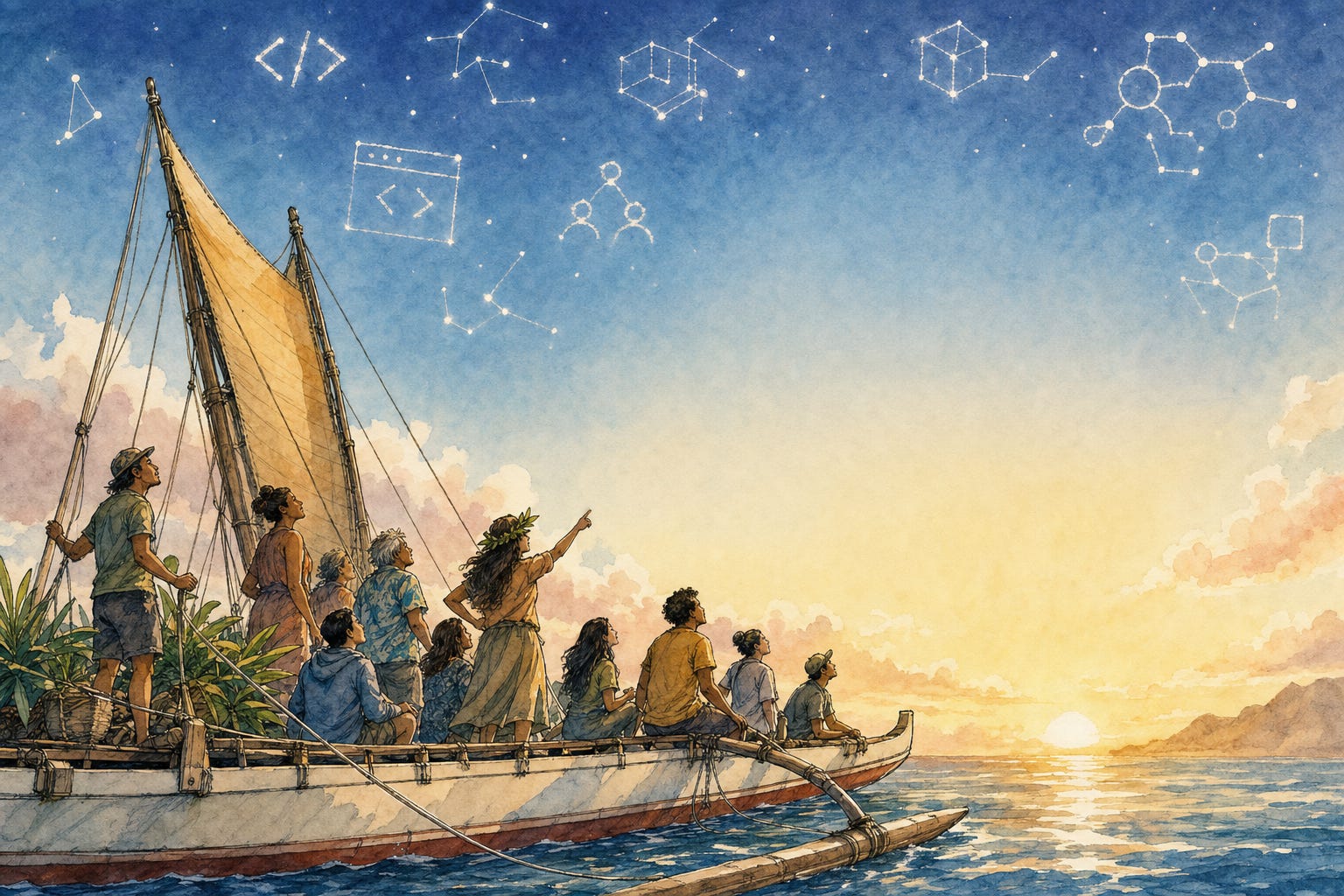
There is a moment before every voyage when the canoe is still on shore. You can feel the wind changing and see the horizon pulling at you, but the map is not finished yet. That is what this moment in AI feels like: the destination is not fully visible, the tools are changing in our hands, and the people willing to learn early are the ones who will help shape the routes others eventually follow.
I felt that in the room at Turn Work Into Agents, a hands-on workshop about AI agents and OpenAI Codex. I was there as an student, trying to understand what this next wave of agentic AI actually means in practice. I’ve explored Claude Code and build many Google Gemini Gems. but like with everything in AI, keeping up with new developments feels like a neverending sprint. Like many people in the room, I came in curious, excited, and aware that we are still extremely early.
Then I ended up becoming the audience volunteer.
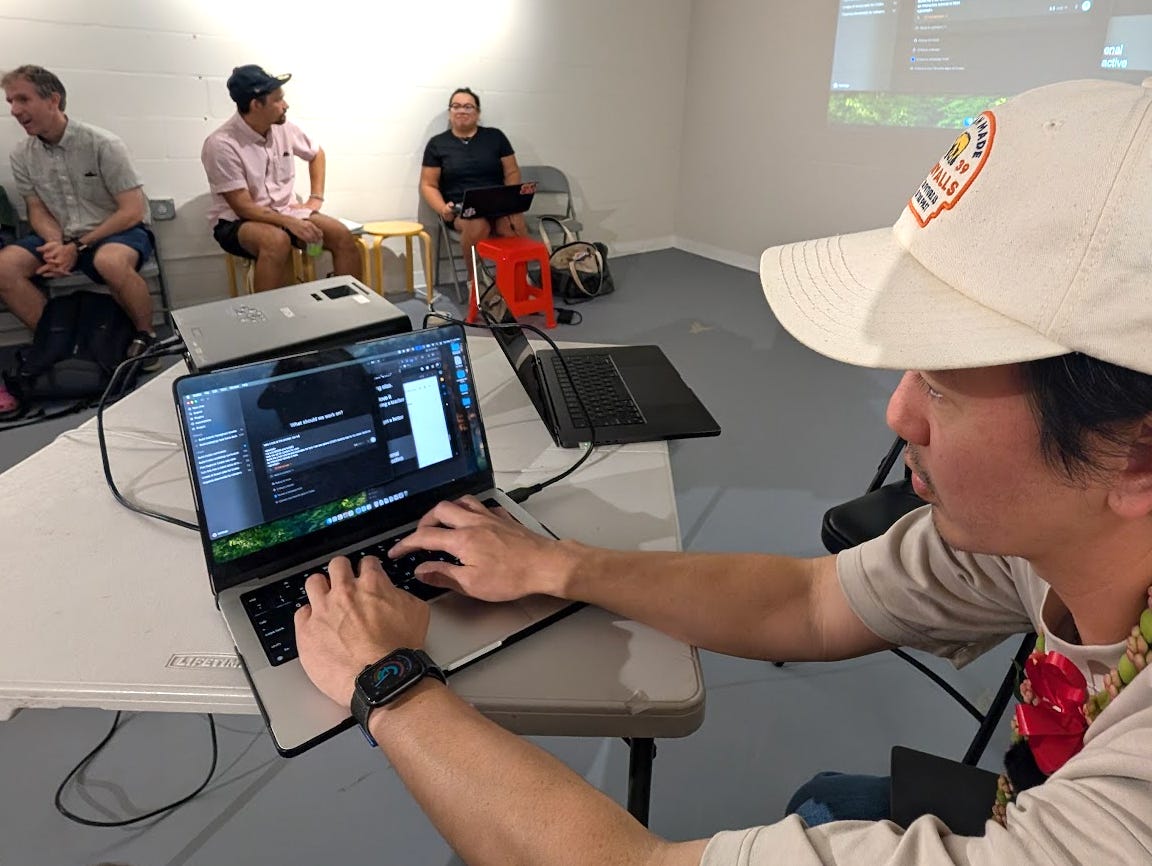
In front of the room, Ray Fernando and Tyler Nishida helped me use Codex to tackle a simulated problem from my own work: building a six-month curriculum and lesson plan for teaching students how to use agentic AI and OpenAI Codex. In about ten minutes, Codex helped generate a full teacher resource of over 100 pages and files: learning outcomes, lesson plans, schedules, power point presentations for each lesson, activities, assessments, and the structure I would need to begin teaching this seriously.
It was a working map. I can now run through it, edit it, test it with students, improve the sequence, add my own examples, align it more deeply to my classroom, and make it real. But those ten minutes kicked me ahead by more than a month of work. They also gave me a much deeper understanding of what this technology can actually do.
That was the part that stayed with me.
For the last few years, most people have experienced AI as a chat window. You type a question, it gives you an answer, and maybe that answer becomes an email, a lesson plan, a summary, a brainstorm, or a first draft. That was powerful, but it was still mostly conversation. Most people haven’t even begun to try Claude Code/Cowork or OpenAI Codex.
What happened in the workshop felt different. We were watching how agents can gather context, move through tasks, write and revise code, inspect what they produce, and help push a real workflow forward. In simple terms, we were watching AI get arms and legs.
That is why Codex matters. OpenAI describes Codex as a coding agent that helps people build and ship with AI across the Codex app, editor, terminal, and cloud. That description is accurate, but the bigger idea is that Codex is becoming one of the clearest examples of AI as an operating layer for work.
The shift is to understand what I am trying to accomplish, gather the right context, make a plan, take action, show me what changed, and help me keep moving. That is a different relationship with a computer. It feels less like prompting a chatbot and more like delegating to a teammate whose work still needs human judgment, review, and direction.
The live curriculum build made that shift concrete for me.
I needed a real plan for helping students understand agentic AI, OpenAI Codex, and the new skills around using AI systems responsibly. I needed learning outcomes. I needed a schedule. I needed lesson structures. I needed activities that would make sense for students. I needed a starting point big enough that I could stop staring at a blank page and start improving something.
With Ray and Tyler guiding the live process, we scoped the task, gave Codex context, clarified the kind of curriculum I needed, and watched it generate the foundation. The output included the pieces that normally take weeks to assemble: a multi-month sequence, student-facing learning goals, lesson ideas, slide outlines, activities, and the scaffolding needed to turn a big topic into teachable chunks.
Again, this did not replace the teacher. That is the wrong way to understand what happened. Codex did not know my students the way I do. It did not know the classroom culture, the pacing, the moments where a concept needs to slow down, or the examples that will resonate locally. But it gave me a serious first draft to argue with, improve, and build from.
That is a huge difference. Ten minutes with Codex merely accelerated the beginning so dramatically that I left with momentum instead of a vague intention. It put me ahead on the work and, more importantly, helped me understand the technology by using it on something I actually cared about.
What I felt in that room was hunger. They wanted to see over the horizon what it could do when they set sail with AI blowing in their sails. They wanted to understand the difference between a chatbot and an agent. They wanted to know what breaks, what works, what is safe, what is not, and how these tools might fit into their own work.
That matters because one of the biggest barriers to AI literacy right now is shame. People think they are supposed to already understand this. They see a flood of new tools, acronyms, model names, workflows, and warnings, and they assume everyone else is ahead. They are not. We are all early.
Someone in the room compared this moment to Web 1.0, and that felt right because the emotional texture is similar. You can feel the future forming before the rules are settled. You can feel that some of what we are building now will look primitive later. You can also feel that the people willing to learn early will help shape what comes next.
Hawaiʻi is ready for that. We need rooms where local educators, designers, engineers, founders, students, artists, small-business owners, and community leaders can learn together. We need workshops where a live demo can become a teaching moment. We need spaces where someone can say, “Wait, how did you do that?” and someone else can turn their laptop around and show them.
That is how fluency spreads.
Hawai’i’s ancestors crossed oceans by reading the stars, wind, swell, birds, clouds, and memory. They trained, observed, trusted each other, and built systems of knowledge strong enough to carry people across open water.
We are looking at a whole new sky.
Agents, Codex, local models, context windows, automations, tool use, browser control, computer control, AI-assisted design, AI-generated code, and personal software are all stars we are still learning to read. Some are bright and obvious. Some are confusing. Some will disappear. Some will become fixed points that the next generation uses without thinking.
Right now, our job is to start mapping. That means being brave enough to learn in public, bold enough to build before the instructions are perfect, humble enough to admit when the agent breaks something, careful enough to ask what should not be automated, and responsible enough to think about privacy, school policies, student data, public profiling, bias, misinformation, and the people who could be left behind.
The future of AI in Hawaiʻi should not be something that happens to us. It should be something we help shape.
One of the biggest mindset shifts from the workshop was simple: stop treating AI like a chatbot and start treating agents like delegatable teammates.
A good manager does not just say, “Do work.” A good manager gives context, constraints, examples, access to the right information, a definition of done, and a review process. Agentic work functions the same way. If you give Codex a vague task, you may get vague work back. If you give it the history of a project, the audience, the standards, the desired output, and a clear sense of what good looks like, the quality changes.
That is what I experienced with the curriculum build. Codex was useful because the task became concrete. It had a goal, a learner, a timeline, a subject, and a real person who would review and improve the result. The human work moved upstream into scoping, context, judgment, and iteration.
That is the new skill. The people who learn how to define the work, provide the right context, review the output, and keep the system pointed in the right direction will be able to move faster than people who only know how to ask one-off questions.
The school context makes all of this more complicated, and it should. Schools have real constraints: student privacy, IT restrictions, age requirements, blocked integrations, procurement rules, safety concerns, and the responsibility to protect students while preparing them.
For students, the answer may be standalone systems, read-only datasets, sandboxed projects, clear boundaries, no sensitive accounts, and no pretending every adult automation belongs in a classroom. But the answer also cannot be avoidance. Ignoring AI in schools does not protect students. It just means they learn from social media, group chats, and whatever tools they find on their own.
We need to teach the real skills: how to ask better questions, how to give useful context, how to evaluate outputs, how to know when not to use AI, how to protect private information, how to spot bias and hallucination, and how to turn a vague idea into a working prototype. Most of all, we need to teach students to use these tools to create value, not just complete assignments.
That is why the curriculum moment mattered so much. I did not just leave with a document. I left with a clearer sense of what students need to understand: not only how to use AI, but how to think with it, challenge it, direct it, and stay responsible while building with it.
There was also an unsettling side to the workshop, and we need to say that out loud. When agents can gather public information, analyze patterns, summarize behavior, and generate personality-style profiles, the power is obvious. So are the risks. Just because an agent can do something does not mean it should.
This is where Hawaiʻi’s values matter. AI literacy cannot only be technical literacy. It has to be ethical literacy. It has to include consent, dignity, privacy, relationship, and responsibility. It has to ask not only “Can we build this?” but “Who could this harm?” and “What kind of community are we becoming if we normalize this?”
The point of learning these tools is not to remove human judgment. The point is to make human judgment more important.
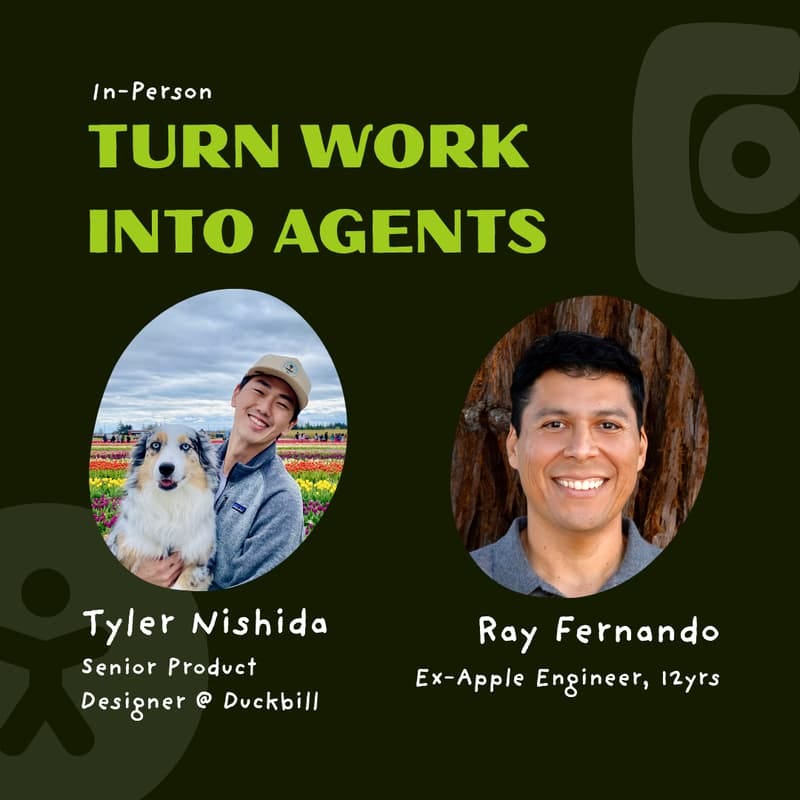
Mahalo to Piʻikū Co. for continuing to build pathways for emerging tech talent in Hawaiʻi and for creating community events where people can learn by doing. Mahalo to OurSpace for helping create the kind of physical infrastructure that makes this work possible: a place for creatives, changemakers, entrepreneurs, educators, technologists, and community builders to gather around tools and ideas.
Mahalo to Ray Fernando and Tyler Nishida for leading a hands-on workshop that was not about passive inspiration, but active building. The event page described it plainly: bring an idea, task, workflow, or small product; scope it; give the agent context; review code; run the project; fix what breaks. That is exactly what happened, and I was lucky enough to be one of the examples.
Mahalo also to the teams building tools like OpenAI Codex and the official Codex docs, because these tools are making a new kind of learning environment possible. But most of all, mahalo to everyone who showed up willing to be early. It is much easier to wait until the map is clean, the vocabulary is settled, the risks are solved, and someone else has figured out the path. But that is not how voyages begin.
A digital voyager is someone willing to learn the tools, test the waters, bring back knowledge, and make the path safer for the next person.
It is the teacher who tries Codex before writing an AI policy. It is the designer who uses an agent to prototype three versions of an idea before a meeting. It is the nonprofit worker who turns a repetitive spreadsheet workflow into something that saves their team hours. It is the student who realizes they can build a website, a game, a data tool, a lesson, a product, or a company from Hawaiʻi. It is the engineer who lets an agent take the first pass, then brings testing, taste, review, and accountability. It is the community organizer who looks around the room and asks, “Who is missing, and how do we bring them in next time?”
That is the work now: learning AI in a way that carries people with us. We are standing under a new sky. The stars are unfamiliar, the maps are unfinished, and the tools are changing in our hands. Good. Hawaiʻi has navigated the unknown before. Now it is time to set sail together.
OpenAI Codex: https://openai.com/codex/
OpenAI Codex quickstart: https://developers.openai.com/codex/quickstart
Piʻikū Co.: https://piiku.co/
OurSpace: https://ourspacehawaii.org/
Ray Fernando: https://www.rayfernando.ai/

No posts
Comments
Nothing yet. Say the first thing.
Sign in to join the conversation.