
Jazz on low. Herbie Hancock, Head Hunters, something about that record that sounds like the future being built in real time. One spray of Gentleman Givenchy on the wrist before sitting down. The amber settles fast tonight. Good.
Let me tell you something that is going to reframe the last several years of your life.
Every time you opened a game and couldn’t put it down, that wasn’t weakness.
Every time you leveled up a character at 2am when you swore you’d stop an hour ago, that wasn’t a lack of discipline.
Every time you felt more alive inside a fictional world than you did inside your actual one, that wasn’t escapism.
That was your brain telling you, in the loudest possible way, exactly how it needs to be fed in order to perform.
The problem was that nobody taught you how to apply the same architecture to your real life.
Because here is the thing that the most productive, driven, seemingly unstoppable people have quietly figured out that everyone else is still missing.
They do not have a fundamentally different relationship with discomfort, sacrifice, or delayed gratification.
Their real life produces the same neurological responses that a well-engineered video game produces. The same dopamine loops, the same progression systems, the same sense of meaningful challenge, the same feeling that the next level is always just within reach.
And because their real life feels like a game worth playing, they play it obsessively.
As a literal neurological strategy built on decades of behavioral science that most people have never been introduced to.
This post is that introduction.
And if you read it carefully and actually build what it describes, your relationship with your own life will never be the same.
The neuroscience of dopamine, reward prediction error, and why the human brain was always designed to operate this way.
The psychological traps that make real life feel flat, joyless, and impossible to stay motivated inside of.
How to design your real-life identity the way a game designer would, with stats, attributes, and a progression system that actually maps to who you want to become.
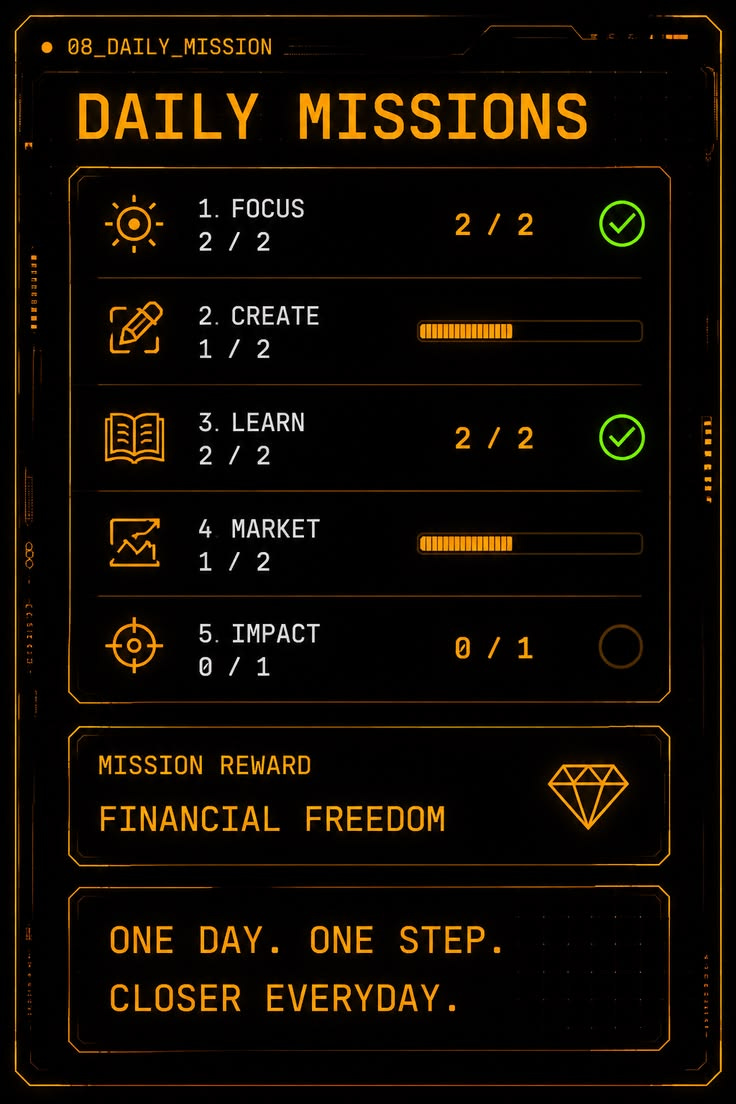
How to restructure your goals into missions with clear objectives, meaningful stakes, and the variable reward architecture that keeps the dopamine system locked in.
Why most people’s effort disappears into a void and how to build a feedback system that makes every day feel like measurable progress.
The science of optimal challenge, why too easy and too hard both kill motivation, and how to calibrate your life to the exact difficulty level your brain finds irresistible.
How to put everything together into a life that your nervous system cannot help but stay engaged with.
“The brain is the most complex thing we have yet discovered in our universe.” — David Eagleman
Your brain did not develop a reward system because video games were invented.
Video games were invented because someone figured out how to exploit a reward system that was already there.
The mesolimbic dopamine pathway, the neural highway running from the ventral tegmental area through the nucleus accumbens and into the prefrontal cortex, is the primary motivational architecture of the human brain. It is ancient. It predates civilization by hundreds of thousands of years.
To drive you toward things that improve your survival and reproduction. To make the pursuit of meaningful targets feel compelling, urgent, and worth continuing even when it’s hard.
The key word there is pursuit.
Wolfram Schultz at Cambridge spent decades mapping exactly when dopamine neurons fire. What he found changed everything. Dopamine does not release when you get the reward. It releases when your brain predicts the reward is coming.
Dopamine is released not when you get the badge, but when you are about to earn it. It is not a pleasure chemical. It is a seeking chemical. It drives anticipation, not satisfaction.
This is why achievement so often feels hollow the moment it arrives and why the period of working toward something so often feels more alive than the moment of having it.
Your brain was never designed to enjoy arrival. It was designed to enjoy the journey toward arrival, provided the journey is designed correctly.
And this is exactly where most people’s real lives fail catastrophically.
Not because the goals aren’t worthy. Not because the effort isn’t real.
Because the journey is designed in a way that produces almost no dopamine.
Vague targets. No visible progress. No feedback on performance. No escalating challenge. No sense of a story being built.
The brain looks at that structure and produces what it was always going to produce in the absence of a meaningful game.
Apathy. Procrastination. The inexplicable pull toward anything that produces a faster, cleaner dopamine hit.
Your phone. Your feed. The game you actually feel alive inside.
The problem was never motivation.
The problem was architecture.
This post goes six more chapters deep.
The quest system. The experience points architecture. The difficulty curve. The full framework assembled into something you can actually build starting today.
Everything above was the neuroscience foundation. What comes next is the construction manual.
You now have the occasion to join other 200+ paid subscribers that are improving themselves every single day.
If you are on the free plan, this is where the post ends for you.
The rest is inside the paid tier, along with every post that goes this deep, every framework this specific, and every piece of science applied this directly to how you actually live.
Less than a coffee twice a week.
For the kind of thinking that most people spend years and thousands of dollars trying to find in courses, coaches, and books that say the same three things in four hundred different ways.
Everything you need to actually build a different life is in here.
The next chapter is one scroll away.
Click the “Upgrade” button.
If that button does not work, try the one below:
Comments
Nothing yet. Say the first thing.
Sign in to join the conversation.