
For many of us, commercial success – the fact someone wants to publish our finely honed words – is the purest validation of ‘product’. Pressing characters onto paper or screen has turned from a private act, co-sponsored by one’s inner critic, into a public act of sharing.
All the writer asks or expects in return is a fair hearing from a ‘gentle’ reader – 90% subjective consideration to 10% old-fashioned considerateness, paralleling the writer’s 90% of perspiration to 10% inspiration.
But in the world of creative writing for therapeutic purposes (CWTP), it’s ‘process’ that counts both towards validation and a sense of personal achievement.
This is not a charter to patronise: all writers engage in an ongoing ‘process’ of developing and editing material. In therapeutic writing, it’s more a case of arriving at the same destination by a different means; by giving voice to that experience on the page, therapeutic writing also gives you permission to progress as a writer – permission you might have withheld from yourself for a range of reasons: I’m not good enough, I don’t have time to write, who’d be interested in what I have to say, anyway?
Everyone’s a critic…
All of the above come courtesy of your inner critic, the glass half-empty Jiminy Cricket who’s perched on my shoulder even as I type this. However, just as there’s no shade without light, the inner critic is also a force for good in your writing, becoming especially useful as you edit and re-edit, giving you the nerve to excise purple prose and throw a coldly critical over your own shortcomings. You can chew the fat very productively with your inner critic (check out Critic Tango: A Workshop on the Inner Critic, by River Wolton, in the excellent book Writing Works), turning that hectoring naysayer into a patient, mentoring guide.
‘OK,’ you might say. ‘Love yourself, not your failings. I get it. Now push off and let me write.’ By all means. But the point is, it’s not that easy. It’s always easier to take the road less well surfaced and commit to a bumpy ride with no end in sight. Yes, spiritually speaking, the journey is more important than the destination (process again), but who wants to be frustrated or stymied along the way?
Here’s a case in point. Recently, I facilitated a workshop where someone nearly fled the country at the words ‘we’re going to write a poem.’ I was a bit more subtle about it, but not much. At this point, the participant had stopped listening to anyone and was hearing only their unfettered inner critic reminding them they’re ‘rubbish’ at poems – always have been, always will be.
We mucked about a bit, swapping paper and finishing each other’s lines – the ‘mucking about’ integral to writing a poem without dwelling anxiously on the fact of writing it – the participant duly declaring it was the first ‘proper poem’ they had ever written and they would now take it home, frame it and hang it in the downstairs loo (nice bit of self-deprecation there).
On the way home, I stopped to admire a glorious rose hanging over a fence, angling for attention the way a horse might offer its velvety nose for stroking. I wished I’d taken a photo, but then, a few minutes later, I saw a flower like this one:
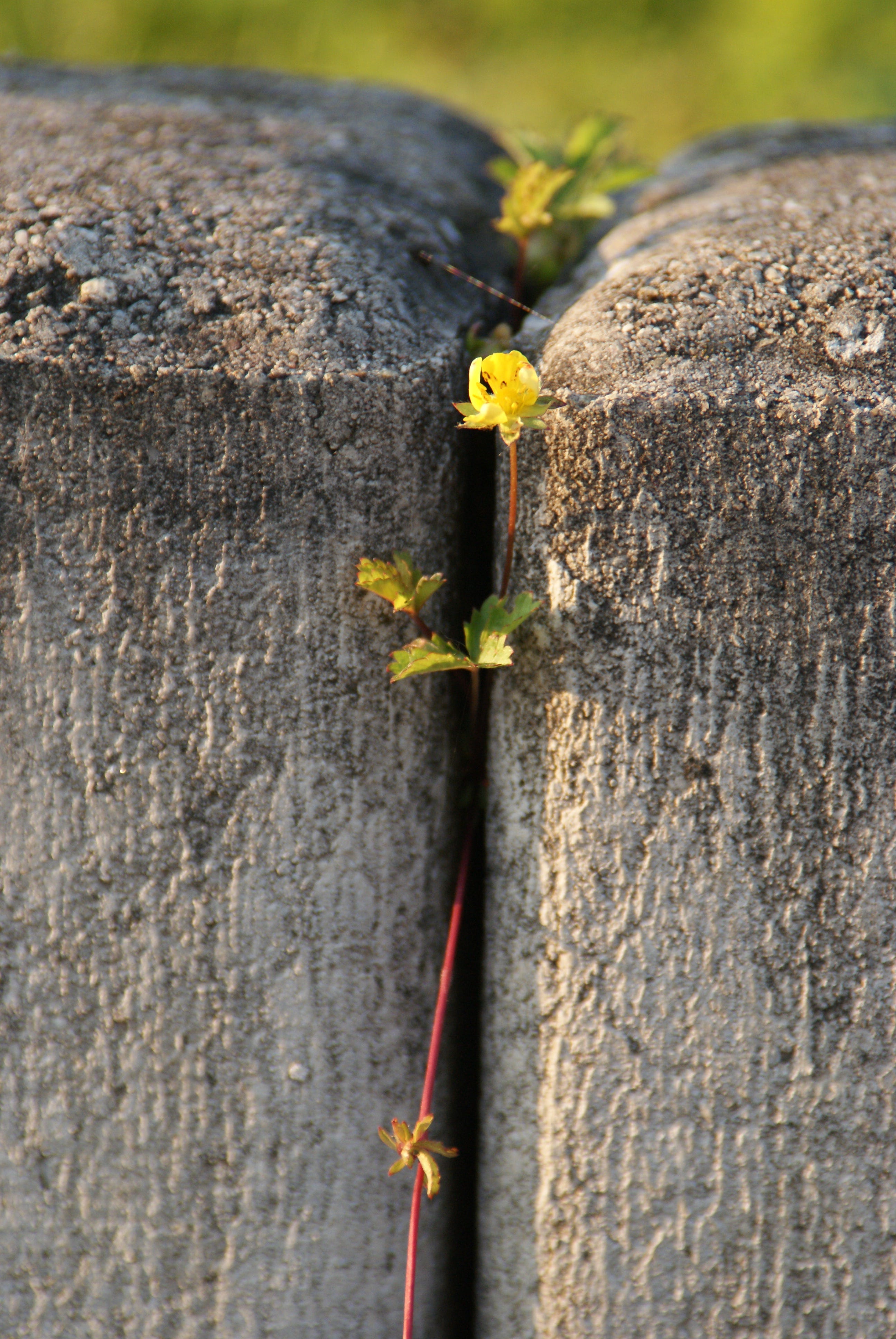
An overlooked flower growing up through a tiny gap in a wall, where nothing else had taken root, struck me as a metaphor that seemed both clear and circular: if you let the creative process find a way, it’ll come to you, and equally, if you let the creative process come to you, it will find a way.
Incidentally, thank you to Claire Williamson for pointing me towards LoVerne Brown’s poem, Meeting of Mavericks, well worth checking out online.
One other thing happened on the way home. I stood in a post office queue and scooped up additional riches growing through the cracks. They are everywhere if you keep ear, eye and notebook open. Make what you will of these overheard gems:
‘I’ve never liked baboons and seeing one at close hindquarters has done nothing to change my mind’
‘She’s got too many fingers in the fire’ (irons? Pies? Is she a pie-ro-maniac?)
‘There’s no fool like a gold fool’ (Imagine if Icarus flew too close to the sun but instead of his waxen wings melting, he was gilded down to his fingertips by its rays and transformed into Midas?)
Happy scribbling!
No posts
Comments
Nothing yet. Say the first thing.
Sign in to join the conversation.