
A journey through the indigenous spiritual traditions of Europe before the triumph of Christianity.
Each week we travel to a different region, exploring the sacred landscapes, forgotten gods, seasonal rites, folk traditions, and mythic imagination that shaped Europe for thousands of years before the coming of the Christian world.
Paid subscribers receive a new essay in the series every Sunday morning, delivered straight to their inbox, along with full access to the archive of more than 150 essays, myths, poems, and all future entries in the series.
Hi friends,
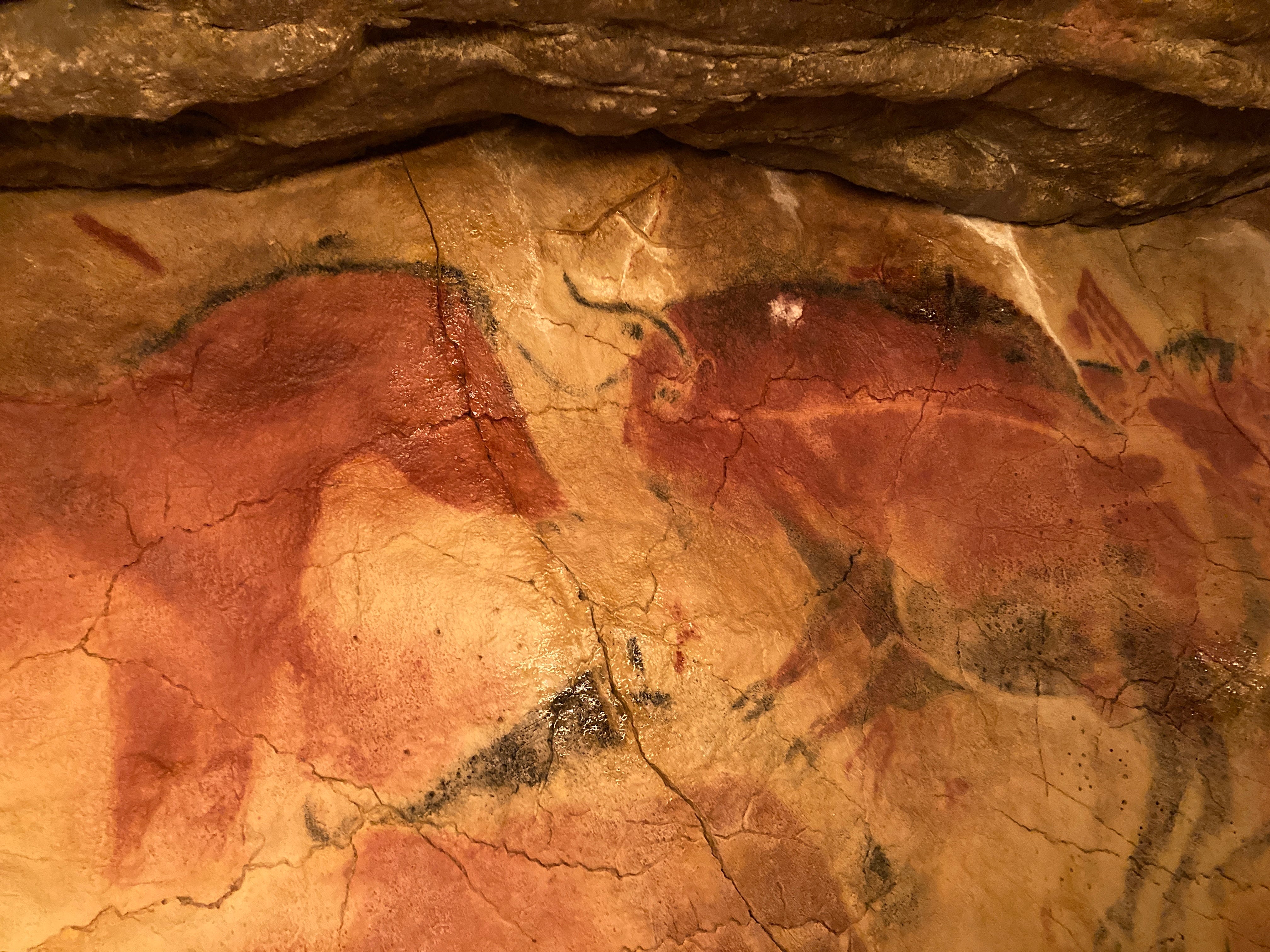
I’ve gone back and forth this week over the next pieces in The Old Gods of Europe series because we’ve reached Palaeolithic caves and, well, I just love caves. Cave art is one of my most studied subjects, and I have spent a great deal of time underground since I was born—quite literally.
During my mother’s postpartum, my family took me, still in arms, into Altamira cave. We returned many times throughout my childhood, along with visits to other cave-art sites across northern Spain. When I was twelve, we visited Lascaux in France, and in my adult years I’ve sought out caves from Western Europe and Greece, to Indonesia and Australia.
I feel a magnetism towards them. They draw me like bees to flowers. I suppose that’s what happens, be it in art or scholarship. For mysterious reasons, we find ourselves drawn to particular places, subjects, and time periods. My soul feels most at home in prehistory, up until the early Bronze Age. After that, it begins to feel like a foreigner in a land not its own. But give me a cave or a megalithic stone circle to lounge in and any whiff of imposterhood drifts away. I feel (to of course the limited degree it’s possible across such an immense gulf of time) that I can hear something of their old language, and to the best of my ability, attempt to speak on their behalf.
So, as we reach the caves in the Old Gods of Europe series, I’ve decided to give them the space they deserve. I’ll begin this week with a broader introduction to the Palaeolithic cave world, revisiting and substantially expanding two essays I first published in 2022 with new research and material. Next week, we’ll return to the sacred landscape of Iberia and descend into the painted caves of northern Spain, followed by southern France the week after. And as our journey across the European continent continues, we’ll eventually enter some of its other significant prehistoric cave sites, from Germany to Greece and Bulgaria.
It isn’t quite the route I had planned, but, as is their nature, caves seem to have a way of asking us to take the longer way in.
G x
Magic Words
Inuit poem
— From Rag and Bone Shop of the Heart by James Hillman, Robert Bly, and Michael Meade
In the very earliest times,
when both people and animals lived on earth,
a person could become an animal if he wanted to
and an animal could become a human being.
Sometimes they were people
and sometimes animals
and there was no difference.
All spoke the same language.
That was the time when words were like magic.
The human mind had mysterious powers.
A word spoken by chance
might have strange consequences.
It would suddenly come alive
and what people wanted to happen could happen —
all you had to do was say it.
Nobody can explain this:
That’s the way it was.
0:00
-19:10
I was only a few months old when I first entered a prehistoric cave. It was the same cave my father visited as a child, and my grandparents before him.
Altamira, nestled in the wet green mountains of northern Spain, lies in the country where my grandfather was born and where he died, where my family fought in the Civil War, and where, almost forty years ago, my father found a priest willing to breach the Church’s rules against interfaith marriage to wed my Welsh “pagan” mother.
She carried me into the cave in a sling, still deep in the holy, liminal time of postpartum, accompanied by my father and grandparents. It is perhaps the closest thing to a baptism outside the Church that a 90s baby raised in the industrial West could hope for.
This land was home to my ancestors for at least nine generations. It was the last part of Spain to be colonised by the Romans, and the only part of the country the Arabs of the eighth century had no interest in because of its wild, indomitable terrain and peoples. The Cantabri, or Ancient Cantabrians, were seen as savage and barbaric mountaineers by the then ‘more-civilised’ Iberian Peninsula, and earned a derogatory name that translates as “cave people” given to anyone who did not take on the Christian faith at the time of its dissemination, and still used today.
I feel irrepressibly drawn to caves. To their darkness. To their peace. Perhaps it is because their ochre runs in my ancestor’s blood. Or perhaps I’m just tired of a “love and light” spirituality that seems to have forgotten that all light, all life, comes from darkness.
Caves offer a reminder of such a time. One that makes me gasp. The prehistoric era is a time shrouded in mystery and is deeply misunderstood. I think familiarising ourselves more with this colossal span of our history is incredibly important if we are ever to know our origins and, as a result, ourselves.
Caves are holy, sanctified, sacrosanct. Being within them is a religious experience. It is down deep in the belly of the Earth where I find my God.
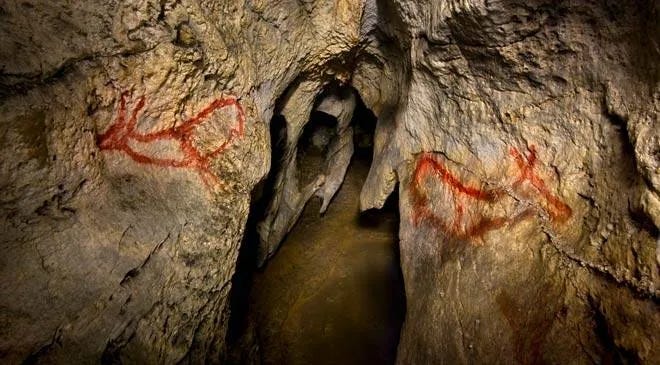
There are many theories concerning prehistoric caves and their paintings.
I believe the paintings represent the religious experience and cosmology of prehistoric culture, which I think was, at its heart, animistic.
To briefly describe animism for anyone who is unfamiliar with the term, it simply means the belief that everything is alive—that all things, animal, human, river, rock, tree, or cave, are imbibed with the same life force and have their own intelligence. This belief is still held by indigenous peoples around the world, such as the Arctic Inuit, the Australian First Nations, and the Southern African San.
I believe that at least some of these images were created within shamanic or ritual contexts, and that women played an important role in their creation—a topic I have explored at length in my recorded lecture series, When Women Were the Shamans.
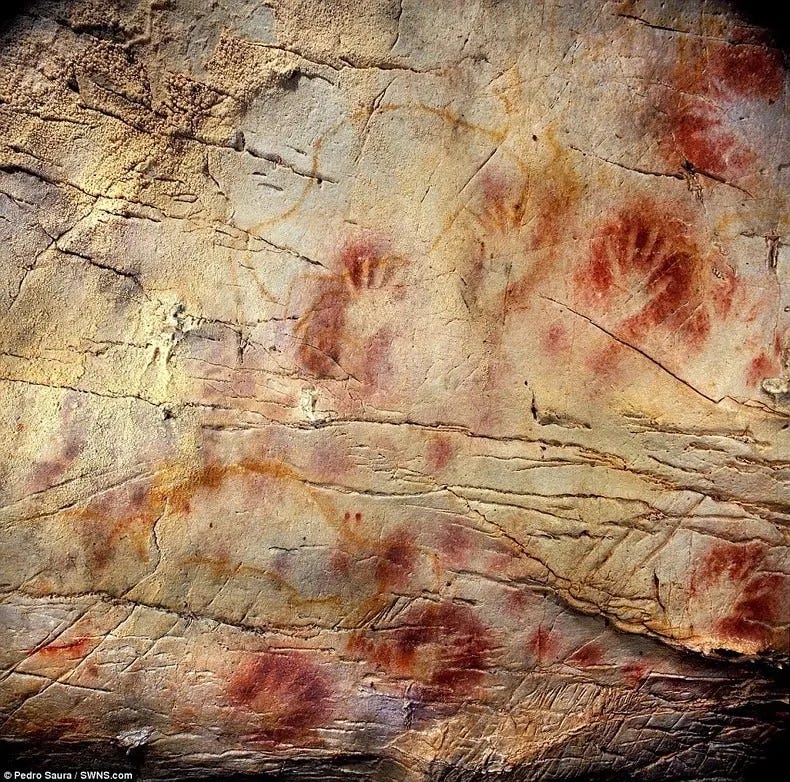
One tantalising line of evidence for female painters comes from the hands themselves. For generations, the painters of the great Palaeolithic caves were routinely imagined as men, an assumption increasingly challenged by attempts to identify the sex of the people whose hands remain stencilled upon their walls.
In 2013, archaeologist Dean Snow analysed thirty-two hand stencils from caves in France and Spain and attributed twenty-four of them to females, suggesting that women may have been responsible for a substantial proportion of these marks.
The methods used to sex prehistoric hand stencils remain debated, but collectively the evidence has helped dismantle the old assumption that Palaeolithic cave art was principally the work of men. Women—and probably children too—were among those placing their hands against these walls.
I agree with the archaeologist David Lewis-Williams in his proposal that hand prints were a way of making intimate contact with the cave itself.1 This concept of permeability suggested by the hands and the shapeshifting quality between human and animal indicate there was believed to be no barrier between the human and more-than-human-worlds.
As the Inuit poem tells us:
Sometimes they were people, and sometimes animals, and there was no difference.
If we proceed as though it were true that cave art represents the earliest depictions of a spiritual belief, and the first record of a worldview and cosmology, then the paintings can be approached as religious icons.
In other words, representations that hold the symbolic essence of a tradition.
Imagine our descendants tens of thousands of years from now excavating churches and trying to decipher iconography like the Cross or Mother Mary holding her baby, without the use of any documentation or scripture. Only images.
Such is our task.
The more time I spend both in the caves and studying them, the more I am convinced that approaching them as humankind’s first temples can provide vital understanding concerning our origins and, ultimately, self-knowledge.
Understanding the prehistoric worldview, and seeking what existed before, can help us deconstruct modern beliefs shaped by histories of oppression, including the persistent Western fixation on transcendence: the idea that the sacred lies somewhere above or beyond an unholy material world.
But this work is not only about dismantling what came later. Recovering the sophisticated spiritual cosmologies of our own ancient cultural inheritance can offer Western people a deeper sense of belonging in an age of growing cultural and spiritual displacement, while restoring something of an older relationship with the Earth; not as inert matter to be transcended or exploited, but as a living world in which we are embedded and to which we belong.
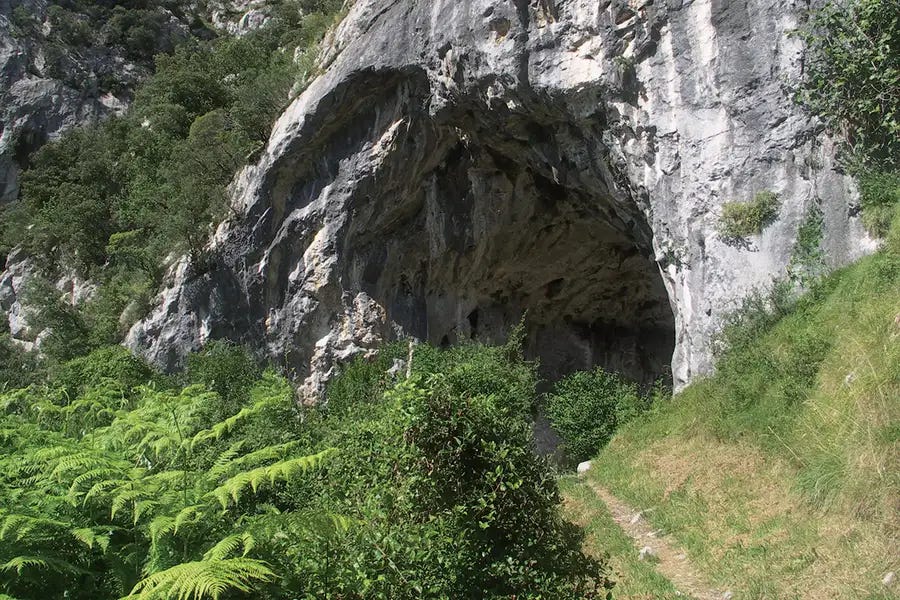
The Palaeolithic era, or Old Stone Age, encompasses the overwhelming majority of human prehistory. This is an almost incomprehensible span of time when compared, for instance, with the few thousand years occupied by the major organised religions familiar to us today.
The earliest known stone tools date to around 3.3 million years ago in East Africa. For tens of thousands of years towards the end of this immense span of time, people were also painting, engraving, and marking the walls of caves.
Palaeolithic cave art has been found across the world, but the extraordinary tradition of art made deep underground is particularly concentrated in Europe, above all in southern France and northern Spain. Here, some of the most elaborate images were created not simply at cave entrances or in places reached by daylight, but deep within the earth, in chambers and passages enveloped in complete darkness.
The oldest cave paintings on Earth have recently been attributed to three caves in Spain: La Pasiega in Cantabria, Maltravieso in Extremadura, and Ardales in Andalucía. Red pigment, hand stencils, and geometric markings have produced uranium-thorium dates of more than 64,000 years ago.2
If these dates are correct, the markings were made some twenty thousand years before Homo sapiens are generally thought to have arrived in western Europe, leaving Neanderthals as their most likely creators.
The possibility that Neanderthals themselves entered caves to undertake ritual and ceremony has radically deepened this story, because it means that they were far more sophisticated than previously accredited by nineteenth-century narratives rooted in colonial notions of progress.
The attribution remains debated, particularly over whether the dating method securely establishes the age of the pigment itself, but the possibility is extraordinary: that long before our own species painted the great animal galleries of Altamira and Lascaux, another kind of human was already carrying pigment into the darkness and deliberately leaving signs upon cave walls.
The possible Neanderthal images found in Spain are strikingly different from the great animal paintings that would appear tens of thousands of years later.
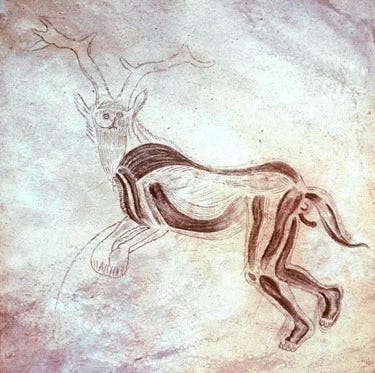
At La Pasiega in Cantabria, a red scalariform, or ladder-shaped, sign composed of horizontal and vertical lines has been dated to at least 64,800 years ago. It forms part of the complex Panel 78, although only the red line beneath the dated calcite can securely be assigned this minimum age; the animals and other signs surrounding it may have been added much later.
The evidence is more hauntingly familiar at Maltravieso in Extremadura. Red hand stencils, made by placing a hand against the cave wall and applying pigment around it, have yielded a minimum age of 66,700 years, and more recent dating has strengthened the case that at least some of Maltravieso’s hand stencils belong to the Middle Palaeolithic.
Neanderthals appear to not have painted recognisable figures at all at Ardales in Andalucía. They repeatedly applied red ochre to a great flowstone formation within the cave. Chemical analysis suggests that the pigment was deliberately brought into the cave and applied, possibly by blowing or splattering, on multiple occasions separated by thousands of years.
These sites suggest that Neanderthal mark-making was not necessarily concerned with representing the visible world, but in some form of symbolic relationship with the cave itself, and the living Earth.
There is a line of interpretation that is important to introduce here. Researchers of Palaeolithic art, most famously David Lewis-Williams and Thomas Dowson, have noted that many of cave art’s geometric signs resemble the internally generated visual phenomena that can arise during altered states of consciousness: dots, zigzags, parallel lines, grids, lattices, and other recurring forms.
Such patterns emerge from the architecture of the human visual system itself and can appear in darkness and altered states without an external object producing them.
These so-called “entoptic” phenomena have been proposed as a possible source for some of the earliest and most widespread geometric motifs in human symbolic behaviour. The altered-state model was developed primarily in relation to much later Upper Palaeolithic art, and its application to earlier periods remains debated and speculative, but it has become an influential framework for thinking about the origins of non-figurative imagery in deep prehistory.
Whatever the marks meant, they suggest that the human impulse to enter the earth, engage with it, and make meaning there may reach far deeper into our evolutionary past than we once imagined.
I recommend neanderthal paganism for a wonderful Substack exploring how Neanderthal symbolic and spiritual traditions may have laid some of the deep foundations for the shared myths, rituals, and archetypes of Northern Hemisphere cultures.
Up until fairly recently, I believed that caves were the homes of prehistoric peoples. This is what we were taught in school, and what I was always told by guides when I visited the caves as a child.
I believed this narrative until I began to study shamanism. Beginning with the work of the historian of religion Mircea Eliade, and anthropologist Michael Harner, and then continuing on to apprentice with shamans in Peru. I became fascinated by the question of our origins and an animistic worldview that seemed to span across cultures and time.
I’m genuinely thrilled to finally be able to say the narratives are changing. Some archaeologists have interpreted the deep caves as ritual or sacred spaces and their imagery through shamanic frameworks.3
Cave art tells us that there was once a magical relationship between humankind and the more-than-human-world. For early humans, that ‘magic’ was the belief in a charged cosmology inhabited by supernatural beings and forces that influenced human life.
If we can shape our modern thinking to imagine what an interaction with a cave may have been like when caves were perceived as live, sentient beings, then perhaps we can begin to conceive of the changes that ensued from our migration away from them.
From the earliest known Neanderthal cave markings around 64,000 years ago through to the great painted caves of the Upper Palaeolithic, we encounter a persistence of certain images, gestures, and relationships with the underground world.
The continuity over tens of thousands of years suggests an extraordinarily deep history of symbolic and perhaps ritual engagement with caves. In his book Cave Art, the world-renown specialist in prehistoric art Jean Cottes remarks that it is the longest tradition humankind has ever known.4
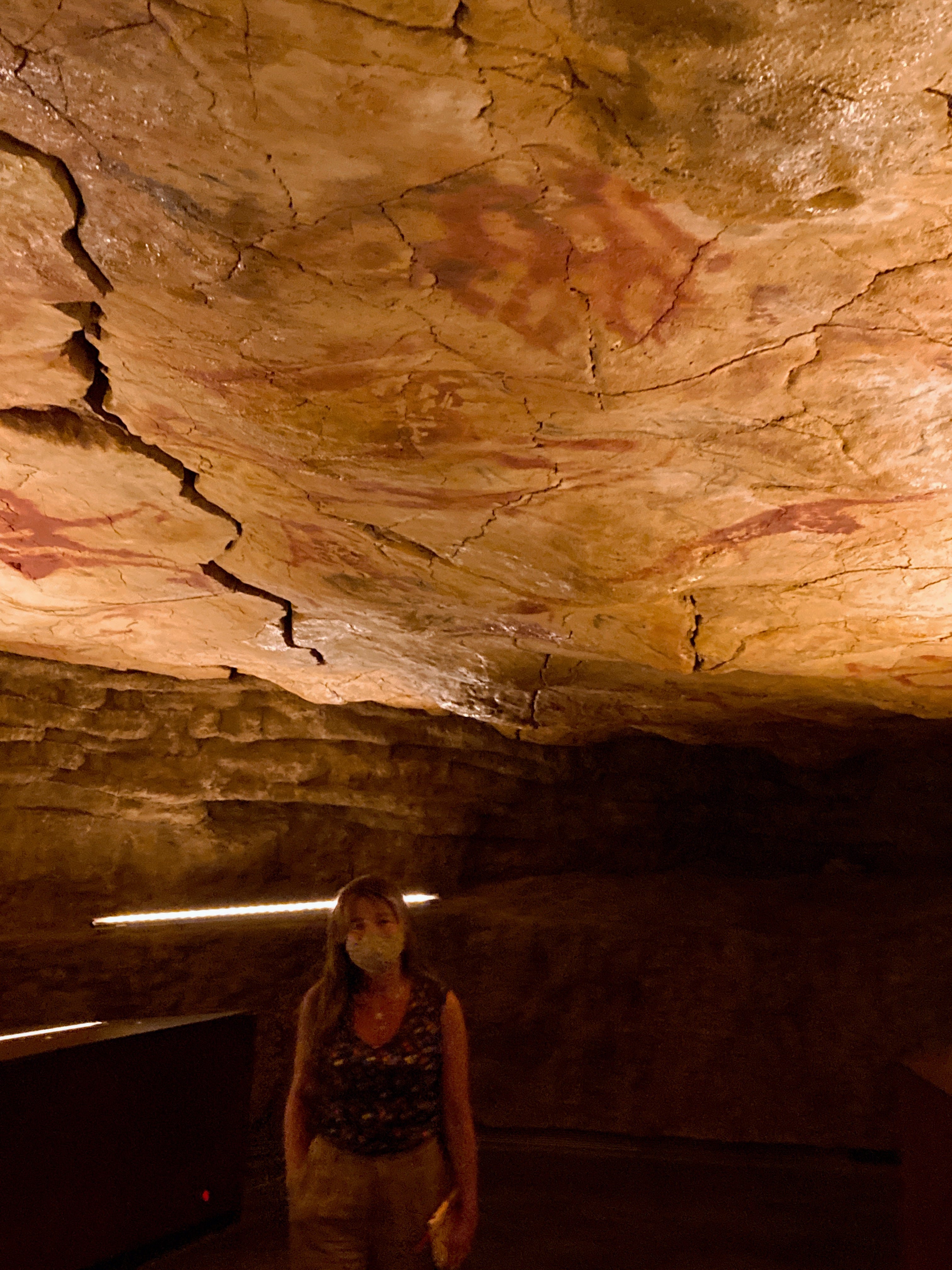
If you enjoyed this piece, please do hit that “like” button and share it along. It really helps get the work out!
If you’re joining us for the first time, or missed the announcement, I’ve included the introduction to The Old Gods of Europe below. It offers a broader overview of the questions that inspired this series and the journey we will be undertaking together over the coming months.
David Lewis-Williams, The Mind in the Cave: Consciousness and the Origins of Art (London: Thames & Hudson, 2002).
Dirk L. Hoffmann et al., “U-Th Dating of Carbonate Crusts Reveals Neandertal Origin of Iberian Cave Art,” Science 359, no. 6378 (2018): 912–15, https://doi.org/10.1126/science.aap7778.
See Jean Clottes and David Lewis-Williams, The Shamans of Prehistory: Trance and Magic in the Painted Caves, trans. Sophie Hawkes (New York: Harry N. Abrams, 1998).
Jean Clottes, Cave Art (London: Phaidon Press, 2008).
Comments
Nothing yet. Say the first thing.
Sign in to join the conversation.