
Welcome to a new series of posts, exploring a topic which has been on my mind:
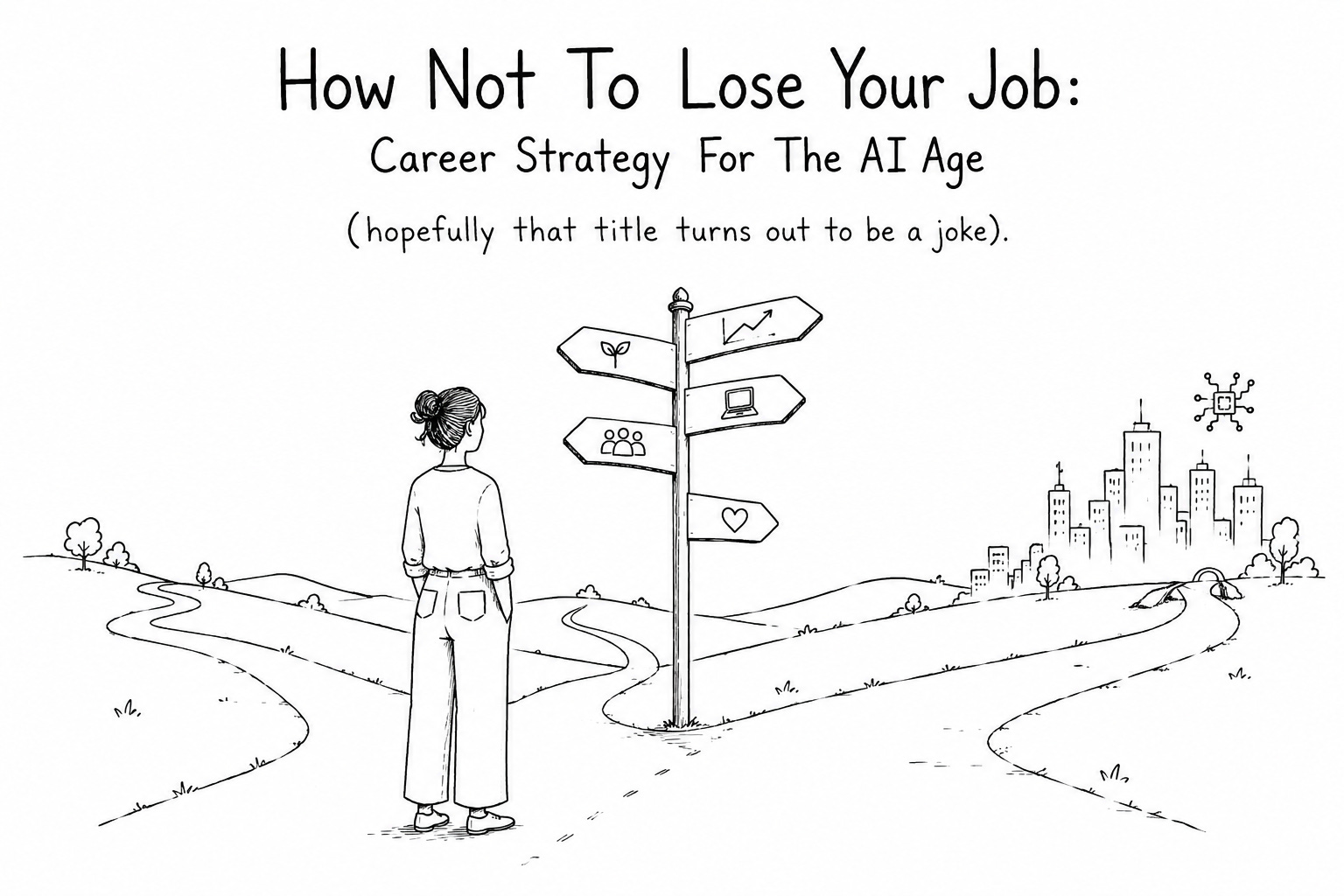
What is currently happening to work and jobs because of AI?
What is the range of potential future scenarios - and what indicators should we watch to understand where we are heading?
Based on this, what are the best career strategies for individuals?
Back in 2024 I created this Substack to share 15 recommended career strategies for the world of modern work.
I created that series in an optimistic mindset - believing we have more opportunity than ever before to chase fulfilment, flexibility and financial freedom at work, if we are just given the tools and frameworks to navigate our careers thoughtfully.
Like many writing projects, it started as a way to share finished thinking - turning a long-running personal research project into a talk at Sunrise Festival, which then became a Substack series, to help other people navigate their careers.
Fast forward just two years, and I am writing in a very different headspace.
There is a lot of fear and uncertainty about how AI could impact the world of work, and in this series, I am writing to understand and refine my own thinking. My goal is to sort the hype from the reality, break down the best information on how AI is changing work, and share updated career strategy recommendations that are genuinely helpful.
A few quick callouts to set expectations:
This is probably not the last word. My plan is to update regularly based on new data and thinking as it emerges. I have an AI agent which does a nightly scan of key experts, think tanks, economic journals, data sets and news articles related to this topic, and I review these on weekends to shape my own mental models.
I’m not an economist… I am a social scientist by training, but I am more focussed on translating insights from credible sources than providing graduate-student level critiques of economic papers (a task which AI models are arguably replacing soon anyway…).
… but I am a nerd. One of the most abundant features of conversations around AI is hype - whether about the positive potential of the technology, or the negative impact on our livelihoods and economies. This is amplified by the way most content-sharing platforms reward extreme predictions that play into fear, greed and uncertainty. I think headlines predicting a jobs apocalypse based on weak data or single anecdotes help no one, and I will be weighting rigorous analysis with publicly available methods more heavily than anything else.
I have a humanist bias. I think technology is exciting, and I use AI a lot in my life, but I am interested in this topic because I think financial security and meaningful work is an important ingredient for good human lives and societies, rather than beginning from techno-pessimism or techno-optimism.
I am Australian. As of writing, this Substack has subscribers in 47 countries, and the world has fundamental disagreements about critical spelling conventions in the English language, including the word “labour”. I will be using this word a lot, and using Australian (a.k.a. British spelling conventions). If reading this is too much emotional labor for any of our American readers, feel free to unsubscribe 😉
So that’s the goal - and in the second half of this post, I’ll start with a primer on a few labour economics and technology concepts which are really useful to understanding the discourse around AI and the world of work.
You have a couple of options here.
If you want to understand these concepts personally, pour yourself a beverage, settle in and read through to the end of this post.
If you understand these concepts already - or you just want the career strategy advice, minus all the economic theory - feel free to just subscribe and skip ahead to those posts when they are released.
And if you’re an expert in one of these fields, please feel free to share tips to improve the explanations in this post by messaging me directly!
Concept 1: Tasks vs. jobs vs. occupations.
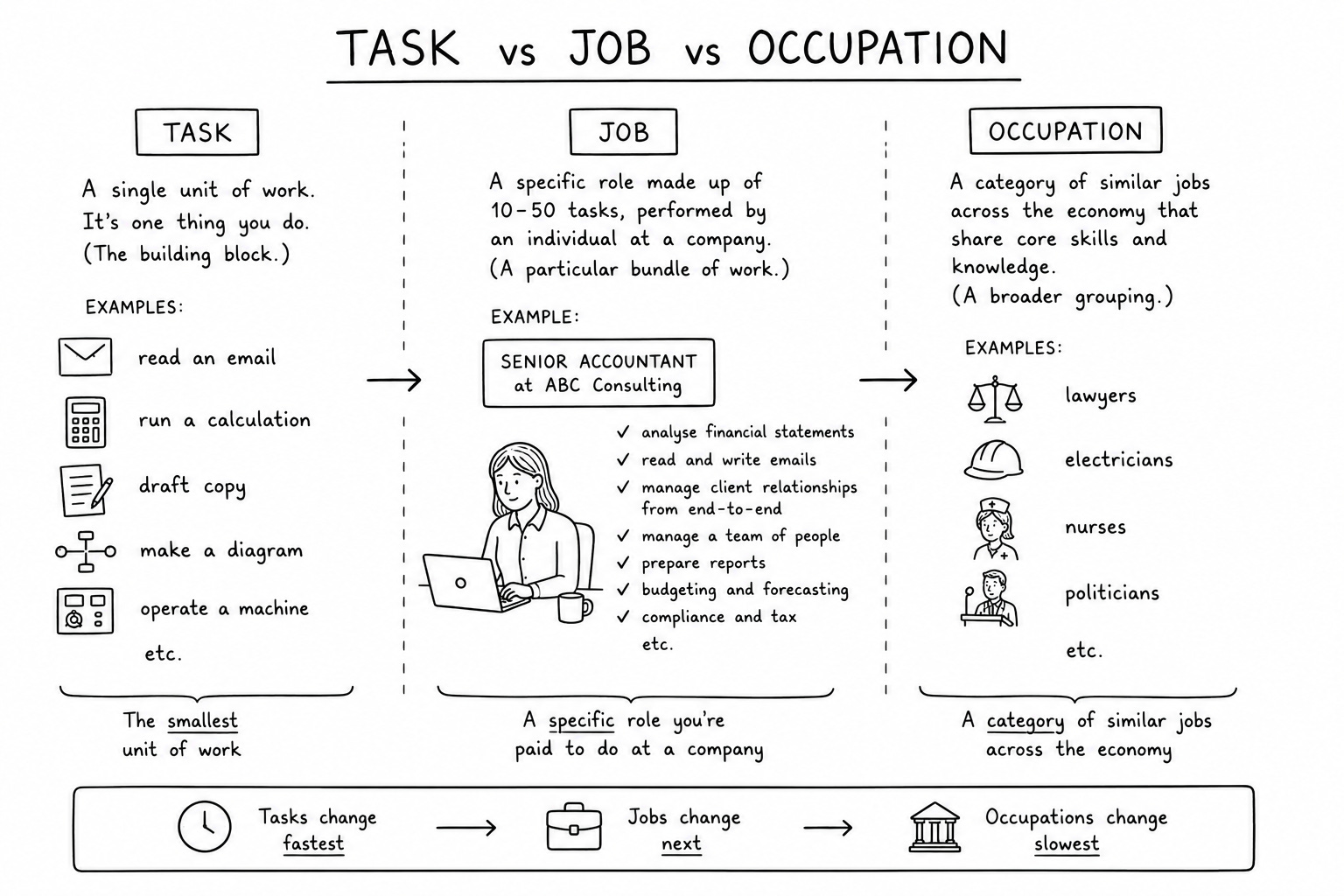
What it is: Think of a task as a single unit of work (like reading an email, running a calculation, drafting copy, making a diagram, operating a machine, etc), and a job as a collection of 10-50 different tasks with a title (like an accountant who must be able to analyse financial statements, read and write emails, manage client relationships from end-to-end, and manage a team of people), and an occupation as a cluster of commonly grouped tasks, often defined by licensing or a specified form of training (like a lawyer, an electrician, a nurse, etc).
Why we care: Understanding this distinction is important to evaluating claims like ‘AI will take jobs’ - for example, a more nuanced answer may look like ‘AI replaces some tasks, reshapes jobs and changes the demand for occupations’.
Concept 2: Cognitive vs. manual work.
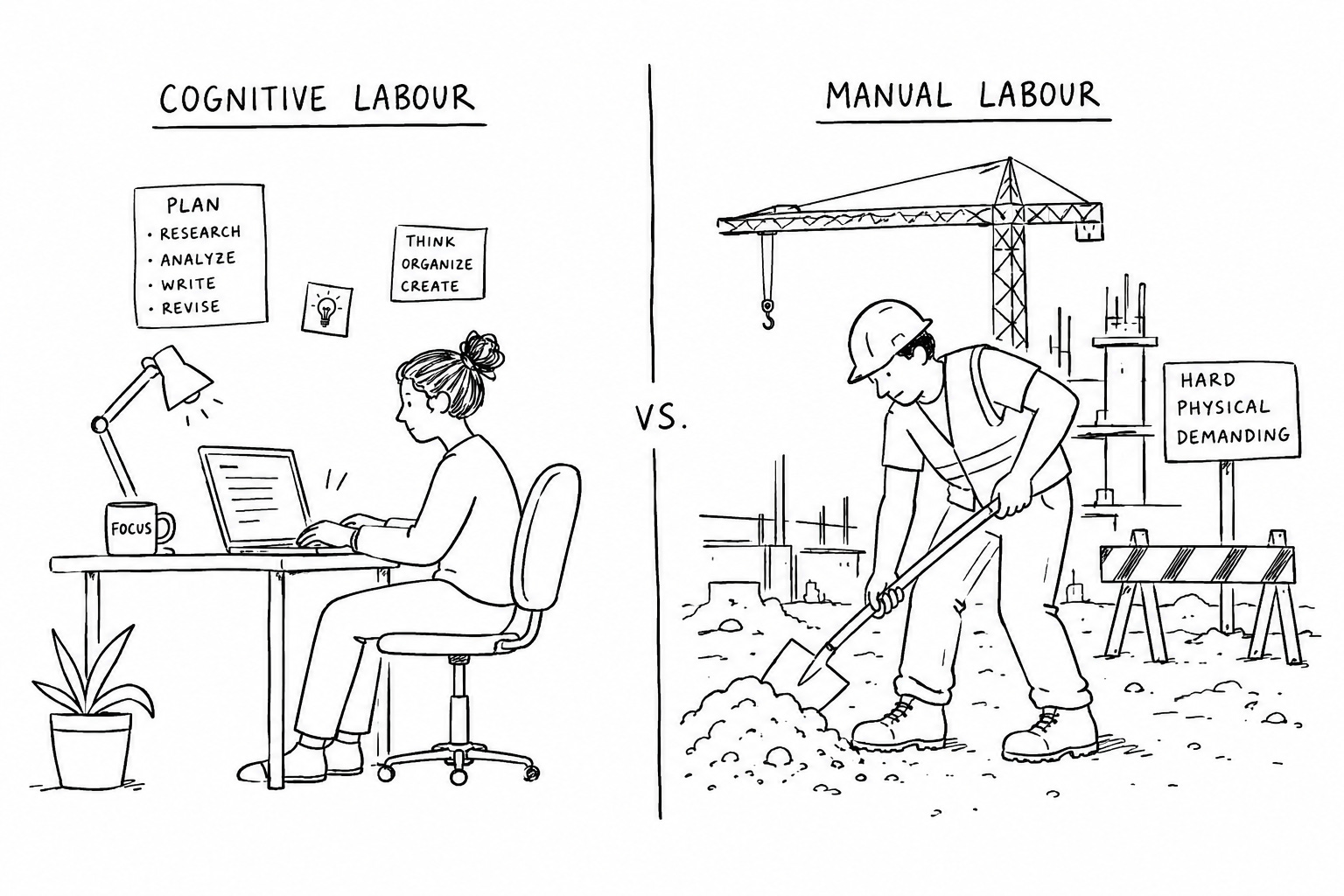
What it is: This boundary can be a little fuzzy (many jobs are hybrids), but you can think of this as the distinction between knowledge work, where the primary value comes from processing information, analysis, decision-making, or communication, and manual work, where the primary value comes from physical tasks and interaction with the physical environment. This can also be sometimes also referred to as ‘white collar’ and ‘blue collar’ work. It’s important to note here that this is not a statement of someone’s personal value or worth, just a classification used in labour economics.
There is also an additional distinction worth noting - namely between routine and non-routine labour, which is expressed in the chart below. Routine work typically involves more repetitive tasks, non-routine work involves more use of judgment and problem-solving to perform. With these two distinctions, we end up at a useful framework for classifying jobs into 4 major groups:
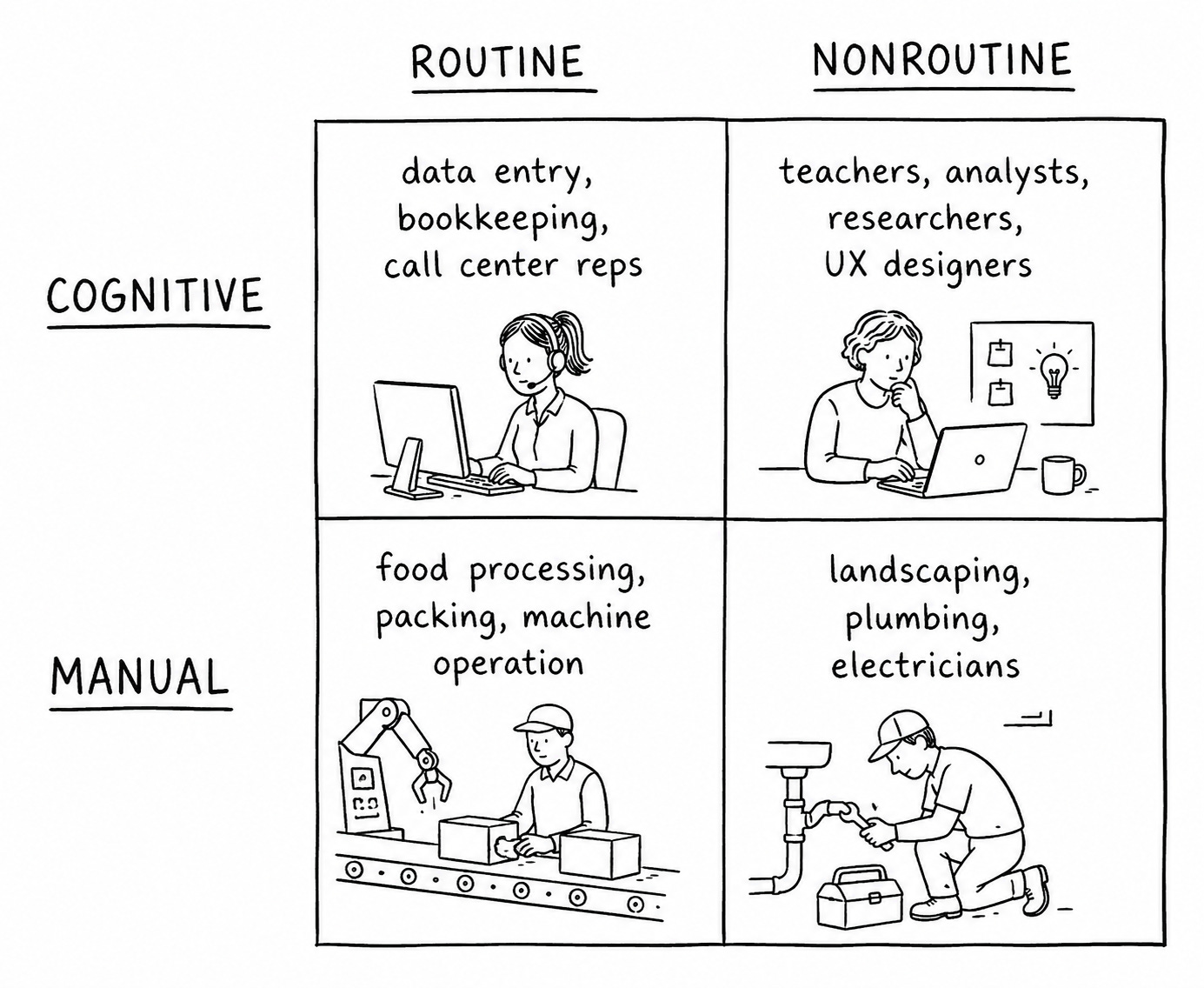
Why we care: Historically, waves of technological change have impacted manual work and routine cognitive work more than non-routine cognitive labour, or ‘white collar’ jobs - for example, machines and assembly lines reducing jobs available in manufacturing, and the rise of personal computers and word processing software (like Microsoft Word) reducing the need for routine cognitive roles like a typist. Throughout these past waves of technology change, training for jobs in non-routine cognitive work has often been seen as the permanently secure path to greater financial security and status - think doctors, lawyers, software engineers and the like. But the new capabilities of AI models may mean this assumption that white-collar jobs are the ‘safe ground’ no longer holds.
For example, AI may have a deep impact on routine cognitive work (e.g. data entry and call centres, where tasks are rules-based, digital and language-driven), and on non-routine cognitive work (from automating tasks like research and writing legal opinions, to running entire projects end-to-end independently). And while routine manual work is still vulnerable to automation, even this is constrained by the dexterity and cost of hardware like robots - and non-routine manual work (like plumbers, electricians, landscapers), where physical dexterity, unpredictability, and on-site judgment make full automation difficult, may remain the most protected in an AI age.
Understanding distinction is important to a number of future scenarios we’ll cover in future posts - and particularly to the much-discussed idea of a ‘bifurcation’ in labour market impacts between blue-collar and white-collar work.
Concept 3: Generative vs. Agentic vs. Self-Recursive AI.
This is a simplified explanation of the technology behind common AI tools for a non-technical audience, so feel free to skip if you are already familiar.
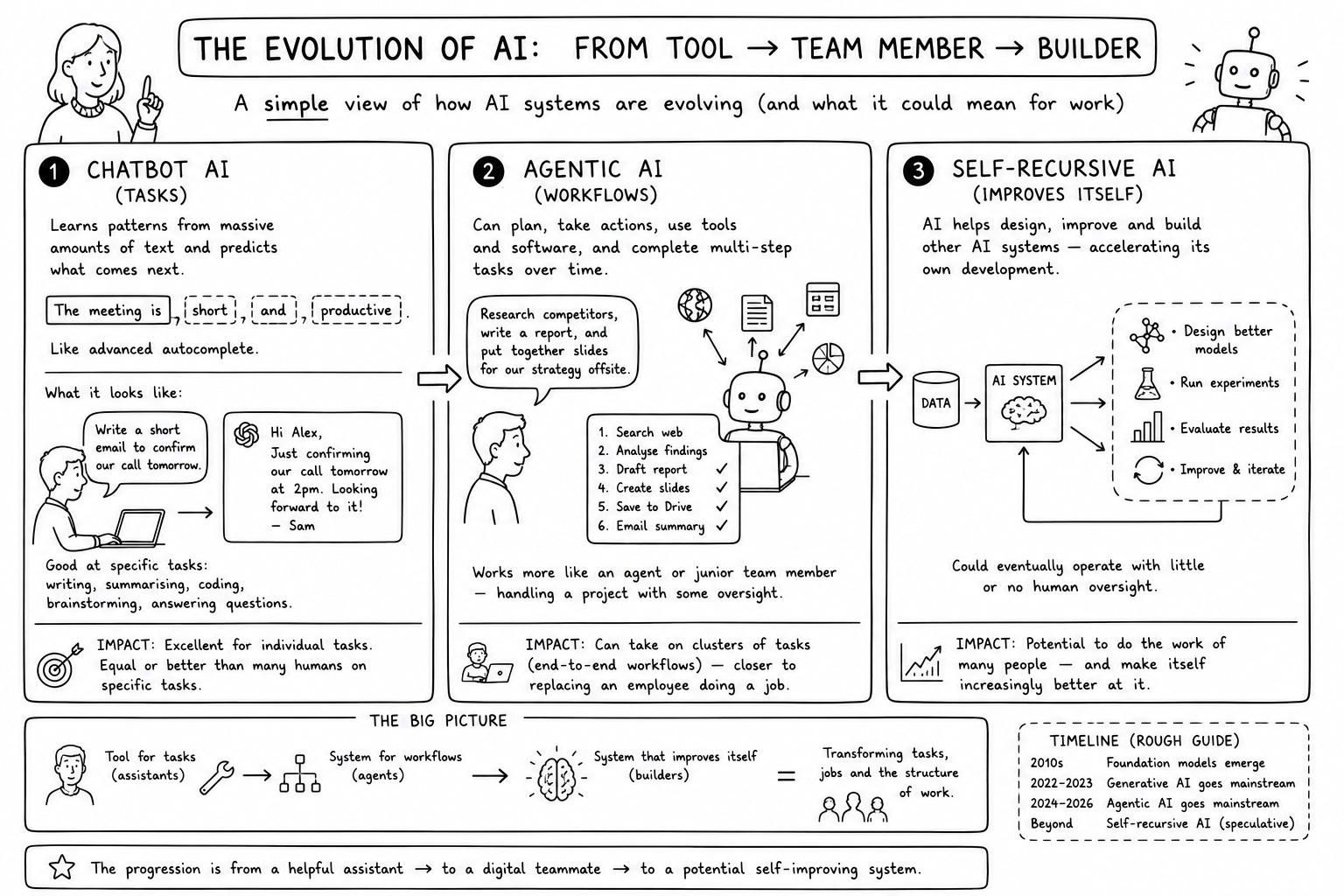
What it is: Companies like OpenAI (the AI model maker behind ChatGPT) have been building modern AI systems for over a decade. At a simple level, these systems work by learning patterns from massive amounts of text and then predicting what comes next - like an extremely advanced version of autocomplete. For a long time, the results were clunky and unreliable, so the technology wasn’t very useful in everyday work, but that changed around 2022–2023 with the rise of ‘generative AI’, where tools like ChatGPT suddenly made it easy to generate decent writing, code, and ideas on demand. For most people, this was the first time AI felt genuinely helpful - like a smart assistant you could ask questions or delegate small tasks to, which would reply with useful answers.
As of late 2025 to early 2026, AI is becoming ‘agentic’, which means major companies are releasing tools like Claude Code, OpenAI Codex and Claude CoWork, which can do more than just respond to prompts - they can act like an agent on your behalf to plan projects, take steps, use other software, and complete multi-step tasks over time while you are away from your computer. This means AI is moving from being a helpful assistant to something closer to a junior team member - able to take on chunks of work with some oversight.
Looking ahead, some researchers and companies expect a further phase where AI systems help design, improve, or build other AI systems - sometimes referred to as self-recursive AI. If it emerges, it could accelerate progress by allowing AI to contribute directly to its own development at an unprecedented pace.
Why we care: These shifts in capability could have very different implications for how AI changes tasks, jobs and the structure of work - where a chatbot-style tool like early ChatGPT might be equal or better than a lot of humans on specific tasks (e.g. writing a succinct email), an agentic AI tool like Claude CoWork can take on clusters of different tasks in something which looks much more like replacing an employee doing a job - and a self-recursive AI tool may do this and more, without any oversight at all.
Concept 4: Artificial intelligence capability curves.
What it is: Capability curves measure what different AI models can do, compared to a human, at a task level. For example, if a human requires an hour to complete a task (like building a spreadsheet model of a business), how does the model compare, and how is the difference changing as AI models improve? When does AI eclipse human capability on a given task? There are versions of these capability curves which show tasks and durations compared to model release dates - tracking how new models (or LLMs) perform, especially since the release of Chat-GPT 4, have been improving rapidly.

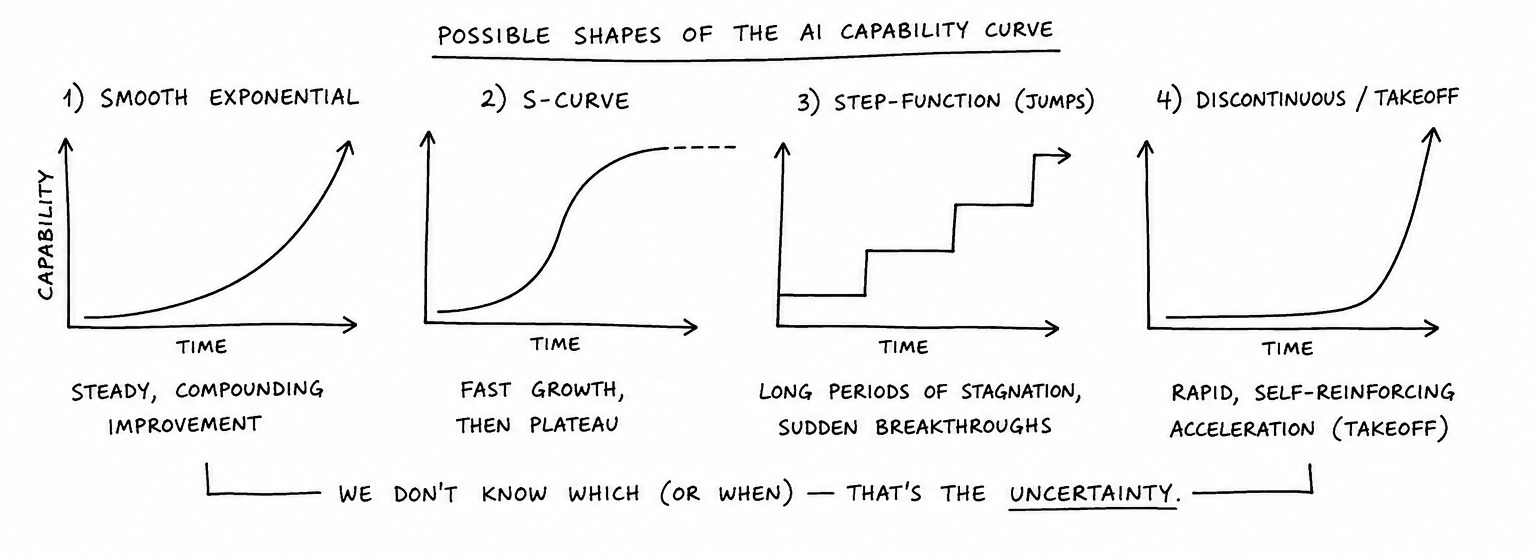
Why we care: The shape of the curve matters a lot, because it influences the speed and nature of the impact on jobs - and our ability to adapt while it happens. Does it improve at a steady pace, does it plateau, does it move in sudden step-changes, or does it hit a point where it accelerates dramatically - for example, when we hit a level of capability where AI models can continuously improve themselves?
Concept 5: AI capability vs. AI impact.
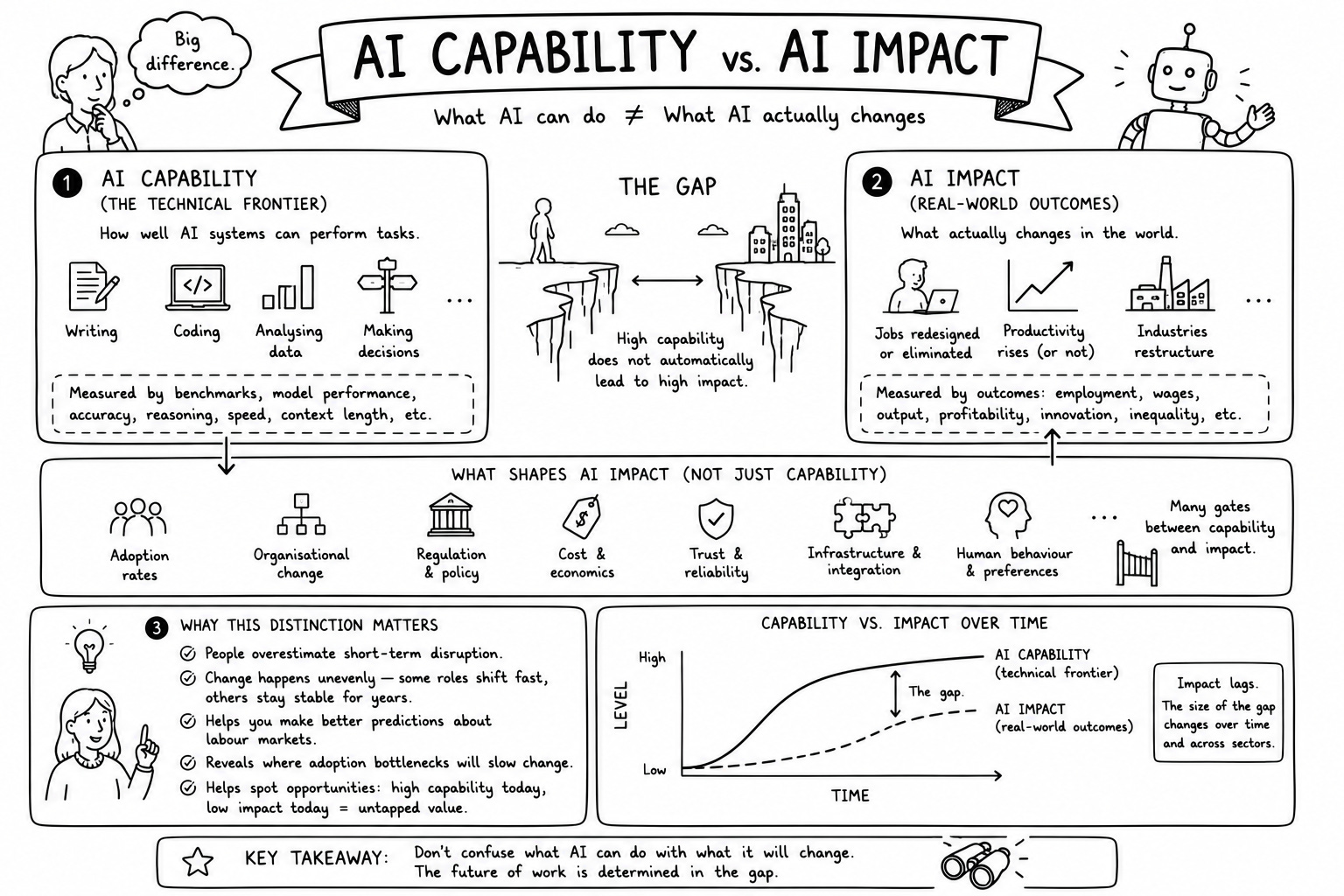
What it is: Capability captures what AI systems can do (the technical frontier of how well models can perform tasks like writing, coding, analysing data, or making decisions). Impact captures outcomes - whether jobs are redesigned or eliminated, whether productivity rises, and whether industries restructure.
Why we care: Capability means very little in the absence of real-world impact, and impact is shaped by a lot more than just what models are technically able to do - it is shaped by who adopts the technology, how much organisations incorporate AI into how they work, government regulation, costs to use the technology, trust, and many other factors. If you focus only on capability, it’s easy to assume rapid job loss or instant transformation across entire sectors, but in reality, the impact of technologies can lag and vary widely. Understanding the gap helps to make better predictions about labour markets, identify where adoption bottlenecks will slow change, and spot where it may go next.
Concept 6: Augmentation vs. automation.
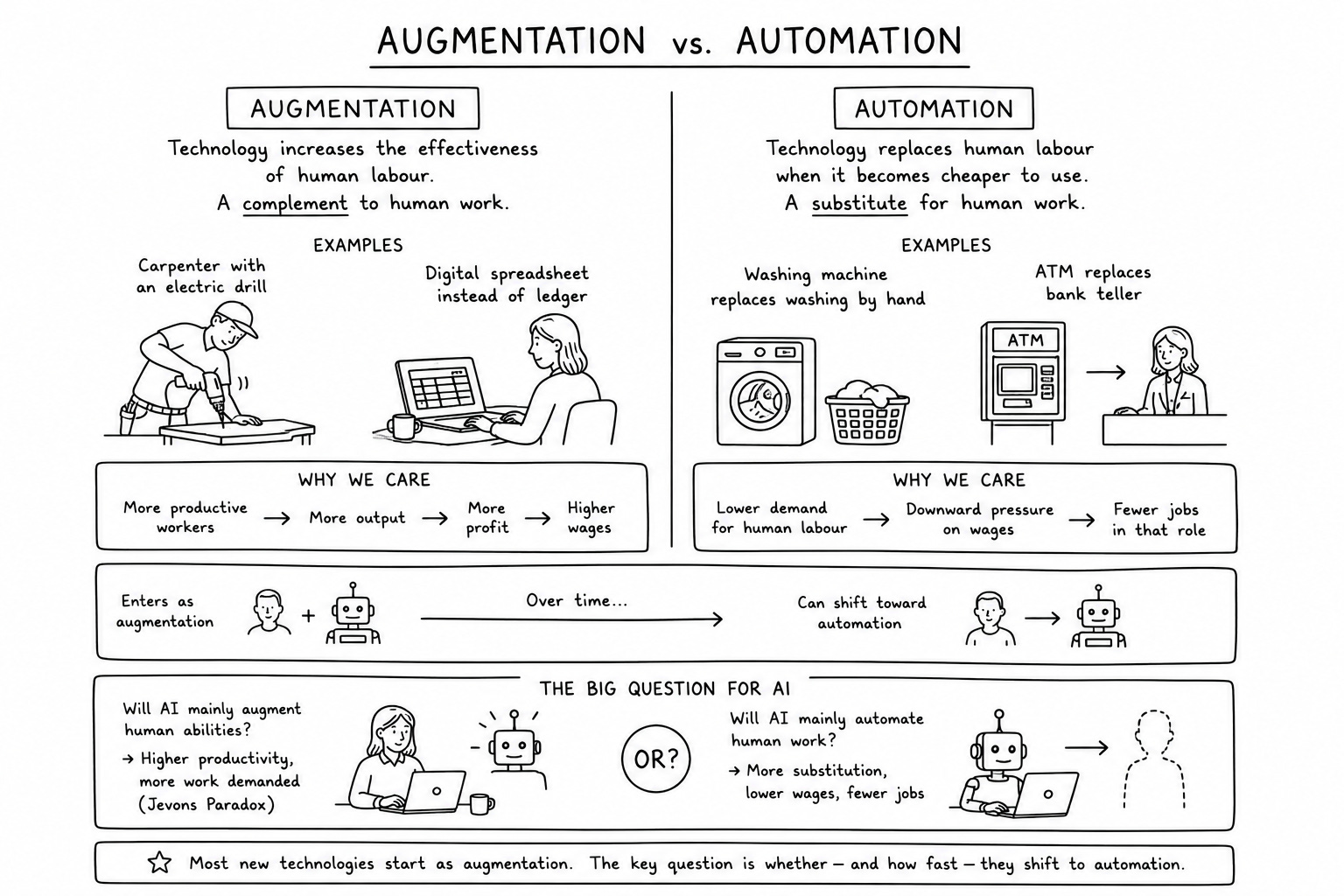
What it is: Augmentation involves a technology increasing the effectiveness of human labour (making us more productive and able to increase output for the same inputs) - so think of this as a complement to human work, like a carpenter with an electric drill, or a digital spreadsheet instead of a physical ledger. Automation involves a technology that replaces human labour, by making it cheaper to use the technology than the human-plus-technology mix - so think of this as a substitute for human work, like a washing machine fully replacing human labour, or an ATM replacing a bank teller.
Why we care: Historically, when a new technology emerges, if it augments human labour then it tends to increase wages, because more output means more profit and more ability for some of that profit to be reflected in wages - and if it automates human labour, it tends to put downward pressure on wages in a profession or reduce overall employment in that profession - and often a new technology will enter the market as augmentation, and over time shift increasingly into automation mode.
This distinction connects to one of the most important debates in the economic literature on how AI will affect labour markets - will the deployment of AI lead to augmentation of human abilities, greater productivity, and more work being demanded by the market (this is known as the Jevons Paradox, more to come on it in future posts), or will it lead to mass automation, reducing wages and employment as AI becomes cheaper than humans to deliver those services? (known as job displacement).
Concept 7: AI exposure vs. AI displacement vs. AI adaptability.
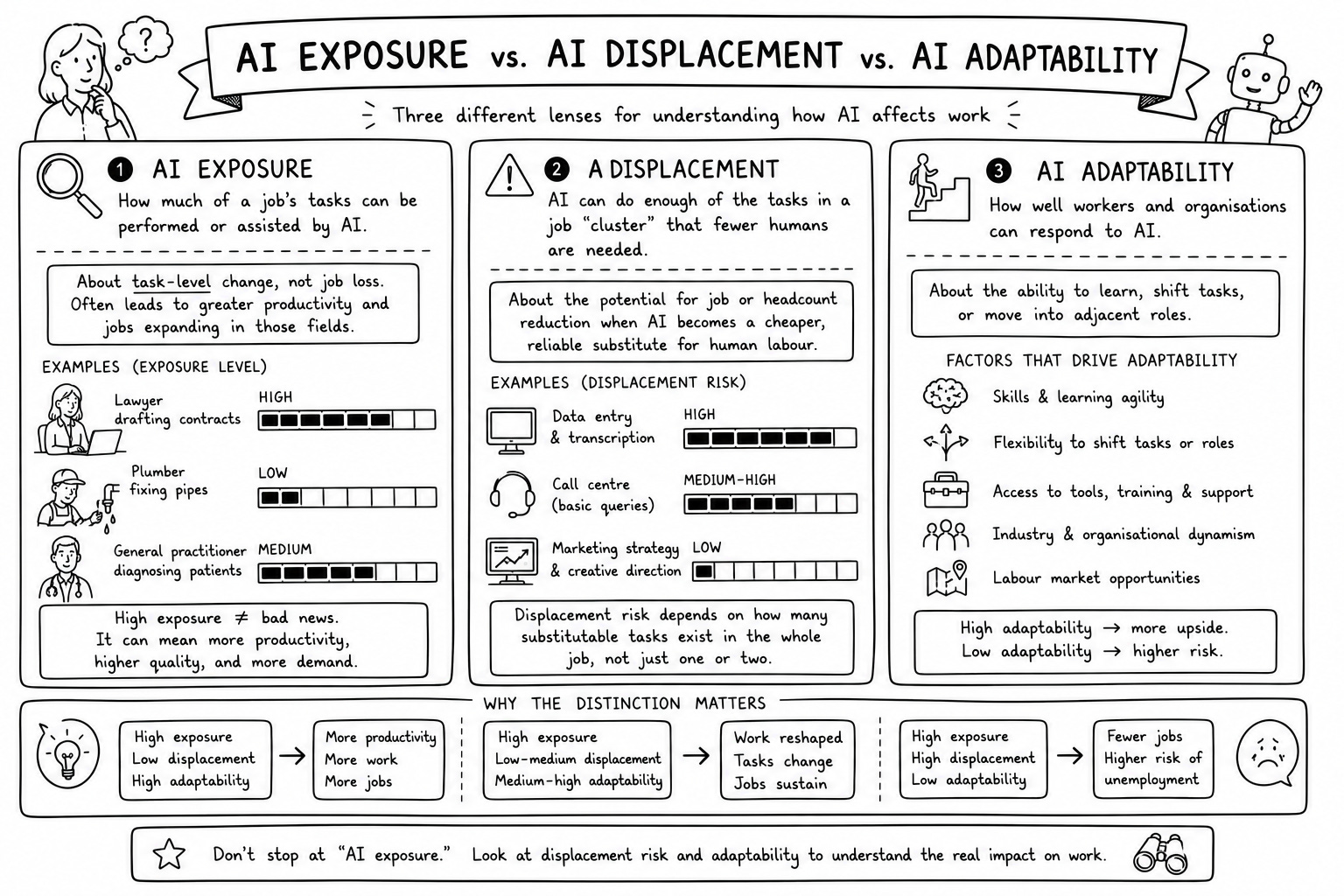
What it is: Exposure, displacement, and adaptability are three distinct ways to think about how AI affects work. Exposure means how much of a job’s tasks can be performed or assisted by AI - so this is about task-level change, not job loss (and can often lead to greater productivity and jobs expanding in those fields). For example, a lawyer drafting contracts has high AI exposure, a plumber fixing pipes has low AI exposure, and a general practitioner diagnosing patients could have medium exposure across their tasks. Displacement means that AI can do enough of the tasks in a job ‘cluster’ that fewer humans are needed - so for example, careers in data entry may high displacement risk due to AI. And adaptability refers to how well workers can respond - for example, whether by learning new tools, shifting tasks, or moving into adjacent roles.
Why we care: This is an important distinction to understand, especially at a time when there are a lot of hype-driven headlines about the percentage of jobs or people in the economy who are ‘AI-exposed’ (because exposure does not equal displacement, or even negative impacts). And understanding the displacement and adaptability picture is important for understanding where AI exposure could lead to increased productivity and an expansion of jobs, a reshaping of the way work is done without job losses, or a significant increase in unemployment.
Honestly, this can be pretty dense - well done!
But hopefully understanding these concepts will allow you to make sense of how labour markets might actually shift in coming years, and what to do about it.
Or at least, allow you to bore the pants off people at dinner parties for a few months.
Check out the next post for a breakdown of the evidence on what is actually happening right now in terms of AI and its impact on labour markets.
No posts
Comments
Nothing yet. Say the first thing.
Sign in to join the conversation.