
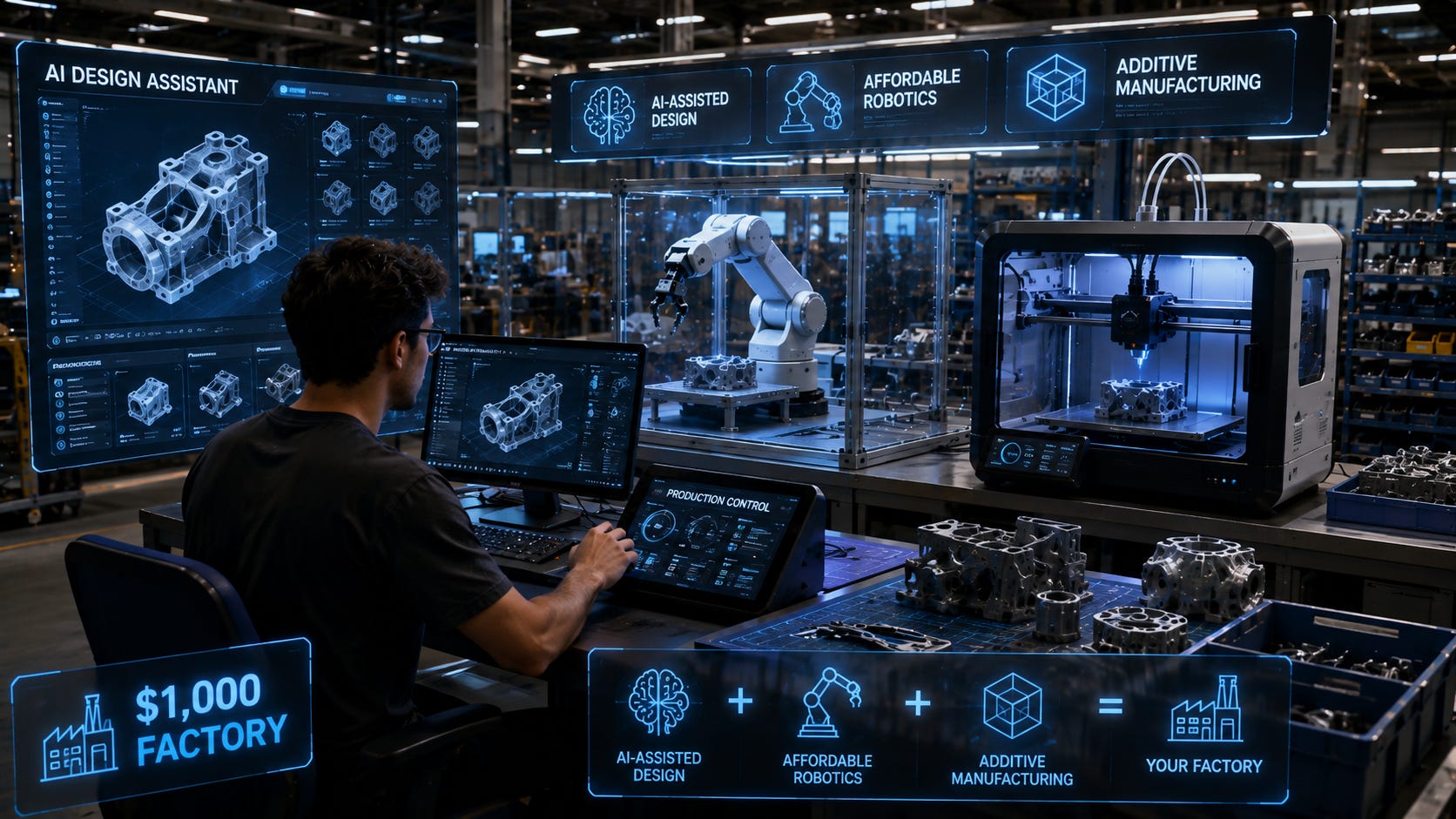
For most of the industrial age, becoming a manufacturer meant becoming a capitalist in the oldest, heaviest sense of the word. You needed a building, a production line, skilled labor, expensive machinery, and enough working capital to survive the months between spending money on tooling and actually shipping a finished product. Manufacturing was a wall, and only people with serious money, serious credit, or serious institutional backing could climb it. That wall is starting to crumble, and the reason has nothing to do with policy and everything to do with three converging technologies: AI-assisted design, increasingly affordable robotics, and additive manufacturing. Put them together, and you get something that would have sounded like science fiction a decade ago: a factory that costs about as much as a decent laptop.
To understand how radical this shift is, it helps to remember what starting a physical product business used to require. A minimum viable manufacturing setup for even a modest product line, injection molding tools, a CNC machine or two, a handful of trained operators, quality control equipment, easily ran into hundreds of thousands of dollars before a single unit shipped. Industrial robot systems alone have historically started around one hundred thousand dollars for a basic setup, before installation, training, and integration, which routinely tack on another twenty to fifty percent of the total cost. That wall didn’t just keep out amateurs. It kept out entire categories of good ideas that simply couldn’t clear the financing bar, no matter how promising the product itself was.
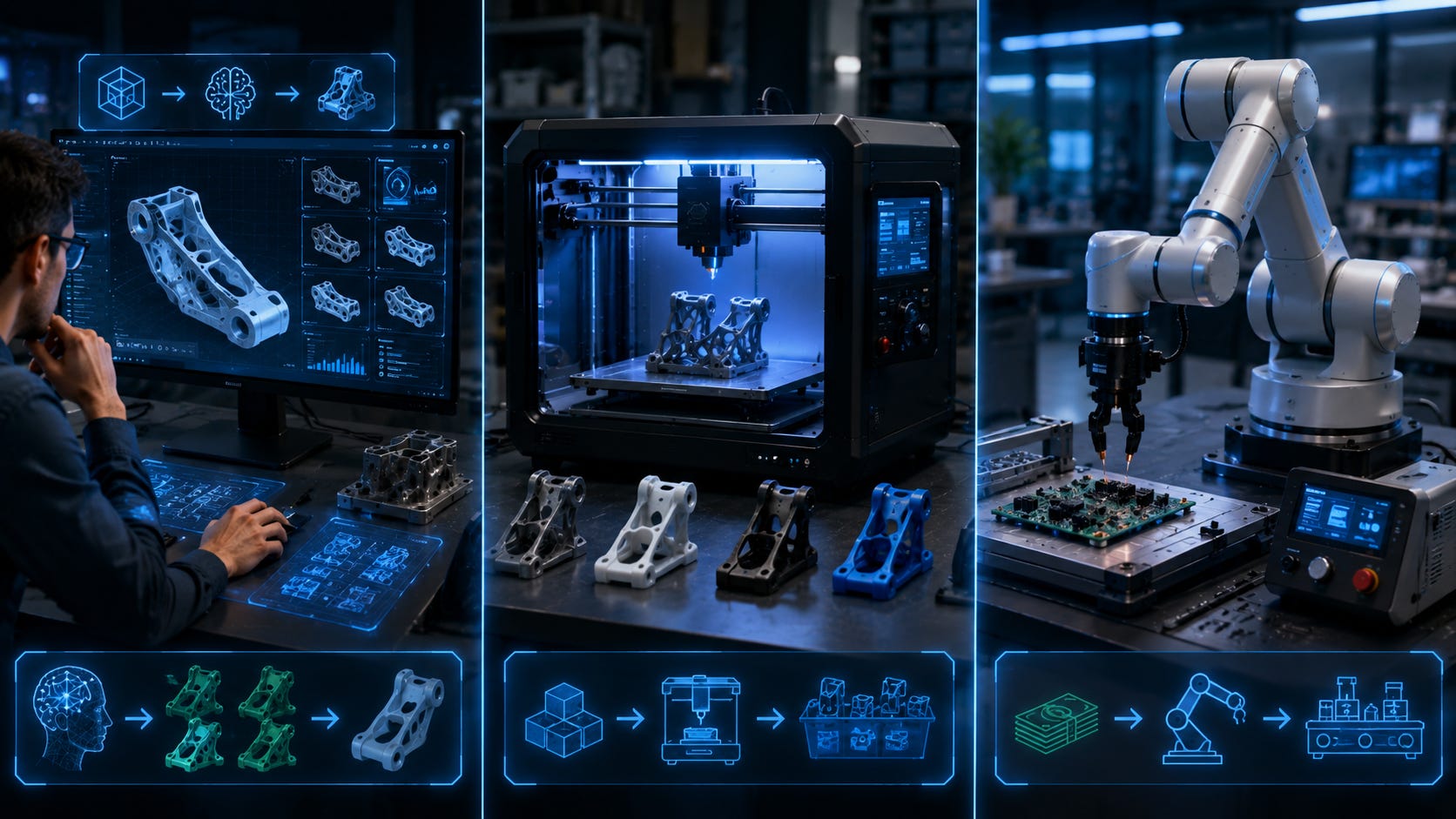
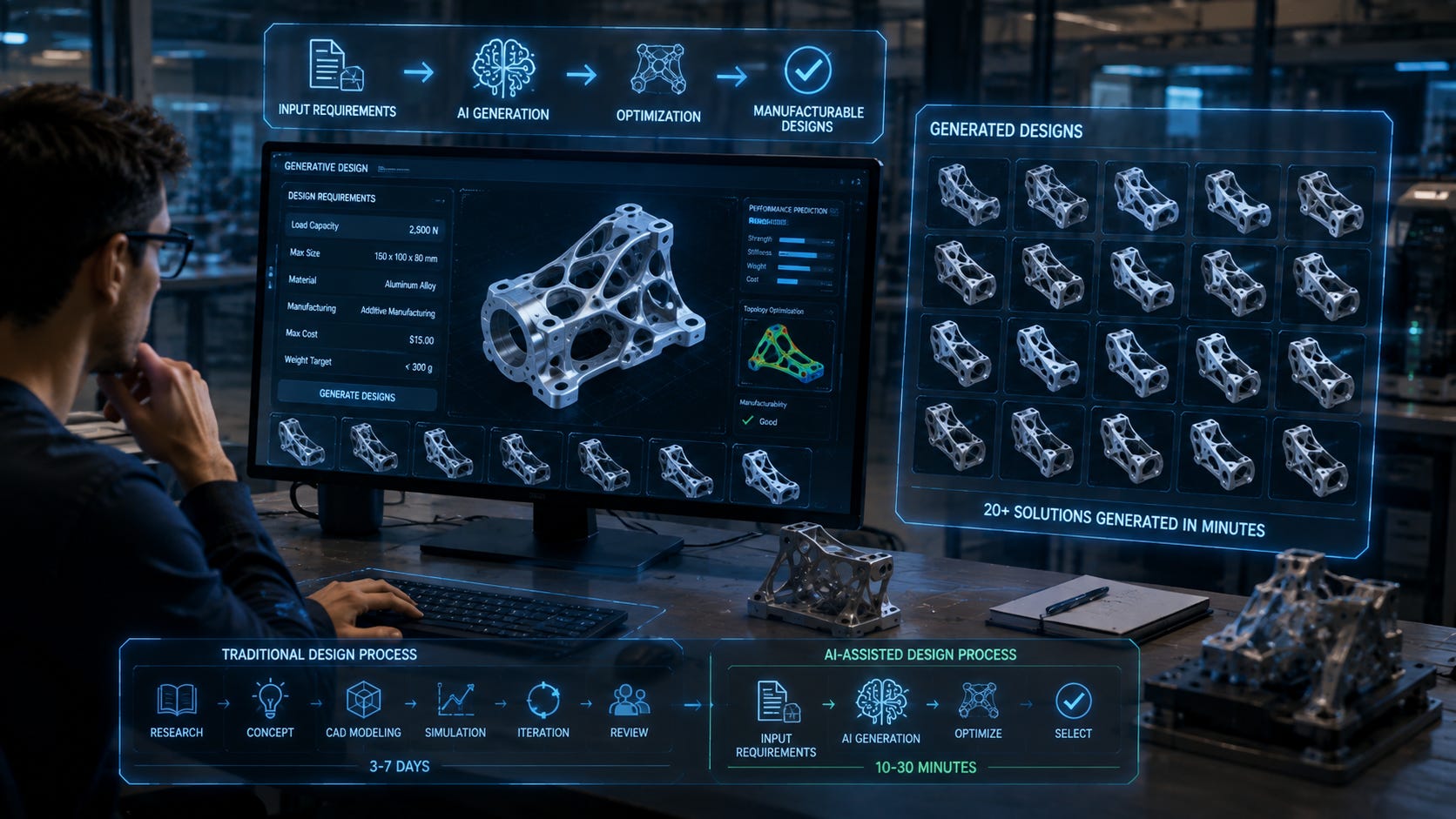
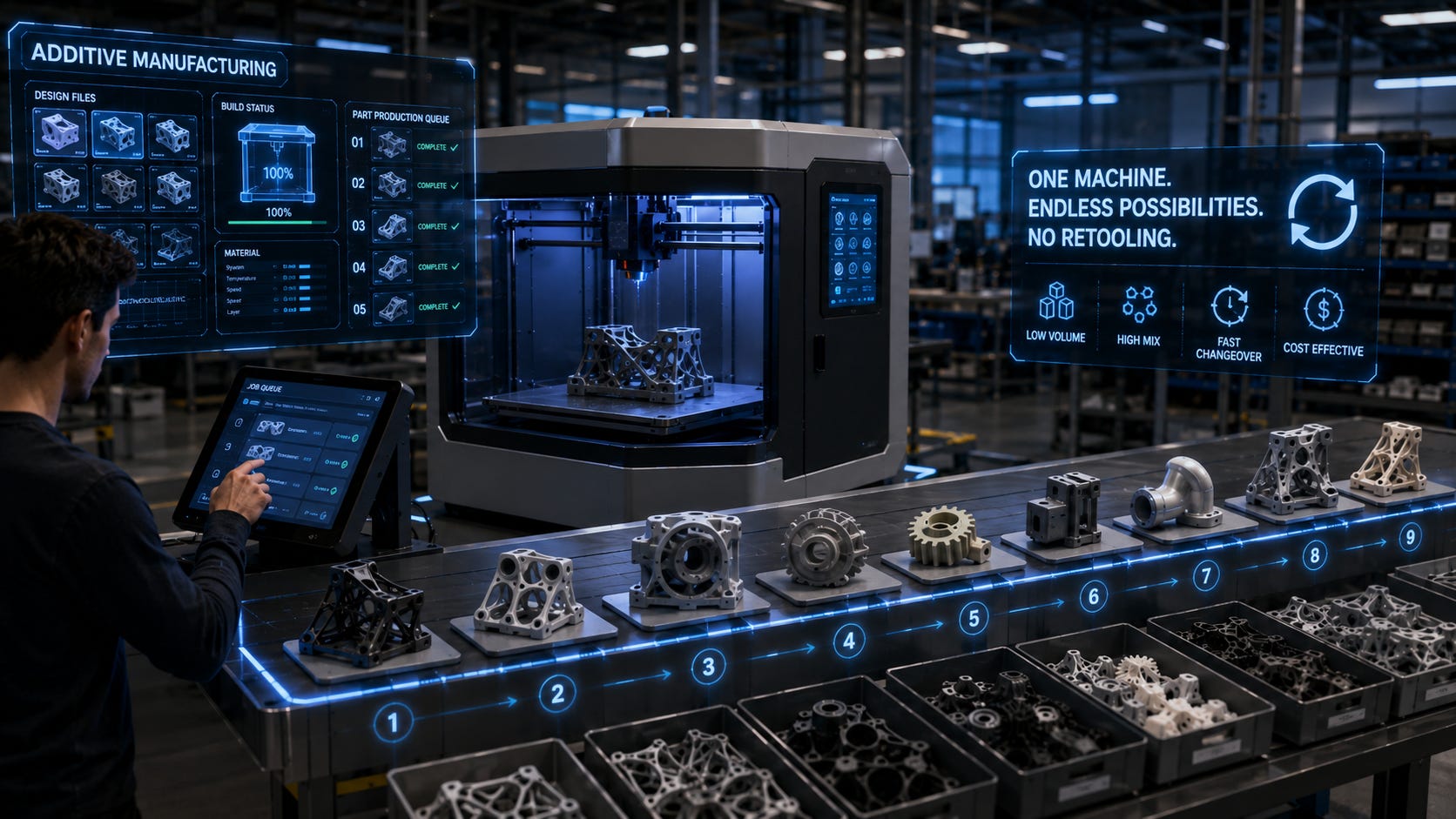
The first crack in that wall is AI-assisted product design. Generative design tools can now take a functional requirement, this part needs to hold this much weight, fit in this much space, cost this much to produce, and generate dozens of manufacturable geometries in minutes, work that used to require a trained mechanical engineer and days of iteration. The second crack is additive manufacturing, which has quietly matured from a prototyping novelty into a genuine production method for small-batch, high-mix goods, letting a single machine produce wildly different parts back to back without retooling.
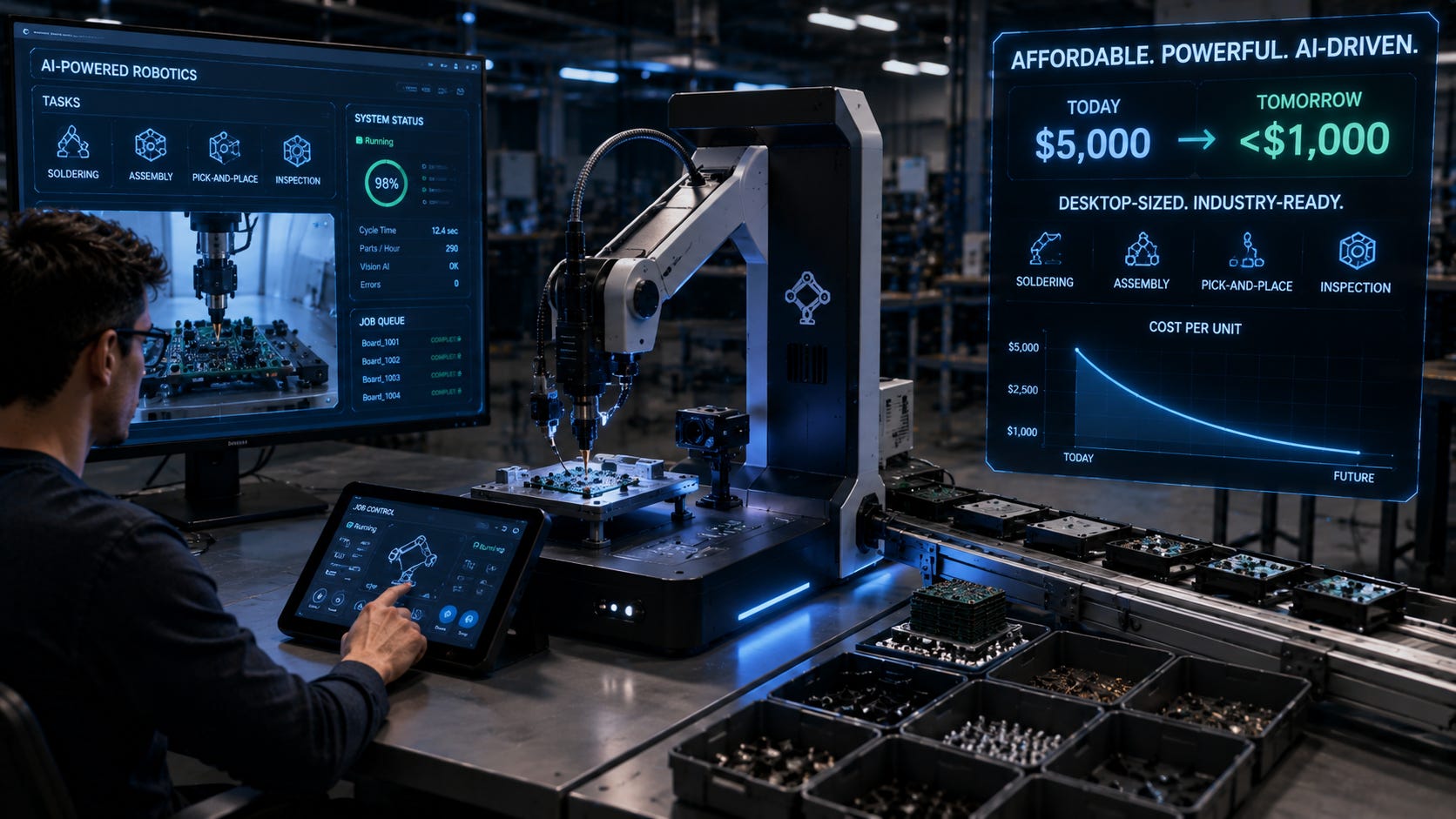
The third crack, and the one doing the most dramatic work right now, is the arrival of genuinely affordable robotics. A San Francisco robotics startup recently raised funding for a desktop-sized, AI-powered robotic system that automates tasks like soldering, assembly, and pick-and-place work, priced around five thousand dollars, with an explicit long-term goal of pushing hardware costs below one thousand dollars per unit. That’s not an incremental discount off industrial robotics. That’s a different category of machine entirely, small enough to sit on a workbench, cheap enough that a hobbyist-turned-founder could plausibly buy one on a credit card.
It’s worth taking the comparison in the original question seriously, because it’s more accurate than it sounds. Starting a website in the 2000s required a server, a domain registrar, hand-coded HTML, and enough technical skill to keep the whole thing running. Within a decade, hosting became a monthly subscription, design became drag-and-drop, and a teenager with no coding background could launch a functioning storefront in an afternoon. That collapse in cost and complexity is precisely the pattern now playing out in physical manufacturing.
Consider what a genuinely lean modern product launch could look like. An AI design tool generates and optimizes a part geometry in an afternoon instead of a week. A desktop-scale robotic cell handles the assembly and light fabrication that used to require a dedicated line. A small-batch additive manufacturing run replaces the injection mold that used to cost tens of thousands of dollars in tooling alone. None of these pieces individually eliminates the need for capital and expertise entirely, but stacked together, they collapse what used to be a six-figure barrier into something closer to a serious hobbyist’s budget. Industry analysts tracking factory robotics in 2026 note a broader trend toward lighter, cheaper collaborative hardware specifically designed to lower the infrastructure requirements for deployment, extending automation into smaller spaces and smaller budgets than traditional industrial systems ever reached.
So what actually happens when starting a factory becomes almost as easy as starting a website? The honest answer is a mix of genuine opportunity and genuine disruption, and both deserve equal attention.
On the opportunity side, we should expect an explosion of hyper-niche physical products that never made economic sense under the old cost structure. A product serving a market of ten thousand people worldwide was rarely worth the six-figure tooling investment required to manufacture it at scale. When the barrier to entry drops toward a few thousand dollars, that same niche market suddenly supports a viable business, the same way blogging platforms once made a website serving a niche audience of a few thousand readers economically sensible for the first time. We should also expect a wave of localized, on-demand manufacturing, small operators producing goods close to their customers instead of routing everything through distant mega-factories, which changes supply chain resilience in ways policymakers are only beginning to think through.
On the disruption side, the same dynamics that flooded the internet with low-quality content once website creation became trivial will likely flood physical marketplaces with low-quality, poorly designed products once manufacturing becomes trivial too. Quality control, safety certification, and genuine design expertise don’t disappear just because the tooling got cheap, and the businesses that actually thrive in this new landscape will likely be the ones that treat affordable manufacturing as a starting point for craftsmanship rather than a shortcut around it. There’s also a harder question sitting underneath all of this: what happens to traditional manufacturing labor and to the established manufacturers who built their competitive advantage on economies of scale, when a competitor with none of their infrastructure can suddenly match their unit economics on a niche product line?
If you’ve ever had a product idea and shelved it because manufacturing felt like someone else’s world, that assumption is aging out fast. The relevant skill isn’t capital access anymore. It’s the ability to combine AI-assisted design thinking with a working knowledge of what affordable robotics and additive manufacturing can and can’t yet do reliably. That’s a learnable skill set, not a inherited advantage, and it’s becoming learnable faster than most people who dismissed manufacturing as “not my world” have noticed.
This is exactly the kind of relevance gap worth paying attention to right now, not because the technology is fully mature yet, desktop robotics and generative design still have real limitations in precision, speed, and reliability, but because the trajectory is unmistakable, and the people who start experimenting early will have a multi-year head start on the people who wait for the technology to be perfect before taking it seriously.
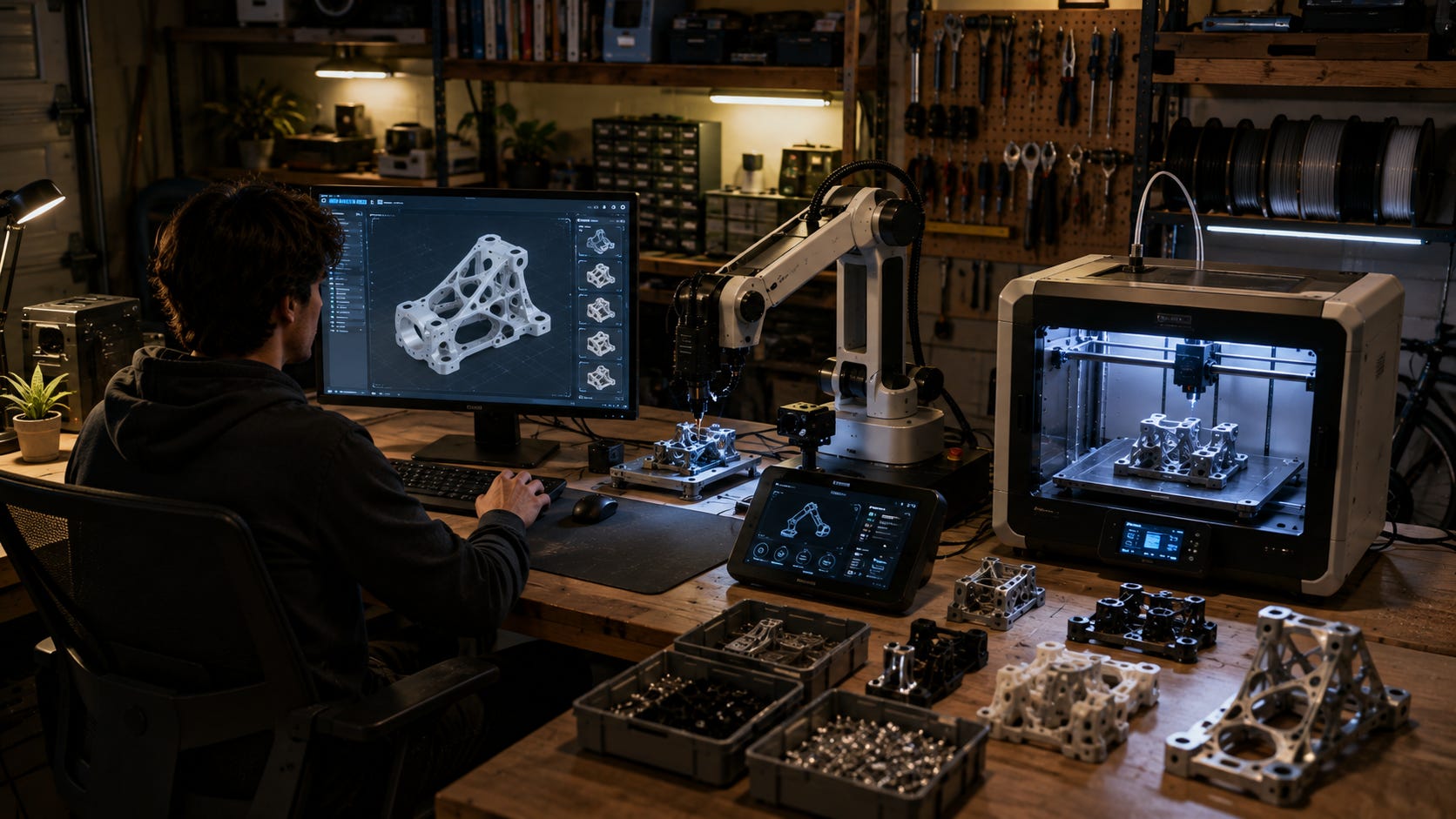
Here’s my prediction. Within the next decade, “I have an idea for a physical product” will carry roughly the same weight “I have an idea for a website” carried twenty years ago: an ordinary starting point for an ordinary person, not a credential-gated ambition reserved for people with serious capital behind them. The factories of the near future won’t all be sprawling industrial complexes. Many of them will be a desktop robot, a small additive manufacturing setup, and an AI design tool, running quietly in a garage, a spare bedroom, or a shared workshop space, operated by someone who never once thought of themselves as a manufacturer until the wall that used to keep them out simply wasn’t there anymore.
The $1,000 factory isn’t a guarantee that everyone who builds one will succeed. Most startups still fail, whether they’re built on code or on hardware. But it is a guarantee that the question of who gets to try is about to change dramatically, and that alone is worth paying very close attention to.
App Developer Magazine — MicroFactory Raises $1.5M to Scale Manufacturing Robot
Standard Bots — Robots for Manufacturers: 2026 Guide to Cost, ROI, and Use Cases
No posts
Comments
Nothing yet. Say the first thing.
Sign in to join the conversation.