
Hey,
The other day, I sat quietly and still by a bubbling small river in upstate New York for about 45 minutes and just watched.
Squirrels were playing in the trees. A chipmunk came up to me, sat back on its hind legs, and stared at me for a few seconds, trying to make sense of what it was looking at. At one point, a beautiful white-bellied duck came flapping by, skimming the water, turning hard to follow a tight bend in the river, flashing red and green feathers on its wings. Geese honked in the distance. A trout jumped for a Mayfly. And, maybe best of all, I watched the head of a mink bobbing up and down in the current as it floated downstream.
It was amazing. And it settled me for the whole day.
Get outside, people!
SUMMER REGISTRATION OPEN!: Reminder: My Confronting Education Workshop is now open for registration. I hope you’ll consider joining us for Cohort 5 of the workshop, which starts on June 26. If you’re feeling all the world craziness and the struggles education is having to deal with it, you’d be in the right place. Early Bird pricing through May 15. Reach out with questions.
FINALLY: As always, thanks for reading. As a reminder, all posts here are free, but if you want to show your support for my work in general, a paid subscription is always an option. Remember: I’m donating all proceeds from paid subscriptions to my local food pantry ($247.50 so far for 2026…) at the end of the year.
With gratitude,
~Will
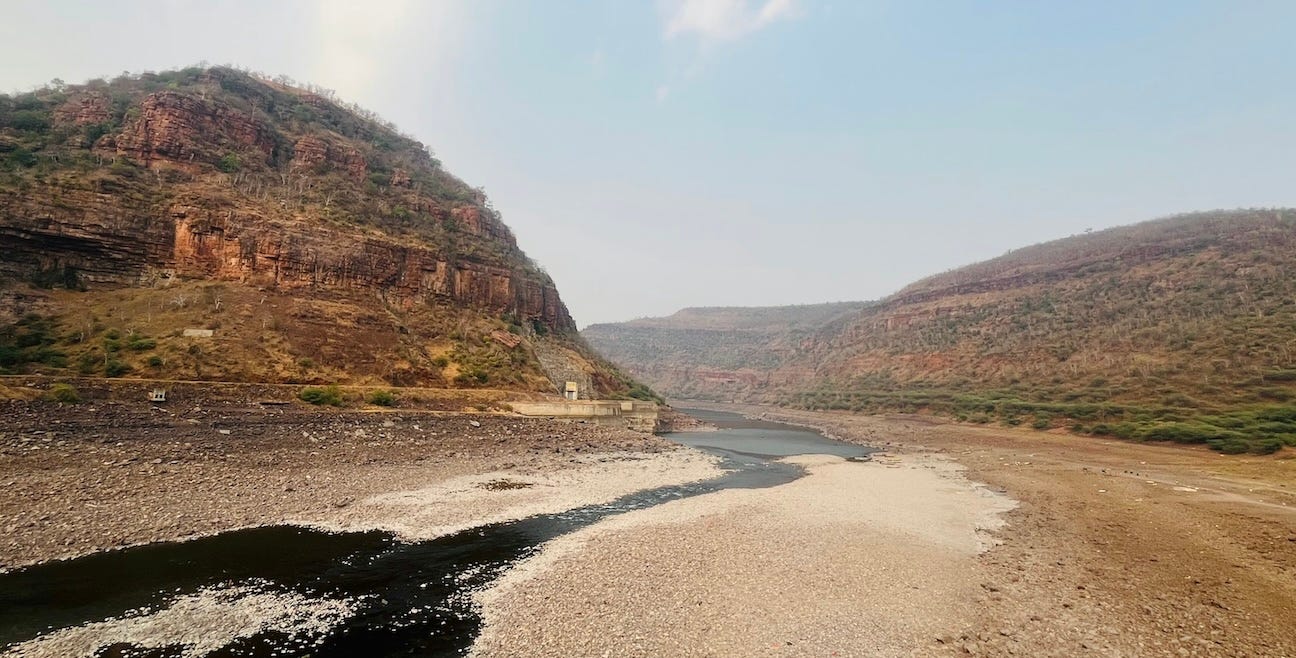
From the “I’m Not Sure What to Think Department” comes this piece in Outside magazine that argues water usage by AI processing centers is actually a minor problem. As in very minor:
For 11 weeks, I tracked all of my AI use. One hundred sessions. I counted the tokens processed and applied publicly available numbers on per-token energy and water intensity from Epoch AI and operator-reported data from Microsoft and Google. Anyone can run this math.
In those 11 weeks, I built an iOS app from scratch and wrote policy briefs on extreme heat for nonprofits I work with. I produced documentary pitch decks and drafted a 15,000-word climate fiction piece about the Colorado River collapse. I used AI every single day, often for hours at a time.
Total lifecycle water footprint of all that work: about five gallons. That accounts for everything: the water used to cool the data centers, the water consumed at power plants to generate the electricity, and the water embedded in manufacturing the hardware.
When an Outside editor reached out to ask me to write this story, I was on a trip to Marble Canyon, Arizona, to train raft guide companies on what is happening with the river. I drove my diesel Sprinter van from Tucson to the site, which tallied 383 miles at 20 miles per gallon of gasoline. When I ran the numbers later, the lifecycle water footprint of my fuel was around 110 gallons. One drive to the work I do on the Colorado River used more than 20 times the water of everything I did with AI in 11 weeks. That comparison stopped me cold—and I study this for a living.
I’m sharing this for two main reasons. First, it’s good news, if true, that efficiencies have lessened the water use of AI queries dramatically. I mean, regardless of how you think about the technology, if people are going to us it, let’s continue to try to minimize the impact.
But second, this is another example of how easy it is today to be drawn in by the narrative which happens to fit your worldview more comfortably. I mean, I know that’s been true forever. But it feels much more acute now with so many narratives competing for our attention. I read this and was arguing with it the whole time, until I accepted that the author was writing from a certain expertise for a legitimate publication that hopefully has a vetting process that confirmed the information offered. (See also.)
Still, do I discount the other narrative about the cooling centers running us dry?
It’s a full time job to try to figure out what to believe any more.
I don’t think the authors of this provocative research article are saying that we should give up all hope for surviving the next few decades. But what they are saying, namely that we shouldn’t lie to our students (in this case higher ed, but I would argue any age) about the realities of this moment and what appears to be coming.
Rob to 18-year-old daughter Ana: “Do you have hope for the future?” Ana: “What future?”
We need much more than hope as a strategy for living and learning at a time described as a psychological, social, political and environmental ‘meta-crisis’ or ‘polycrisis’ (Rakowski et al. Citation2025). In this article, we refute the received wisdom that ‘we need to provide hope’ when educating young people. Focusing on senior secondary and undergraduate education, this article explores a series of reasons why hope is often ‘obscene.’ This critical approach to hope aligns itself with the view of Munanjahli and South Sea Islander Professor Chelsea Watego, whose exhaustion with mainstream, liberal, colonial and white ‘hopefulness’ has resulted in her exclamation – ‘Fuck hope’ (Watego Citation2021). It also aligns with what young people themselves are saying. Along with Robert’s daughter in the above quote, who (happily) doubts if there is a safe future to be hopeful about, Greta Thunberg (Thunberg Citation2019), has found hope pointless at best:
“Adults keep saying we owe it to the young people, to give them hope, but I don’t want your hope. I don’t want you to be hopeful. I want you to panic. I want you to feel the fear I feel every day. I want you to act. I want you to act as you would in a crisis. I want you to act as if the house is on fire, because it is. (para. 13)”
Doing away with hope, we argue, constitutes a philosophical shift in worldviews that goes beyond fear and panic. It also goes beyond the delusional elements of hope; its palliative qualities in the face of the status quo; and the barriers it creates to the deeper sorts of critical and creative agency required in an age of the ‘meta-crisis’ (Hayden Citation2016; Stratford Citation2019, Citation2024).
That’s a heck of a lead-in to this well-researched paper that is worth reading through.
And I don’t disagree with the thesis, to be honest.
I’ll offer Joanna Macy’s idea of “Active Hope” as pretty much summing up my personal strategy here. Be honest and have a clear view of what we’re facing, identify what we desire the future to be, and then actively work to realize those desires, all the while knowing that some paths to our aspirational outcomes have already closed while others are closing.
Hoping everything will be ok, “hopium,” as many people call it, just isn’t a healthy approach right now,
I know, I know. I’m turing into an Indy Johar fan boy in these updates. But his stuff is just so damn good! And prolific.
This recent piece of rethinking our approach to “creativity” is just fascinating.
This leads to a more unsettling possibility. We have not simply built machines that can imitate us; we have become the kind of beings that can be imitated. Our thinking, our making, and our expressive forms have been shaped over time into narrow channels of production. Industrial civilization did not only organize economies; it organized cognition. It disciplined imagination into formats that could function as labor, privileging what could be reproduced, scaled, recognized, and valued within systems of exchange. Even our sense of originality sits within these constraints.
When machines begin to outperform us within this domain, they are not invading a wild territory. They are operating within a domesticated one. This is why defending creativity as it currently exists is unlikely to be sufficient. That field is already compromised, not because machines are too powerful, but because the terrain itself was structured to become computable. Nor is it enough to retreat into a romantic notion of human creativity as artisanal exception, where the human becomes a premium producer of handcrafted meaning. That move simply reproduces the same system at a different price point.
The more radical response is to break from industrial creativity itself. Rewilding creativity is not about becoming more expressive within the existing frame. It is about stepping outside the frame and recovering modes of thought and making that are not organized around output, but around transformation; not around recognition, but around encounter; not around legibility, but around depth, ambiguity, and relation.
I mean, come on. If that doesn’t get your brain spinning in good ways I don’t know what to tell you.
What emerges when you think of humans as “the kinds of beings that can be imitated” by machines? What we’re talking about here is another level of using the human mind, a level that’s “in there” but has just atrophied under the spell of modernity.
What to do?
The task, then, is not simply to protect creativity from machines. It is to unlearn the conditions that made our creativity machinable in the first place. It is to re-open the human as a site of emergence rather than function, and to re-enter forms of aliveness that cannot be easily captured, predicted, or scaled.
Sign. Me. Up.
We’ll soon find out what is truly special about human writing - Deep dive.
Question: I heard this phrase at some point this week: “Grow your soul.” How exactly does one do that?
Deezer says AI song uploads have nearly overtaken human music- Is it still music?
As nature terms disappear, so does our ability to see and protect the natural world - Really sad.
As always, let me know what you’d like to see more (or less) of in these newsletters. I’m always open to learning and evolving in ways that help you make better sense of this interesting moment.
With gratitude,
~Will
Comments
Nothing yet. Say the first thing.
Sign in to join the conversation.