
Hey,
The good news is I’m feeling my writer’s brain opening up a bit more these days. I’ve written literally millions of words in my life. To struggle with getting the ideas out is kinda weird. So it feels good to feel it freeing up. Must be spring!
The world continues to swim in precarity. I think one of the reasons I was so drawn to the moon voyage last week (even though I do think we can be spending that money in much better ways) is that something actually worked. What a concept. We humans, with the help of technology that we created, are kinda amazing when we want to be. It’s just too bad that energy isn’t focused on things that are better for life on this planet. Small feels…
SUMMER REGISTRATION OPEN!: Reminder: My Confronting Education Workshop is now open for registration. I hope you’ll consider joining us for Cohort 5 of the workshop, which starts on June 26. If you’re feeling all the world craziness and the struggles education is having to deal with it, you’d be in the right place. Early Bird pricing through May 15. Reach out with questions.
FINALLY: As always, thanks for reading. As a reminder, all posts here are free, but if you want to show your support for my work in general, a paid subscription is always an option. Remember: I’m donating all proceeds from paid subscriptions to my local food pantry ($247.50 so far for 2026…) at the end of the year.
With gratitude,
~Will
I’ve linked to Jem Bendell’s work here before, and his latest post that unpacks his deep adaptation framework is definitely worth the time. It assumes that you have already labeled yourself as “collapse aware” (which I did on my LinkedIn bio last week), and it frames the work ahead through inquiry, which I obviously appreciate. While I sometimes find it too cute by half when people try to start every word with the same letter, I think it works in this case
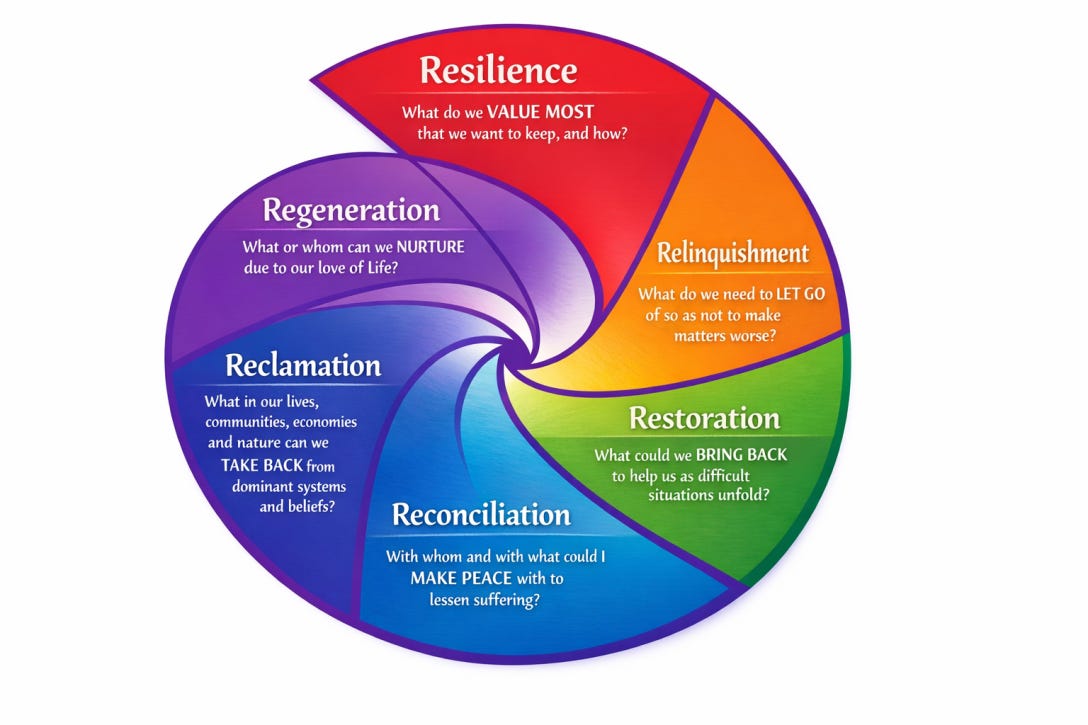
For me the question that is pulling at me the most is “What do we need to LET GO of so as not to make matters worse?” I’ve been mulling over a piece that articulates many of the conveniences we take part in at the expense of the planet, things we don’t have to do or have and yet choose anyway. Letting go is hard.
I found this part especially interesting:
I know that some people who appreciate the DA framing, and associated communities, can be hesitant to move beyond a focus on emotional coping of people in general, the collapse-aware in particular, or just themselves and their acquaintances. But if we want to embody and enable loving responses to our predicament, we can value our persistent desire to serve Life over our wish to avoid personal anxiety. We can also honour the fact that different generations have different emphases on how to become more collapse ready. Each of us will gain more from different questions in the DA framework at different times, and that is fine: as we don’t have a blueprint for how to live in a world where so much of what we knew to be real and true is now fracturing.
Also interesting is that as a group of us were discussing this framing at a recent planning session for a new conversation community we’re launching (tease), someone wondered if “Resistance” might not be a useful addition. I think I agree.
Anyway, a good starting point for some personal pondering around how we best navigate this moment.
For the last couple of years, I’ve been floating the idea with educators of making Nature a voting member of the local school board. (I cribbed the idea from the company Faith in Nature, and you can get details on how to do something like that here.) So whenever I see moves in that direction, I want to highlight the work.
Here’s a piece in the Guardian last week with the subhead that I just loved: “In a village in Norway, humans representing flora and fauna of all kinds meet to reimagine ‘nature-centric governance’.”
On the morning of the council, 38 representatives gathered at Bjerkeløkkja conference centre – all local people, all new to this. Floor-to-ceiling windows framed conifer forest and snow-dusted foothills. Chada was there representing a spider. Schneider-Marin was a Norwegian spruce, Vognild Blokhus a purple saxifrage flower. The mayor would arrive later, as a cloudberry.
The day began with a briefing, then icebreakers. When asked whose great grandparents lived in Oppdal, about half the room stood. An invitation to embody their beings elicited the odd squawk, wing flap and lumbering stride.
The council centred around a series of discussions about beings’ needs, challenges and ideas for Oppdal. Ritualistic touches, such as beings bowing in introduction, added ceremony.
A rockfoil flower wished that humans would slow down and listen “to where nature can tolerate more human activity and where it needs space”. “I’m worried there’s too much of me,” said a birch. “I thrive in open spaces, but I can take over.”
If that pushes you out of your normal headspace, good! These are the types of imaginative gatherings we need more of, not just in our local communities, but in our school communities as well. Imagine if the pond on the school property had a voice in deliberations about building and expansion. Or the birds that live on campus. Or the squirrels.
Nature is not an object. It’s a subject, one whose needs deserve a vote.
It’s been a while (I think) since I shared one of those long, complex, brain-stretching posts that require more than a quick scan and leave just a few lingering thoughts. So, before you click, grab a snack and a beverage, get comfy, and take a few deep focusing breaths…
Ready?
The Planetary Civics Inquiry is a collaboration between global thinktanks and universities that are diving into “the governance of planetary futures.” And it focuses on “planetarity,” which “is to acknowledge human coexistence with other species on Earth.” How we doing so far?
Seriously, while the .pdf is a bit wonky, there are definitely some ideas that make it worth the time. The context setting is profound. And if you get to it, the idea of “hyperobjects” is fascinating: “something so massively distributed in time and space relative to humans that they elude understanding,” i.e., climate change.
And toward the end, they dive into some interesting thinking about what learning conditions and environments might look like:
Central to our pedagogic framework will be the organising of knowledge at problem domains e.g. common goods with planetary stakes and impacts such as The Himalayas, rather than through specific disciplines. A further question therefore will be to assess how existing disciplines can fold into action/research/learning structures that are problem based to create new hybrid practitioners or capabilities. For example, how do we expand urban design and landscape-level design into adjacent pathways and towards planetary scale design? How do communication and media designers learn to develop the interfaces for new approaches to ownership, treaty-making and governance?
Organising such problem domains will centre practitioners into problem spaces. A new action/research/learning orientation and knowledge facilitation economy may be required as the capabilities and the hybridity of the new knowledge that is needed do not yet exist. Practitioners might be given action-based professorships working across multiple projects to build knowledge. The aim would be to inculcate active learning communities that document their practice knowledge, are auto-reflective, share open documentation and critical analysis, and follow peer review models.
Throughout, they frame governance through bioregions, not borders. And it’s deep inquiry, once again.
I know, I know. Maybe too much of a stretch. But hey, a little mental workout from time to time isn’t a bad thing.
The Age of AI Parenting - Are we losing touch…literally?
Half of the United States Is Now in Drought - Move along. Nothing to see here. It’ll all be ok…
Revisited Thinking: We’re all going to have to fundamentally redefine what it means to be a human on this planet. We get this, right?
The “rawdogging” trend: A new term for an ancient practice - How sitting and doing nothing is actually good for you.
I wore Meta’s smartglasses for a month – and it left me feeling like a creep - I’m shocked. No really.
As always, let me know what you’d like to see more (or less) of in these newsletters. I’m always open to learning and evolving in ways that help you make better sense of this interesting moment.
With gratitude,
~Will
Comments
Nothing yet. Say the first thing.
Sign in to join the conversation.