
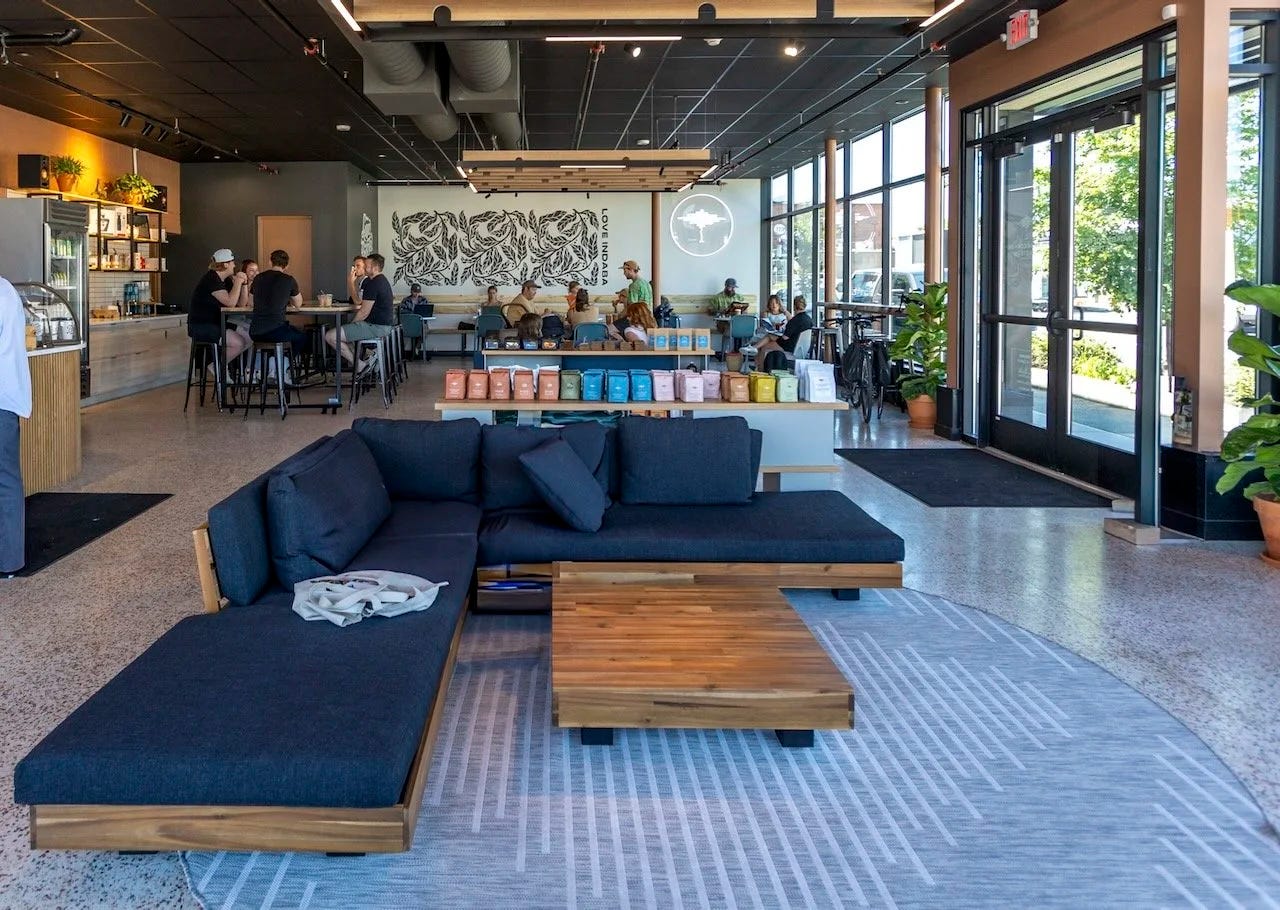
The Indaba coffee shop in a former auto showroom on a commercial strip in Spokane
Thanks for the huge response to our “Ask Me Anything” call! Thrilled to provide more responses today. The Future Of Where depends on you to keep us going, so become a paid of free subscriber today!
Alan Kandel asked:
How is smart growth faring these days?
Better than you might think at first glance. The term has gone out of vogue. But the underlying concepts are still being used.
The fundamental concept of smart growth was to create more compact, walkable neighborhoods, put them close to transit, and also put a good mix of things in them. So, for example, you might want to be a heavily used government building in a smart growth neighborhood rather than out in an auto-oriented suburban area.
Not all of this translates effectively from the 2000s to the 2020s, but a lot of it does. We talk a lot these days about “transit-oriented development” and “walkable communities,” both of which are fundamental to smart growth. The biggest change from the height of the smart growth era 20 years ago, of course, is that now housing supply is viewed as a major crisis – so far more effort is being put on building more housing.
The risk there, of course, is building high-density housing and not much else. (See my response to Schaf below.) That can cut into the whole idea of smart growth. After all, if you are going to have walkable communities, there has to be someplace to walk to.
Fred Lazare asked:
Will climate refugees help drive Rust Belt city revivals?
I think the short answer is yes, though to what extent I don’t know. Mostly on this one I’d defer to my Substack buddy Pete Saunders, the master of Midwestern urbanism, who wrote about it here only two weeks ago. Pete even imagines Rust Belt cities using climate migration as a marketing tool, just as Sunbelt cities use temperature as a marketing tool today: “Water restrictions getting you down? Coastal flooding ruining your beaches? Homeowner insurance skyrocketing? In Cincinnati, we have amazing affordability, charming neighborhoods, a great downtown – and plenty of fresh water.”
My old Ventura buddy Schaf asked:
Is Mixed Use broken? It appears that the empty ground floors of MU buildings all over are just underutilized or empty, and out of scale (20’ head heights in a 9’ neighborhood), and we keep approving them like they’re going to attract organic butchers, bespoke candlestick makers, and artisanal cheesemongers, as if Costco doesn’t have a hold of us. You could put another floor of residential units in most of that space, but then it wouldn’t be mixed.
Yeah, I suppose there are only so many bespoke candlestick makers and artisanal cheesemongers to go around, and that’s a problem. But as you say, the alternative is walls of nothing but housing, and that’s a problem too.
The notion that the ideal urban form is a few stories of residential above retail on the ground floor is an old one – centuries old in practice, of course, but more recently revised as American urban planners have tried to figure out how to get past the suburban form. My own introduction to the idea came in large part from the work of William H. Whyte Jr., who created both the book and film called The Social Life Of Small Urban Spaces (and not incidentally had been Jane Jacobs’ editor at Fortune magazine).
Holly White strongly believed that you had to have ground-floor retail to have a vibrant street life and he was right. That view – and his films – influenced a couple of generations of planners grappling with the question of higher density development, especially housing, along commercial strips.
As developers became interested in building multistory housing in formerly commercial areas, planners – especially in the Los Angeles area – got into the habit of requiring ground-floor commercial space as a condition of approval. Developers went along with this in order to get their projects approved, even though they didn’t really like it. They viewed the commercial space as a giveaway amenity, kind of like a park. Their lenders wouldn’t let them include any potential revenue from the commercial space in their pro forma, so they didn’t put a whole of effort into leasing the space.
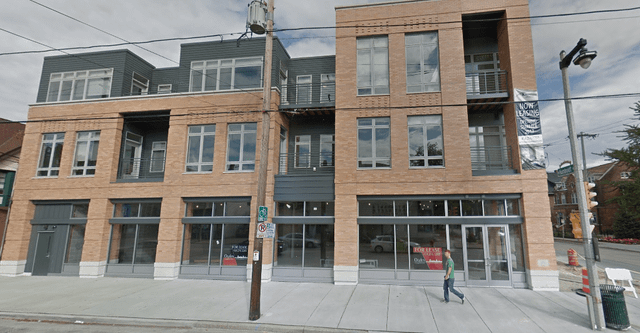
An empty commercial space in a mixed-use building. Source: Strong Towns
And at the same time, of course, the demand for small retail spaces in apartment buildings on commercial corridors wasn’t as great as it was in Holly Whyte’s day. As Schaf points out, we all go to Costco now, or at least Target, or we order everything through Amazon. There’s simply not as much call for a corner store as there used to be.
So somebody builds one four-over-one podium building on a commercial strip, surrounded still by used car lots and stuff like that, and the building has retail space that’s hard to lease. Maybe a small coffee shop moves in. The developer just
Comments
Nothing yet. Say the first thing.
Sign in to join the conversation.