
There’s a number almost nobody calculates, because calculating it feels like rubbing salt in a wound: the gap between what you actually paid the tax authority last year and what you legally owed.
For most self-employed people, freelancers, small business owners, and even salaried high earners, that gap is not zero. It’s not a rounding error either. It’s the home-office proportion of your electricity bill you never claimed. The professional subscription buried in your bank statements. The mileage you didn’t log. The retirement contribution structured the expensive way. The credit you didn’t know existed.
The reason this money stays on the table is boring and universal. The most common reason deductions go unclaimed is simply that the taxpayer didn’t know the deduction existed — the tax code is dense, and most people focus on the deductions they’ve always taken rather than researching what else might qualify. A freelancer knows to deduct their accounting software but never thinks their online courses, professional association dues, or coworking membership are equally deductible. In the UK it’s the same story: business owners filing Self Assessment can cut their bill by claiming overlooked expenses like a proportion of household bills, software, and marketing — but only if they know to.
Here’s what changed. The exact same technology that everyone is (rightly) warned about for filing your taxes turns out to be genuinely, quantifiably good at finding what you’re missing.
I don’t say this lightly, because most of what I write is about the dangerous overselling of legal and tax AI. But the numbers on the discovery side are real.
AI accounting tools now analyze every transaction a business makes and match spending patterns against comprehensive deduction databases, surfacing deductions that most owners would never think to look for. These aren’t obscure loopholes — they’re legitimate, well-established tax benefits that people simply don’t think to claim. One firm reported using AI-driven scenario modeling to uncover $250,000 in additional tax savings for high-net-worth clients in a single quarter. At the macro scale, one analysis estimates AI could save taxpayers and accountants as much as $256 billion in productivity by cutting up to 62% of the time spent on tax filing.
That’s the promise. And for once, it’s not entirely hype. If your problem is “I don’t know what I don’t know,” an AI that reads your whole year of transactions and cross-references the code is a legitimately powerful tool.
Now the part the marketing buries.
The same tool that brilliantly finds a deduction will, with equal confidence, invent one that doesn’t exist — or misstate the rule for one that does. And unlike a bad accountant, it never hesitates.
This isn’t speculation. When tested on standard tax scenarios, leading AI systems routinely made big mistakes — misapplying thresholds, miscalculating liabilities, and incorrectly determining eligibility for common credits that millions of taxpayers rely on. One study found that state-of-the-art models correctly calculated less than a third of federal income tax returns even on a simplified sample set. Would you keep an accountant with a 30% success rate? The danger isn’t just that AI gets things wrong — it’s that it gets them wrong with confidence. A chatbot doesn’t hesitate or flag uncertainty.
And the errors aren’t only arithmetic. They’re temporal. Tax law changes every year, and models trained on last year’s internet don’t know it. A West Virginia University accounting professor tested this directly: she asked ChatGPT whether tip income was taxable, and it told her, incorrectly, that no federal law made tip income tax-free and that tips remained fully taxable — missing the deduction created by the One Big Beautiful Bill Act. Her conclusion: individuals unaware of recent tax law changes could unknowingly rely on outdated AI information and under- or overpay their taxes.
Here’s where most people ask the wrong question. They ask: “Which AI can I trust to do my taxes?”
Wrong question. The answer is none of them, and the reason is the single most important sentence in this newsletter:
When you sign that return, the liability is 100% yours — no matter what tool produced the numbers.
The IRS could not be blunter. No safe harbor protects you from liability based on reliance on algorithmic outputs. If the AI is wrong, the IRS treats that error as your mistake. As one adviser put it: AI can help you get organized, but you sign the tax return — and you pay the penalties and interest if you’re wrong. The UK works identically: with HMRC, if an error is discovered you pay the underpaid tax plus interest, and in serious cases penalties can reach up to 100% of the tax due on wrongly claimed amounts.
So the right question is not “which AI can I trust?” It’s:
“What system lets me use AI to find every dollar I’m overpaying — while making its confident errors impossible to file?”
That’s a completely different problem, and it has a real answer. The people who get burned treat the chatbot as an oracle. The people who save thousands treat it as a bloodhound: something that sniffs out opportunities you’d never have found, which you then verify against primary sources before a single number touches your return.
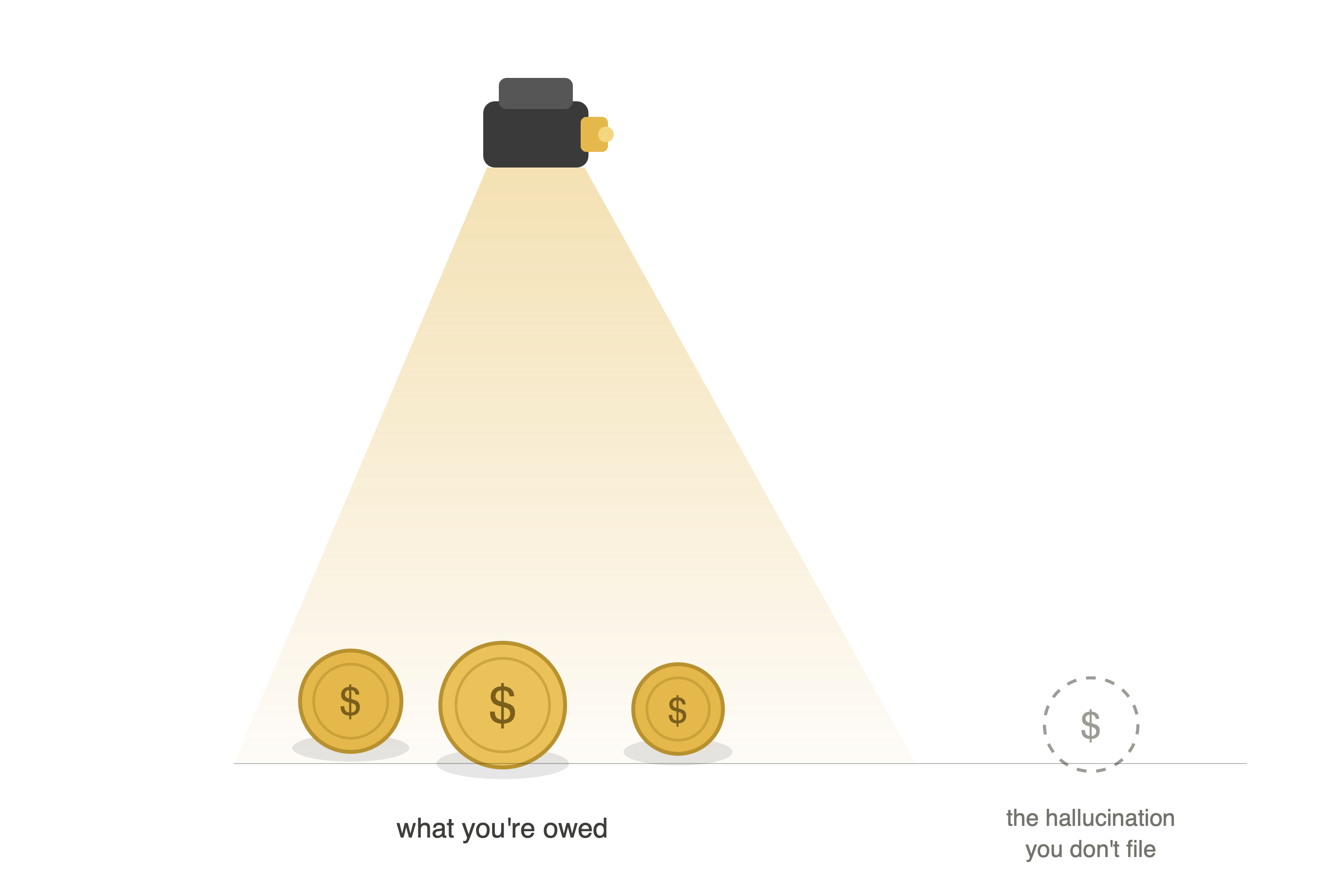
The AI is not the accountant. The AI is the flashlight. You are still the one deciding what’s real.
There’s a second, quieter reason to build the system rather than wing it: confidentiality. When you paste your income, national ID number, and financial life into a consumer chatbot, that data leaves your control — and a New York federal judge has already ruled that a defendant’s conversations with an AI platform about strategy were not protected by privilege and did not qualify as work product, reasoning that could extend to civil matters including tax disputes. Where your data physically goes stopped being an IT question. It’s now part of the system.
The free verdict:
AI won’t file your taxes. It will show you exactly where you’re bleeding money — and it’s on you to verify before you sign. Used as an oracle, it’s a liability. Used as a discovery engine with a verification gate, it’s the cheapest tax adviser you’ll ever have.
The premium edition below is that engine, built step by step: the exact workflow, the prompts that make the model findinstead of invent, and the verification protocol that keeps a hallucinated deduction from ever reaching your return.
This section is for paid subscribers.
The build-it-this-weekend system for using AI to legally cut your tax bill — without ever filing a hallucination. No theory. The workflow, the prompts, the guardrails.
Part 1 — The Two-Job Rule (the mental model that keeps you safe)
Why AI has exactly two jobs in tax — discovery and explanation — and why letting it do a third (deciding/filing) is how you end up owing penalties
The “flashlight, not oracle” framing translated into a concrete workflow
A one-page decision tree: which tasks are safe to hand the model, which must never leave your desk unverified
Part 2 — The Discovery Pass (finding money you’re leaving on the table)
The transaction-audit prompt: feed the model a year of statements and force it to surface candidate deductions it flags as “verify,” never “claim”
The overlooked-category checklist AI is unusually good at catching: recurring subscriptions, home-office proportion of utilities/insurance/council tax, mileage, Section 179 / capital allowances, professional dues, pension structuring, QBI
US and UK/international variants (IRS deductions vs HMRC “wholly and exclusively” allowable expenses, trading allowance, flat-rate homeworking)
The high-earner layer: tax-loss harvesting, wash-sale traps across accounts, entity-structure scenario modeling
Part 3 — The Anti-Hallucination Protocol (the part that actually saves you)
The single biggest ChatGPT tax trap — stale law — and the prompt that forces the model to date-stamp every rule and admit when it can’t confirm the current-year figure
How to catch the “misgrounded” answer: a real deduction, cited correctly, applied to a situation where it doesn’t qualify
The sycophancy trap: why the model agrees with your wrong premise (”so I can deduct my whole rent, right?”) and the exact phrasing that stops it
The copy-paste verification prompt that makes the model argue against its own suggestion and flag its confidence level
The primary-source rule: how to make the model hand you the IRS Publication / HMRC helpsheet number so youcan confirm in 60 seconds
Part 4 — The Confidentiality-Safe Setup
What you must never paste into a consumer chatbot (ID numbers, full financials) — and why the privilege ruling makes this a real risk, not paranoia
The redaction workflow: getting the model’s help without handing over identifying data
When to step up to a local or enterprise-grade tool, and the cheap way to do it
Part 5 — The Verify-and-File Handoff
The mandatory pre-file checklist — every AI-surfaced deduction traced to a primary source before it touches your return
What AI can and can’t replace: the short, honest list of when you still need a human CPA / chartered accountant
The current-year figure sheet: thresholds and rates that changed this year and that models get wrong (US OBBBA changes; UK Making Tax Digital from April 2026, trading allowance, mileage rates)
A plain-English record-keeping standard that survives an IRS notice or HMRC enquiry
Comments
Nothing yet. Say the first thing.
Sign in to join the conversation.