
For most of the past three years, the AI story has been told through software.
New models. Better benchmarks. Smarter assistants. Lower inference costs.
But the most important AI announcement I saw this week had very little to do with software.
Brookfield and NextEra plan to build a $100 billion data center and power campus on a former uranium enrichment site in Paducah, Kentucky.
The location is almost too symbolic.
A site built in the 1950s to produce enriched uranium—first for nuclear weapons, then for reactors—could now become one of the physical foundations of the AI economy.
The project is expected to provide more than 1.2 gigawatts of computing capacity. NextEra plans to develop up to 2 GW of natural-gas generation and 2.6 GW of battery storage, with operations targeted to begin in 2028.
Why build it there?
Because the site already has what AI increasingly needs: transmission capacity, water, fiber and industrial infrastructure.
That is the larger shift I’m watching.
AI is no longer constrained primarily by the quality of its algorithms. It is increasingly constrained by the physical systems surrounding them: power plants, optical networks, cooling equipment, chip packaging, memory bandwidth and factories capable of building machines at scale.
The next stage of AI will not be won only by the company with the smartest model.
It may be won by the companies that can connect, power and deploy intelligence in the real world.
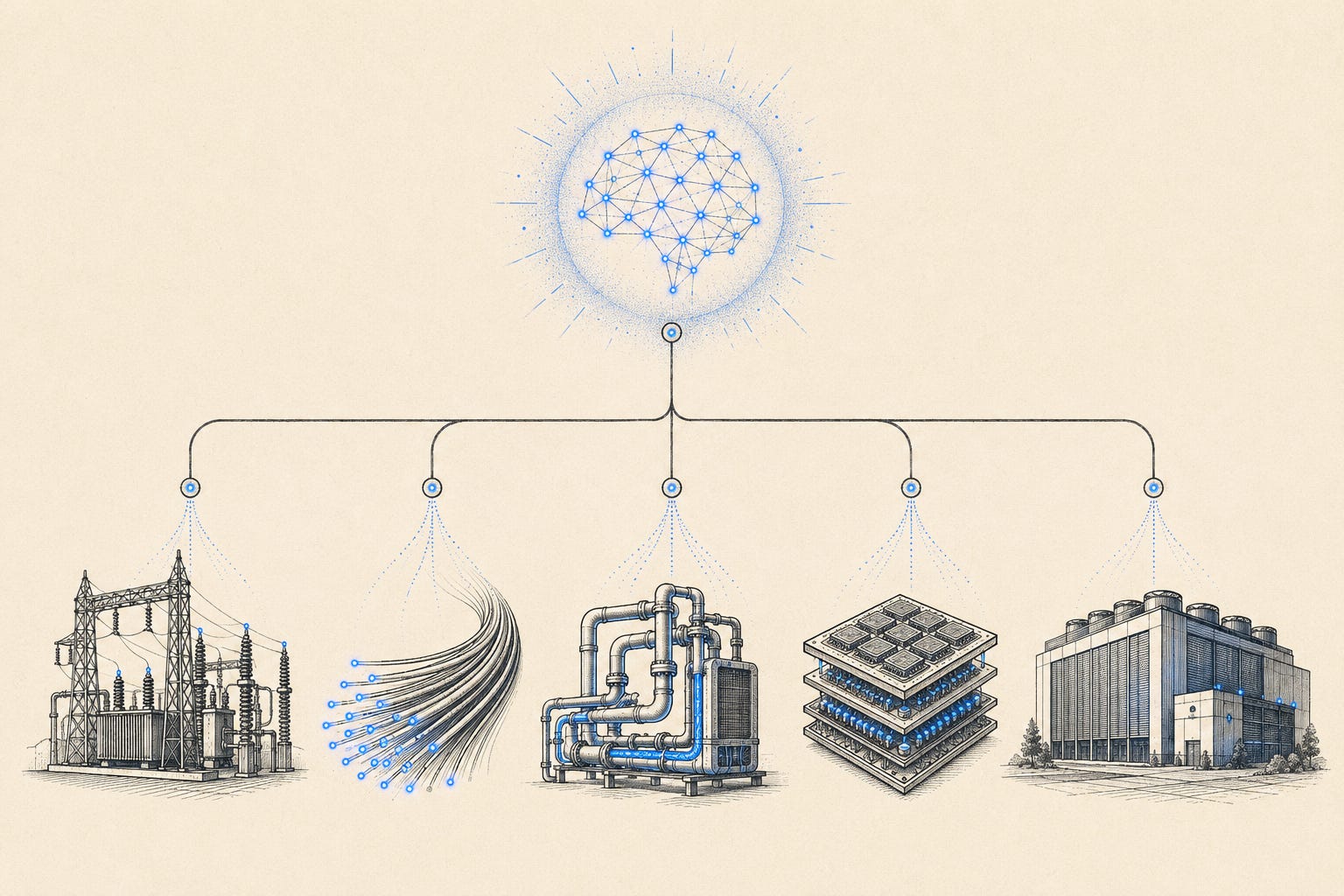
Brookfield and NextEra announced plans for a data center and power complex in Paducah, Kentucky. The campus would combine server infrastructure with dedicated energy generation and storage, rather than waiting for the existing grid to catch up.
The project remains subject to final agreements, but the intended scale matters on its own.
I think the phrase “data center” is becoming misleading.
These new projects are closer to vertically integrated industrial cities: they need their own energy supply, water, fiber, batteries, security and long-term access to land.
That changes where value is created. The beneficiaries are no longer limited to GPU manufacturers and cloud platforms. Utilities, electrical-equipment suppliers, fiber producers, engineering firms and energy developers are becoming part of the same AI stack.
It also creates a new competitive advantage: time to power.
The best AI chip is useless if it sits in a facility that cannot connect to the grid for another five years.
That is the planned investment associated with the Paducah campus—larger than the annual economic output of many countries.
Eliyan raised $145 million at a $1 billion valuation to develop technology that moves data more efficiently between AI chips.
Its investors include Cisco and Lumentum. The company plans to license its interconnect technology and sell chiplets that can be integrated into custom AI processors.
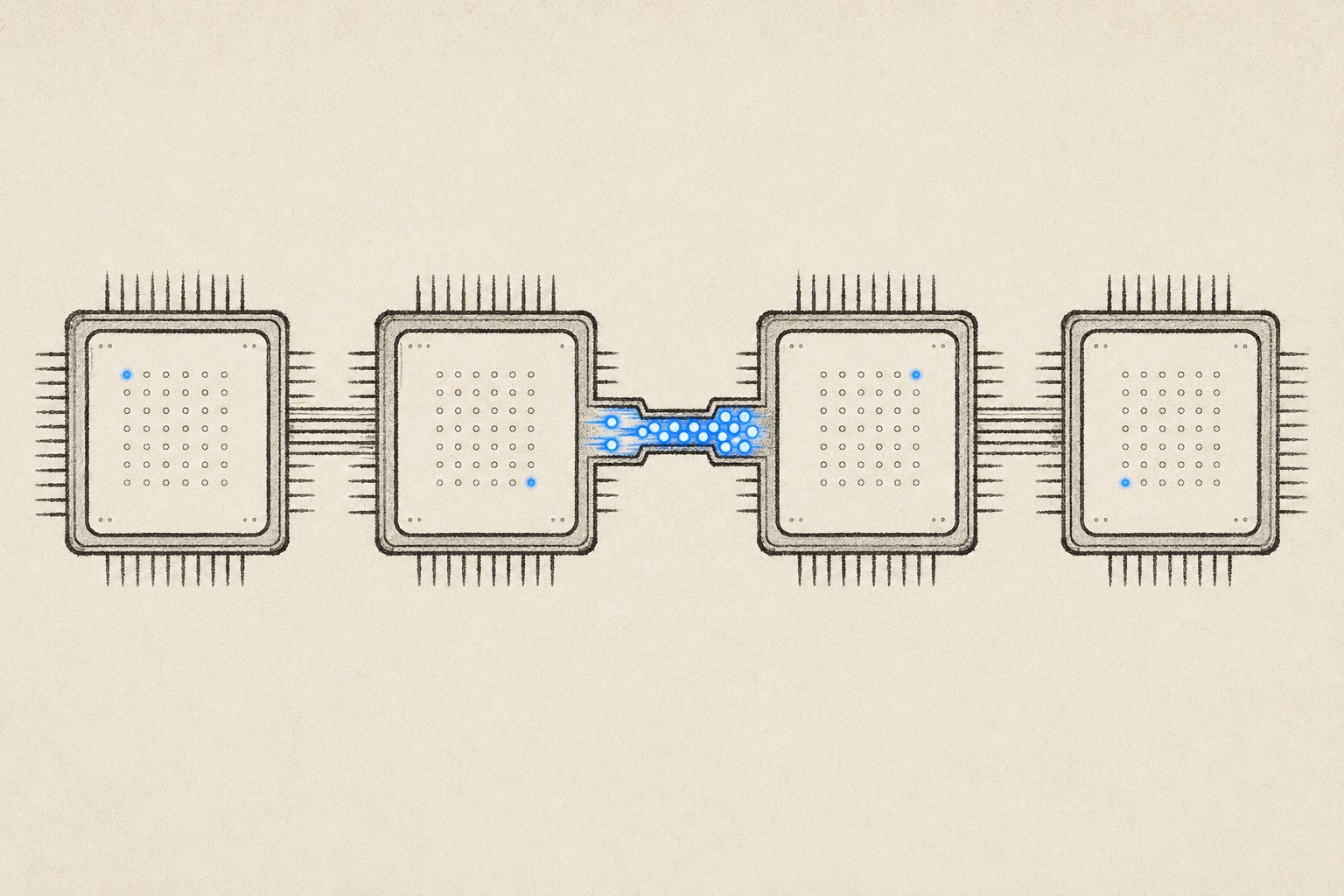
The AI race is usually presented as a contest to build faster processors. But a processor is only valuable when it receives enough data to stay busy.
Eliyan’s CEO estimates that only 30% to 40% of GPU capacity may actually be utilized in some systems because data cannot move fast enough. That is the company’s estimate, not an industry-wide audited figure, but it points to a real architectural problem: compute has improved faster than connectivity.
This is why I keep returning to networking and optical infrastructure.
When a company spends billions of dollars on GPUs, even a modest increase in utilization can be enormously valuable. The economic opportunity is not only to sell more compute. It is to make the compute already installed perform more useful work.
Eliyan’s estimate of current GPU utilization in bandwidth-constrained systems.
ChipAgents added $60 million to its Series A, bringing the round to $131 million.
The 64-person startup uses AI agents to accelerate semiconductor design, particularly verification—the long and expensive process of finding out whether a chip will actually work as intended.
It is also expanding a strategic collaboration with Nvidia to develop a specialized AI model for chip design.
This is one of the most credible forms of the “AI improves AI” loop.
Chip development can take years and cost hundreds of millions of dollars. Verification is especially painful because a mistake discovered after manufacturing begins can be extraordinarily expensive.
If agents shorten that cycle, they do more than reduce engineering costs. They make it possible for more companies to design specialized chips for narrower workloads.
That could accelerate the shift from a market dominated by general-purpose GPUs toward a more diverse ecosystem of custom accelerators.
My view is that this will expand the semiconductor market rather than simply destroy the existing design-software incumbents. Cadence and Synopsys are already adding agents to their own products. The real question is whether the new AI-native startups can create a sufficiently large advantage before the incumbents absorb the same capabilities.
The total size of ChipAgents’ Series A—remarkable for a company with roughly 64 employees.
OpenAI launched a program that aims to give 100,000 scientists, mathematicians and engineers free access to frontier AI models through 2027.
The first 10,000 researchers are expected to join this summer. OpenAI says roughly 1.3 million people already use ChatGPT for advanced science and mathematics each week, generating about 8.4 million messages.
Consumer AI made intelligence cheaper. Scientific AI could make experimentation cheaper.
That distinction matters.
Writing a faster email is useful, but it does not create an entirely new industry. Helping a researcher generate a hypothesis, analyze genomic data or test a mathematical proof can.
I do not expect a sudden “AI discovers everything” moment. Research still depends on good questions, reliable data, physical experiments and expert verification.
But giving frontier tools to 100,000 researchers creates an enormous distributed experiment. Even if only a small fraction produce meaningful breakthroughs, the downstream value could be substantial.
The companies I would watch are not only the model providers. I would also watch the businesses that own unique scientific datasets, laboratory automation systems and the infrastructure required to validate AI-generated ideas.
This week, Eliyan is the startup I would keep on the radar.
Not because every technical claim will necessarily translate into commercial success, but because it is attacking a problem that becomes more valuable as AI spending increases.
Eliyan’s technology is designed to connect chiplets and processors using a more open architecture. The company wants to become an independent alternative for businesses designing custom AI chips, rather than forcing them to depend entirely on one vendor’s networking stack.
There are three reasons I find the company interesting:
It targets utilization, not just capacity. Making existing GPUs work harder can create an immediate economic return.
It sits inside the custom-chip trend. Google, Amazon and other hyperscalers increasingly want silicon optimized for their own workloads.
Its strategic investors make sense. Cisco understands networking, while Lumentum sits directly inside the optical-connectivity ecosystem.
The risk is execution. Semiconductor startups face long development cycles, demanding customers and powerful incumbents. Eliyan expects initial chiplet shipments this year and forecasts hundreds of millions of dollars in sales by the end of 2027, versus low millions in 2025. I would treat that as an ambitious company forecast—not a guaranteed outcome.
Still, the bottleneck it is addressing is real.
And in infrastructure markets, owning the solution to a bottleneck is often more valuable than owning the most visible product.
Robotics startups raised $18.8 billion globally in the first part of 2026, according to Crunchbase data. That is already above the $15 billion raised during all of 2025 and the $14.1 billion recorded in 2021.
What changed?
Investors no longer see robotics only as an expensive hardware category. They increasingly see it as the physical deployment layer for AI.
I think the enthusiasm is directionally justified, but the valuations deserve caution. Robotics businesses still need manufacturing, supply chains, maintenance and real-world reliability. A robot that performs beautifully in a demonstration is not necessarily ready to work eight hours a day in a factory.
The important signal is not that every humanoid startup will win. It is that capital is rapidly assembling the supply chain needed to move AI from software into machines.
Read the robotics funding overview
The common thread running through this entire edition is connectivity.
Larger data centers need more fiber. Faster chips need faster interconnects. Distributed AI campuses need enormous amounts of data to move with minimal latency and power consumption.
That is why we recommend reading the latest Macro Notes investment thesis on the fiber-optics market.
The easy version of the AI trade was buying the companies that make GPUs.
The more interesting version now is identifying the physical bottlenecks created by those GPUs—and the less obvious companies paid to remove them.
The report explains:
why copper connections are reaching their practical limits;
where optical connectivity enters the AI architecture;
which parts of the value chain have real pricing power;
how the different layers of the value chain could benefit;
which risks could invalidate the thesis;
and how Macro Notes is positioning around a market that could reach $73 billion.
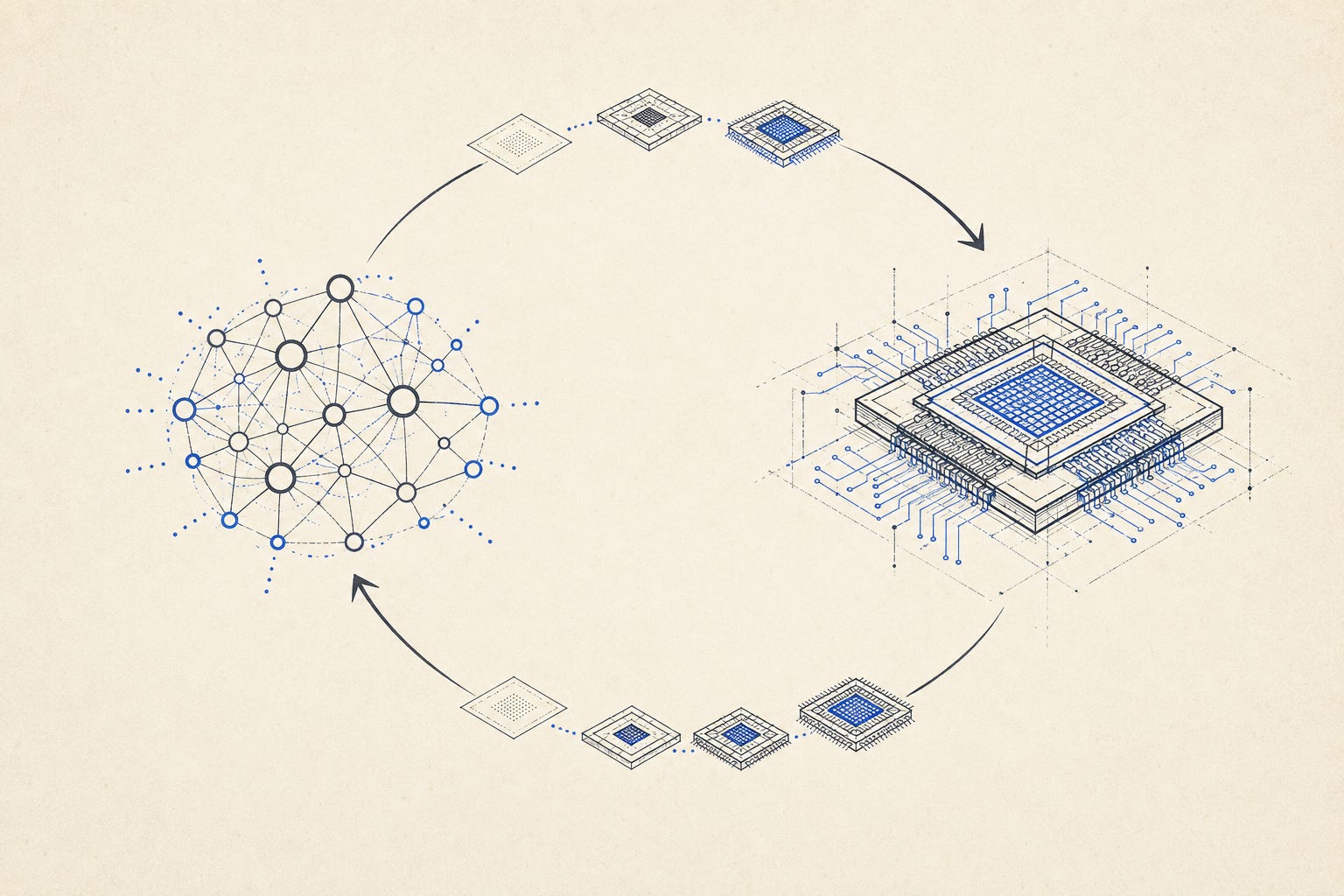
If compute is no longer the only scarce resource, which layer becomes the next toll road of the AI economy?
Our answer is not one company or even one sector.
It is a group of physical bottlenecks: electricity, networking, cooling, memory bandwidth and advanced packaging.
Below, for Premium members, we rank these five bottlenecks using four criteria—scarcity, pricing power, time required to add supply and the risk of commoditization. We also explain what could break each thesis, which indicators we would monitor and where the market may still be underestimating the opportunity.
Comments
Nothing yet. Say the first thing.
Sign in to join the conversation.