
Future Forward Wichita launched on Thursday, November 7 with a thoughtful conversation around a handful of signals of change and an emerging trend. Thank you to everyone who attended! We have such smart, creative, compassionate, open-minded and thoughtful people in the Wichita metro area. Our future will be brighter because we have cooperative conversations like this one.
Some highlights of the meeting include:
Signals of Change
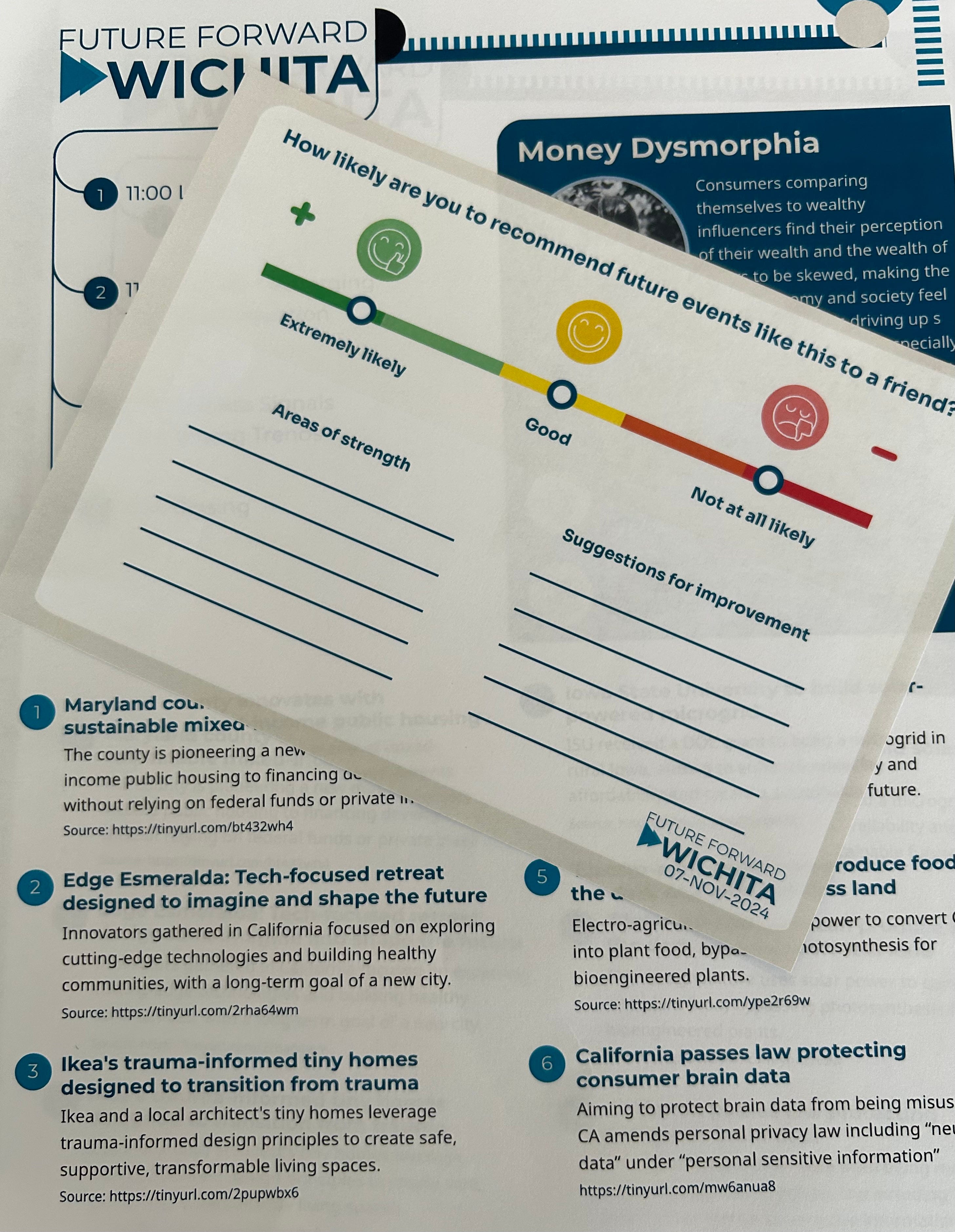
A Maryland county pioneering an innovative model of mixed-income public housing to financing developments without relying on federal funds or private investors. Insights: Wichitans, like most Americans, are struggling with housing (both ownership and rental) costs driven up by limited supply compared to demand. Innovative models like the one above can not only stretch public funding and turn it into recurring income that can be reinvested to maintain properties, but create local jobs and diverse, inclusive communities. How can our city, county and state leverage tax dollars in more creative ways that allow a single funding to become revolving? How can these revolving funds meet the intended needs, over and over, but also bring together more diverse and inclusive communities that will result in a healthier city?
Ikea and a local architect's tiny homes leverage trauma-informed design principles to create safe, supportive, transformable living spaces. Insights: Rather than assuming the struggling members of our communities should be grateful for any accomodations, IKEA, this architect and the San Antonio community considerd the emotional and physical needs of the homeless in their communities transitioning into housing. In this case, slowly building up layers to create privacy. In other circumstances, someone, for example transitioning out of domestic violence, might want to slowly remove layers to build trust with the outside. The group’s insight was to bring humanity to every community-based initiative, seeking insights from those being served, rather than assuming the minimum was good enough, or that an expert designer might know better than the community being served. How can we seek out and understand feedback from citizens in our cities to better understand holistic needs, versus meeting simply the immediate, obvious needs?
Electro-agriculture uses solar power to convert CO2 into plant food, bypassing photosynthesis for bioengineered plants. Insights: This technology has the potential to bring lower-cost food to local communities, using temperature controlled buildings with less water and light. However, it also has the potential to displace our Kansas farmers, who likely won’t have funding to build the building and might be displaced. One great example of the positive potential of a new technology that also has the potential for local challenges. We discussed how these technologies can be embraced if we can begin to brainstorm with our farmers ways to either leverage the technology or find a new strategy to compete in agriculture or otherwise not sacrifice the generational wealth and knowledge and protect these farming communities. How can we leverage new technologies like this to improve access and cost across our cities, while also supporting the gaps and challenges created through leveraging?
Emerging Trend
Money Dysmorpia: Consumers comparing themselves to wealthy influencers find their perception of their wealth and the wealth of others to be skewed, making the world, economy and society feel more unfair. This is driving up spending, debt, insecurity, and disillusionment, especially among Millennials and Gen Z. These consumers see the world through a lens of fear, exacerbated by misinformation algorithms. Insights: We didn’t discuss this emerging trend for very long, but this emerging trend is an example of ways we can support the younger generation of Wichitans, the first generation to grow up with social media, comparing their lives to those of the wealthiest influencers. While there are definitely economic struggles for most Wichitans, and younger Wichitans are struggling in ways different than older, social media makes the situation feel much more dire. Discussing this topic, building resiliency strategies and commmunity outreach outlines, could be a half-day event. If there are Wichitans who are interested in discussing and have some power to influence those most heavily impacted, please reach out! You can message me on LinkedIn until I get my communication on my website up and running. How can we do better bringing hope for the future to young Kansans? How can we bring perspective on what the average first time home buyer’s home looks like, and how everyday Kansans move practically into their second, third, and dream homes? How can we better share what the average retirement savings portfolio looks like at different age milestones to retire comfortably in Kansas?
Thank you to those who attended our first meeting. Your open-minded, compassionate and passionate ideas are what ensures Wichita will have a bright future.
Our next event will be in January. See you in the future!
Comments
Nothing yet. Say the first thing.
Sign in to join the conversation.