
What are brands for?
If you ask people this question, I fear you may well hear something along these lines.
It’s an intangible asset that’s the sum of its associations that people say about you when you’re out of the room.
If that sounds flaky, that’s because it is.
On the contrary, brand is very tangible.
You can eat it, drink it. Drive in it, fly in it. Wear it, sleep in it. And so much more.
So it is that the definition of brand, its role and value can be so much more definitive too. As I wrote here this time last year: keep it simple; be specific; and, make it real.
All of which is to say that the role of a brand is to drive choice for customers and employees alike. Not only to ‘buy from’ but also to ‘work for’ a company.
It’s something we’ve explored using a decade of data from the FutureBrand Index to produce this latest Employer Brand study – follow the link to reflect on the decade in which employer brands came of age, and to explore Five Strategies for the Future.
Plus, it helpfully informed and inspired this latest op-ed written for the The Growth Agenda in The Australian, which I’ve reproduced below, one final missive before the curtain falls on 2025.
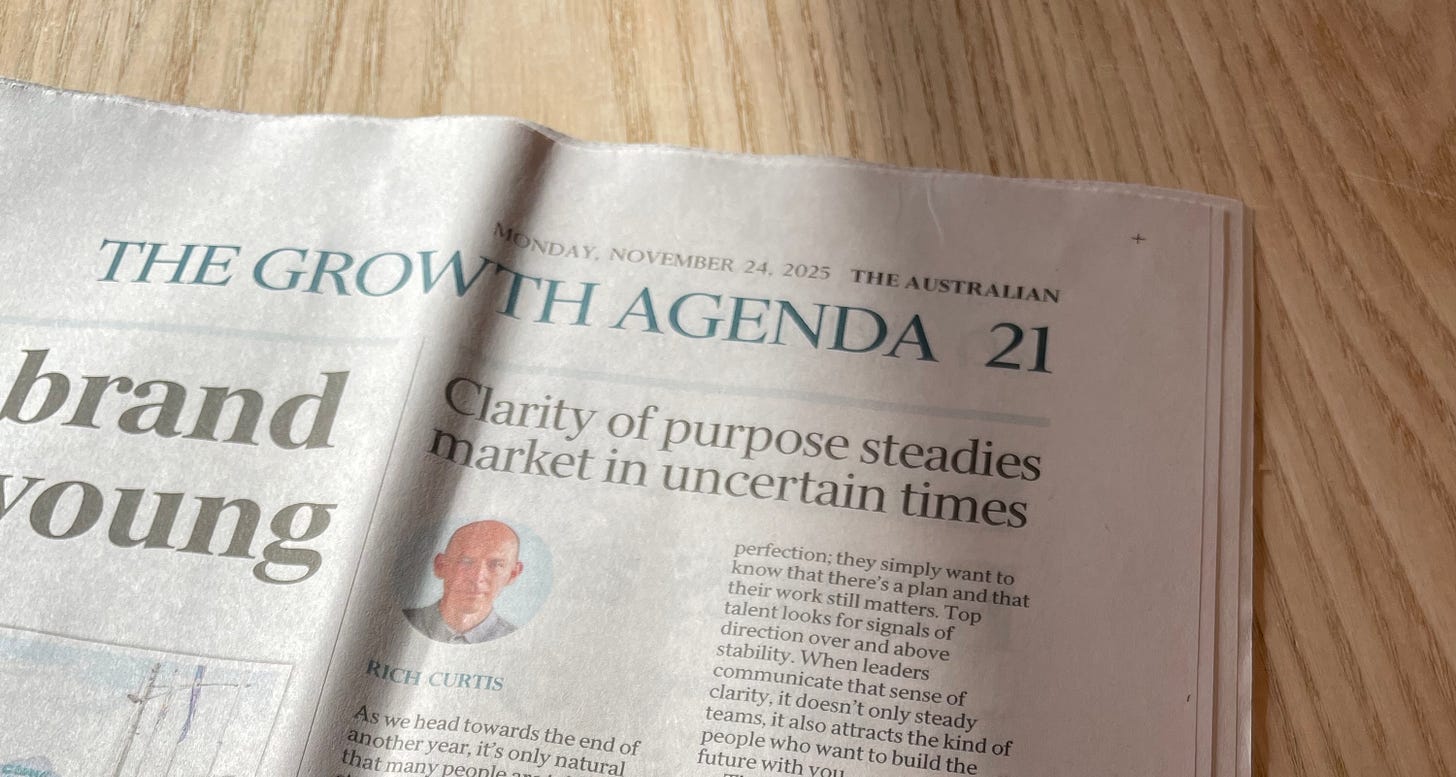
Clarity of purpose steadies brands in uncertain times
As we head towards the end of another year, it’s only natural that many people are taking stock.
While it’s easy to get caught up in the weekly deadlines and quarterly targets that get rolled into annual reviews, it’s true to say that what keeps people engaged is not necessarily completing those checklists but rather feeling the sense that what they do might actually matter. Yes, many people with whom I talk are in a reflective mood – but they’re not merely taking stock of what they’ve achieved, more so whether or not it still feels meaningful.
What we know from our own Employer Brand research is that this sense of ‘purpose’ doesn’t necessarily come from some grand, corporate manifesto. On the contrary, it can be as simple as seeing how your work made something better: for a colleague, a client or a customer.
In other words, it’s the practicalities of the purpose that are the difference between strategy and reality, and it’s these small moments of impact that connect people to the bigger picture. Consequently, leaders who make that visible – who take time to show people the difference they’ve made – create teams who feel invested and empowered. After a decade of data, it’s this pivotal theme that keeps coming up in our work: the organisations to which people are drawn are the ones that help them see their impact, each and every day.
That’s not to ignore the fact that it’s been a tough year for many people across many different sectors. So much so that I’ve spoken to more leaders lately who are quietly asking the same question: ’How do you give people certainty when everything around them feels uncertain?’
Reflecting on the data, what we’ve found is that the organisations people most want to ‘work for’ are the ones that project clarity and confidence, even in uncertain times.
Truth be told, none of us can promise certainty. But we can give clarity. Clarity of direction. Clarity of purpose. Clarity about what the next few months look like – even if it’s only the next few steps.
What the research tells us is that people don’t expect perfection; they simply want to know that there’s a plan and that their work still matters. Top talent looks for signals of direction over and above stability. When leaders communicate that sense of clarity, it doesn’t only steady teams, it also attracts the kind of people who want to build the future with you.
The rise of technology brands are the bellwether for this kind of clarity amidst uncertainty, or at least amidst ambiguity in the face of constant change. The top technology brands are also some of the strongest employer brands and the data reveals that they share almost identical drivers: namely, ‘Mission’ (clear purpose beyond profit), ’Innovation’ (shaping tomorrow’s world) and ‘Authenticity’ (showing up as yourself). Instead of reacting to change, these employer brands shape it, offering professional pathways that feel like partnerships in building the future, and these opportunities for meaningful growth strike the pivotal balance between security and possibility.
It’s not surprising that change is an ever-present theme and change fatigue is real. But it’s not necessarily the change that wears people down – it’s how it happens.
When change is done to people, they resist it. When it’s done with them, they build it.
That’s one of the strongest lessons from our research: organisations that make change a shared project build stronger cultures. What’s more, it’s part and parcel of the reason why the top brands over the past decade have experienced an average 11-point increase from 24% to 35% in response as a result of their ability to attract more people to want to work for them.
With a new year on the horizon, perhaps the edge we all need is change that is not imposed but all the more inspired.
That’s it for another year of news, views and insights. I hope you enjoyed reading this deep dive into the FutureBrand Index and what we can learn from a decade of data. If you’re interested in learning more, the data is there to be used so feel free to hit ‘Reply’, we’re always happy to add value where we can.
All that’s left to say is to wish you all the best for the holidays and a happy new year, see you in the future ;)
No posts
Comments
Nothing yet. Say the first thing.
Sign in to join the conversation.