
Download futi for iOS and Android.
Jude Bellingham stands, staring upwards, mouth slightly agape, eyes shining with the little moisture his body has somehow managed to retain. I don’t know how much of the Miami Stadium crowd are there for England but all of those who are — every single voice — are singing the same name, and its owner listens as if suspended in a very humid dream.
Since the beginning, Bellingham has carried a sense of … what would you call it? Destiny? Aura? Many have misdiagnosed it as arrogance, which I now feel comfortable saying is objectively wrong, given arrogance by definition requires the sense of one’s own importance to be exaggerated. Bellingham turned 23 two weeks ago — still a full World Cup cycle away from peak age for a midfielder — yet he is already arguably the most consequential England men’s player since 1966. He has two more World Cup goals than Geoff Hurst, six more than Wayne Rooney. Only Harry Kane can claim a greater influence over modern England’s successes, and even then Bellingham has something totally different: that sense I can’t quite put my finger on, of inevitability, history, the feeling he is at the apex of whatever story he chooses to write. I’ve seen more AI-generated imagery in the past week than I’d care to in a lifetime and all of it has been tawdry attempts to wrestle with this undeniable, irresistible feeling: Bellingham in knight’s armor, Bellingham as England’s true monarch.
Is any of this exaggeration? I can only tell you, as I sit and write this in South London on the morning after England’s 2-1 victory over Norway, I keep hearing the same name. The family behind me is passing it around in reverence right now; I caught it three times on the street. It has entered the collective imagination of this country in a way I’ve never experienced. Before the tournament, Bellingham had a crowd of England fans who believed he shouldn’t be in the side at all, who preferred Cole Palmer or Phil Foden, who had fallen for the arrogance trap. I’d be shocked, today, if any still remain.
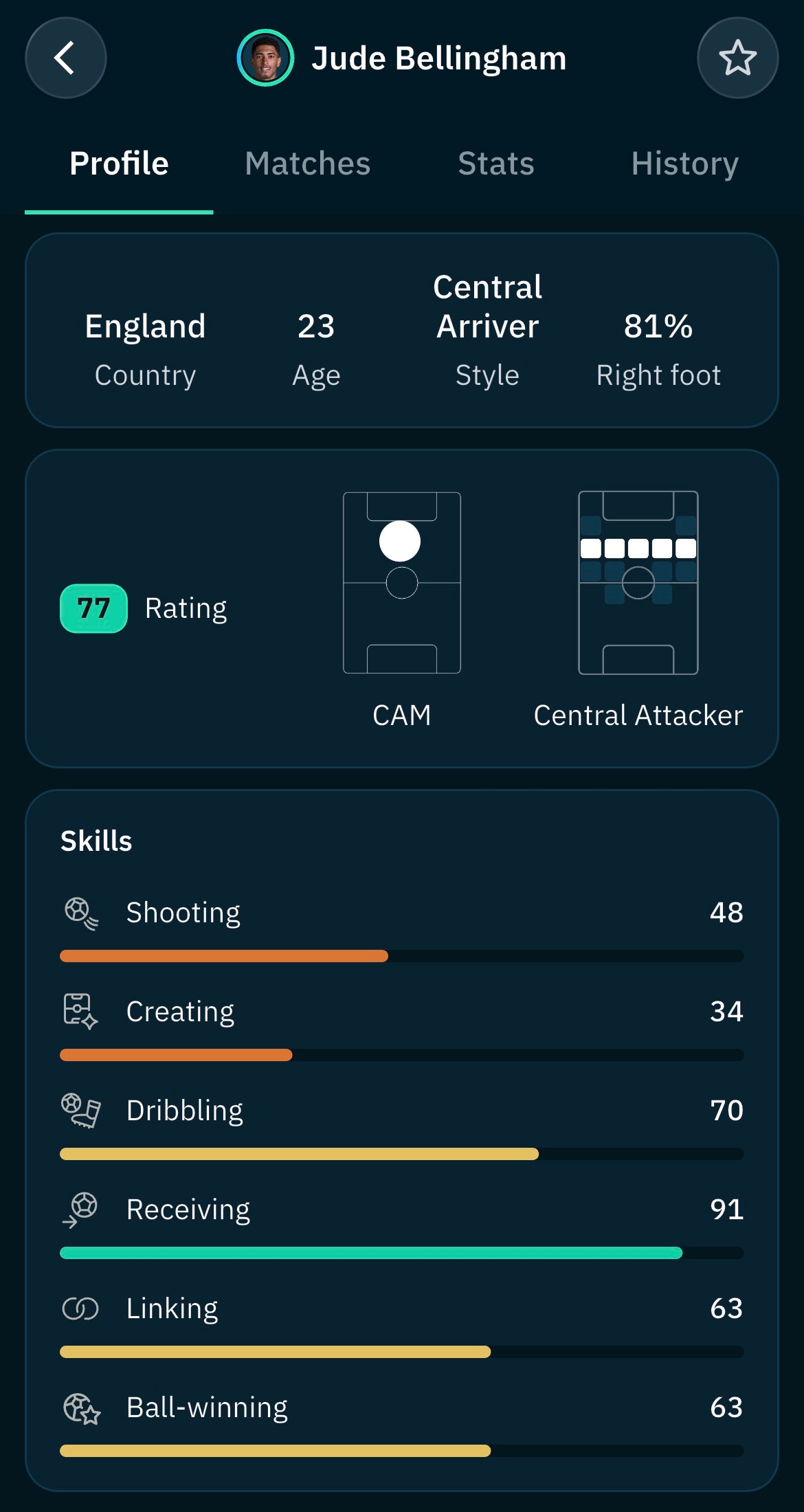
As this tournament has developed, England have become Bellingham’s team a little more with every game. Any sense of a cohesive tactical entity has collapsed, ripped to shreds by the thunder of the Azteca and melted into a sloppy mess against Norway in Miami’s corrosive heat. Some of this is the natural result of tournament football, where progression comes by any means necessary; much of it, one must imagine, is simply the output of a group of athletes who’ve been put through a meat grinder for ten months and then dropped into a whirlwind of air travel, adaptation and brutal atmospheres. Declan Rice’s body seems to have finally given up, even if his mind refuses to yield.
Whatever the reason, against Norway England felt, again, like a team slowly winding a coil. Go through the motions, pass it around, fall into an inevitable low block: do whatever you must to build the tension, because only when the elastic is taut will the knife appear. Gone was the original blueprint of deep central possession to probe for wide attacks, particularly through the right: here England’s build-up was far more balanced.
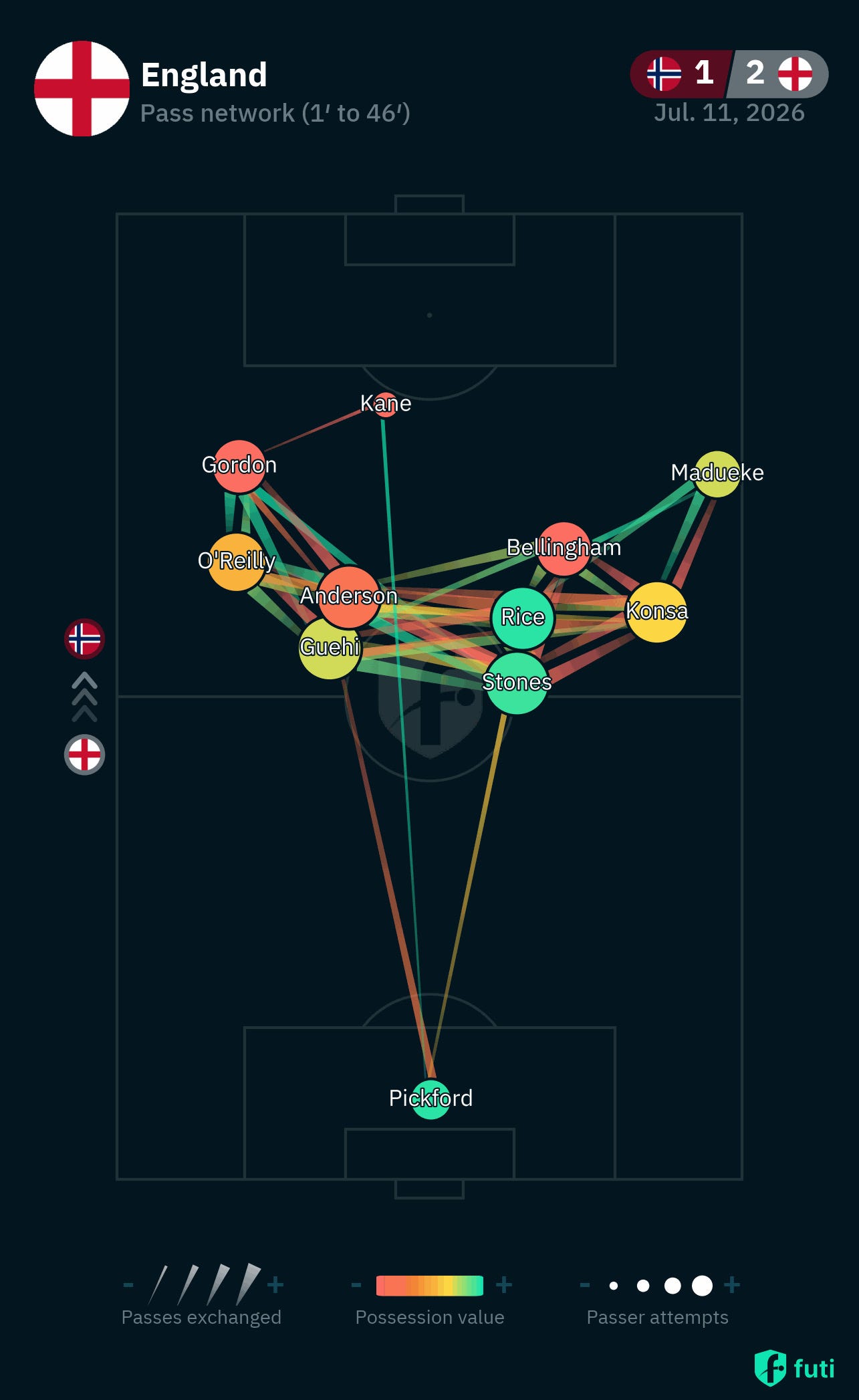
The game again was cut starkly into quarters by the hydration breaks, this time understandably so. England had the first and then Norway the second, when they switched to press aggressively against England’s wilted build-up as the crowd built a tattoo beat of their now-famous Viking row. Andreas Schjelderup’s bizarre but beautiful wondergoal seemed to be sucked into the net by the collective inhalation behind it. So much of international football is about vanquishing national demons and grappling with history, but Norway’s lack of recent scars has created a void throughout this tournament they’ve filled with a startled kind of joy. It’s been remarkable to watch.
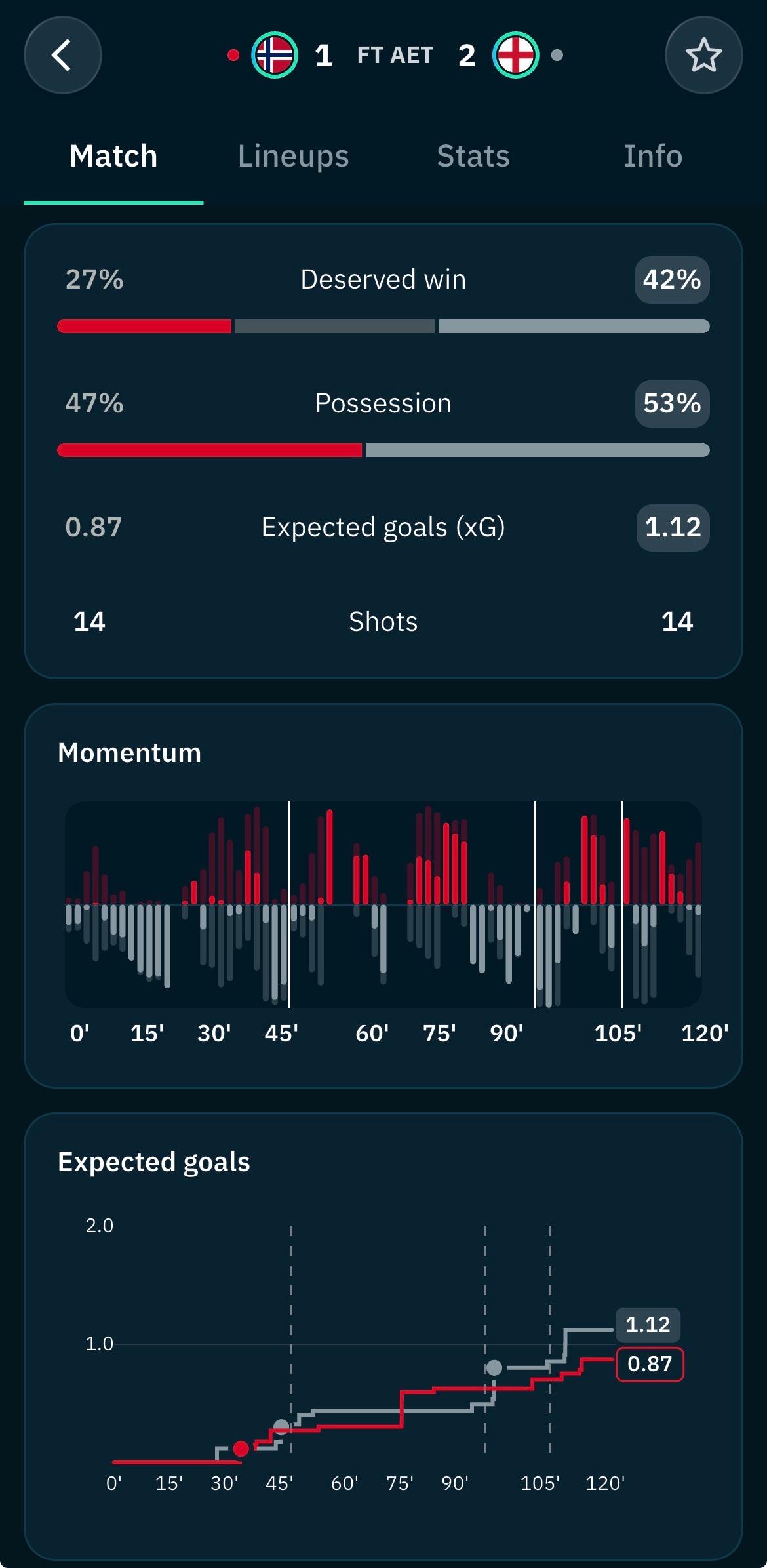
After Declan Rice left at halftime, any semblance of English sense or control vanished. The astonishing Elliot Anderson ripped around midfield one-against-three before Tuchel admitted he would probably soon collapse with the effort and sent on help. England looked vastly better when Reece James and Djed Spence replaced Ezri Konsa and Nico O’Reilly in the fullback spaces. Not much has been said about England’s fullback injuries contributing to their stylistic stagnation, probably because Tuchel kept a bunch of really good ones at home. James being fit to start against Argentina — he managed over an hour total in the quarterfinal — will be crucial.
This is about all I can tell you about what happened during the game. If I relied on memory alone I’d only be capable of recounting two events: one left foot, one right, both sliding.
In the end all that mattered, again, was that England created the conditions to be bailed out. The elastic was pulled tight enough to snap with force when it was cut. Tuchel went viral for a furious response to Gabriel Clarke’s questions about his team’s mentality, which he insisted wasn’t the issue: his team had come through on pure mentality. Welcome to international football, Thomas; welcome to England. That’s how we do things here. We suffer, play so within ourselves it seems purposeful, all to satisfy our Arthurian need for a hero.
Perhaps that’s why, as England prepare for their fourth World Cup semifinal, there persists a bizarre sense this group is still underachieving. They have, after all, a collection of many of the world’s best players: their midfield are breaking transfer records, while the only player in their first-choice attack you could meaningfully put a price on is Anthony Gordon, and that price was £80 million, paid by one of the best attacking sides in world football. No matter how high this team climb, expectations are still higher.
But England’s distance from destiny can now be measured in minutes. And maybe what matters when you’re this close is not that you have eleven great players, but just one capable of grasping the moment. I’m finished here now, and I know I’ll hear his name again on the way home.
No posts
Comments
Nothing yet. Say the first thing.
Sign in to join the conversation.