
Futi’s World Cup coverage continues with a guest blog from Tom Curren.
Join the waitlist here to get the app in wide release soon.
Sufferball. Heroball. Footballing austerity. Gareth Southgate’s last England tournament was so turgid I spent most of the summer of 2024 splicing words together in an attempt to describe it.
Southgate’s England were, in so many ways, a simulacrum of the nation’s best and worst impulses, threaded together by the manager’s charmingly naive patriotism. It was a team of immigrants from a country built by them, a team of little English towns and sprawling metropoles, a team that enshrined the individual as sacred even as they claimed to be uniquely collectivist. The talent will trickle down: Jude Bellingham will bail us out, Bukayo Saka will save us, and if they fail, well, we always have Harry Kane. It didn’t matter that the left side was a black hole, the midfield looked confused and the pressing lackluster and disorganized, because all these systemic failures would be banished eventually, someway somehow, with a bicycle kick and a moment of singular triumph. It was terrible until it was wonderful, and then it was terrible when it had passed.
The problem with building a football team in the image of a failing state is, well, it fails. The hope when Thomas Tuchel — a real chalkboard tactician, for better or worse — took the reins was that his England team would look a little less like the country itself and a little more like its greatest export, the one beamed weekly to televisions around the world. Tuchel told us he wanted to play Premier League football, and in the year or so since we’ve begun, piece by piece, to see exactly what that meant.
Yesterday against Croatia was the thesis moment: a rock-and-roll World Cup opener, the most electric in the country’s living memory. For all the magic of Southgate’s reign, he never captured English football quite like this.
The Premier League is many things; the prospect of distilling it into a singular style is a fascinating challenge. Although some argue it is increasingly homogeneous it still contains, to my eyes, a sprawl of tactical diversity. Do you build England as a ball-dominant, dribble-heavy possession side that reflects Pep Guardiola’s final form? Do you make them as stoic and unmovable as Mikel Arteta’s Arsenal? Or perhaps the heavy metal, run-till-you-can’t fury of Andoni Iraola would best represent the league on the world stage?
Tuchel’s answer has been taking shape, chipped slowly into form game by game: a little of all the above, please, but only where it suits these players.
What we saw against Croatia was a stretchy, transitional England, keen to draw pressure and play directly over it into as much space as possible. They looked to me most like Unai Emery’s Aston Villa, who love to bait the press, wait for the jump and then drop the ball into Morgan Rogers in the middle to carry it through the chaos.
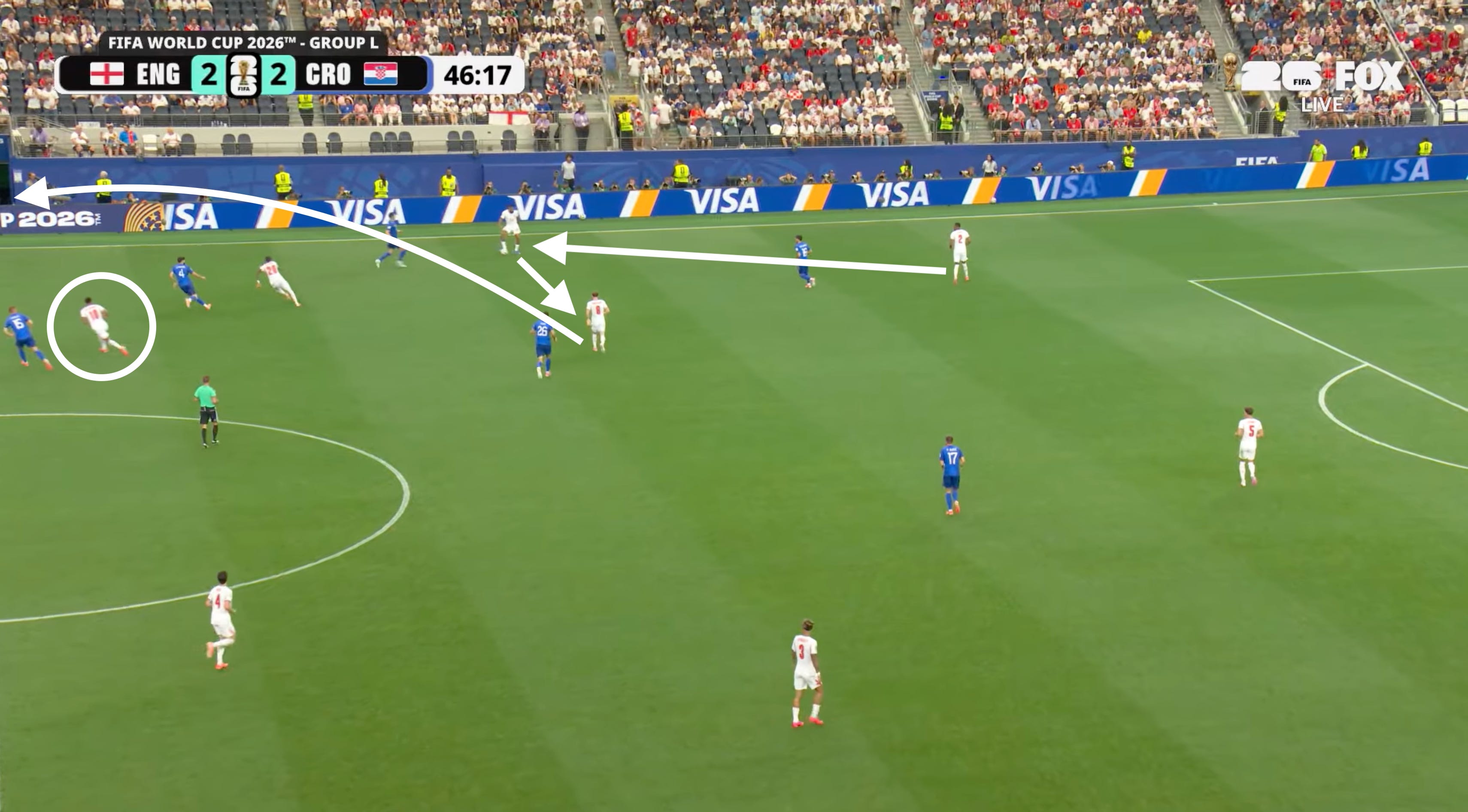
In Kane, Jude Bellingham, Elliot Anderson and Declan Rice, England have a core of players who enjoy coming deep to suck markers with them before releasing the ball into the vacuum they’ve vacated. Into that space sprinted Noni Madueke, who found acres between Ivan Perisic and Josko Gvardiol. Jude Bellingham spent most of his time in the little pocket behind his winger, waiting for the moment to release him — or lead a break himself, as he eventually did to score.
A cursory glance at the maps of touch count and possession value generated of England’s creative forces makes obvious the constant circulation behind Madueke and progression through his side.
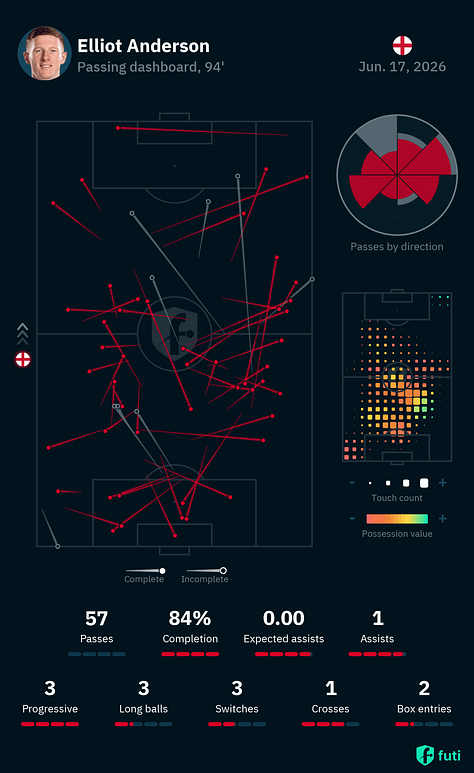
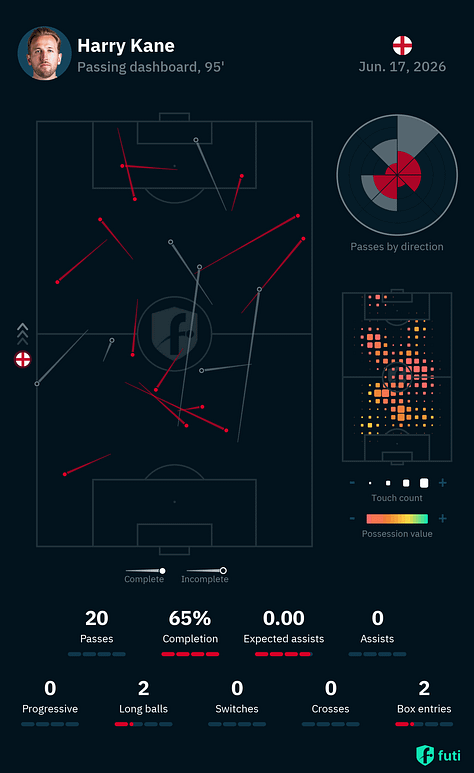
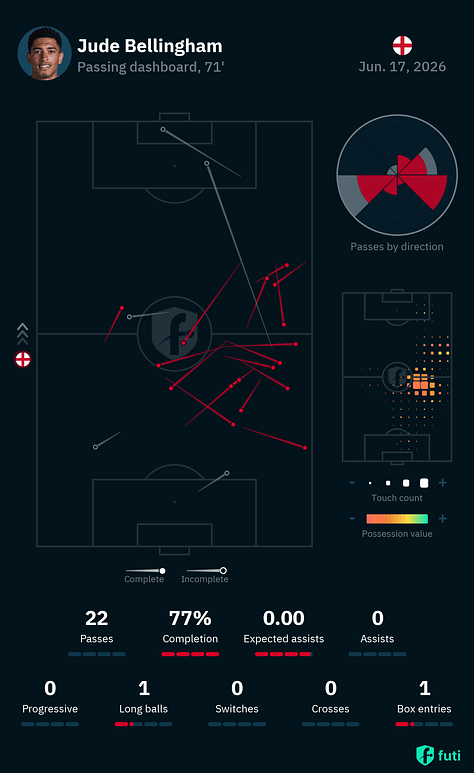
There was a little bit of all things Premier League in this performance. The world is beginning to understand that Arsenal score so often from set pieces mostly because when Rice is taking them it’s often hard not to. There was a hint of latter-day Guardiola in England’s persistent intent to carry: Nico O’Reilly tried to extremely mixed results, but he did try. And Iraola’s incandescence was here in that ruthless second-half blitz, a torrent of energy that exploded out of the tunnel and straight through England’s opponents. Tuchel has taken a little of all of English football’s best features and woven the country’s famous physical intensity through it, and the tapestry he’s created looks, so far, pretty good.
But not perfect. Anthony Gordon was totally isolated on the left, marooned by Bellingham and Anderson’s right-side bias. Conceding two goals on 0.8 expected goals is concerning, and how this back four will cope with the world’s best attackers remains a worry. Rice and O’Reilly looked awkward trading responsibilities between midfield and the left flank. And it’s an open question how long this high-octane style can persist deep into a sweaty tournament after most of these players have just emerged from a brutal campaign slog. In tournament football, how you start is rarely relevant to where you finish.
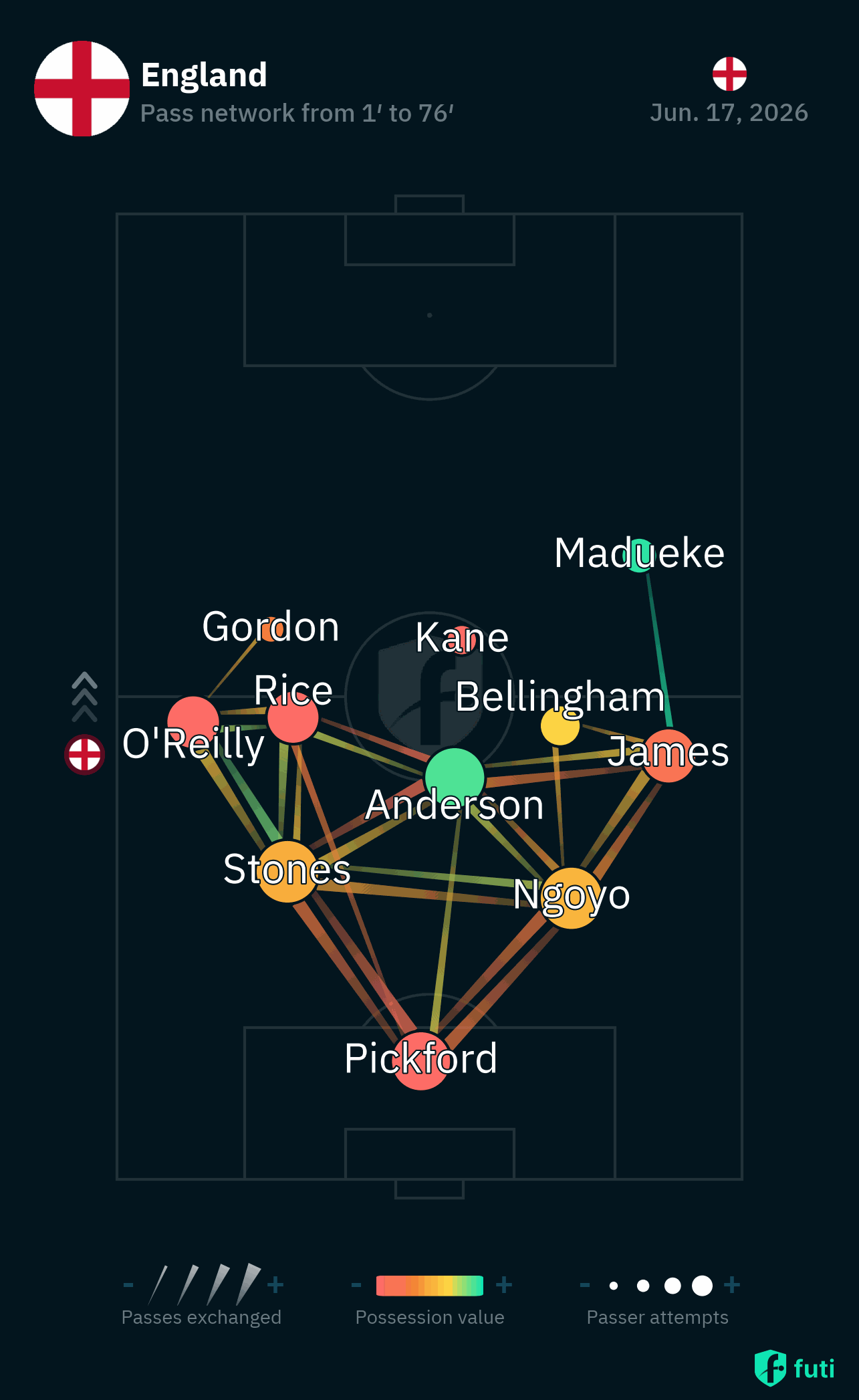
But this was a beginning of coherence. All of Tuchel’s choices to this moment have followed the same through-line, have pointed towards his intent to assemble a squad that understands its talent only in the context of the collective. Most coaches would have welcomed Phil Foden and Cole Palmer onto the plane, but neither would have stretched Croatia as Madueke did all night.
The beautiful, strange thing about collective football is that it is actually the best way to platform your individuals. Superstars perform because of a system, rarely in spite of it. To date, this World Cup has been a procession of icons, each waiting their turn to one-up the last: Erling Haaland, Kylian Mbappe, Lionel Messi. The world’s greatest players are going bar-for-bar in teams built for them. If Tuchel’s continues to draw the best from Kane, Bellingham and Saka, they’ll each get a chance to submit a verse.
What matters more than the specifics of Tuchel’s style is that he as a style at all. Whether it will take England further than the old passion-over-tactics approach is an open question. Perhaps by the end we’ll be pining for Southgate’s soft charm, for the magnificent way he brought a country together despite his clumsy football. Perhaps. But England needed to be fun again. They needed to be Premier League again.
Hallelujah, it looks like they are.
No posts
Comments
Nothing yet. Say the first thing.
Sign in to join the conversation.