
Individual marksmanship and gun ownership was important enough in the Twentieth century that the U.S. government actively encouraged and funded both firearm ownership and marksmanship, including making the sale of military weapons available to individual citizens. Published history and current Federal law confirm these facts, as explained in this video:
In October 1904, New York Times reported that, with the approval of Congress, the National Board for the Promotion of Rifle Practice began distributing surplus Krag carbines to schools and rifle clubs across the United States. It also distributed millions of dollars for the construction and operation of rifle ranges and similar facilities.
The board, authorized by Congress, had the mission of devising “ways and means ... by which the interests of the general public in rifle practice might be stimulated.”
At the turn of the century, there was a great fear among some Americans that with the “closure of the frontier” and the accelerating industrialization and urbanization of the United States, the country was losing some of the essence that made it American. Part of this was a perceived decline in marksmanship and familiarity with weapons, as Americans moved from the country to the city.
As the United States did not have a significant permanent standing army until the Korean War (except for temporary increases during the world wars), it was believed that civilian marksmanship skills were critical to deploying an effective volunteer military if war broke out.
As the October 1904 New York Times story linked above points out:
“The Krag carbines soon will be discarded by the cavalry arm of the regular establishment, and the National Board will seek to obtain possession of them for distribution to the military schools ... It is also proposed that one carbine for each twenty-five scholars should be issued to public schools possessing indoor ranges and carrying on rifle practice. When the new Springfield rifle is issued to the regular establishment about 100,000 Krags will be available for distribution.”
The story quotes Assistant Secretary of War Robert Shaw Oliver: “Our permanent military establishment or regular army must be small ... and in the event of a war with one or more of the first-class powers of the world we must depend largely upon the militia and the volunteers for our fighting force. With the modern long-range small arm it is all-important that the soldier should know how to shoot, and to hit what he shoots at.”
Further, Theodore Roosevelt stated in 1904: “As a nation we must depend upon our volunteer soldiers in time of trial. . . . Of course, a soldier who cannot shoot is a soldier who counts for very little in battle, and all credit is due to those who keep up the standard of marksmanship.”
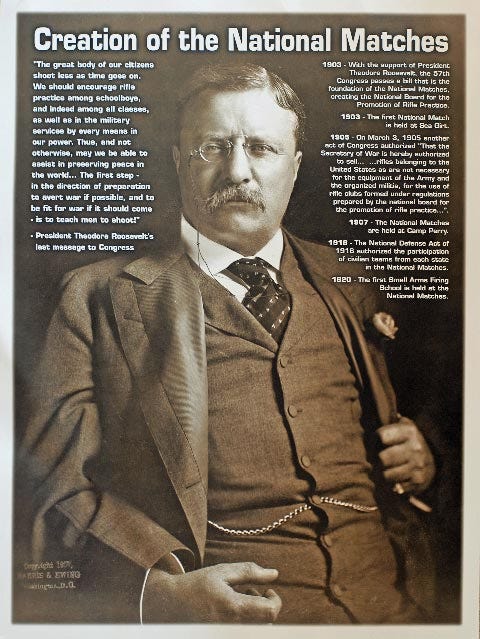
Later, the Chairman of War Manpower Commission during World War 2 stated: “Our men must be trained to make the best use of the superior weapons with which they are armed,” and said that the National Rifle Association’s program “means more straight shooting and makes for victory.”
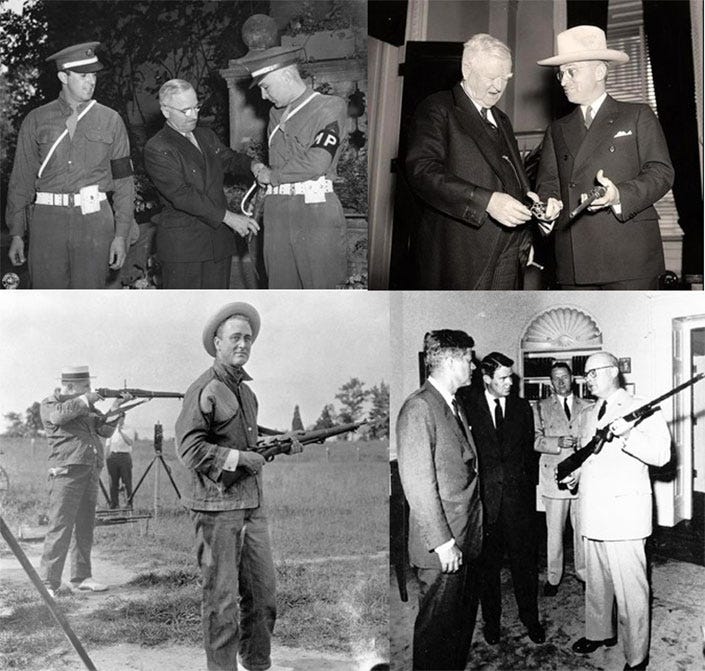
This was supported by numerous U.S. Presidents who also participated:
The National Board, which included members of the National Rifle Association, developed into the Civilian Marksmanship Program (again administered in conjunction with the NRA). That program distributed thousands of weapons, tons of ammunition, and extensive lessons across the country. Between 1959 and 1964 alone, the Army sold 539,267 surplus rifles and other firearms to members of the NRA and other civilians at large discounts.
John F. Kennedy also supported this, saying, “Through competitive matches and sports in coordination with the [NBPRP], the [National Rifle] Association fills an important role in our national defense effort, and fosters in an active and meaningful fashion the spirit of the Minutemen.”
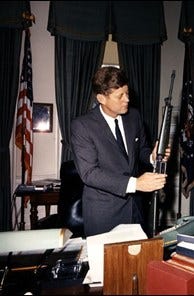
In 1966, Harlon Carter, president of the National Rifle Association, declared to the Times that “in Vietnam, a soldier with prior marksmanship training as a civilian stands a better chance of survival in combat, is a more efficient marksman and has more confidence in his ability to use his rifle effectively in action.”
But in the late 1960s, with concerns about urban riots among the young rising, there was fear in Congress that weapons and ammunition from the Civilian Marksmanship Program were making their way onto the black market and arming rioters. There was also fear among some Democrats, such as Rep. Henry Gonzalez, D-Texas, that the Civilian Marksmanship Program was deliberately arming right-wing militias. Gonzalez’s target was the Minutemen, a right-wing militia organized and trained to defend against a communist takeover of the United States.
The Arthur D. Little Report of 1979 analyzed data from over 12,880 Army trainees at four Army Training Centers, and found that trainees who had previous experience with firearms in civilian life are generally better marksmen, are more likely to use their weapon effectively in combat, and are less likely to be wounded or killed in combat. [...] While only 15.4% of trainees overall achieved “Expert” marksmanship scores (the highest possible category), 68.6% of trainees who were members of a DCM-affiliated civilian shooting club achieved an “Expert” score. The report therefore concluded that, “[t]he marksmanship instruction, supervised practice, safety training, and competitions . . . sponsored and supported by clubs, the NRA, and the DCM are of particular value to the military.”
Despite this, the Civilian Marksmanship Program fell out of favor and took on diminished importance through the late 1970s and 1980s, particularly in light of America’s strong antimilitarist attitudes following the Vietnam War. In the 1990s, there was a movement to divest the program from the government, and in 1996 Congress passed a law creating the nonprofit Corporation for the Promotion of Rifle Practice and Firearms Safety Inc.
The Civilian Marksmanship Program continues to operate today under that nonprofit, operating competitions and surplus sales (they’re frequently sold out) to this day.
From District of Columbia v. Heller, 554 U.S. 570 (2008):
The Second Amendment protects an individual right to possess a firearm unconnected with service in a militia, and to use that arm for traditionally lawful purposes, such as self-defense within the home. Pp. 2–53.
(a) The Amendment’s prefatory clause announces a purpose, but does not limit or expand the scope of the second part, the operative clause. The operative clause’s text and history demonstrate that it connotes an individual right to keep and bear arms. Pp. 2–22
(b) The prefatory clause comports with the Court’s interpretation of the operative clause. The “militia” comprised all males physically capable of acting in concert for the common defense. The Antifederalists feared that the Federal Government would disarm the people in order to disable this citizens’ militia, enabling a politicized standing army or a select militia to rule. The response was to deny Congress power to abridge the ancient right of individuals to keep and bear arms, so that the ideal of a citizens’ militia would be preserved. Pp. 22–28.
a. “Well-Regulated Militia.” In United States v. Miller, 307 U. S. 174, 179 (1939), we explained that “the Militia comprised all males physically capable of acting in concert for the common defense.” That definition comports with founding-era sources. See, e.g., Webster (“The militia of a country are the able bodied men organized into companies, regiments and brigades . . . and required by law to attend military exercises on certain days only, but at other times left to pursue their usual occupations”); The Federalist No. 46, pp. 329, 334 (B. Wright ed. 1961) (J. Madison) (“near half a million of citizens with arms in their hands”); Letter to Destutt de Tracy (Jan. 26, 1811), in The Portable Thomas Jefferson 520, 524 (M. Peterson ed. 1975) (“[T]he militia of the State, that is to say, of every man in it able to bear arms”).
Petitioners take a seemingly narrower view of the militia, stating that “[m]ilitias are the state- and congressionally-regulated military forces described in the Militia Clauses (art. I, §8, cls. 15–16).” Brief for Petitioners 12. Although we agree with petitioners’ interpretive assumption that “militia” means the same thing in Article I and the Second Amendment, we believe that petitioners identify the wrong thing, namely, the organized militia. Unlike armies and navies, which Congress is given the power to create (“to raise . . . Armies”; “to provide . . . a Navy,” Art. I, §8, cls. 12–13), the militia is assumed by Article I already to be in existence. Congress is given the power to “provide for calling forth the militia,” §8, cl. 15; and the power not to create, but to “organiz[e]” it—and not to organize “a” militia, which is what one would expect if the militia were to be a federal creation, but to organize “the” militia, connoting a body already in existence, ibid., cl. 16. This is fully consistent with the ordinary definition of the militia as all able-bodied men. From that pool, Congress has plenary power to organize the units that will make up an effective fighting force. That is what Congress did in the first militia Act, which specified that “each and every free able-bodied white male citizen of the respective states, resident therein, who is or shall be of the age of eighteen years, and under the age of forty-five years (except as is herein after excepted) shall severally and respectively be enrolled in the militia.” Act of May 8, 1792, 1 Stat. 271. To be sure, Congress need not conscript every able-bodied man into the militia, because nothing in Article I suggests that in exercising its power to organize, discipline, and arm the militia, Congress must focus upon the entire body. Although the militia consists of all able bodied men, the federally organized militia may consist of a subset of them.
Finally, the adjective “well-regulated” implies nothing more than the imposition of proper discipline and training. See Johnson 1619 (“Regulate”: “To adjust by rule or method”); Rawle 121–122; cf. Va. Declaration of Rights §13 (1776), in 7 Thorpe 3812, 3814 (referring to “a wellregulated militia, composed of the body of the people, trained to arms”).
U.S. Law: The Militia
·
March 21, 2023
The U.S. government has been offering firearms to civilians and organizing marksmanship events with the intent of helping all Americans to become well-regulated in the use of arms.
More citations:
http://www.scotusblog.com/wp-content/uploads/2008/02/07-290_amicus_retiredmilitary.pdf
Comments
Nothing yet. Say the first thing.
Sign in to join the conversation.