Happy New Years everyone! I hope it’s been cheerful holiday season to everyone and a fruitful 2026. I was busy working over the holiday season to put together my analysis for you today for my H1 2026 gameplan for my portfolio. First, let’s wrap up 2025.
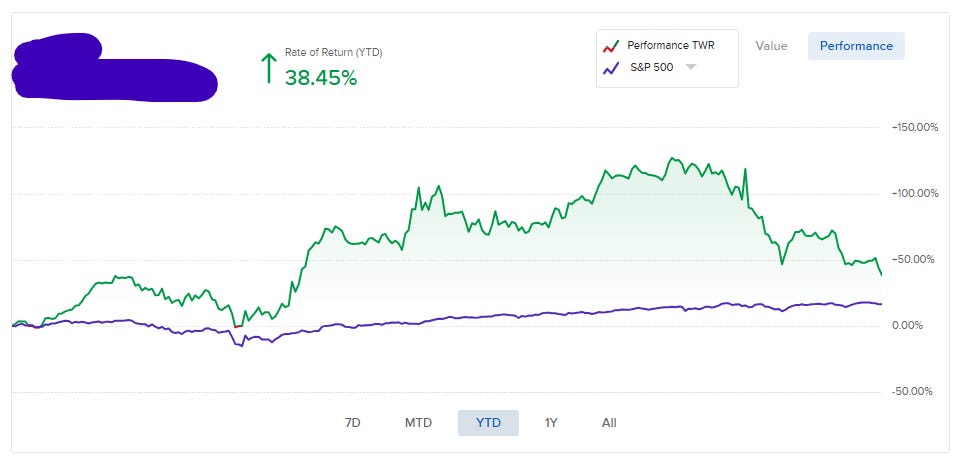
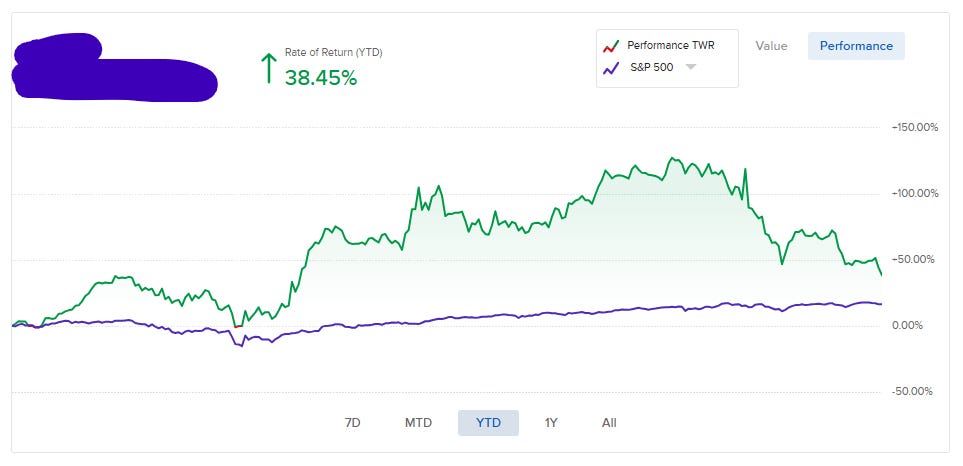
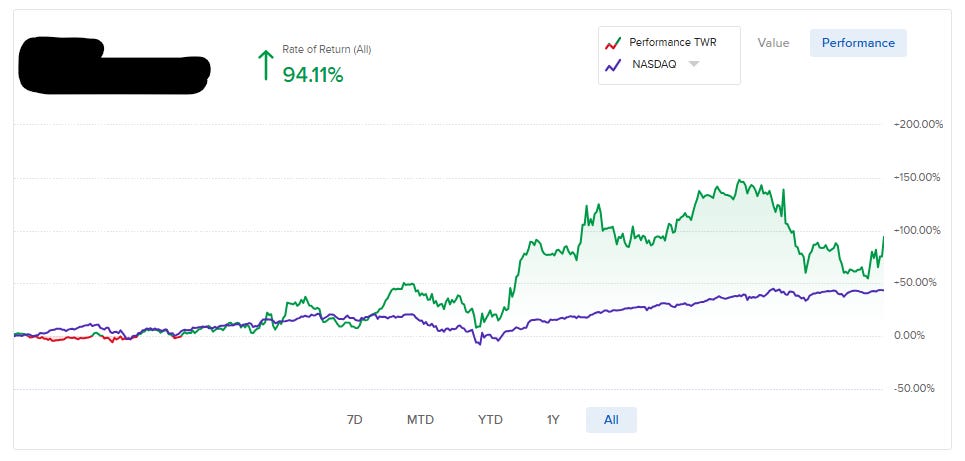
Fundasy Investor finished the year in respectable shape, beating the S&P by roughly a pre-tax/post-tax beat at 20% / 10% respectively. Volatility, of course, did take the reins in my largest holding group in late 2025 — which I will be writing about today. A move from +150% to +38%, 45% drawdown from highs, could shake many investors confidence. Luckily, I saw a Q3 revelation in one of my holdings that reinforced the existing thesis and dramatically changed the Risk/Reward. 2025 returns below with “YTD” that I took on Dec 31st, 2025.
Roughly half of the portfolio is now tied to one blended equity ownership vehicle, where time, volatility, and business execution are widely distributed outcome, yet the destination is clear and simple. This one has pulled back dramatically resulting in the December performance. YTD has responded like I expected thus far with tax-loss selling finalizing.
As 2026 continues, I’ll be entering my fifth year of writing Fundasy Investor and writing about the portfolio that contains more than half my net worth. The real value has been the discipline of documenting decisions in real time. If you track your thinking honestly, year after year, keeping your process accountable — eventually your results improve. Here’s to the New Year!
William
*Nothing you read here is investment advice and it is all to document my entertainment/research services and ensure that everyone can read my work in hindsight and say… wow, maybe he did know what he was doing.
Roy: “Lay up? I don’t lay up.”
Roy: “I know I can do it.” Romeo:“Then f*ing do it.”
Imagine, if you close your eyes and you’re suddenly Kevin Costner, cosplaying a golf pro from a backwater Texas driving range. Some key plot points and character developments occur, and you find yourself on the 18th fairway of the US Open, tied for the lead. All you need is to lay-up, you will likely tie the US Open. The writers in this universe apparently don’t know about tie breakers though in major tournaments.. but we move on.
If you go for it and make it, it proves you’re in a league of your own. One winner. Long story short, he misses the first shot. He kept going though. Again. Again. Again. It’s frankly embarrassing and hard to watch. It’s the epitome of a subversive ending.
Because on the last ball… anyways, watch the dang movie or the clip I linked. What I like about that story though, is there was so much on the line and he went for it. The “smart” decision ends up great. You’re among the greats. You aren’t a great though. Essentially, if you play it safe.. you’re prioritizing the money, security, and okay outcome of a tie. Great pay day. Sometimes, you have to think a little like Roy. Roy would rather be legendary than be smart ; Roy sought meaning over money. Tin Cup teaches you that sometimes the worst decision to make can be the best one.
However, unlike my a fore-mentioned counterpart, I am a +15 handicap golfer. I will still go out and go for it every time though, just like Roy. However, what’s on the line for me is a $1 Kirkland Golf Ball and a loss of a little gusto, which already has been gone from my step post-achilles surgery.
Basically, the real lesson here is this… if you know you suck at golf — buy Kirkland golf balls, not ProV1s. I suck at golf. Today with my capital allocation strategy though, I’m on that 18th Green and I’m going for it. I have the experience. I know what club and how far it can go. I can feel the strength of the wind. It’s a great lie.
This blog post will be to formally write down my assumptions of returns and justify to myself why I have this position of 50%+ of my Gross Assets in my Brokerage account. Basically, I’m going to give you a short summary on why this stock is a layup and how I’m taking advantage of it with my position structure. Also, to justify the “level of returns” of what a Warren Buffett punch-card is worth. That’s good information to reflect on in a few years — after this investment pans out and I have the ability of hindsight.
In my eyes though today, this one is a basketball layup to win the U.S. Open. How about that for a sports analogy?
Pay for more than what you get
Utilize use low cost of leverage (6%) with high margins of safety as a higher priority. At my age and Equity to Free Cash Flow, this balance sheet leverage is a valuable and dangerous tool. Luckily, my area of investment specialty.. is financials.
Okay, if you think of the core concepts of every great intellectual investors to learn from (Lynch, Buffett, Graham, Munger, Garner, Murphy, Singleton, Malone, etc. there is one common denominator across all of them. They all knew a bargain in markets, — able to figureout when an asset was undervalued, very clearly and taking advantage of it. Get more for what you buy than what you pay. Simple idea.
Now, this is my conceptual view as well with it being so well documented. Therefore, my process involves finding deals and simply writing down on my blog posts the simple assumptions that these guys just did in their head. With this in mind — this is how I’ve observed Credit Risk ratings to Returns right now in public markets. This method of looking at my risk/rewards across each asset in the portfolio individually assists with maximizing future returns and minimizing risk — go figure.
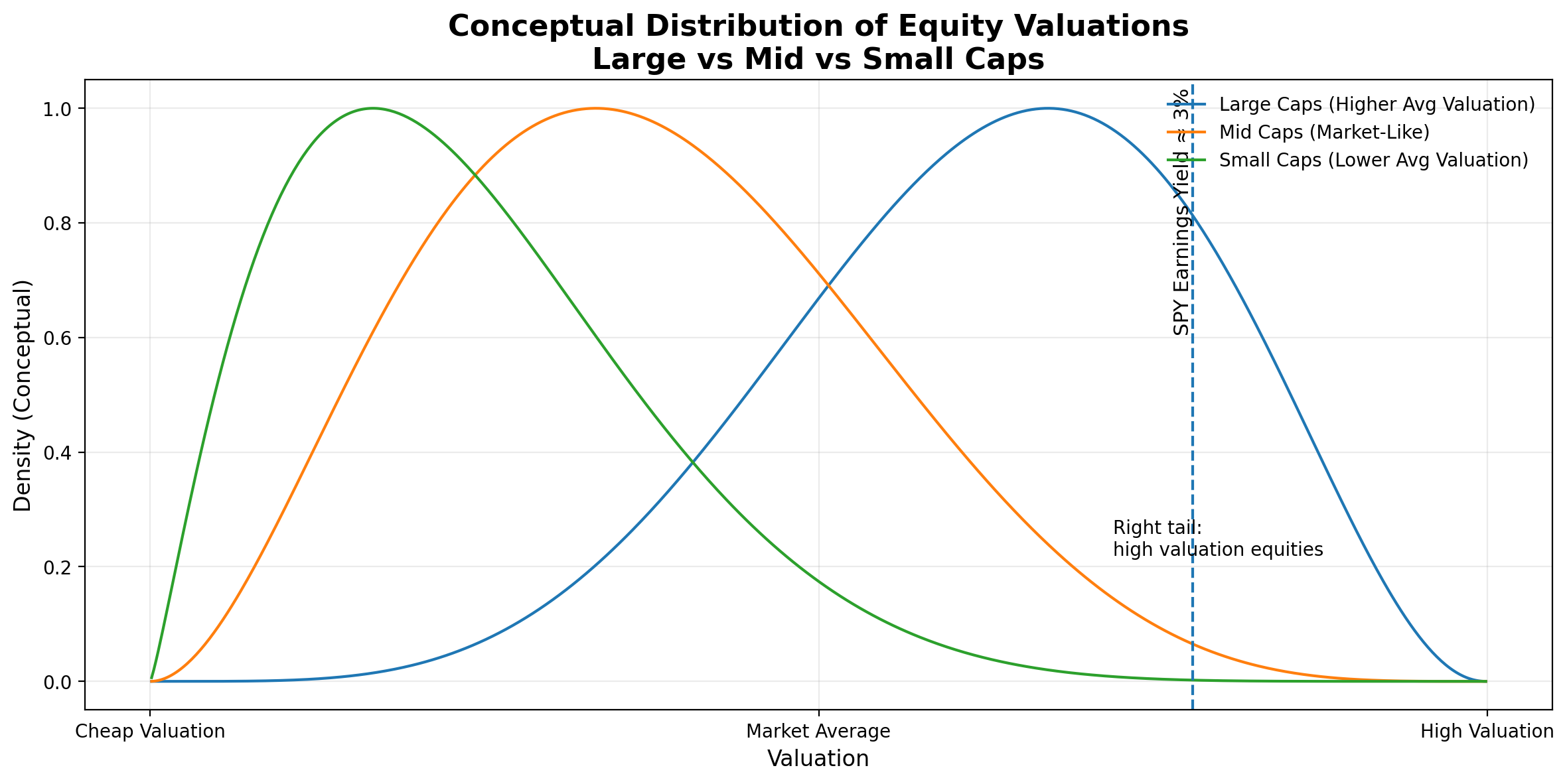
If you think of the risk/reward of stocks in terms of bonds, my conceptual view among the current state of the public equities market is as following:
AAA (Large Caps): Growing 10-20% per year (AAPL, META, GOOG, AMZN) all are trading at 30-40 PE → 2-4% yields on average
Midcaps and Small-caps have might higher volatility of growth though. Some names growing 50%, most are growing 0-10% per year. This larger variance of outcomes, creates more “disconnects” in intrinsic value than large caps
Easy deals are possibly right in front of you in Small/Mid caps right now — if you’re looking for them. Therefore, that is logically where I started looking for this year’s allocations for my portfolio.
How to find a deal is simple — Buy a company growing at a cheaper price than the profitable and internally compounding rate you buy it for. That’s purely conceptual though. Let’s see how the sausage is made.
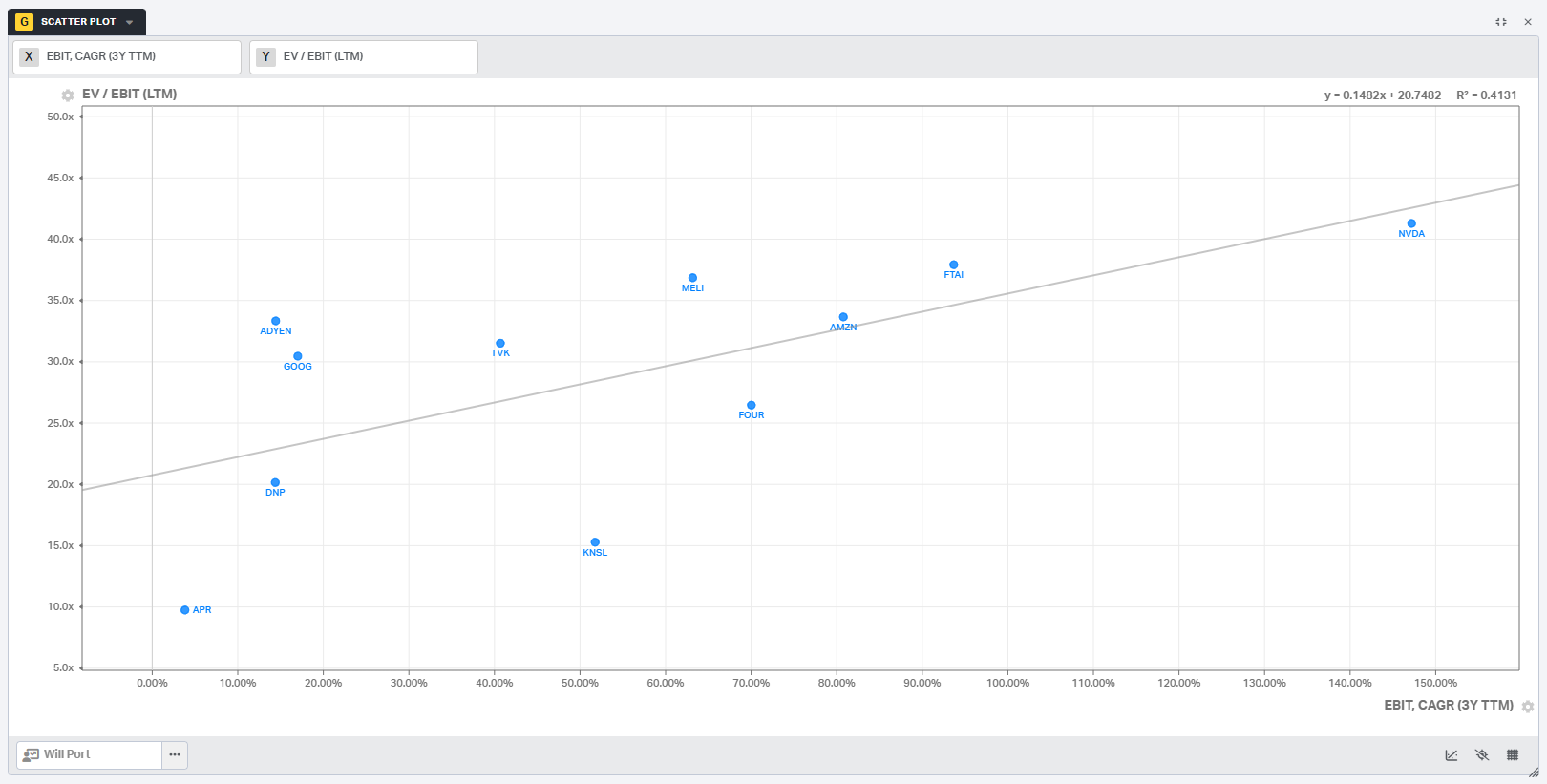
Generally, I prefer Scatterplots to visualize multi-variable relationships (X vs Y). This way the Risk/Reward relationship can accurately analyze the two metrics together. You need a way to test when individuals claim: “this is riskier that competitors”, “this isn’t that cheap”, “this needs to drop 20% more”, “I think this 10x’s” etc.
However, usually the person only analyzing one side of the equation (X or Y). So this analysis of X vs Y, will likely yield… a potentially good future holding for 2026 and beyond. That’s what we want — the best idea for 2026 to consider reweighting. Why now? In the beginning of January of this year (2026), your taxes will be paid in 2027. Therefore, it will give you 14 months of Working Capital on those allocated taxes, the maximum time horizon extension possible. One can also just pull from something at cost basis if it isn’t as good of a return.
* Below: Risk/Reward analysis contains my Holdings and my Watchlist
X: EBIT 3Y CAGR
Y: EV/EBIT (LTM)
KNSL on this metric looks pretty great. However, I know from my article back when it was released. Their trailing metrics look great. Future guidance/assumptions are much lower. Too expensive to return capital yet realistically to boost returns. Decision: Waiting
Nvidia is an outlier on growth and valuation. Jensen Huang is awesome. I just don’t know anything about Nvidia’s technology advantage. It’s on the radar for 2026 to at least learn more about one of the largest companies in the world. Decision: Waiting
FTAI Aviation is expensive now but dang it. They just announced they’re using Airplane Engines, that they vertically integrate and sell recurring service contracts to maintain, to power AI Data Centers. It’s a really powerful engine and they figured out the Power to Electrical conversion design (really old concept, proven methodology) for the engines to get a second life (or a first) powering constant, instantly transmittable electrical capacity to the grid. Smart idea. It’s still an expensive stock, even without that call option. I will target a write up on it in Q1. Decision: Trim
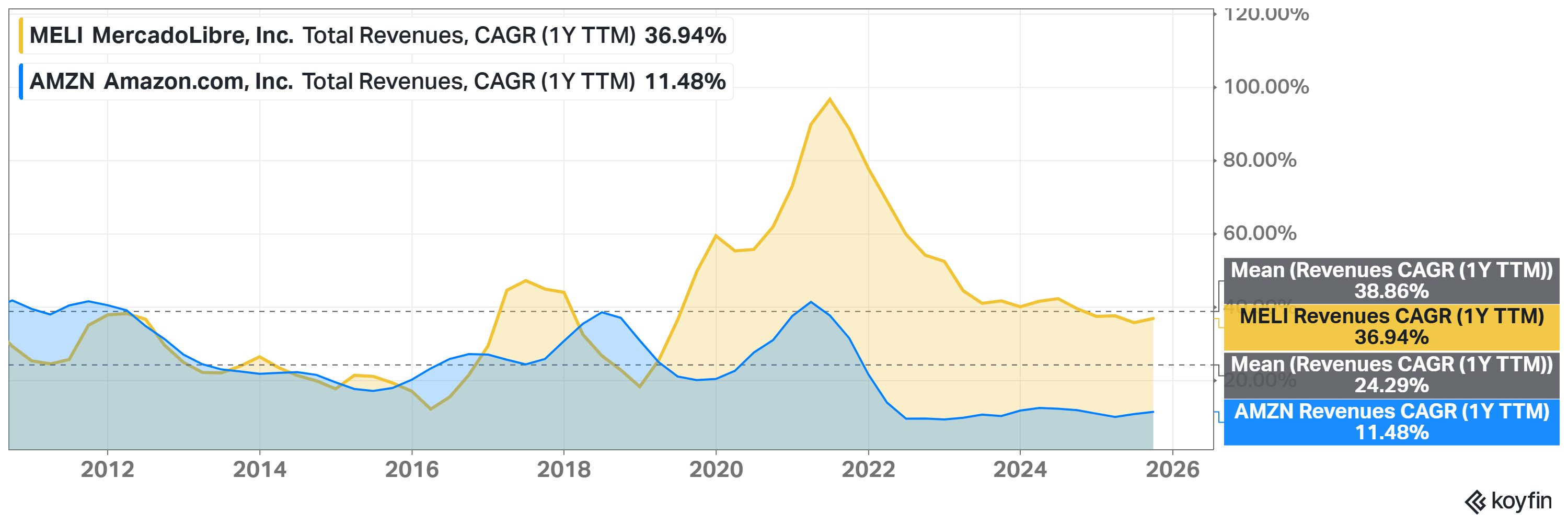
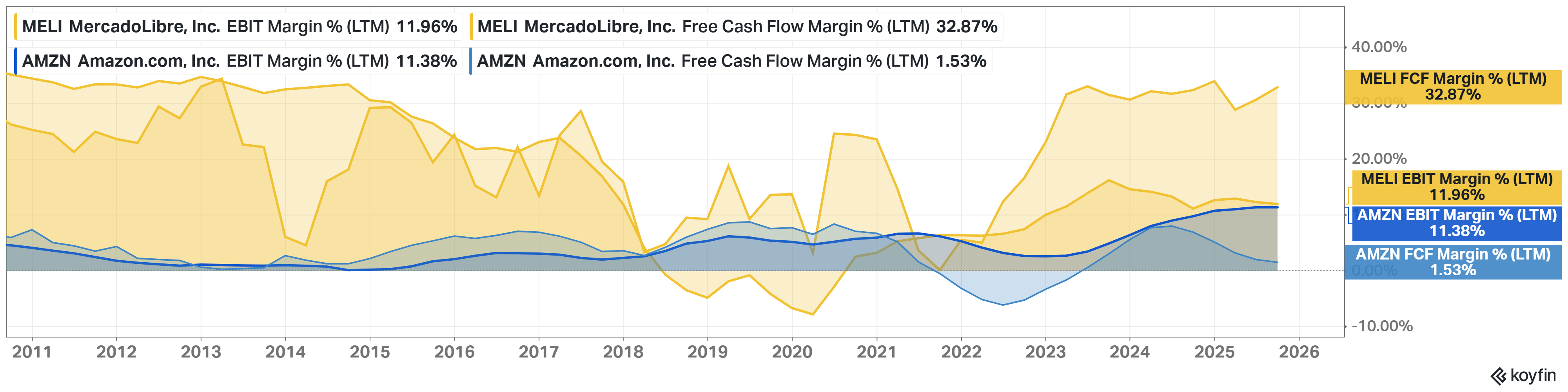
Large caps (GOOG, ADYEN, MELI) are indeed very expensive compared to their peer’s valuation in small caps. Amazon… looks interesting though. Which matches online discourse about the stock being undervalued. Mercado Libre also is below Amazon’s trailing growth on this. However, that is because Mercado Libre is in a heavy heavy investment cycle right now to keep growing topline at 30%+ rates, compared to Amazon’s 11%. This is also funding via Free Cash Flow, unlike Amazon who has near zero Free Cash Flow after investments… they might seem equal in hindsight, but they’re not really. You’ll see on the forecasted risk/reward.
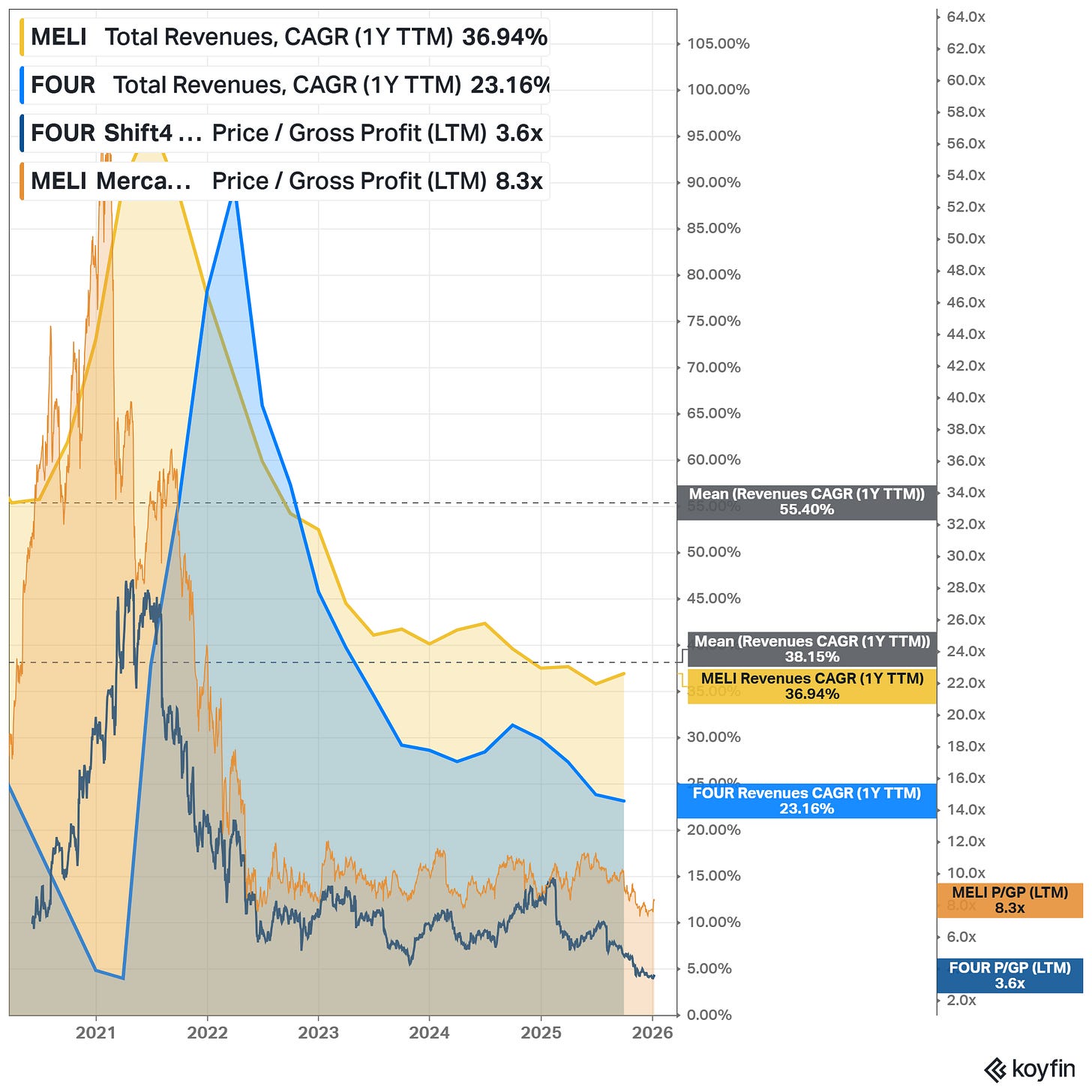
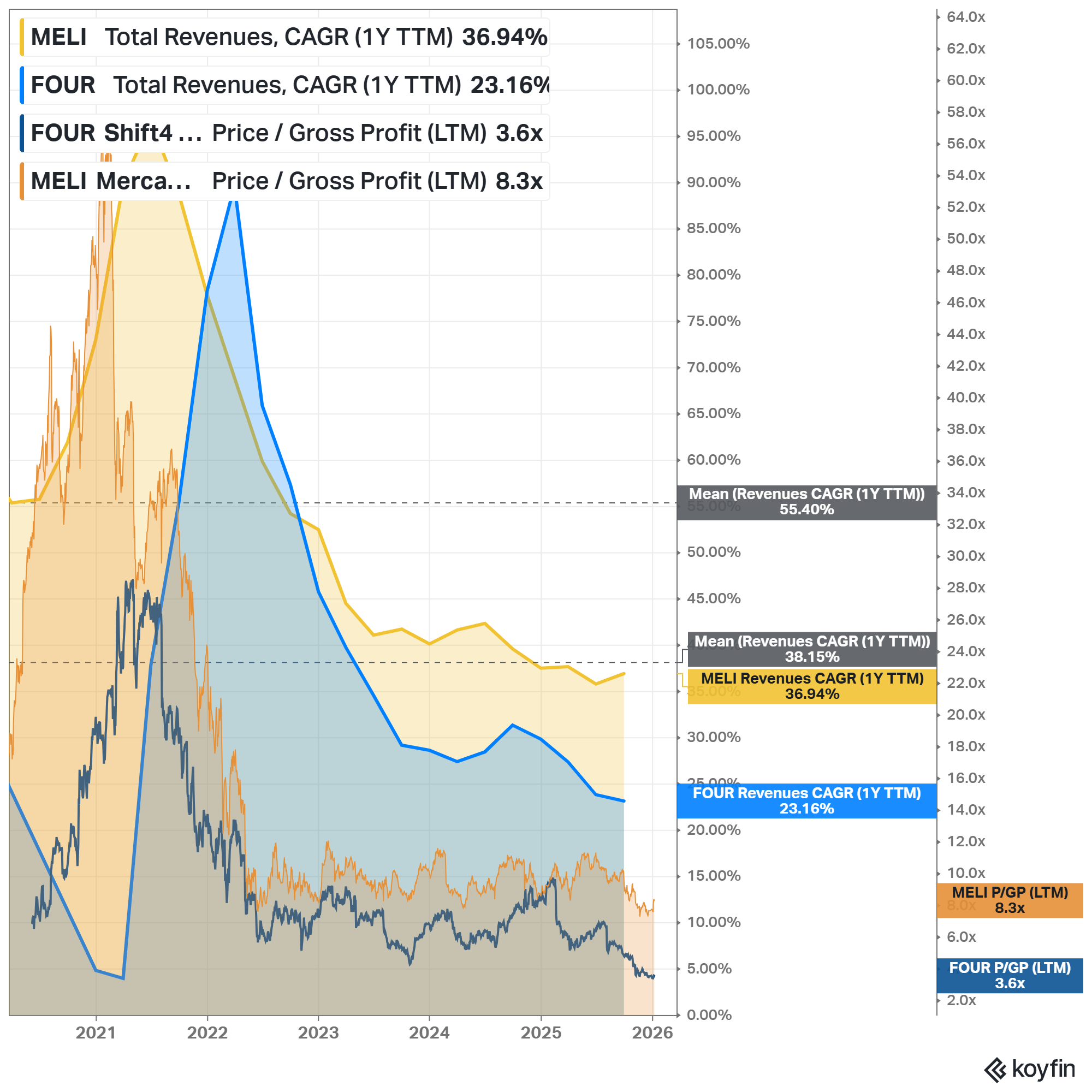
Shift4 looks really cheap on risk/reward. It’s trailing growth is in-line with one of my favorite companies like Mercado Libre. Both being in the middle of the trailing multiple, trailing growth comparison… As covered in my Shift4 Article, both are great companies. Shift4 looks a lot cheaper. Mercado Libre is a fantastic company with network effects, scale effects, working capital advantages, etc. It is hard to beat this holding in risk/reward quite frankly. International payments is higher take rates, much less competitive than the US payment sector. Remember when Adyen struggled entering the US and going up market with compressing take-rates? Shift4 is moving down-stream to International Payments. Want to read more on my qualitative analysis of Shift4? Read my previous Business Breakdown.
Based upon limited evidence, both are trading at 5-year lows in valuation. That is actually really interesting how much lower Shift4 is valued. Especially as Shift4 is entering International Payment tailwinds, World Cup year for its stadiums in organic pass through take-rates for the ticketing, concessions, hotels, and restaurants connected to the stadium… Shift4 Global Blue (Pro-forma) results also got integrated into the Q3 results, they look really good Q/Q and I don’t think the market realized that on the last Earnings Call... when they also simultaneous are going into their seasonally best quarter (Q4 - Holidays, Reporting ~ Feb 17th 2026).
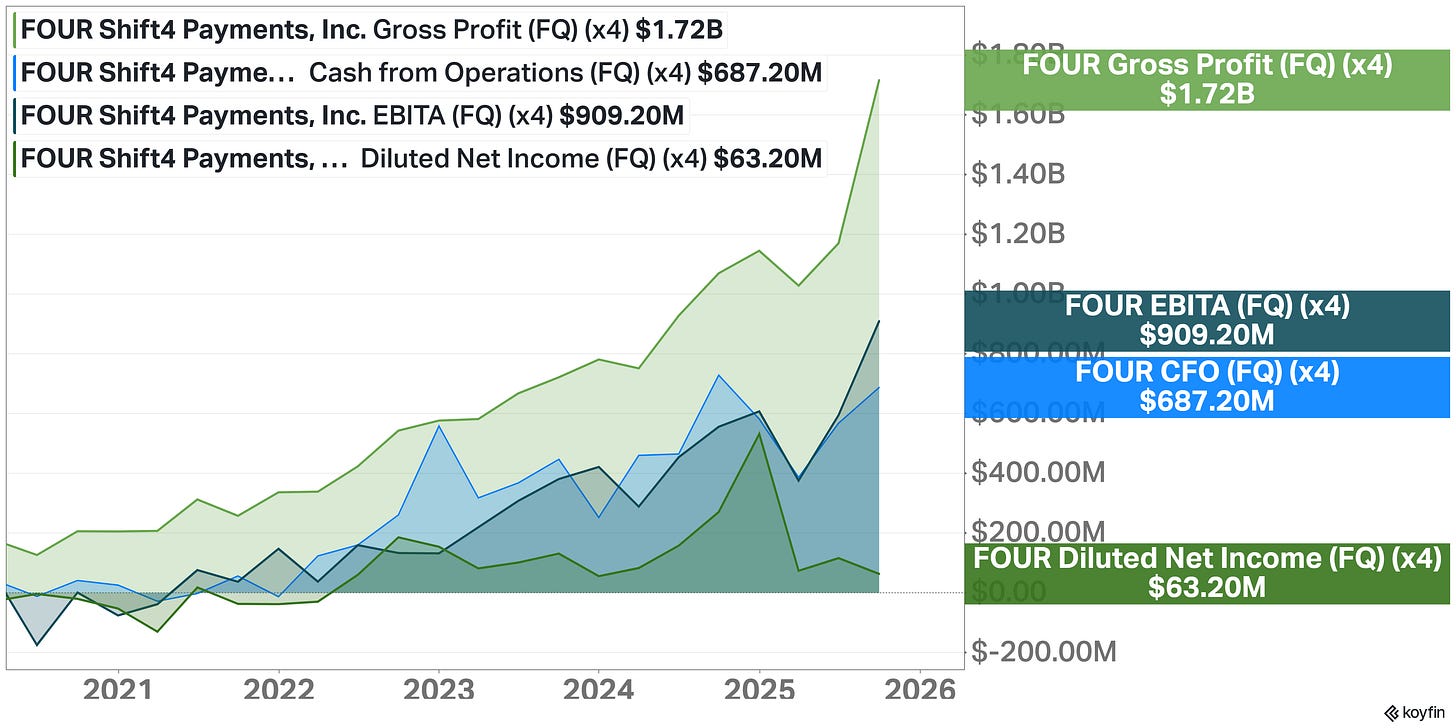
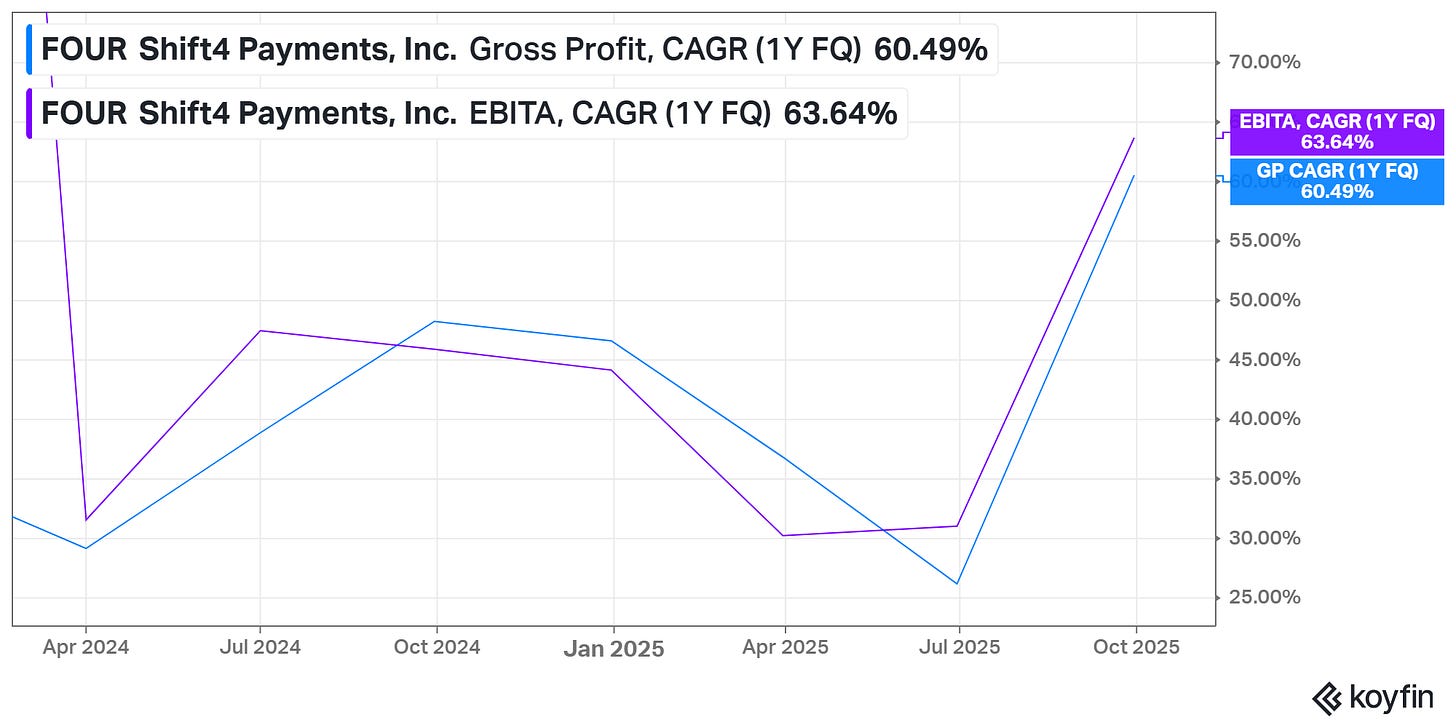
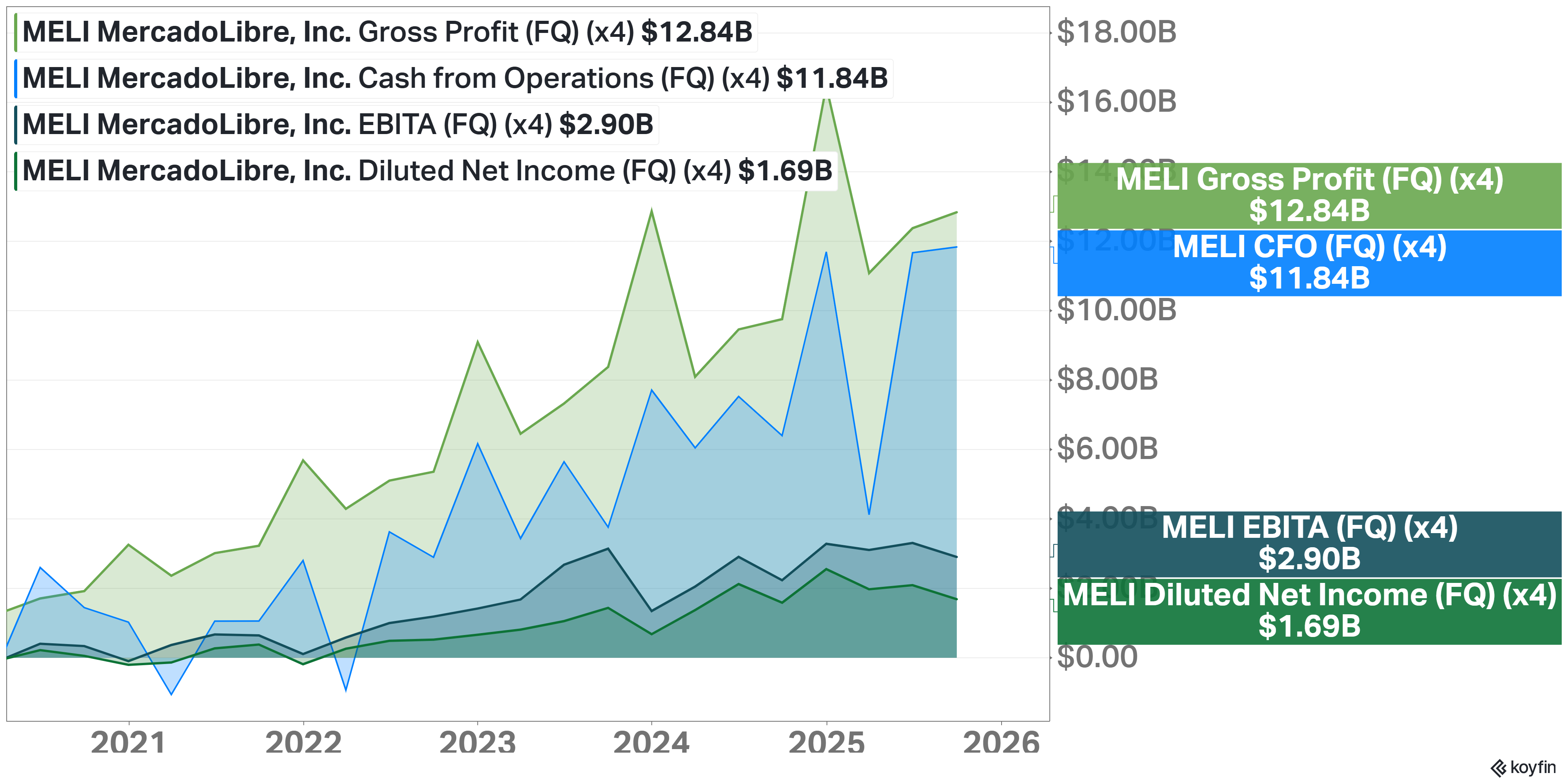
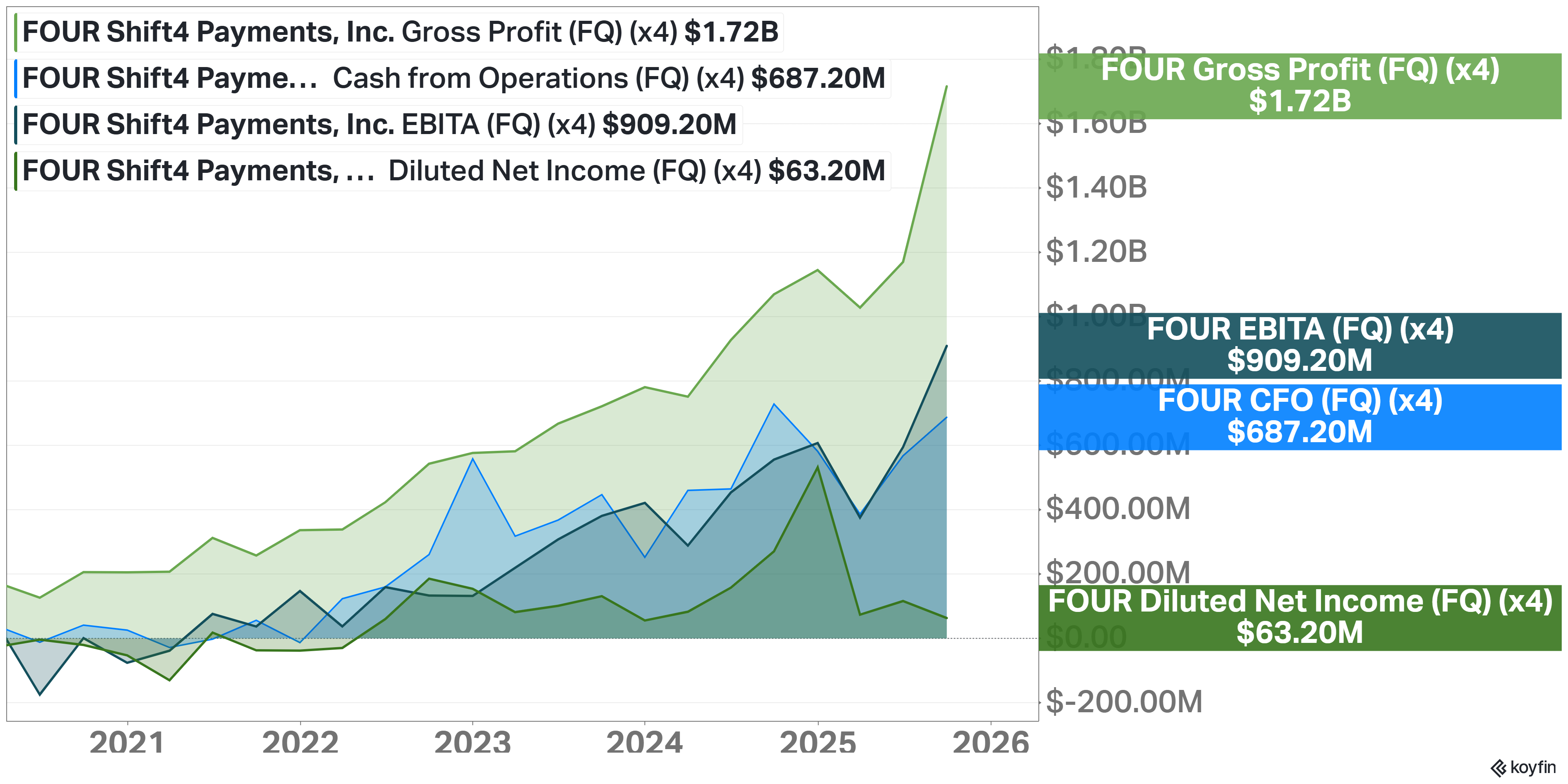
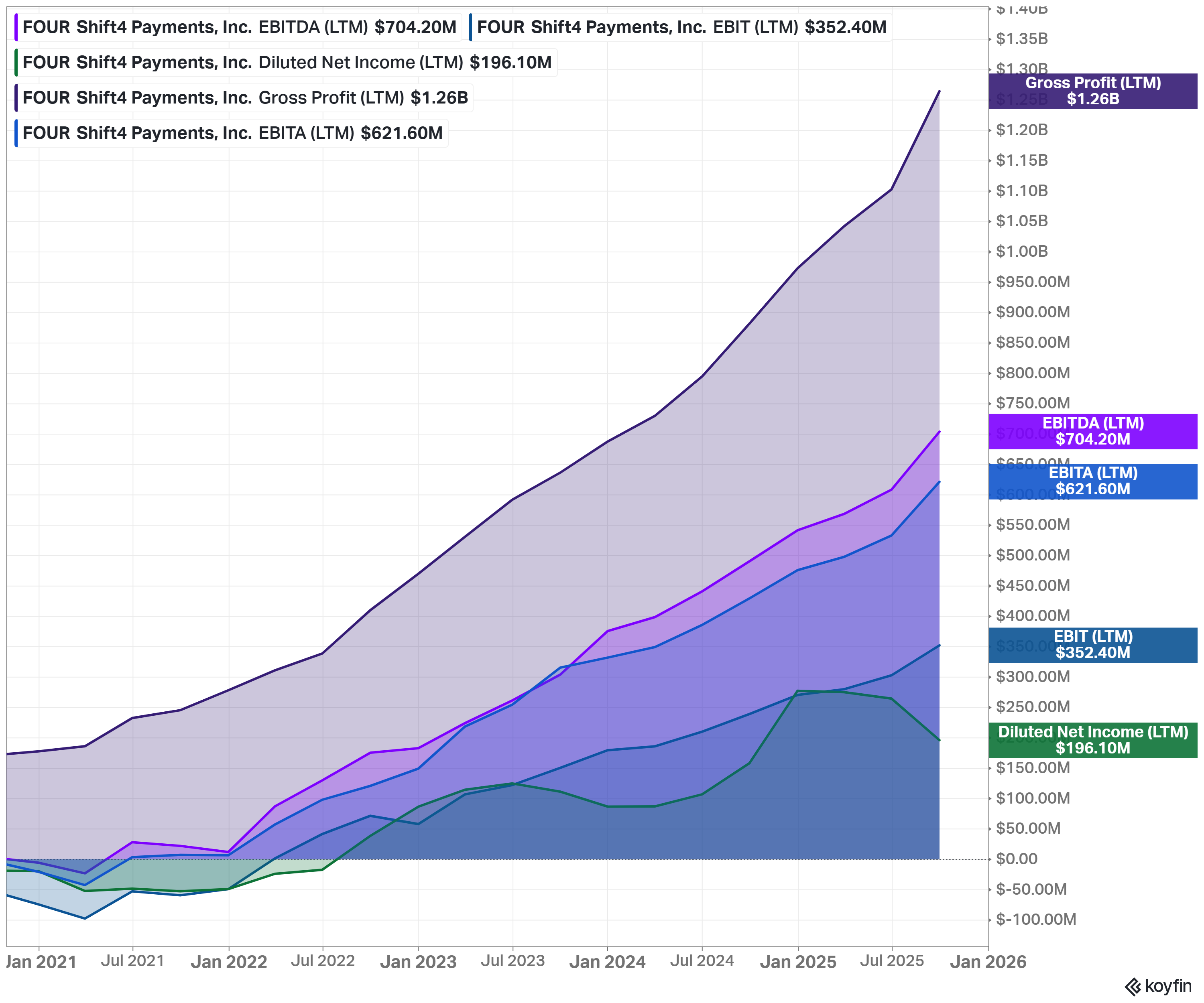
By annualizing both MercadoLibre and Shift4’s (x4) Quarterly Results from P&L and CF statement you end up with their annualized but seasonal results from the past 5 years. What a great set of payment companies. Clearly good Q4 coming up when they’re already at lows in valuation on increasing Gross Profits. Shift4 looks to be coming ahead in annualized recurring growth of payments.
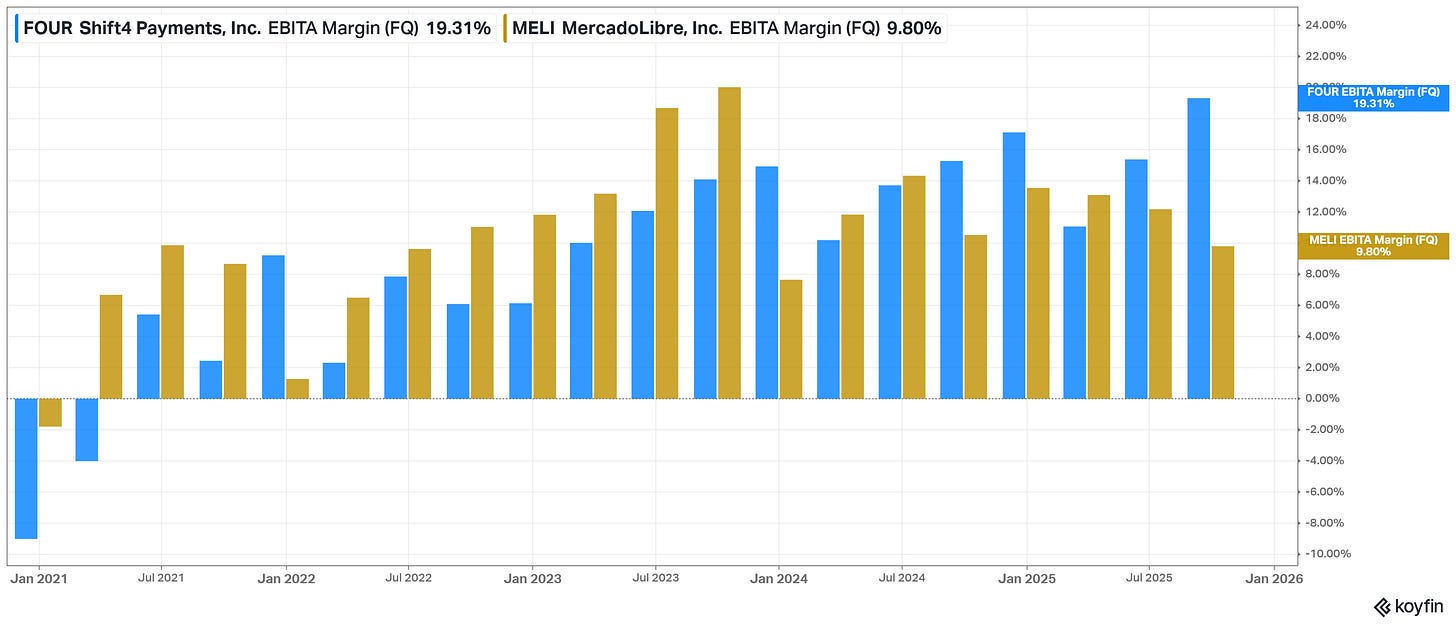
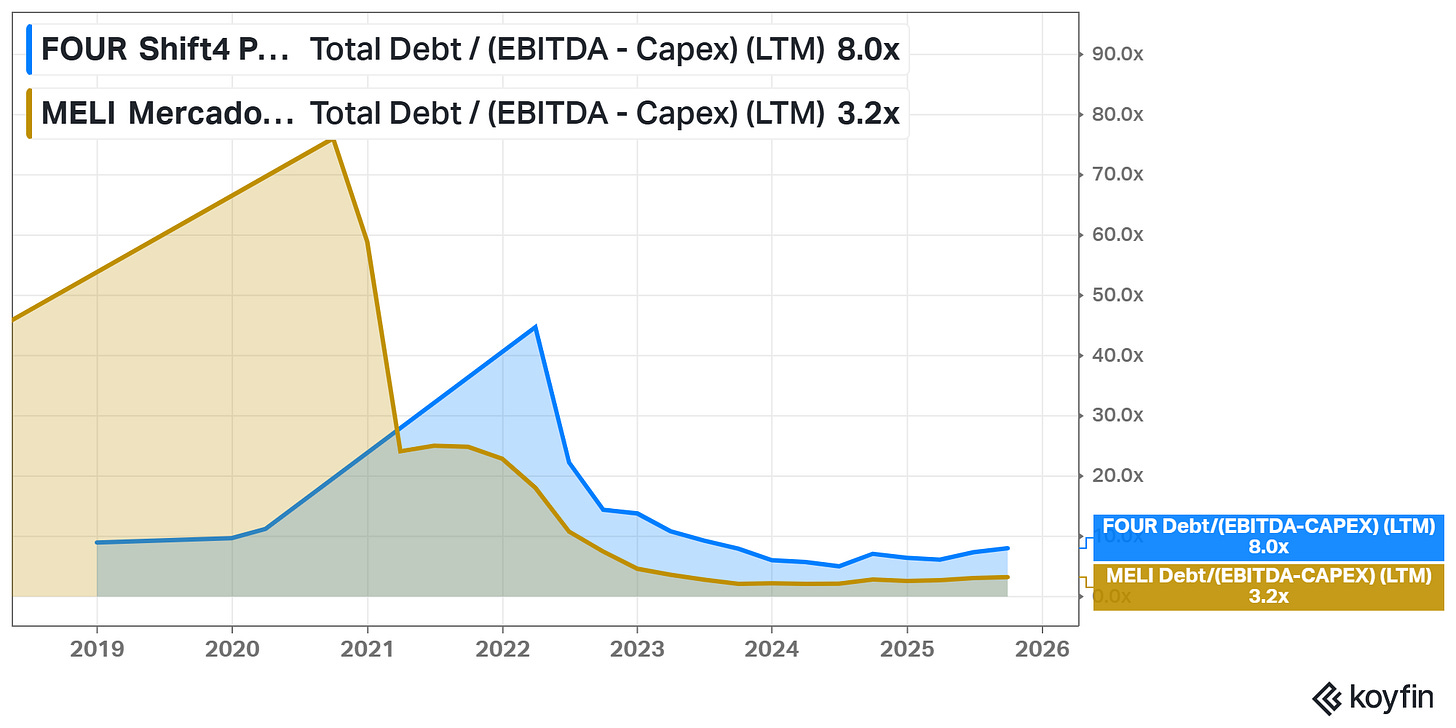
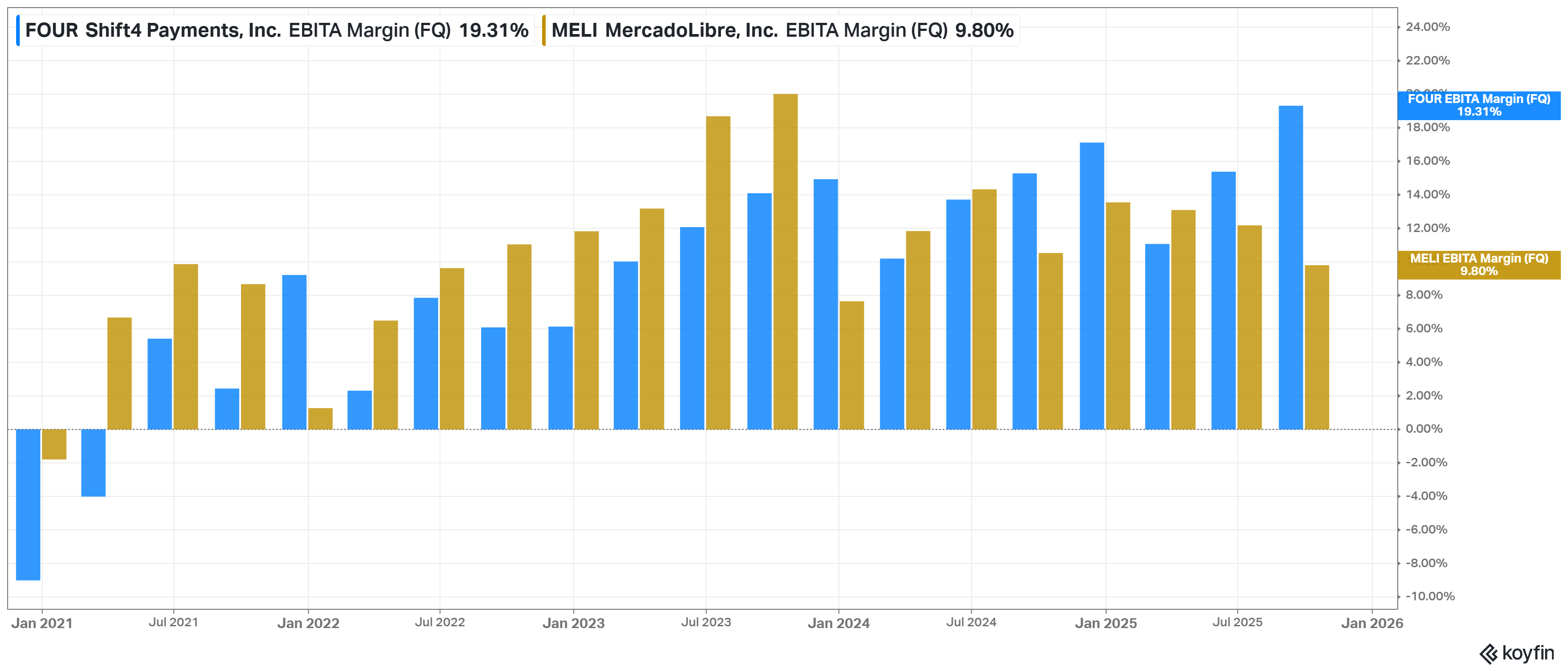
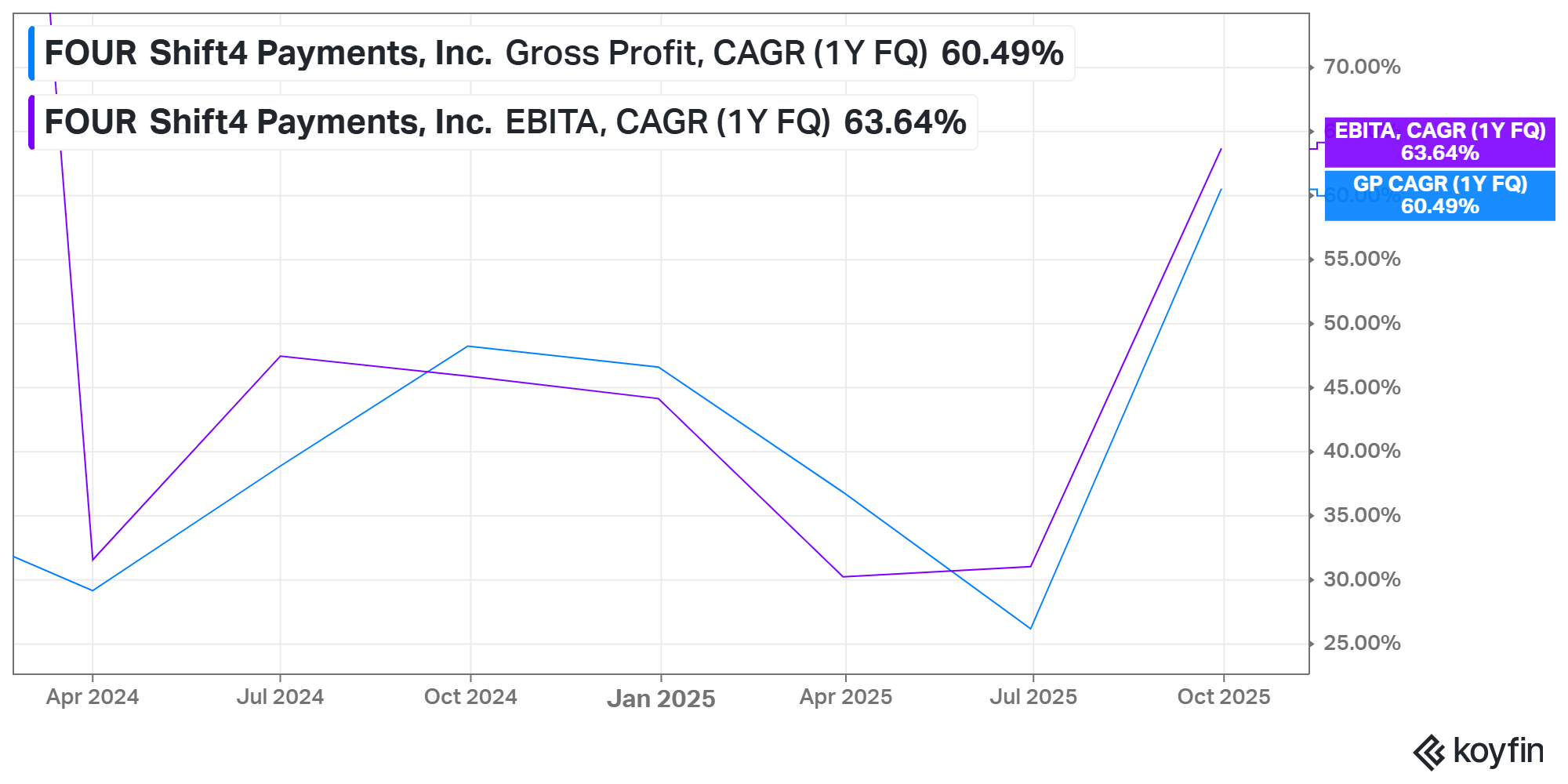
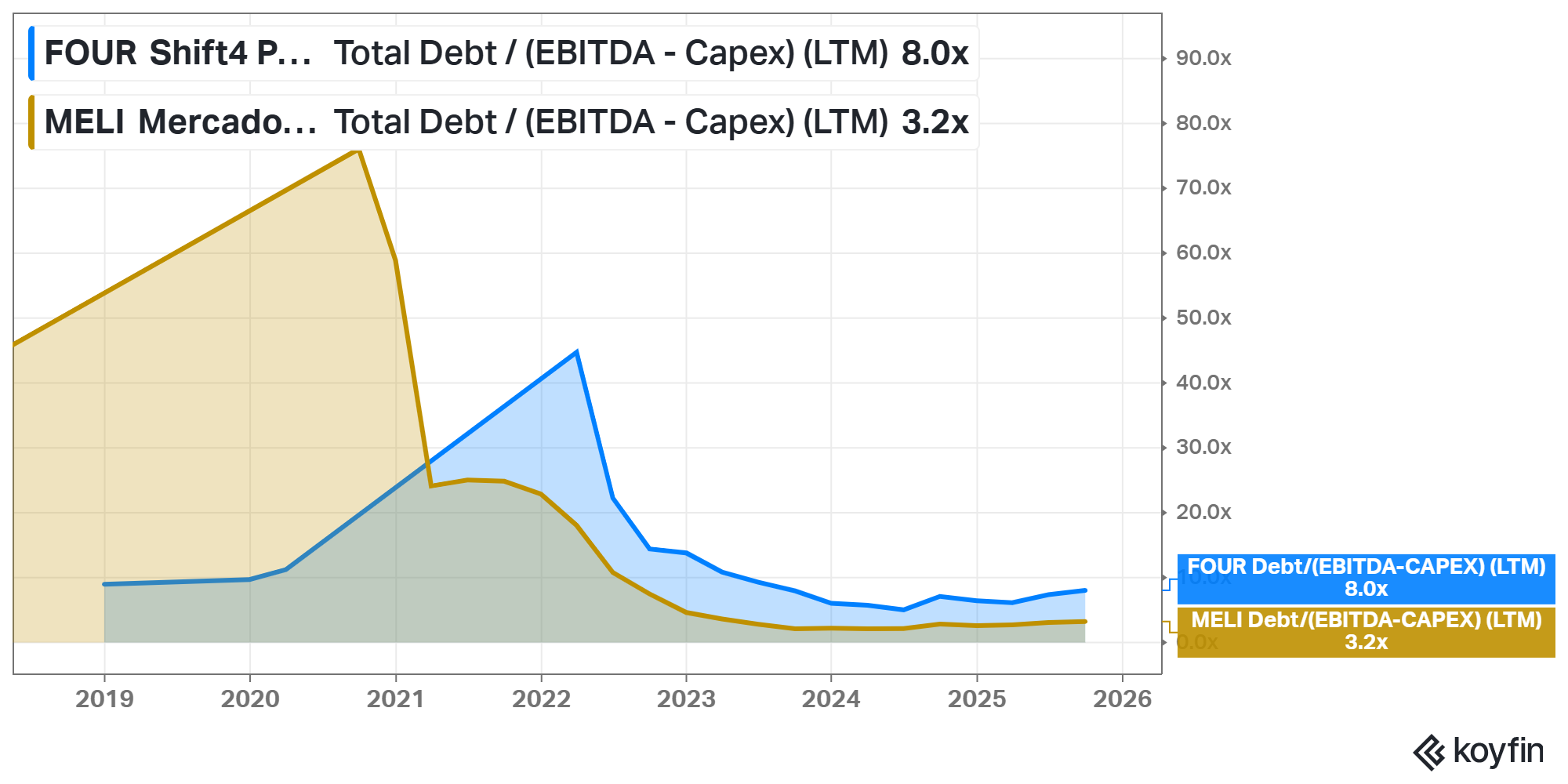
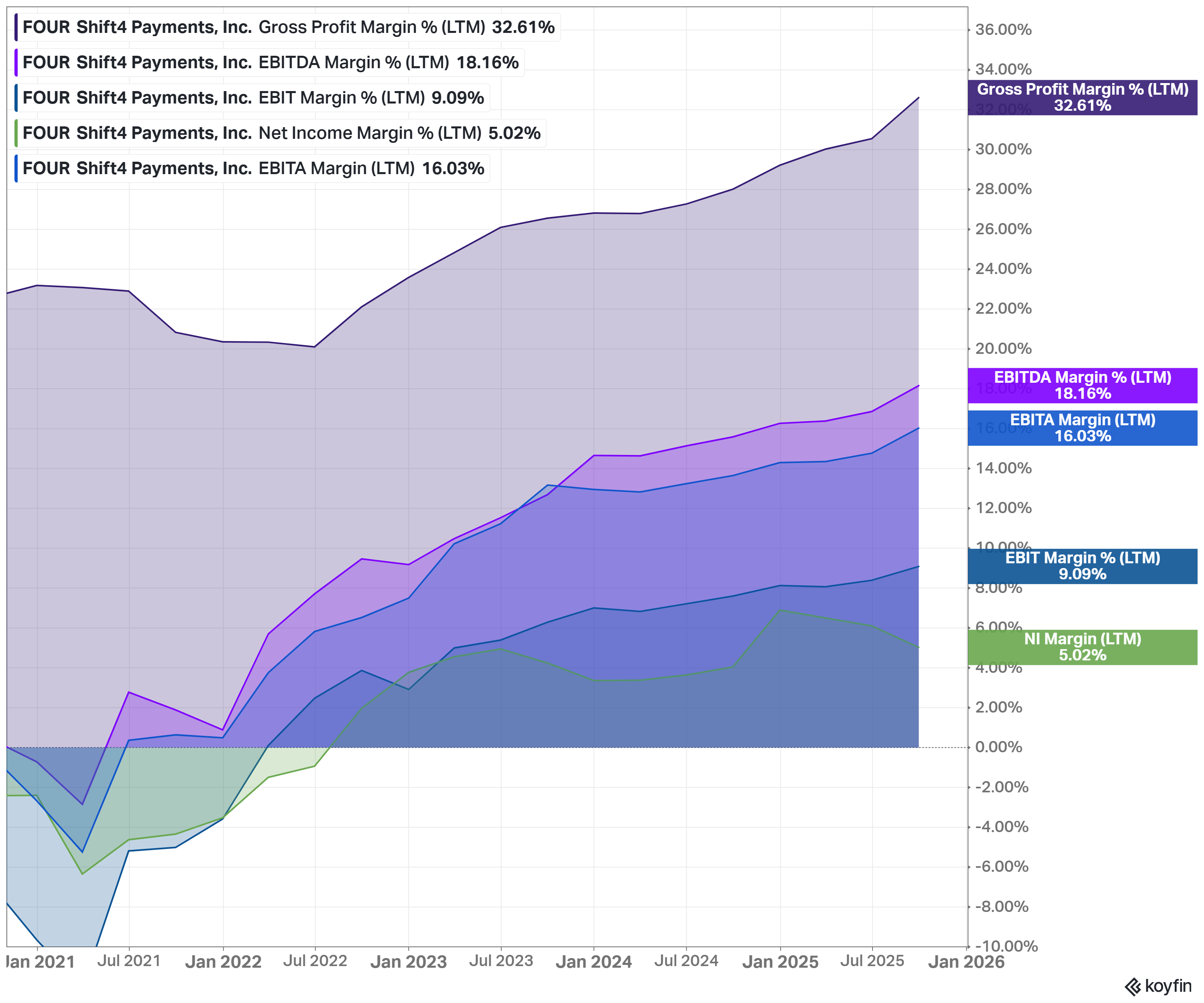
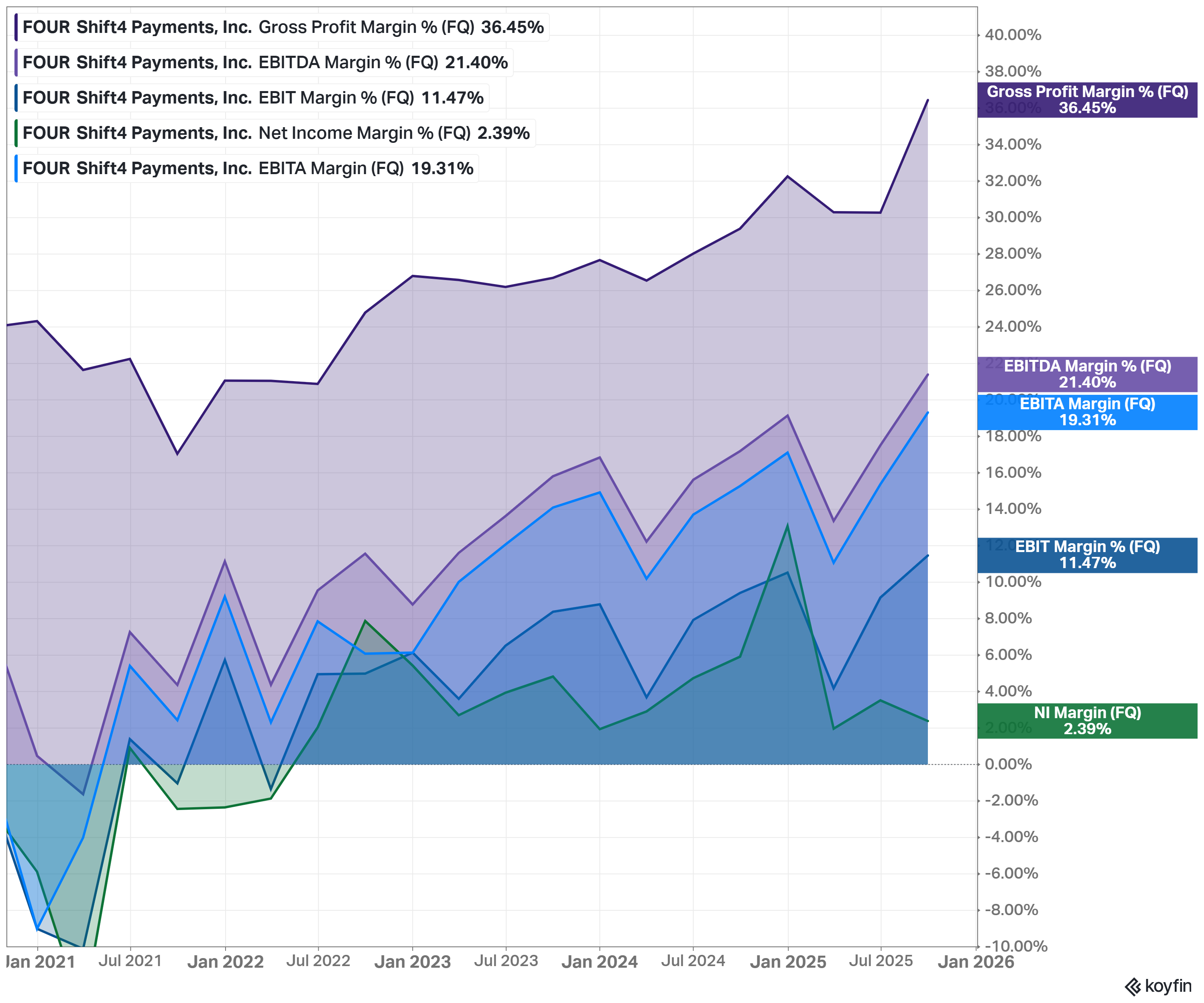
Global Blue being incorporated is an insane Q/Q jump this past quarter. What is also crazy is… these revenues are appearing steadier than even MercadoLibre’s. They’re also higher EBITA margins — meaning each unit economic or $1 of revenue is more profitable after non-recurring expenses for Shift4. Interesting. I thought Mercado Libre was also the best of the best already? Not to mention that 4% jump Y/Y in margins, due to Global Blue adding so much higher revenue… that’s before Shift4 even adds their processing products or POS onto their merchants and they convert existing merchants that haven’t transitioned yet. Shift4 is actually like 2x more profitable than MELI on each unit of payment/good processed… cool but crazy implications. Not to mention the impressiveness of the company’s unit economic margin improvements, and simultaneously rapid growth/rapid de-leveraging combination, shown below:
With all those factors in mind, the Debt levels don’t worry me. If FOUR was losing Total Payment Volume or not converting Merchants to E2E from every acquisition from the past 5 years, I’d be worried. I’ve been watching it over this whole 5-year stretch though. I have much more confidence in that credit risk than the market is. Pro-forma already brings you down to 4x and CapEx being growth CapEx to onboard merchants only (100% toll-both revenue model - same as V/MA)… that comes down to a 3.25x…
Wait a second… so the market is viewing Shift4 like a CCC bond, when it’s an AAA bond like Mercado Libre in Equities — explaining the valuation being 40% of the price in Mercado Libre, a LATAM Payments provider… compared to a primarily US recurring payments provider with 100% retention… with recurring revenues that deserve a higher underwriting…
“It is a capital mistake to theorize before one has data. Insensibly one begins to twist facts to suit theories, instead of theories to suit facts”
Sherlock Holmes
I fully believe in the experimental forward based reasoning of Sherlock Holmes. We’re solving a mystery here to try to find the best players/companies/rewards, for the cheapest amount of money like in the movie “Moneyball”. This movies core theme was to work to your advantage in a smaller market to find the best players statistically for the cheapest price possible. Same idea as what we’re doing today. Let’s find some stocks that get on base and buy them at cheap prices.
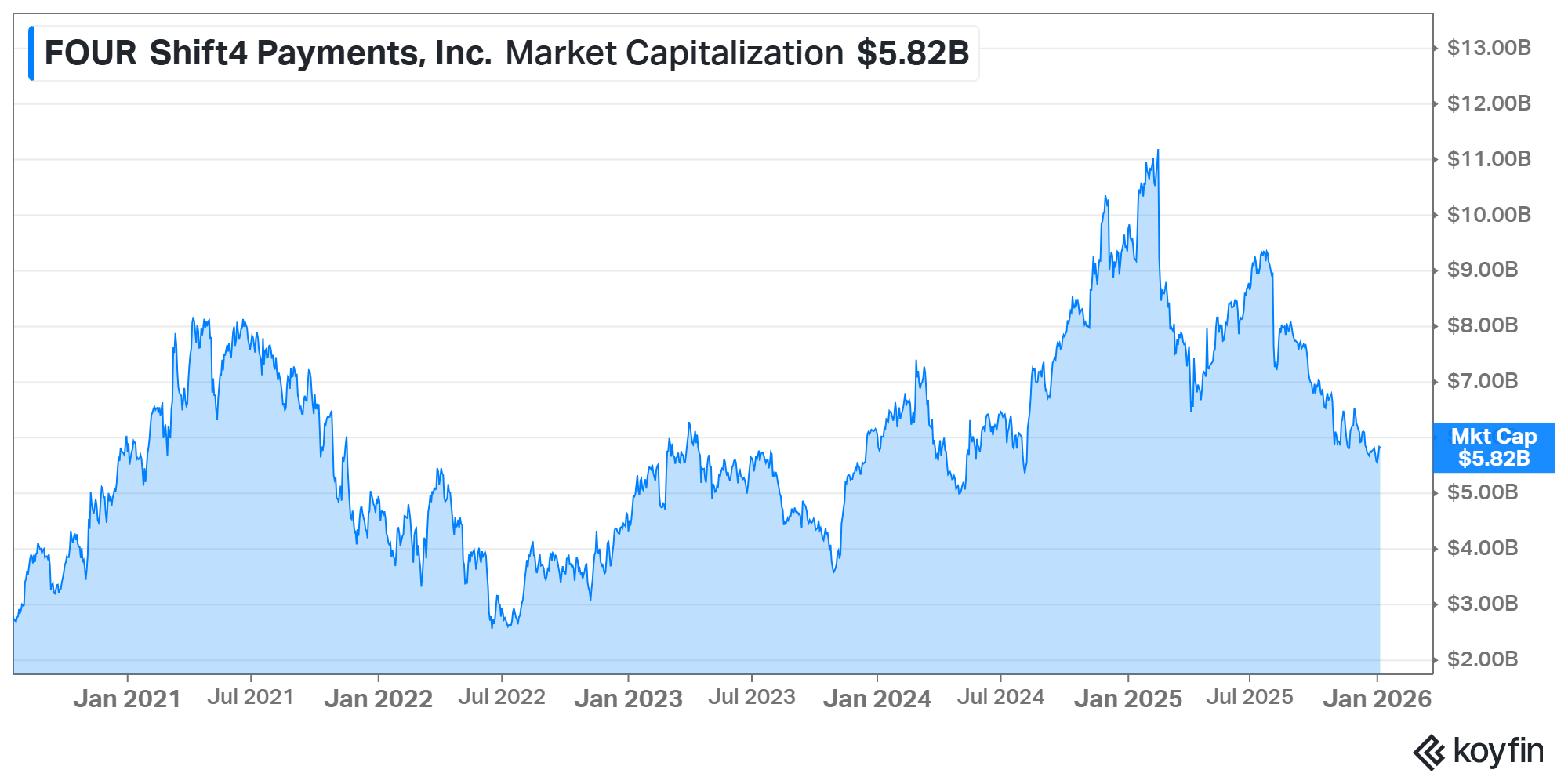
Also… stocks aren’t baseball teams. They’re businesses with owners with incentives to drive per share value upwards. Shift4’s management team has been verbally open about how they feel about the company valuing them at a $65 a share ($5.5B fully diluted market cap ; $9.33B Enterprise Value).
I will close by reminding you all that capital allocation is a core competency of our business. This forces us to prioritize where the next dollar is spent, and with urgency, as the free cash flow of the business improves each quarter. Nothing has changed with regard to this philosophy. New products and geographies present themselves often, M&A opportunities come and go, and our own equity fluctuates; often as a result of what our competitors are doing as opposed to our results. To this end, our board has authorized a new $1 billion stock repurchase program, which is the largest in our history. "
Taylor Lauber, Shift4 Chief Executive Officer
Shift4Q3 ER Shareholder Letter
Remember that quote — It’ll come up again later for Paid Subscribers.
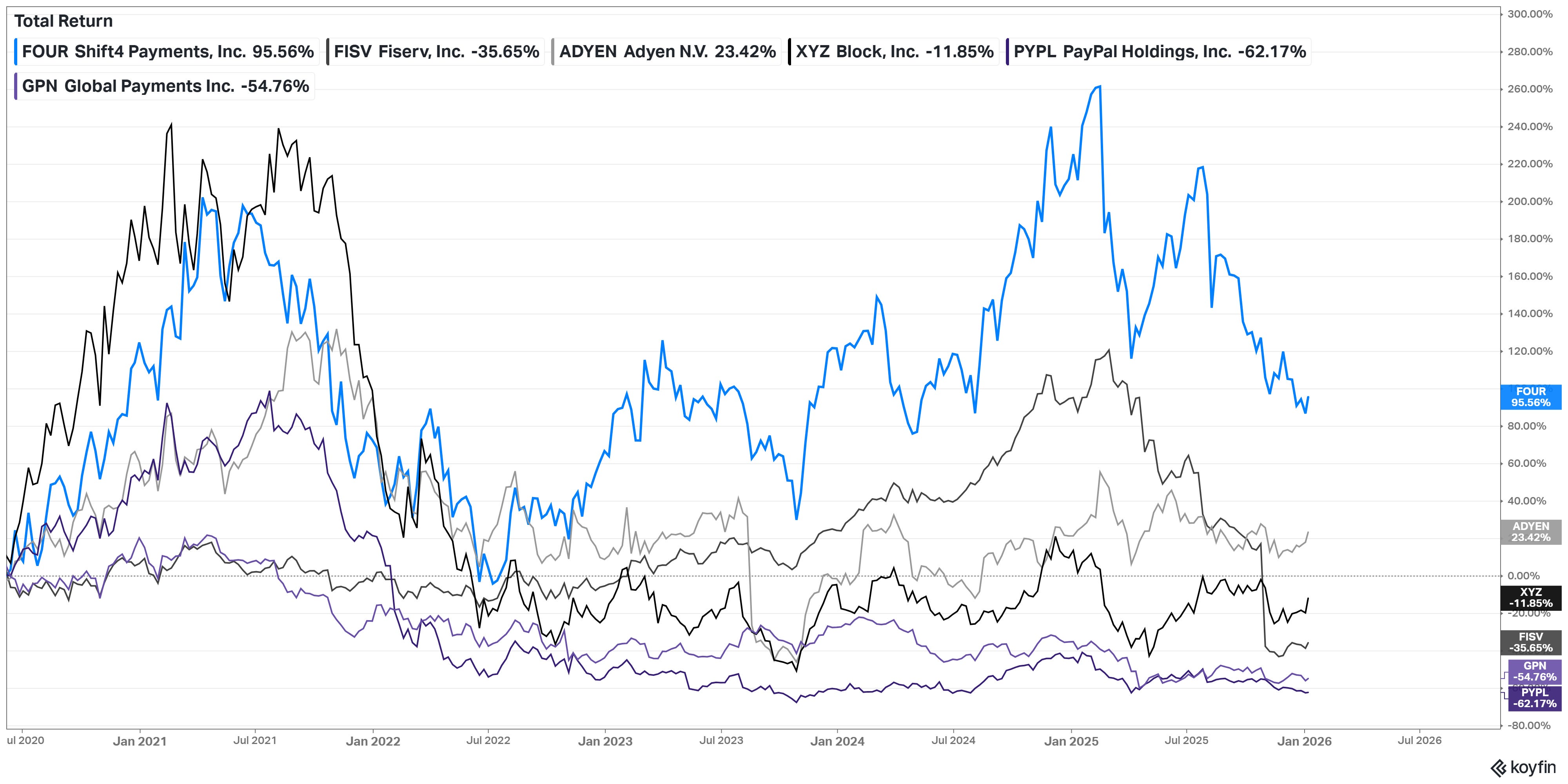
Their comments on Fiserv appear to be accurate on first glance too, when you look at the Payment Processing Sector’s returns over the past year… so Barry Bonds is also going to use one turn of EBITDA in 5.5% debt, expiring in 2033… to repurchase 15% of the shares within his entity… making his stats 20% higher next year? He can also repurchase another 20% at 75% higher values next season too at proportional mathematical values too, boosting his stats further??
Shift4 is in a terrible sector. However, it’s a player that is using the weakness to its M&A + organic growth roll-up strategy… which has proven pretty well over the past 5 years.
Sometimes, you need to be like Roy and go for the Green. Except in this case, you’re sitting over a 3 footer to win. Back of the cup.
Roy: “I know I can do it.” Romeo: “Then f*ing do it.”
Dear Fellow Investor,
Everything below—my portfolio allocations, IRR expectations, and trade decisions—is reserved for paid partners. Fundasy Investor exists for one simple reason — most market commentary comes from people with no capital at risk. I disagree with that Investing Newsletter model.
I document my actual positions, in real time. My incentives are fully aligned with yours—if I’m wrong, I feel it directly. I’m 27 and focused entirely focused on long-term, risk-adjusted compounding. You’re not just buying a newsletter membership. You’re getting transparent access to my process and how I manage my own capital, with the same discipline I display as a Financial analyst… with some occasional sports metaphors.
Pricing Evolution
As the depth, quality, and accountability of the work has grown, pricing will evolve as well:
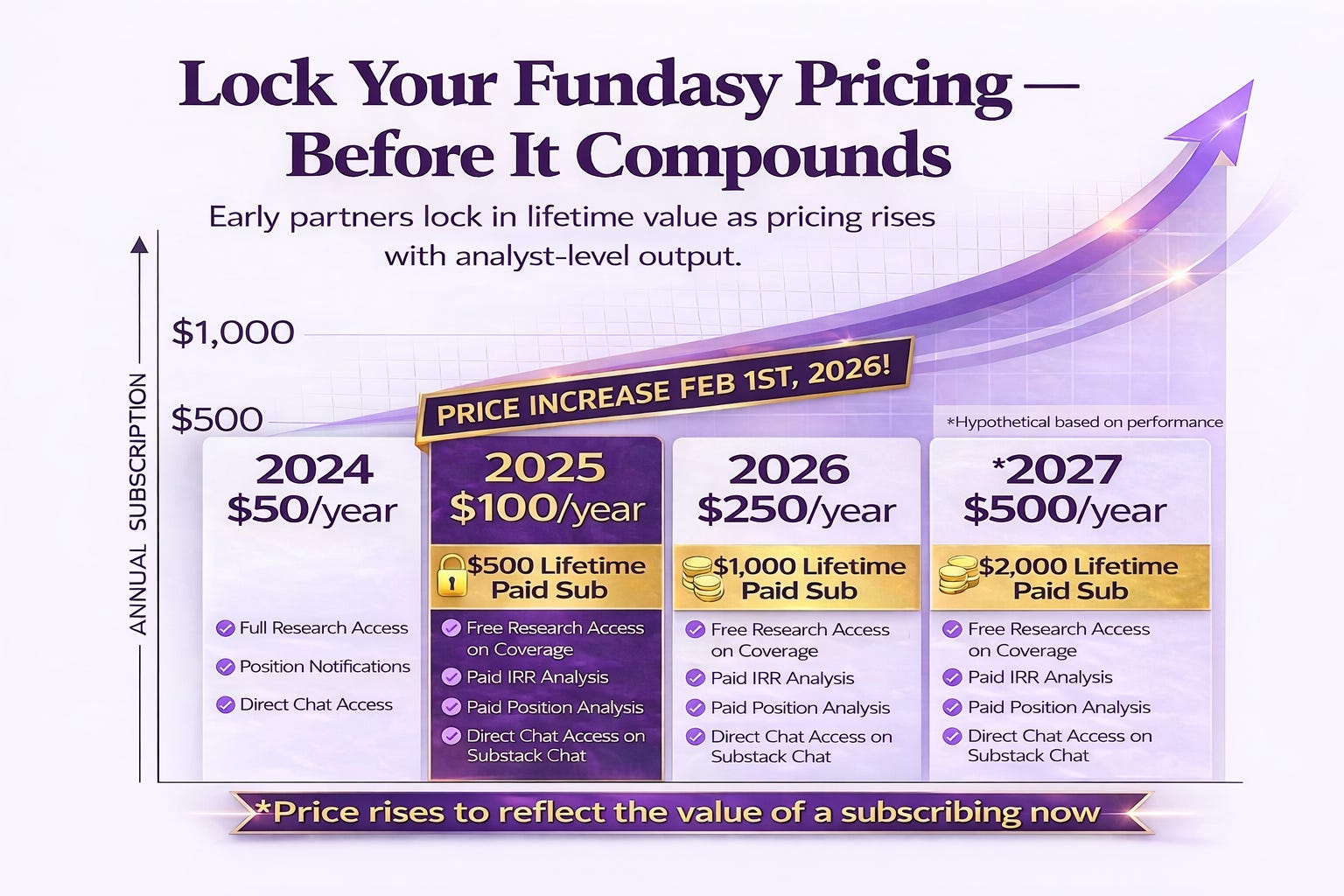
*1* Until Feb 1, 2026: $25/month ; $100/year ; $500 Lifetime Access
After Feb 1, 2026: $50/month ; $250/year ; $1,000 Lifetime Access
I will re-release today’s Paid Subscriber H12026 Gameplan to all Free Subscribers — letting Paid Subscribers benefit first
*2* - After Feb 1, 2027: $100/month ; $500/year ; $2,000 Lifetime Access
*Membership purchases bought before price increases - only renew at new rate when it’s up. Lifetime Membership took some manual workarounds. I will be in email contact as support to get you set up on these. If I miss your Lifetime sign-up, shoot me a message. This feature isn’t native to Substack so I’m having to do some small workarounds. Lifetime Memberships are an effort to charge 2x NY Annual rates to incentive long term partners locking in fixed pricing — for as long as I’m managing my portfolio professionally (27M).
*Future price increases will need to be justified with outperformance.
If this research produces even a handful of actionable ideas per year, it more than pays for itself. If you value alignment, transparency, and long-term thinking, you’ll feel at home here. If I don’t earn your subscription today — hopefully I will in the future. Happy 2026 everyone!
Here’s to the long game, William
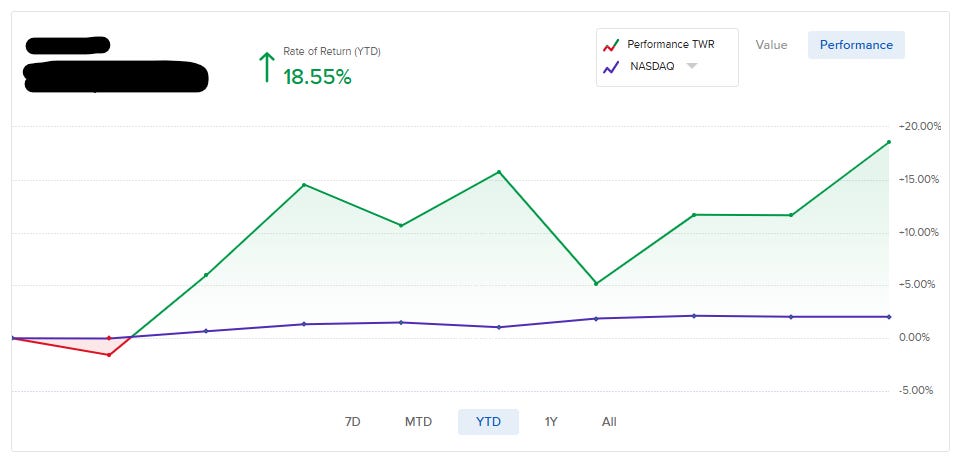
YTD (2026): +23% — largely all due to my recent positioning







Comments
Nothing yet. Say the first thing.
Sign in to join the conversation.