
Or: A blog post for all and none.
I was recently prompted1 to revisit Nietzsche's Thus Spoke Zarathustra and found myself especially struck by Zarathustra's first speech on the three metamorphoses, especially the final transition into the child — the only being capable of the naiveté necessary for (value) creation. Having spent some time reading a number of mathematician Alexander Grothendieck’s non-mathematical writings, this encounter with Nietzsche led me to revisit Grothendieck’s emphasis on the importance of child-like innocence and simplicity in mathematical inquiry through abstraction.
A Cautionary Note. For wider readability, I have tried to be generous in both mathematical and philosophical background. Hopefully I have succeeded. Though, should I fail, I take solace in the fact that the subtitle of Nietzsche’s Zarathustra would (still) speak prophetically: a blog post for all and none.2
Or: A confessional, of sorts.
My reactions to Grothendieck’s methodology, however, were admittedly not always positive.
In the Spring of 2022, Prof. Eric Ramos graciously agreed to conduct an informal reading course on the then-recently-released survey article by Melody Chan “Moduli Spaces of Curves: Classical and Tropical” in the Notices of the American Mathematical Society. Having completed a course out of Fulton’s Algebraic Curves the previous summer, the study of varieties proved manageable, but as more complicated concepts were introduced such as sheaves, schemes, and algebraic stacks I found it more difficult to understand the objects at hand. When I found out that the founders of these subjects saw their endeavors as ones that simplify and not complicate, I was astounded.


Regardless of one’s mathematical background, I think it can be appreciated that an algebraic variety — defined by polynomials — is more concrete than a scheme. Believe it or not, the non-mathematical reader of this blog has already seen an algebraic variety. It’s just the zero of a polynomial equation. For example, the variety associated to the polynomial
\(x^{2}-5x+6=(x-2)(x-3)\)
are the two points 2 and 3 on the real line since these are values on which the above polynomial vanishes. Look back on the definition and try to convince yourself that the example above indeed describes an algebraic variety. Since schemes generalize algebraic varieties, the above is also an example of a scheme. But a scheme, prima facie, seems to be much more mysterious by virtue of its abstraction.
However, as I have matured, mathematically and otherwise, I have come to see the wisdom in Grothendieck’s approach. The language of sheaves allows us to understand global behavior from local behavior, schemes let us describe beautiful mathematical objects that aren’t varieties, and, in the case of algebraic stacks, I find no better words than paraphrasing something I once was told by an acquaintance (who shall remain unnamed) in the back of a taco shop on a gray rainy day in Long Island, NY:
As algebraic geometers, we care about varieties and families of varieties. It’s just an unfortunate coincidence that families of varieties are algebraic stacks.
I now understand Grothendieck’s contention differently. Abstraction allows us to understand the “natural character” of things.3 Mathematical inquiry leads us to ask questions about objects that are not varieties and we are thus called upon to write down definitions that capture the essence of these objects. Grothendieck’s insight here that simplicity and thus insight can be found in abstraction is not novel. Indeed, it is a sentiment echoed by many of the great thinkers of history.4 Abstraction, and the definitions that come along with it, gives a name to these abstract objects.5 Naming is powerful, causing us to see the concept as distinct and better locate it within the vast interconnected network of the things we know.6 I had dismissed Grothendieck too soon.
However, as evidenced by the definitions above, abstraction is hard to learn. The initial trudge motivated only by the promise of insight on the other end. Put another way — if only to indulge a desire to allude to the forthcoming discussion of Nietzsche — you have to get through the foggy mountain climb to enjoy the clear mountaintop view.7
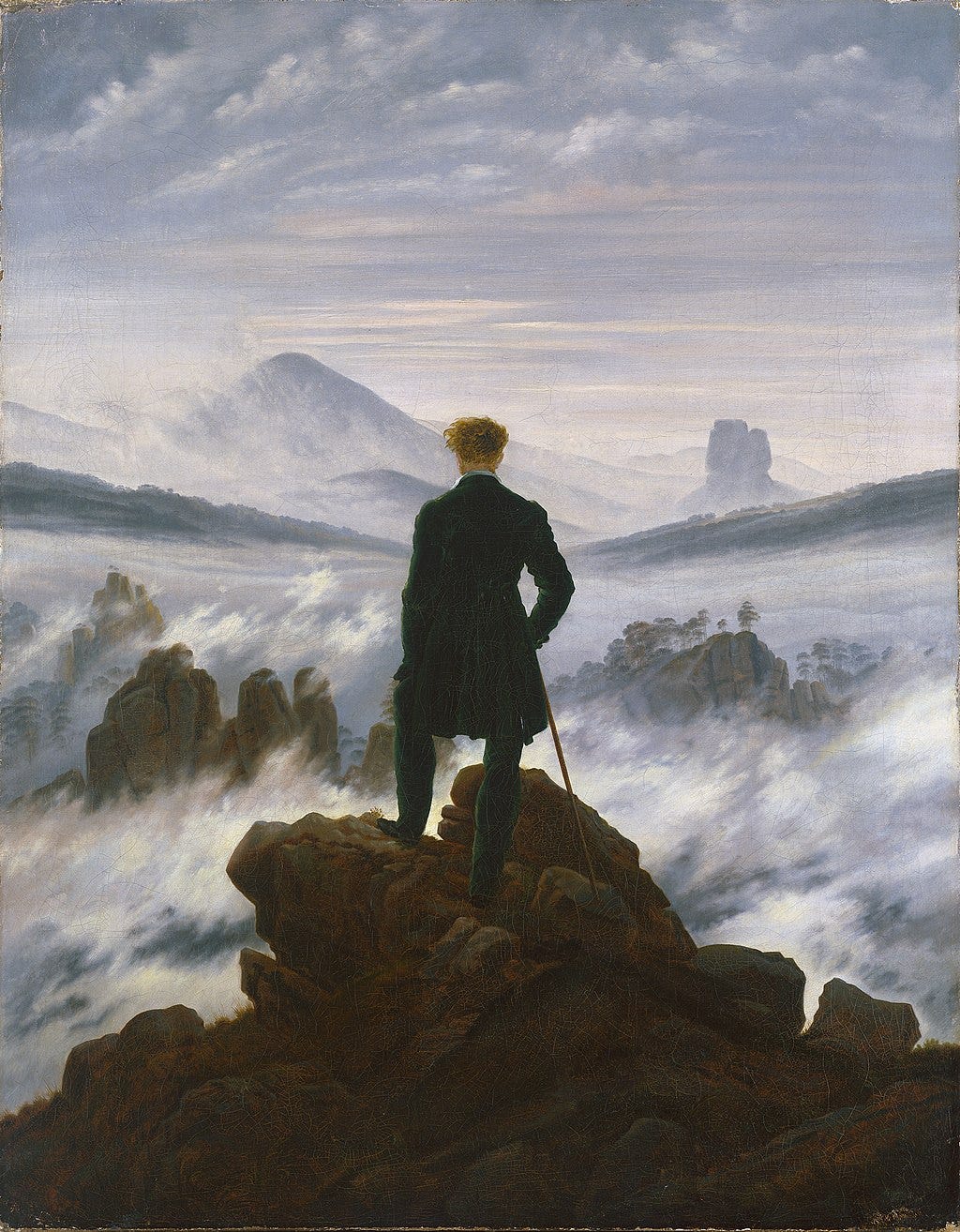
Perhaps puzzlingly, this discussion of simplicity in abstraction is embodied in the figure of the child. Looking back on his development of schemes in his autobiography Récoltes et semailles, he speaks of the construction as follows:
As with the very idea of sheaves (due to Leray), or that of schemes, indeed as for any “great idea” which comes to disrupt an ingrained vision of things, the notion of topoi is unsettling due to its natural character, its “evidence”; due to a simplicity (which is almost, one could say, naive or simplistic, even “silly”) of the particular flavor which makes us so often exclaims: “Oh, that’s all there was to it!”, in a half disappointed, half envious tone; with perhaps an undercurrent pertaining to the “zany”, the “unreasonable”, which is often reserved to that which is shocking through an excess of unexpected simplicity. A simplicity which reminds us, perhaps, of the long buried and repressed days of our childhood.
-Récoltes et semailles, Topoi - or the double bed.8
Elsewhere:
The very idea of a scheme is of a childlike simplicity - so simple, so humble, that no one before me had even thought to look so low. So “silly”, in fact, that for many years and despite the evidence pointing to the contrary, many of my erudite colleagues found this whole affair “not serious”!
- Récoltes et semailles, The magical fan - or the innocence.9
It goes without saying that Grothendieck’s instructions here are not to be taken literally. But he does elucidate an important point: while our “ingrained ideas” on one hand serves as a foundation for further understanding, it also inevitably mediates these encounters in a way that may obfuscate alternative (possibly simpler) approaches.
The child, embodying an approach free from an intellectual legacy, offers a solution to this problem. Thinking as a child allows us to encounter things anew. Grothendieck says as much in the Récoltes et semailles:
Discovery is the privilege of the child. It’s the little child that I want to talk about, the child who is not afraid to be wrong, to look silly, to not be serious, to not be like everyone else. He is neither afraid that the things he looks at will have a bad taste, different from what he expects, from what they appear to be, or rather: from what he has already understood them to be. He ignores the unspoken and unwavering consensus that form part of the air we breathe - which all the grown-ups are supposed to know and they do know.
- Récoltes et semailles, The Child and the Good God.10
The child is not afraid to be wrong, not afraid to look silly, not afraid to be different. The child is free to think and question outside societal expectations. The child is unafraid of failure and goes in without expectations, being “neither afraid that the things he looks at will have a bad taste, different from what he expects.” Child-like inquiry is profoundly open, one that is free from expectations and seemingly exempt from the pernicious phenomena of judging a book by its cover. The adult is instead burdened by convention and societal norms: the convention of “what he has already understood [something] to be”, the convention of the “unspoken and unwavering consensus that form part of the air we breathe.” It is only in child-like thinking — the willingness to return to restart from foundations and stubbornness in the face of other’s criticism — that great discoveries are possible.
Grothendieck, however, was not the only thinker to speak of the child in this way. Decades earlier, philosopher Friedrich Nietzsche similarly noted that it was only through becoming a child that greatness was possible.
Following the prologue where the eponymous Zarathustra proclaims of the death of God, he notes the necessity for humanity to embrace a new way of thinking and living. This new way of thinking was to be embodied by the superhuman (Übermensch)11. For Nietzsche, the death of God ushers in the era of the last human being12, marked by a culture of meaninglessness and nihilism.13 Superhumans are thus Nietzsche’s solution to this cultural crisis — the leaders and architects of a European cultural revival.
These superhumans, however, are not from another planet such as Krypton, but instead regular human beings who undergo a process of overcoming — a process likened to Darwinian evolution.14 As Nietzsche later describes, the process of self-overcoming involves three metamorphoses — first into the camel, then the lion, and finally the child. In Nietzsche’s telling, the camel — loaded with the burdens of convention and societal norms — leaves for the desert where the vast empty expanse causes the camel to realize that those burdens need not have been carried in the first place. In internalizing Zarathustra’s teaching on the death of God, we too meditate on the vast possibilities unbound by obligations. And, just as the camel sheds its load to become the lion, so too humans shed the boundaries erected by religion, culture, and history.
While the lion is necessary — with reinvention and renewal only possible after a rejection of the old — it is not sufficient, as evidenced by the necessity of the third metamorphosis:
To create new values — not even the lion is capable of that: but to create freedom for itself for new creation — that is within the power of the lion.
…
But tell me, my brothers, of what is the child capable that even the lion is not? Why must the preying lion still become a child?
The child is innocence and forgetting, a new beginning, a game, a wheel rolling out of itself, a first movement, a sacred yes-saying.
Yes, for the game of creation my brothers a sacred yes-saying is required.
-Z, I, On the Three Metamorphoses
Nietzsche distinguishes between the creation of new values and the “creat[ing of] freedom for itself for new creation.” The former being Nietzsche’s hope for the superhuman and the latter an insight that the constructive project of value-creation cannot arise from mere rejection of the past. The lion cannot create because it is stuck in this stage of rejection without any capacity for construction. This traps the lion in the old tradition, even as the lion rejects it. Opposing the old inevitably necessitates a comparison of the new with the old, allowing the old to continue haunting the lion’s mind.15 It is only in forgetting — being childlike — that genuinely new creation is possible. The parallels with Grothendieck are immediately apparent: creativity as the activity of a child, the necessity of openness for creation as exemplified by “yes-saying”, and the tabula rasa of “innocence and forgetting.”
Let us return to Grothendieck. While Grothendieck and Nietzsche see the openness of child-like thinking are necessary conditions for creativity, I think Grothendieck provides an interesting problematization of the Nietzschean progression from camel to lion to child to superhuman.
While Nietzsche’s child is represents a complete forgetting of the past, Grothendieck’s child-like approach seems to be only a statement about method, not about content. In other words, the questions Grothendieck sought to address with child-like inquiry were ones grounded in history. He says as much in a number of his writings. Consider the following discussion of arithmetic geometry:
The first embryo of this vision of “arithmetic geometry” (the term I hereby suggest for this novel geometry) can be found in Weil’s conjectures. In the development of some of my principal themes, these conjectures served as my main source of inspiration, throughout the years 1958-1969. Before me, Oscar Zariski on the one hand, and later Jean-Pierre Serre on the other, had developed some “topological” methods tailored for the unruly spaces of “abstract” algebraic geometry, inspired by the standard methods previously used for the “nice spaces” everybody knows.
-Récoltes et semailles, The novel geometry - or the marriage of number and size.16
For Grothendieck, the value of his “principal themes”17 — which included the theory of schemes — lay in their applicability to enduring questions in mathematics, such as in Weil’s conjectures that sought to understand the properties of algebraic varieties over different number systems. Grothendieck also acknowledges his debts to Zariski and Serre whose work served as “starting points and as tools (which I had to more or less entirely remodel to cater to the needs of a much more general context).”18 Grothendieck’s reworking — considering schemes in place of varieties — can be seen as the act of Nietzsche’s child. Forgetting the old methods allowed Grothendieck to rethink the subject from a new perspective, an openness that formed the foundation of creativity. Nietzsche’s forgetting is not an impediment to thinking but an aid, an invitation to encounter things anew.
Despite all the talk about forgetting and reinvention, Nietzsche too was not ignorant of the value of history. In the second of his Untimely Meditations, he distinguishes between the three ways history can be studied: monumental, antiquarian, and critical.19 Nietzsche considers the latter two inferior with antiquarian history lacking an appreciation of how history can affect the present and critical history thoughtlessly passing judgement on the past.20 It is monumental history that is of greatest value to Nietzsche, noting that:
Of what use, then, is the monumentalistic conception of the past, engagement with the classic and rare of earlier times, to the man of the present? He learns from it that the greatness that once existed was in any event once possible and may thus be possible again; he goes his way with more cheerful step, for the doubt which assailed him in weaker moments, whether he was not perhaps desiring the impossible, has now been banished.
-HL, 2. (emphasis in text)
The greatness of the past serves to remind us that greatness is possible, and thus calls upon us to be great once more. History, in demonstrating the possibility of greatness, serves to refute our own self-doubt and ignites the desire to pursue it.
Grothendieck too embodies this philosophy of monumental history. Throughout the Récoltes et semailles, his admiration for mathematicians of the past is readily apparent. Yet, within his recounting of the history of mathematics, one mathematician stands out:
I am referring to Evariste Galois. Within his brief and dazzling life, I seem to discern the beginning stages of a grand vision - precisely that of the “marriage of number and size”, within a novel geometric vision. I mention elsewhere in Récoltes et semailles how a sudden intuition appeared to me two years ago: that the mathematical work which at the time exerted upon me the most powerful fascination was in a way a “revival of Galois’ heritage”.
…
There is yet another reason which contributes to this feeling of “essential kinship” - a kinship which doesn’t stop merely at the level of “mathematical temperament”, nor to the defining aspects of one’s work. I also sense a kinship of destiny between his life and mine. … In Galois’ case, a superficial judgement could lead to the conclusion that his marginality was “accidental”, and that he simply had not had enough time to “impose himself” through his innovative ideas and through his work.
-Récoltes et semailles, “The unique” - or the gift of solitude
For Grothendieck, Galois was a figure of monumental history. He recognized the greatness Galois had, even when it was unrealized, and the connections between Galois’ program and his own. This, in addition to the personal kinship he felt with Galois, drove him to delve deeper in his work which he saw as a direct continuation of Galois’ investigations.
This reverence for the past, as exemplified by Grothendieck’s homage to the monumental figures in mathematics, perhaps paradoxically, underscores the essence of child-like thinking in the realm of discovery. A return to the foundational questions with a freshness of perspective akin to that of a child is complemented by a deep historical awareness that allows us to appreciate the full spectrum of innovation hence serving as a source of inspiration for our own pursuits. As embodied by Grothendieck, the monumental historian and the child are not at odds but are instead complementary facets of the creative spirit. The synthesis of history and child-like wonder forms the bedrock of true creativity, bridging the gap between what was known and what is yet to be discovered.
The image in the social preview is by Islingt0ner via a Creative Commons Attribution 3.0 License.
By J. Kripal's The Superhumanities: Historical Precedents, Moral Objections, New Realities, a book well worth reading. Perhaps a topic for another day.
A play on “A Book for All and None,” the subtitle of Nietzsche’s Thus Spoke Zarathustra.
Récoltes et semailles, Topoi - or the double bed. Translation by Saad Slaoui: web.ma.utexas.edu/users/slaoui/notes/recoltes_et_semailles.pdf.
A note on the text. A complete English translation of Grothendieck’s Récoltes et semailles does not exist as of the writing of this post. For untranslated texts of Grothendieck I will use an extant partial translation where available, and provide my own translation otherwise.
I discuss this in the context of Aristotelian thought in an introduction to a previous blog post on cohomology — see the post and the references therein. Plato’s articulation of the Forms as well as Locke’s discussion of abstraction in Essay Concerning Human and Kant’s project in the Groundwork for the Metaphysics of Morals come to mind, though these are by no means exhaustive.
A sentiment that I became more aware of after reading Ravi Vakil’s The Rising Sea: Foundations of Algebraic Geometry. See the chapter descriptions in the preface especially.
See, for example, Plato’s Cratylus, Confucius’ Analects XIII, and Xunzi’s Xunzi Book 26. Similar themes have been discussed in the contemporary study of the psychology of learning.
Friedrich’s painting is often associated to Nietzsche’s philosophy.
The translation of Übermensch is a topic of some philological debate. Del Caro and Pippin in the Cambridge text (see below) elect to use “overman”, Kripal (see above) uses “superhuman”, Stanley Rosen in The Mask of the Enlightenment: Nietzsche’s Zarathustra prefers “supermen”. I will adopt the convention of using “superhuman” following Kripal for it better captures the gender-neutral German, albeit with some hesitation regarding the interaction of such beings with the wider world (Cf. footnote 3 of Del Caro-Pippin).
It should also be acknowledged that several aspects of Nietzsche’s philosophy was co-opted by the National Socialist Party in WWII Germany. This is largely believed to be driven by his sister, Elisabeth Förster-Nietzsche, who was married to Bernhard Förster, an antisemite. Nietzsche, on the other hand, was critical of both nationalism and anti-semitism. See: NCW, How I Got Rid of Wagner, 1; EH, in UM, 1.
I follow Del Caro-Pippin’s translation of last human being (Letzter Mensch) here and throughout.
Z, I, Prologue, 7 — that is, Part I, Prologue, Section 7.
Fredrich Nietzsche. Thus Spoke Zarathustra. Edited by Adrian del Caro and Robert Pippin. Cambridge University Press, 2006. Following scholarly convention, Nietzsche's works are cited by short name with part number and chapter title in the case of Thus Spoke Zarathustra.
Z, I, On the Three Metamorphoses.
Grothendieck identifies twelve of these: (1) topological tensor products and nuclear spaces; (2) the six-functor formalism; (3) Grothendieck-Riemann-Roch; (4) schemes; (5) topos; (6) etale and l-adic cohomology; (7) motives; (8) crystalline cohomology; (9) higher stacks and homotopical methods; (10) tame topology; (11) Galois-Teichmuller theory; (12) “Schematic” or “arithmetic” point of view for regular polyhedra and regular configurations.
See ibid, The vision - or twelve themes for a harmony.
Ibid, The vision - or twelve themes for a harmony.
HL, 2.
Fredrich Nietzsche. Untimely Meditations. Edited by Daniel Breazeale. Cambridge University Press, 2005.
No posts
Comments
Nothing yet. Say the first thing.
Sign in to join the conversation.