
▶️Prefer to listen? Click play above.
In the podcast, I share more than in the writing below, so I encourage you to listen. Scroll down for music and a poem relating to this topic of becoming apologetically me. There’s also some images I generated with Midjourney and ChatGPT.
Unapologetically Me
I learned how to soften I learned when to be quiet But I've spent enough time I'm unapologetically me I'm unapologetically me No more sorry
The edges of my truth
How to make myself smaller
So there's more room for you
When I wanted to speak
How to make myself easy
Even if easy wasn’t me
Trying to fit
Into somebody else's
version of me
All of the fire
All of the feeling
All that I came here to be
Taking up space
Living out loud
Finally setting myself free
No more hiding
No more asking who I should be
I am one of those people who cry in supermarkets if they are upset. I can’t hold it in. I often have my sunglasses on. Mascara running down my face (the amount I cry, I should really only wear waterproof mascara).
In the supermarket, and other “inappropriate” places, I have overshared with people I barely know. Told them things that were on the surface that I couldn’t push down. And sometimes has a vulnerability hangover from sharing too much.
In my family, I am known as the emotional one. For my entire life, my emotions have lived close to the skin, not buried deep or pushed down. I felt self-conscious about this growing up, and even now with my family, I joke that I am the emotional one so that I can say it before they say I am being too sensitive, or too emotional.
I feel things. And I feel them deeply. And immediately. I don’t have the ability to hide or mask them, and I don’t know why that is.
I would try to keep it all tucked away, and it would leak out anyway, in my face, in my voice, in tears escaping.
I spent a lot of time doing this exhausting thing where I felt I had to hide a huge part of who I am despite me being so bad at hiding my feelings.
Interestingly, this ties in with another part of me that I have tried to minimize over the years. And it’s strange because it sounds like a good problem to have. I learned early on to hide the things I am naturally good at and that come easily to me.
In my final year of high school, I had glandular fever. I was unwell and could barely get out of bed, so I barely studied. Despite this, I still did really well. And I remember a friend being so annoyed with me, because she had worked so hard, and her results came in below mine.
Instead of feeling proud of my results, I felt embarrassed. Like I had done something wrong by being good at it without the struggle. I love learning. I always have. I pick up new things quickly, technology especially. And somewhere along the way I got the message that this was a bit much too. That having gifts that come easily is something to play down, to apologize for, so that other people do not feel bad or inadequate.
So I experienced this odd mixture of feeling too much and being too capable. When I look at these two things, side by side, I can see they were the same lesson, I experienced over and over again.
Make yourself smaller so everyone else is comfortable.
Do not feel so much.
Do not shine so bright.
Apologize for the space you take up.
And I know I am not the only one, because this is everywhere right now. I see so many midlife women writing about it on Substack.
The reflexive sorry. The saying sorry when someone else bumps into us. The softening of every opinion so it does not offend people or get you cancelled.
The over-explaining and justification of why we are allowed to want the thing we want.
A lot of women have picked unapologetic as their word for this year, as if we all reached the same point at the same time. The point where we are done shrinking, even if we are not quite sure how to stop.
Which brings me to a tool I fell in love with about seven years ago from Brene Brown. She calls them permission slips. And the story of how she started is my favorite part.
The morning she was going to meet Oprah for the first time, she was terrified, and so serious, and so in her head about it. And her daughter texted her to check she had signed a permission slip for a school trip.
And Brené sat on the edge of the bed and thought, I need one of those. I need permission to stop being so serious and just enjoy this. So, she wrote herself a note on a Post-it.
Permission to be excited and goofy and have fun.
And that was the first of hundreds she went on to write.
The idea is simple and it works. You write yourself a permission slip for how you want to show up.
Permission to take up space.
Permission to not be perfect.
Permission to feel.
Permission to want more.
It is a permission slip from you for you. You are the one granting permission to yourself.
And while I love permission slips, and did a course with Brené and Oprah online where we created our own, my new question is why do we even need one?
Why does a grown woman need to write herself a note giving herself permission to have fun, or to rest, or to want something, or to be good at what she is good at?
Somewhere along the way, the authority over our own selves got handed to somebody else or to the collective “them.”
And we have been waiting ever since to be excused, like children putting our hand up, hoping to be allowed to use the bathroom. (My son’s school has banned toilet breaks during class time as kids were vaping in the loos, so we have discussed this a lot in our house.)
I think for many women in midlife, we were raised to be good girls. To put others first. As I mentioned in a previous episode/post, I was at the funeral of a wonderful young mother and the eulogies that were delivered all said the same thing, she never said a bad word about anyone, she always put others first.
We have been made to feel like that is what it means to be a “good woman.”
We were raised to be nice. Do not make a fuss. Do not be too loud, too much, too big for your boots.
As with many things I am sharing in Fully Expressed, it comes back to safety. And I have only come to realize just how much the need for safety effects us as women.
From an early age, we may have learned that being fully ourselves was not safe. That we might be judged, or rejected, or left out, or brought down. So of course, our brain knew what it was doing and it subconsciously programmed us to make ourselves smaller to stay safe.
Then as adults, we encountered the same lessons in workplaces, in marriages, in friendships. And we did it without realizing it.
If you listened to the witch wound episode, you may hear the echo here too. It comes back to the same thing: when it doesn’t feel safe to be seen, we learn to shrink.
I couldn’t stop thinking about those permission slips. I wanted something I could hold, something beautiful, that would keep giving me permission for the things I found hardest.
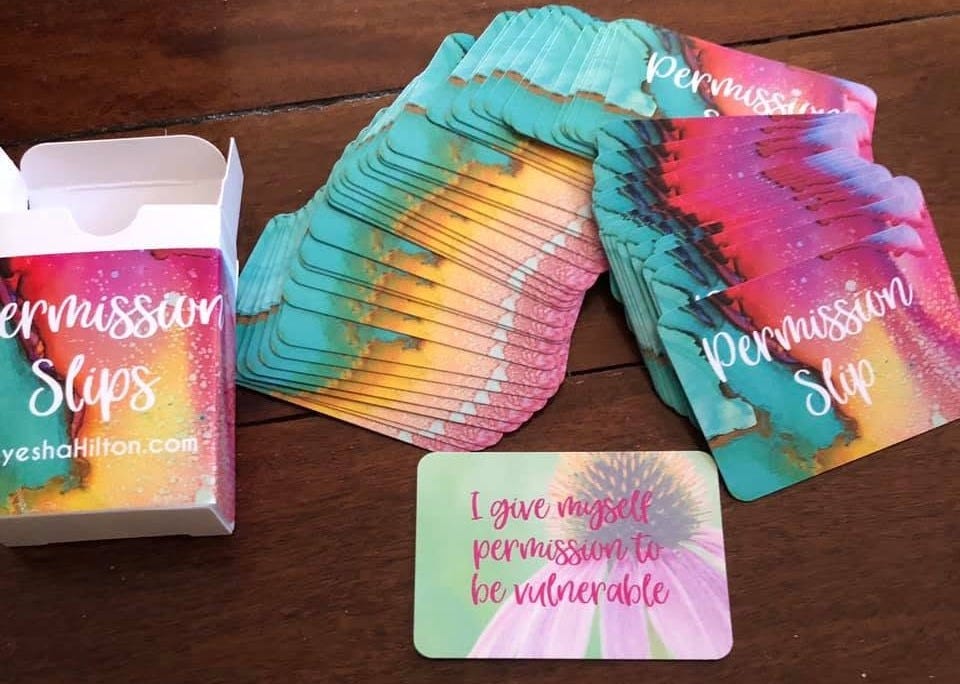
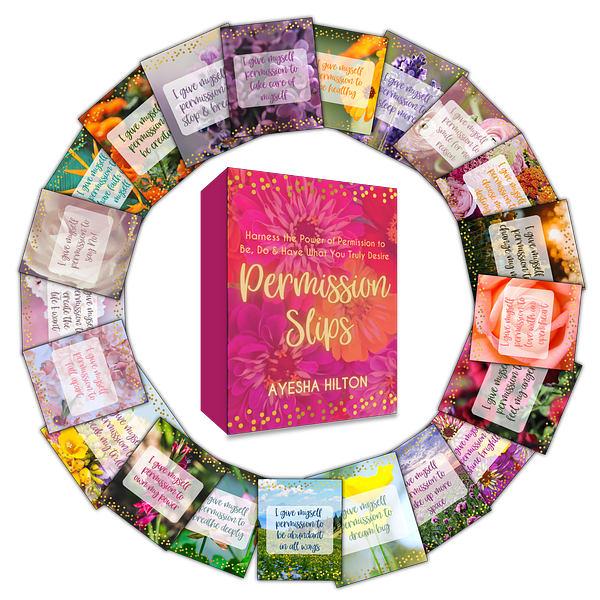
So, I made a deck of permissions slips and sold them online.
Permission to have fun. Permission to be more joyful. Permission to do daggy dancing in my kitchen. Permission to shine brightly. Permission to stop hiding who I am.
Since I made that deck, and started actually living by it, my life has changed for the better. The part I love is not just what it did for me. It is what it did once it left my hands and the life that deck had without me off doing it’s own thing.
One of my coaching clients, who does Reiki healings, started offering a card from the deck to people as they left her sessions. They would take one on the way out, whatever they were meant to receive that day. And people loved it so much that she kept buying more packs.
Then one day I got an email from a man in Newcastle, Australia. He had been in rehab hospital. And in one of his art therapy classes, they had used my deck. He was so touched by the card he received that when he got out, he went looking for it online, found my deck, and ordered his own set.
To this day, I have no idea who that art therapist was. A person I have never met, in a hospital I have never been to, put one of my cards into the hands of a man I will never meet, at a moment when he really needed it. And it reached him. It touched him enough to go and buy his own copy.
I did not know any of that was happening while it was happening. The deck took on a life of its own, and went and did its work places I will never know.
And that is the thing about our gifts. When we stop hiding them, they go out and reach people we will never know about, in ways we would never have planned. But only if we let them out in the first place. The man in the hospital got that card because one day I gave myself permission to make the thing, and to put it into the world with my name on it.
And when I think back to that girl who learned to play down what came easily to her, I wish I could tell her this:
Your gifts aren’t something you need to apologize for. They aren’t taking anything away from anyone else. They’re yours to use.
And sometimes, when you use them, they become something someone else needs.
I could never have known, sitting there making that deck, where it would end up or who it might reach. I just had to make it and let it go out into the world.
I think it is sad that we need permission slips at all. That we have to formally write ourselves a note to be allowed to be who we already are. There is something in that which makes my heart ache for all of us - for every woman has subconsciously had to make herself small to stay safe.
And yet, for now, I think we do need them. Because the conditioning is real, and it is deep, and it doesn’t go away just because we noticed it.
So we can write the slip and give ourselves the permission, over and over, until one day maybe we forget we ever needed it.
The permission is a way we can practice remembering that we were always allowed – even though we didn’t realize it.
We are allowed to be ourselves.
And for me, that includes the part of me who cries in supermarkets. The woman whose feelings live close to the surface. Who makes friends with random people while buying milk and eggs.
I still cry. I still sometimes tell people more than I intended to. I’m still sensitive. The difference is that I’m trying not to make that part of myself wrong anymore. And that has been very freeing.
Just as I don’t want to hide the things I’m good at, I don’t want to hide the things I feel.
They’re both me.
Maybe I have been too much for some people. Too emotional. Too capable. Too sensitive. Too something.
But maybe “too much” is sometimes just what we call ourselves when who we are makes someone else uncomfortable.
We don’t have to keep making ourselves smaller because of that.
We don’t have to live our lives with the focus on keeping everyone else comfortable.
That the authority was ours the whole time. We just had to stop waiting for someone to hand it back to us, and claim it for ourselves.
What would you give yourself permission to do, or feel, or want, or be?
What is the permission slip you need to write?
If this stirred something, please consider becoming a subscriber, if you’re not already, so you can share this journey with me and other women. Each month, we gather for a Futurecasting session with is an amazing but simple process for manifesting and creating what you want in your life.
If this space resonates with you and you’d like to go a little deeper,
you’re warmly invited to join the Fully Expressed Collective.
Unapologetically Me Song
I wrote a song about this too, called Unapologetically Me.
I generated the music with AI.
0:00
-4:22
It feels like the right way to finish this episode, because really, that’s what all of this comes down to.
Giving ourselves permission to stop apologizing for who we are.
So I’m going to leave you with Unapologetically Me.
Here’s to living Fully Expressed!
Love,
Ayesha xox
PS Find out how to work with me if you’ve got something you want to express in the world!
Ayesha Hilton is a writer, creator and mentor who believes there is often far more within us than we have yet expressed. Through Fully Expressed, she explores creativity, identity, self-expression and life in midlife, and what it means to bring more of who we are into the world.
She also mentors women who want to turn their ideas into something real, including books, journals, podcasts and oracle decks. Her Card Deck Creators Toolkit has helped more than 1,200 women create their own card decks.
Find out how to work Ayesha if you’ve got something you want to express in the world! Message Ayesha if you have any questions.
Comments
Nothing yet. Say the first thing.
Sign in to join the conversation.