
We don’t really need each other.
We are independent, resourceful and successful.
When we moved into our new place some years ago, I got a lawn mower. Coming from a place like Singapore, lawn manicure is not something on our to-do list. Majority of Singaporeans live in the sky. You trim plants at your front door just before it creep into your neighbour’s front door.
Does everyone in my neighbourhood own a lawn mower? Does each household actually need to own a lawn mower?
This is absurd. How often does each family need to cut the grass? Once a fortnight, once a week at most?
Can’t we share a lawn mower? (Can’t we not give our hard-earned money to Bunnings?)
I told my wife about this. She looked at me and sighed. “Good idea. Not going to work.”
I knew why.
No one wants to depend on others. No one wants to felt indebted to another.
Spoken and unspoken, everyone is yearning to be part of a community.
Sure, friends are part of our community, but to be in community is to be with people we depend on, to be part of something greater than my self.
But we dislike the idea that we need to rely on others.
In The Ascent of Humanity, Charles Eisenstein writes,
The reason adult friendships seem so superficial is that they are superficial... our society’s specialization has left us little else to do.1
Need someone to look after your child? There’s a childcare down the road.
Need someone to meal prep for you? There’s online services to deliver the raw ingredients to you, or better, order “tapau” as my family would say for takeaways.
Need someone to look after your elderly parents? There’s carers services that you can call upon.
These things are great. It makes life easier, more manageable.
But the truth is, we have outsourced most of our needs to be met by specialists.
When we outsource the lion’s share of our daily living while we get sucked into the vortex of being part of a productive machine, we become the consummate consumer.
Our role is engulfed by consumption, not creation.
When we are consumed by consumption, our role and soul no longer align.
We trade the creative life for an outsourced life.
Eisenstein adds,
As we move into adulthood, in place of play we are offered consumption, in place of joint creativity, competition, and in place of playmates, the professional colleague.
My field of counselling and psychotherapy is part of this specialised universe.
Need someone to help a child who is struggling at school? Go see a psychologist.
If this psychologist not a good fit for you? Ditch them. Go see another one. See someone who specialises in X, Y, Z. In fact, some online therapy services promote this “switch til it fits” tagline. As a therapist, I do agree that you need to be able to connect with the person. But sure an approach treats the counsellor like a cog in the wheel. We become “consumers” of therapy, rather than being part of a therapeutic endeavour.
The most precious things are not easily replaceable.
Eisenstein hits on a nerve-ending with this passage:
The feeling of “we don’t really need each other”... what better description could there be of the loss of community in today’s world? We don’t really need each other. We don’t need to know the person who grows, ships, and processes our food, makes our clothing, girls are house creator music mix or fixes our car; we don’t even need to know the person who takes care of our babies while we are at work. We are all dependent on the role but only incidentally on the person for filling that role whatever it is, we can just pay someone to do it (or pay someone else to do it) as long as we have money. And how do we get money by performing some other specialised role that, more likely than not, amounts to other people paying us to do something for them.
The necessities of life have been given over to specialists, leaving us with nothing meaningful to do (outside our own area of expertise) but to entertain ourselves.
We wish we were closer to our neighbours; we think of ourselves as friendly people who would gladly help them. But there is little to help them with in our house-boxes, we are self self-sufficient. Or rather, we are self-sufficient in relation to the people who know but dependent has never before on total strangers living thousands of miles away.
In short, there is an incompatibility between the premium we place on fierce independence and deep desire for community.
We yearn for community, but we actually don’t need each other.
To reveal a need is to show a weakness.
Your status is lowered; this kind of vulnerability sits uncomfortably.
Yet, true communities are formed by our shared weaknesses, not strengths.
The social media experiment is one such grand failure. There is no real ‘social’ in it.
We failed to comprehend our human nature. Sharing of ourselves, our best selves, leading the best lives, promoting our achievements and successes may lead to virtual thumbs-up and heart-shaped affirmations, but pulls people further apart.
How did we end up letting these tech companies mediate our lives, tearing the fabric of our relationships?
An acquaintance just had a second child. He’s from Malaysia, and he has no other family here in Australia. I asked him how does he and his wife manage this. He said, “Our friends are our family. Some help with pickups from school, some even help with meals... No choice.”
No choice.
When we are pushed to the limit, when our resources are exhausted, we are left to face the fact that we need others.
I don’t know his circle of friends, but I’m sure many are glad to help him and his family, to lend a hand, to be part of their world.
We are quietly yearning to be part of something more than ourselves.
The branches are getting in the way in our home, and I’m in need of a tree pruner. Maybe this time I won’t buy one. Maybe I’d ask a friend, a neigbour if I could borrow theirs.
I will be indebted. It’s not a bad thing. I want to do something to give back out of gratitude.
Gifts are like this. It goes in circles. True gifts keep on giving.
Communities are at the heart of gift-giving.
We may think we don’t need each other.
But we are made for each other.

Crossing Between Worlds is now available in all formats (paperback, ebook, audiobook) and in all good bookstores. You can also buy direct if you wish to support my work. Big thanks.
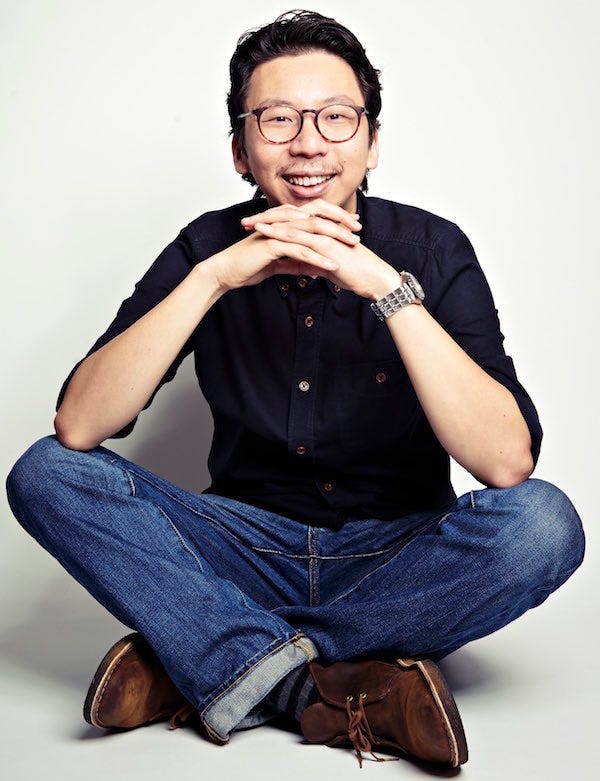
Daryl Chow Ph.D. is the author of The First Kiss, co-author of Better Results, and The Write to Recovery, Creating Impact, The Field Guide to Better Results, and the latest book, Crossing Between Worlds. If you are a helping professional, you might like my other Substack, Frontiers of Psychotherapist Development (FPD).

Passage from Ascent of Humanity, pp. 176-178.
Comments
Nothing yet. Say the first thing.
Sign in to join the conversation.