1
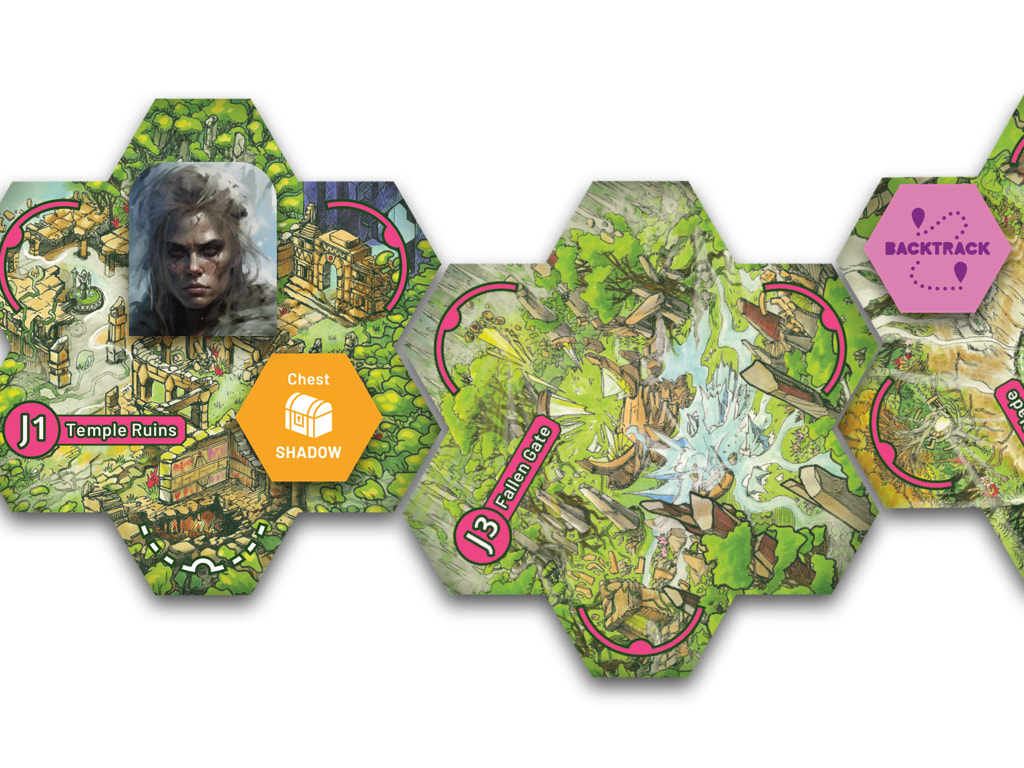
I was wondering if it would make sense to make it clear in the rulebook that there are only two types of movement:
- Backtrack – move among three explored tiles
- Explore – move onto one unexplored tile
This makes it clear that you cannot mix explored and unexplored tiles in one movement. It would also mean that “Move” is removed as an action. Instead, it would be renamed to “Backtrack”.
Under Backtrack, there would be a list of tokens (and what to do with them) that appear on explored tiles, and then under Explore there would be a similar list for tokens that appear on unexplored tokens.
That way, all the information about tokens that appear on tiles would be listed under one of those two actions, so that players don’t have to search the rulebook to figure out how to resolve simple movement across the board.
1 Like
modius 2
I don’t entirely understand the question, but hopefully additional information will help.
Movement around the explored map is possible using:
- Move action; moving between explored tiles
- Escaping from combat; retreat to an adjacent explored tile
- Items that may effect some sort of translocation or teleport to an explored tile
The only way of entering an unexplored tile is using the Explore action.
Backtrack is not a movement. It is a consequence of movement. Thematically it represents the hero’s party bringing attention to themselves and risking a denizen picking up their trail.
Any time you move from an explored location to another explored location, you leave behind a backtrack token.
Backtrack events occur when you enter a tile with a backtrack token. Or in rarer circumstances you are just told to make a Backtrack roll when the scenario would be the “same as” dropping a backtrack token and encountering it immediately.
Mechanically, it simplifies movement and prevents the player from subverting the intent of a fighting retreat. It also provides a nice mechanism for a “wandering monsters” roll.
Some historical context… for the sake of interest only.
Scout and move used to be a combined action. You had a kind of currency for how many “door actions” you could make during the action; either to scout and reveal a doorway or move to an adjacent explored tile. It was unnecessarily fiddly and worst of all encouraged players to reveal the map tiles one at a time. It’s far more fun to reveal as many tiles as possible and then arrange them.
I split scout and move into two separate actions.
Rather than force a Time Passes event on the Move action, I opted for a delayed Time Passes event in the form of the Backtrack token. This allows the player to reposition themselves on the map without penalty, but prevents them from gaming certain situations by moving around the map willy-nilly.
When you retreat from combat you place a Backtrack token. This makes it more difficult to retreat from a fight, and then move back into the tile that originated the combat. Its also a nice touch that if you do retreat from a battle, and sneak back to where the fight started that it takes time and you run the risk of encountering more monsters – but its still possible, and a totally valid tactic.
So today, the rulebook has three entries:
Move
Backtrack
Explore
Move and Explore are actual movement actions, and Backtrack is what happens when you encounter a backtrack token.
Instead, just have two actions:
Backtrack
Explore
And don’t consider encountering a backtrack token as an action. Rather, list it as one of the possible tokens that you can encounter and just describe to do if you do encounter it.
The reason I bring this up is because of this paragraph:
If you end movement or pass through an open encounter, or Place of Interest (POI), consult the encounter for a Move action instruction.
This forces you to look elsewhere in the rulebook to resolve a simple move action. Instead, if all the info on these tokens were listed in under “Backtrack” or “Explore”, everything you need would be in one place.
1 Like
Perhaps its the formatting of the rules that is causing confusion.
The Backtrack section in the RB is a “call out” which would be typeset as a kind of information box. It’s listed next to the Move action because this is the most likely place you will encounter a Backtrack token; either when you are forced to place it or move onto it.
This is similar to placing the exploration token descriptions in the Explore action.
We could place Exploration and Backtrack tokens into their own “Map Token” section or equivalent, but then they would be wholly disconnected from the most likely point of interaction in the rules.
This is a reminder that existing POI location encounters on the map may impact movement. It’s not a specific reference to anywhere in the RB.
For example:
I will try and trim the statement and add the POI icon to that statement in the RB to make it clearer.
That’s why I’m suggesting that you put all information about map tokens under the Move section. Most of the time, you will interact with the token during or after a move/explore. But even if you interact with them at some other point, you’ll know to look them up under the Move section.
But either way, I think it would help if all information on map tokens is spelled out in one area of the rule book.
IMHO, one of the characteristics of a good rule book is that whenever I want to resolve some action, all the information I need is together in the book. If I have flip pages to resolve an action, then that’s bad, even if that means that some information is duplicated.
1 Like
Comments
Nothing yet. Say the first thing.
Sign in to join the conversation.