
Ben here. Over the past few months, we’ve iterated on our digital SNAP application and ramped up client navigation support. I’ve seen firsthand how changes to framing up and asking for information at the beginning of our application can impact how quickly and effortlessly (relatively speaking!) our clients receive benefits at the end of enrollment. We’re dialing in:
Where can we speed up the client experience, streamlining our digital application to remove friction, avoid bounces, improve our completion rate, and reduce overall time-to-complete.
And where to slow down and focus client attention, better collecting a complete picture of the client’s situation to provide precise and timely guidance, and the best outcome possible.
We’ve found that there is one particular question on the SNAP application that has a large impact on how painlessly clients can move through the process. It’s one of the first questions anyone needs to answer when they’re applying for SNAP. It’s also surprisingly hard to answer. And we’ve realized that incorrectly answering this question is one of the main reasons that people who try to enroll in SNAP get denied, despite being eligible.
That question is: Who is in your SNAP household?
In this post, I want to explain the details of why this single question can turn into a barrier that stops, by our estimates, millions of eligible people from accessing benefits each year – and use it as an opportunity to explain the mechanics that we see, day in day out, of how people actually navigate the process of accessing benefits.
The SNAP program defines an applicant’s household, or EDG (Eligibility Determination Group), all of whom must apply for and renew SNAP benefits together. This household must include anyone living in the same place as the primary applicant, specifically (buckle up…):
Their own children under 22 who live with the applicant
Any child under 18 over whom the applicant has parental control who lives with the applicant
If the applicant is under 22, their parents who live with them
A married spouse living with the applicant
Anyone else that the applicant buys, prepares, cooks, or shares food with who lives with them
For each and every one of those additional people above, any children or minors or parents or spouses who live with the applicant, too.
…and some other discretionary situations (for instance, foster children may be included)
First-time SNAP applicants are frequently surprised that they must apply together based on who they share food with. In this respect, the SNAP program is unlike other government benefit programs or government interactions like paying taxes. From there, the specific rules outlined above can make answering this question – one of the very first questions on the application and the basis for the vast majority of subsequent questions – feel like anyone’s best guess.
To show why getting that question wrong is such a problem, let’s get into the entire enrollment process.
SNAP enrollment can be broken down into a sequence of steps, which must take place within 30 days from when an application is first submitted:
Application: The applicant submits an intake application that identifies their eligible household members and financial situation. The clock starts on the 30 day eligibility determination period.
Verification Documentation: The applicant collects and provides verification documentation: for instance, driver's license(s), paystubs or other proof of income, proof of housing expenses, and even more nuanced documents we'll get into.
Interview: The applicant has a mandatory interview with a government eligibility worker, either in person or over the phone. The eligibility worker reviews the application and any verification documents already submitted, asks additional questions, and pulls information (either before, during, or right after the interview) using government and private databases like Equifax’s Work Number (for income verification) to create a complete and accurate case. Frequently, the eligibility worker requests additional documents from the applicant
Determination: At the end of the eligibility determination period a government eligibility worker reviews the case and either approves or denies the application because the client’s household was not eligible for SNAP (a “substantive denial”), or because the household failed to complete the phone interview or provide all requested verification documents (“procedural denial”).
While the interview step does correct for confusion and inaccuracies on the initial application, deferred discovery of household members can drastically impact an applicant’s chances of successfully enrolling. In particular, adding missing household members can lead to adding new sources of income or expenses or new asset tests. All of which requires the applicant to collect new verification documentation. Missing or inadequate verification documentation is the second most common procedural denial reason. (The most common procedural denial reason is missing the interview.)1
And don’t take our word for it. Code for America and NYU, with Los Angeles DPSS, published “Administrative Burden and Procedural Denials: Experimental Evidence from SNAP,” which has information about procedural denials, including this chart:
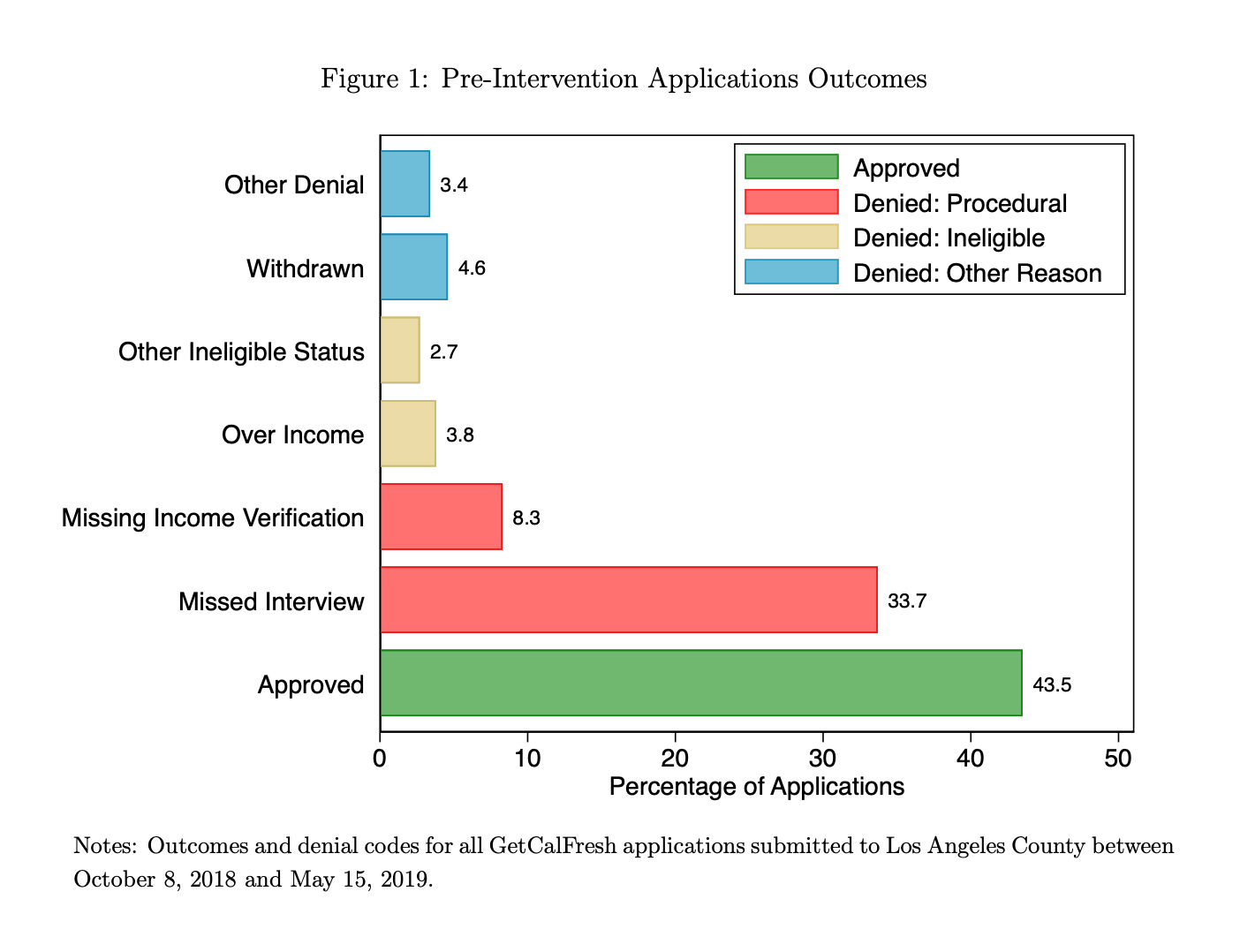
And Code for America’s GetCalFresh team has written extensively already about procedural denials in their “Overcoming Barriers” series: "Overcoming Barriers: Setting Expectations for CalFresh Eligibility" discusses changes they made to provide more specific application guidance to avoid omissions, and “Overcoming Barriers: How GetCalFresh Helps Applicants Submit Verifications” discusses changes they made to guidance around verification documentation.
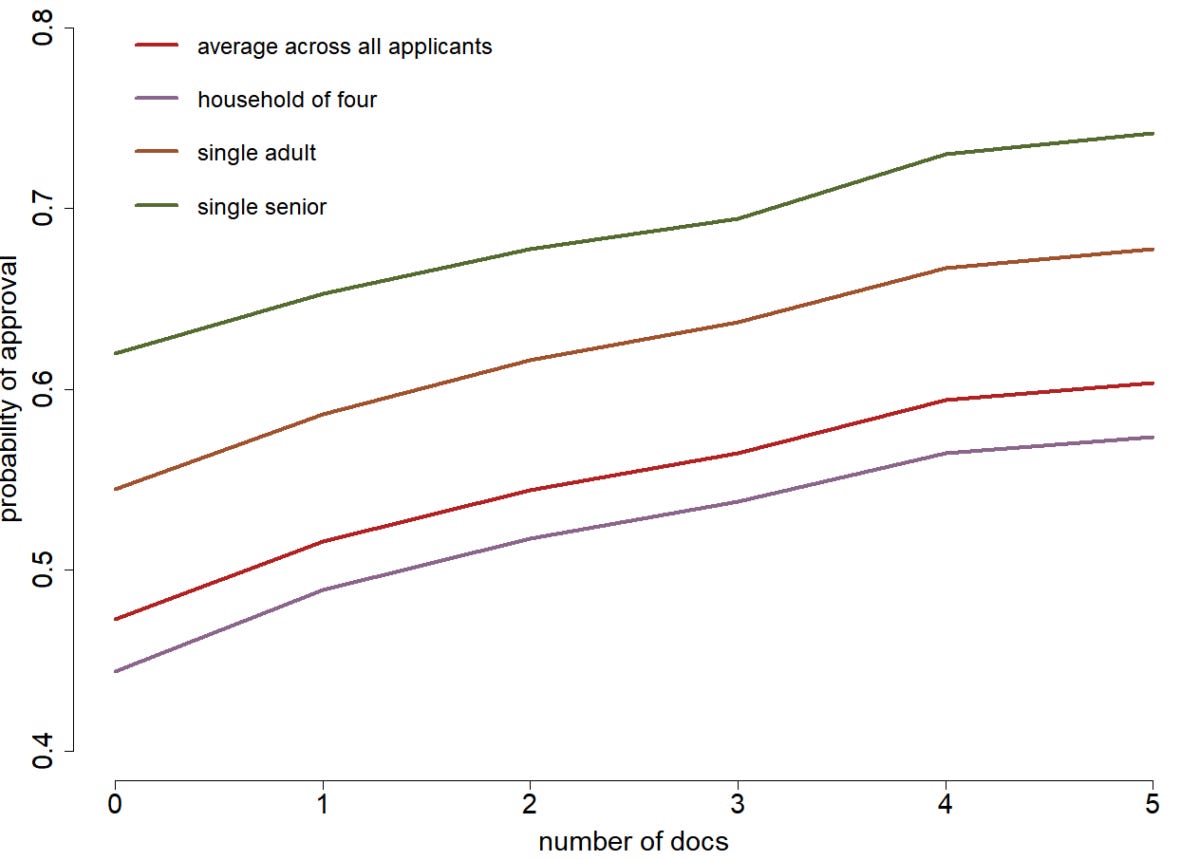
It’s maybe no surprise that more complex households require more complex verification documentation. GetCalFresh’s research included this chart showing a relationship between approval rates and the number of documents submitted for a single SNAP application. As households become larger, providing more documents correlates with a higher probability of approval.
As we’ve found in our work, the pace of feedback is the reason missing verification documents are such a big problem:
When an applicant uploads a new document, it usually takes around a week for the document to be reviewed by a government eligibility worker.
If the document is deficient upon review, it takes a few days for clients to then receive a notice in the mail with further instructions or clarifications.
Final approval of benefits requires a complete case review, and new verification document requests can be generated at the discretion of any reviewing eligibility worker.
…and the cycle repeats – each time a client submits new verification document(s), an eligibility worker reviews the document(s) (along with the whole case), updates the case, then (if needed) sends another letter in the mail telling clients what document(s) are still missing
When you do the math, there are only about three opportunities in the 30-day eligibility determination window to correct verification documents:
Documents provided before the interview can be reviewed during the interview. During regular (non-expedited) service, this happens around day 10.
Subsequently, if any back-and-forth takes 14-20 days (a week or more for a submission to be reviewed and a week or more to receive feedback), there's only time for about two cycles of this within the 30-day window.2
If you think of this in terms of opportunities or shots-on-goal (a soccer or hockey metaphor):
⚽⚽⚽ Documents identified and provided before the interview: the applicant has 3 shots or opportunities to get it right (initially and 2 rounds of feedback). To accomplish this ideal scenario, the initial application must precisely identify the correct household members.
⚽⚽ Documents identified during the interview: the applicant has 2 shots to get their documents right (initially and 1 round of feedback)
⚽ Documents identified after the interview: the applicant has 1 shot to get their verification documents right.
We believe that SNAP application design should emphasize producing an accurate and complete household – for instance, by checking for common household situations, allowing applicants to review and update their household composition, and more. This maximizes shots-on-goal for a complete set of documentation and provides the best opportunity for the applicant to receive a substantive determination instead of a procedural denial.
Procedural denials can have a lasting impact, too: applicants who are in significant financial distress can receive expedited service that accelerates the pace at which the government processes their enrollment. Those applicants may lose their expedited status when (or if) they reapply after being procedurally denied.
After 30 days, an initial eligibility determination will be made, and if still incomplete, there will be a final determination at 60 days. Documents sent in after 30 days may receive limited review or be processed more slowly.
Comments
Nothing yet. Say the first thing.
Sign in to join the conversation.