

In case you missed it, here is EPISODE THREE of “Is This Canon?”, my new superhero film-focused podcast where Skylar Singer and I have been marching through the MCU from a heavy political and analytical lens. This week’s episode: “Iron Man 2”!
Welcome to a week of OFF-BRAND SUPERHEROES! It feels as if I love superheroes more as I get older. Maybe I don’t enjoy superhero MEDIA as much. But I love the questions asked by the idea of a vigilante with special powers who decides to endorse their own brand of justice because the current model just doesn’t work. The tension inherent in that idea often leads to dead ends – the relationship between police/politicians and the most popular costumed criminals always seems as if it’s in limbo, with no decisive point to make. Sometimes there are outliers. The recent animated “Batman: Caped Crusader” series seem to be as much about Batman’s classic rogue’s gallery as much as it’s about the hero’s unsteady trust of the city’s law enforcement. I hardly think this is a radical take as much as it’s simply a more modern one.
Of course, one does not need to be an expert on costumed avengers to note that the movies have embraced a strict orthodoxy regarding the offerings of DC and Marvel, companies with a considerable amount of characters originating from long-gone eras of history, specifically the forties and the sixties, respectively. There’s room for an alternative viewpoint, one that’s satirical, or serious, or dismissive, or more pointedly political. And that’s why I gravitated towards Netflix’s “Thunder Force”, which unapologetically features two superhero characters who are both middle-aged plus-sized women. This alone is a powerful political gesture.
“Thunder Force” takes place in a world where there’s already a fairly elaborate lore that exists, one I truly do not love. It’s true to the methodology of most comic book superheroes, in that it’s about the idea that “bad guys” have always existed, necessitating a costumed superhero to rise up. Here, superpowers were bestowed to groups of people supposedly already inclined to cause havoc. Dubbed “Miscreants”, they’ve been the scourge of the world, particularly to Octavia Spencer‘s Emily, who has been trying to turn the tide since the Miscreants killed her parents. Which is an unusual idea, that being that all, uh, miscreancy must be stopped. Like if Bruce Wayne found out the Joker killed his parents and decided to eliminate all clowns. It’s not THAT far from the quixotic idea that a superhero fights “evil”, but it also doesn’t really interrogate that further.

It turns out, Emily has developed a superpower serum. Melissa McCarthy’s Lydia hasn’t been friendly with Emily in decades, and now she’s the face of a class conflict, as Emily’s been in a well-funded lab trying to conjure up superpowers while Lydia works at the docks. The two of them reunite and end up injecting each other, Emily developing invisibility and Lydia gifted with super strength. You know, superpowers off the rack. Would have loved to see newer, more unique powers, but a lot of these superpower parodies come from people who just don’t read comics. I’m reminded of a major director, I can’t recall who, who did a recent Marvel movie and said they were a big MCU fan because they’d seen something like ten of them. Wow, the devotion.
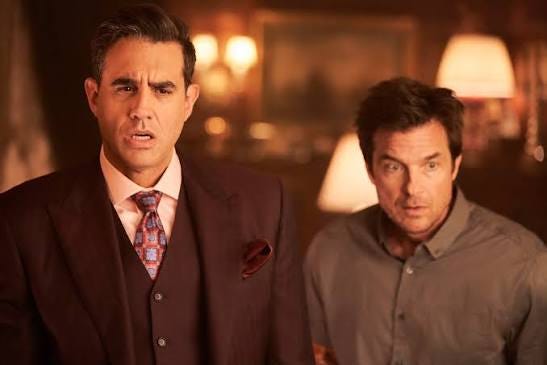
The plot progression is so quick as to be nonexistent. Bobby Cannavale pops up as a shady mayoral candidate who wants to recruit the newly-formed Thunder Force, even though he’s simply looking for OCP-level superpowered protection. Fortunately he has a Miscreant on his payroll, giving Pom Klementieff a chance to cause violence, look fabulous and do little else – sadly her M.O. at this point. There’s a plodding inevitability to this storyline, that feels less like simplicity and more like laziness as the Thunder Force find themselves matching up with Canavale’s clownish evil politician threatening a heavily-underpopulated Chicago. Providing a distraction is Jason Bateman as a Miscreant who has devoted himself to crime even though his only ability is having crab claws for hands. A romance blossoms between Lydia and Bateman’s Crab, and while it’s strictly generic gag-making, the reunion of “Identity Thief” stars is the only hint of idiosyncracy in this entire endeavor.
“Thunder Force” is directed by Ben Falcone, McCarthy’s real-life husband and creative partner. Honestly, I find that terribly romantic. They are my favorite Hollywood couple and I hope they never break up. Having a wife who is that funny must be such a blast, and whenever he appears in public with her, he seems delighted to be her mister. While Falcone has shown to be a capable and funny performer in small roles, he’s taken to being a behind-the-scenes collaborator with McCarthy, and this is the fifth film where he’s directed her. And, sadly, I don’t think he has the aptitude for directing. “Thunder Force” is leaden and unfunny, borrowing tropes without even considering their meanings, let alone thematic purpose. The thrill of having two unconventional superheroic leads is wasted when action sequences are bog-standard CGI exhibitions, and the jokes crawl at a tiring pace. But I don’t know… maybe him being so bad at directing makes the whole thing a little more romantic? He could have become a character actor. But he’s going to be bad at this one thing, strictly for his wife.
Who do you work for? It’s an existential question more than a professional one, in that it implies there are pros and cons to dedicating yourself and your well-being for a certain cause. In a heavily-interconnected modern world, the average person sees the connections more clearly than ever before. So we understand that explaining what you dislike about this world is, in essence, telling everyone who you work for, even if you don’t generate a paycheck or benefits. Who you work for dictates who you are. Hopefully, if you’re out there and you have a job, a profession, you can answer this question clearly. You don’t work for your boss. You work for yourself. Maybe you even work for your customers or clients.

Of course, many people sign up for a chance to NOT consider this an existential question. And others wish to put the cart before the horse. They see an opportunity to work for a boss, or at least pretend they work for a boss. Because there are benefits, you see. At least that’s the attitude of a specific ICE facility in Colorado, owned by a private prison company called GEO Group. In an attempt to dismiss a lawsuit against their slave labor practices, they have tried to make the argument for qualified immunity in order to enjoy the same judicial protection given to cops and government officials. The idea is that, in essence, they were serving the greater good in their labor and trafficking violations, and therefore they should not be subject to any further scrutiny. These are pretend-prison guards, not even real prison guards, playacting as if they were cops. Kind of like if you walked into a dojo for the first time and casually told everyone you were a black belt. And because you had a black belt, you were entitled to hurt people.
This is how you create a police state. It starts somewhere like an ICE facility – a facility that has been fighting this lawsuit for literally a dozen years for the right to abuse detainees. You have people acting in bad faith. But to many, you erase that bad faith because of the people’s worship of authority. So now, you have grunts who claim they’re government employees, even though they’re working for a private company, and the government’s responsibilities have been outsourced to them. They think they’ve been deputized, and they trust the public’s blind worship of authority will excuse their professional malfeasance. Enough judges and political figures have to support this approach, to endorse the idea that some can be without blame for being not law enforcement, but law enforcement-adjacent. And that leaves you, the common man or woman, to have to keep track of who is or isn’t actual authority, even as they mistreat you. When it’s a numbers game, and there’s way more of us than there are them, their greatest weapon is disorientation.
No posts
Comments
Nothing yet. Say the first thing.
Sign in to join the conversation.