

Can you imagine ever being a teacher? It’s hard enough dealing with one or two kids at home, but a whole classroom? You have to keep their best interests in mind, but as a teacher, it’s also your job to literally test them, to take them out of their comfort zones and challenge them. Like a parent, sometimes you have to decide if the child is going to respect and even like you, or if they’re going to learn a pivotal lesson. Being a teacher also requires confidence. What if you don’t have enough to properly connect with a child? Maybe it is important, at the end of the day, to experience a sense of validation in what you’ve done, in order to keep doing it to the best of your abilities. Maybe, in doing the world’s most crucial, eternally underappreciated job, you want a little bit of thanks at the end of the day.
This is the crisis at the heart of “The Kindergarten Teacher”, a sobering film written and directed by Sara Colangelo, based on the Israeli film of the same name. It’s a Netflix film, which may seem stranger to you than it does me. I still recall when I was in prison and they were purchasing downbeat indie films remade from Israeli movies off buzzy festival screenings, and I have not adjusted to the streamer as the sort that releases broad, ugly comedies every Friday starring has-beens and never-weres, mostly with a vague connection to Adam Sandler. Fortunately, “The Kindergarten Teacher” has no room for a David Spade cameo.
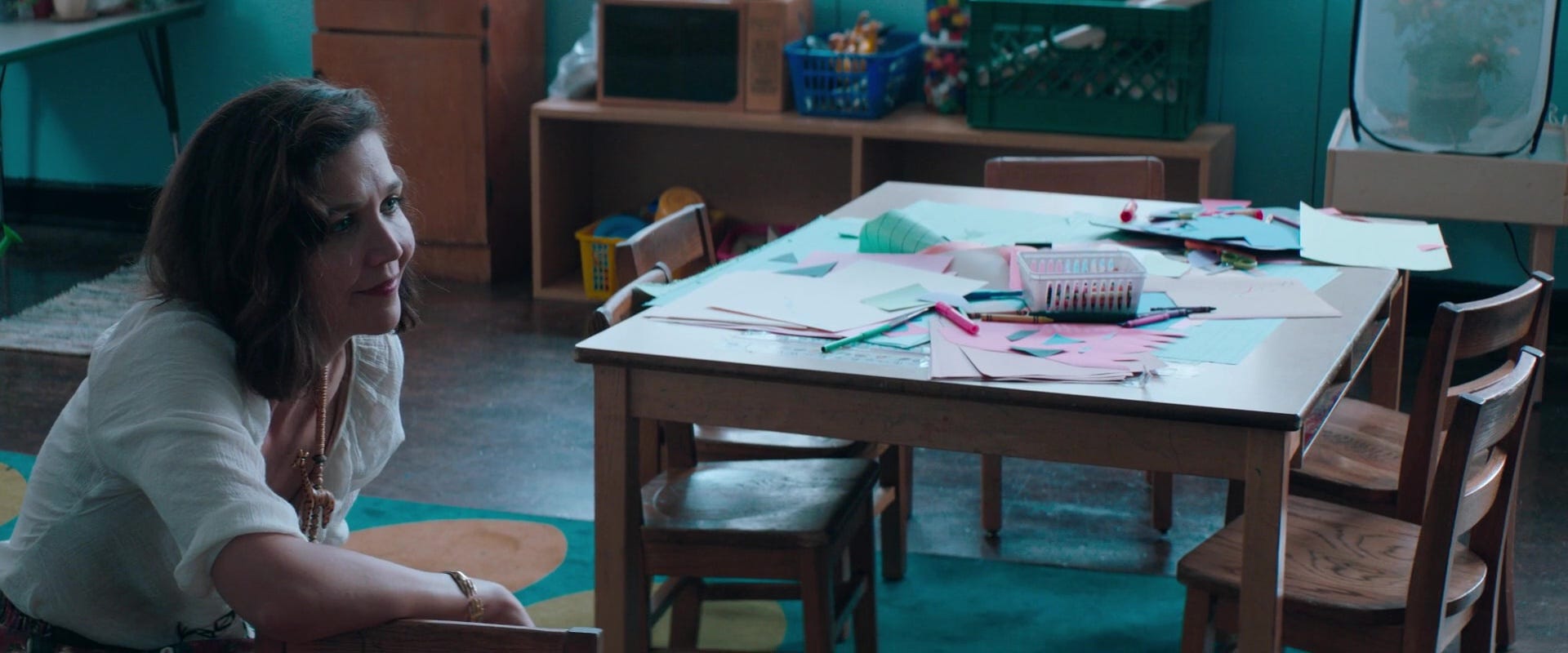
Lisa, Mrs. Spinelli (Maggie Gyllenhaal) watches over her kids during the day in a crowded Staten Island classroom. She’s gifted about how she can relate to these children, but when the school closes, the parents are in a rush to grab their child and take them home without any conversation. After work, Spinelli enjoys a poetry class for adults. But this environment is shot to appear dark, an indoor classroom without windows, and the grumbling of middle-aged students overheard every second. She gets no joy out of it. And as a teacher, it has to bother her that her work impresses no one. She is too wrapped up in herself to grasp that this sounds like a class that wouldn’t applaud anyone’s poetry, let alone her’s.

I do want to stop for a second and point something out, and I’m not sure if it’s a critique, but it’s something that always catches my eye in movies like this. At home, Lisa greets Grant, her husband, who is attentive and gentle, but perhaps not always present. Grant is played by a veteran character actor named Michael Chernus, who is primarily known for his stage work, though he’s appeared in fare as diverse as “Orange Is The New Black” to “Mistress America” to “Spider-Man: Homecoming”. He’s also a doughy, soft-bodied man, as unthreatening as he is likable. Lisa’s poetry teacher, by the way, is played by Gael Garcia Bernal, a dashing handsome personality once referred to as one of the greatest actors of the new century by the New York Times. Given that we’re talking about Maggie Gyllenhaal, what do you suppose happens here? If that counts as foreshadowing, it doesn’t particularly stand out. But it’s not subtle. Ladies, raise your hand if your eyebrows would be raised at Gael Bernal as a poetry teacher for adult classes.
One day, Mrs. Spinelli is waiting with a child who has yet to be picked up after school. As he paces, deep in thought, he starts reciting words. The boy, Jimmy, has written poetry, and Mrs. Spinelli’s ears prick violently. Seeing the ease in which he conjures up ideas, she concludes that she’s discovered a genius in her midst. She presses him to begin writing thoughts down. His babysitter (Rosa Salazar) is only mildly amused by Mrs. Spinelli’s enthusiasm, clearly not seeing the same talent that Lisa finds unmistakable. So enraptured is Lisa, she steals the poem. That night at poetry class, she reads it. A few people are impressed. A few couldn’t care less. Given how casually she recites the words, it’s clear that Lisa has internalized Jimmy’s accomplishments. He’s a genius because he’s her student. She inspired him. She is a muse, what’s wrong with claiming ownership of the work?

At her job, Mrs. Spinelli begins to lightly press Jimmy on his poetry. Write another one, picture this image, do you need help? She becomes a junkie for Jimmy’s imagery, speaking in that sing-song kindergarten advice but physically doing everything but nailing him down to the table until he produces another masterpiece. When the babysitter is only mildly engaged in Jimmy’s talents, Mrs. Spinelli seems willing to chastise her for her unseriousness. This could be the next Bukowski, in child form, and you have to nurture this. Jimmy goes from “he” to “we” in Lisa’s eyes. She harnessed the fire, and isn’t that just as significant as starting the fire itself?
She becomes jittery and demanding. She isolates Jimmy from the class, informing him exactly how to summon and then transcribe a masterpiece. Poem after poem, each one a supposed testament to his own genius. She makes the case to the babysitter, and then even reaches out to Jimmy’s father. It’s maddening to her that everyone else is shrugging. Everyone else is too bothered by real problems to focus on precocious Jimmy putting pen to paper and spitting fire. Given that she cheaply bogarts the poetry and calls it her own in poetry classes, you begin to question the worth of Jimmy’s work. It seems very much that Lisa is trying to impress someone. Gael Garcia Bernal is listening.

The movie overall seems rather pessimistic about the academic interest Mrs. Spinelli might have in Jimmy’s work. His babysitter is an actress, but when Lisa tries to engage with her about this, she makes it sound very much like a job. And she can only get the attention of Jimmy’s father when he is at work. She talks to him while he’s closing down a bar, cleaning used glasses. Whatever Lisa is trying to do, does it pay the bills? Does it change the world? Or is it a child simply doodling? The uneasy question at the heart of the film is whether or not this art has any real meaning. Which then chillingly draws a twisted parallel for the viewer. Are Lisa’s increasingly-invasive and unprofessional actions all that different from what a fan might do? Are we destined to appreciate art to a point where we’ll one day find ourselves so dedicated to the light only we see that we’ll obscure the whole world? What separates the fan from the fanatic, the devotee to the zealot? Is art destined to radicalize us? And how much are we willing to support the death of the artist so that we can truly appreciate the art? Maybe we’re just wasting our time, ladies and gents. Maybe we’d be happier with our children noodling away on a piece of paper while we spend our days doing honorable, menial work.
I have previously explained how everything ICE is doing right now is a test-run for ideas that will be utilized in prisons and jails. And I think it should be clear right now that it will not stop with prisons. And that’s because the Bureau Of Prisons, in association with private prison companies, is simultaneously enjoying an explosion of new funds while also implementing policies that save money. Right now we’re at a supercharged point in regards to income inequality, with businesses moving aggressively with the dawn of new technologies and a very business-friendly President in office. What this means is that ICE is now using automation to provide those in ICE custody with the resources they need.
Specifically, these are new detainment rules for ICE facilities, rules that are intended to “streamline” the process for these centers but in fact is being used to reduce the amount of staff employed while stranding detainees with technology that is far from being efficient. Yes, A.I. is being used, because there’s nothing A.I. can’t make worse and more complicated, as it becomes a weapon the rich use to bludgeon the working class. It also eliminates standards for who can be housed in an ICE facility, which suggests the hope is to fill the facilities with inmates, even the ones who are sick and/or incapacitated somehow. Many of these revisions come via suggestions provided by GEO Group, who have a record I have previously tracked as far as bending the DOJ’s ear. Yes, GEO Group, for all intents and purposes, seems to be running ICE at this point, a mutually-beneficial business relationship, one that sponsors slave labor as an acceptable practice for ICE detention centers. We’ve been protesting this. In the meantime, it only gets worse.
Join me next week for five days of MOVIES ABOUT MOVIES.
No posts
Comments
Nothing yet. Say the first thing.
Sign in to join the conversation.