
I’m a stickler for titles. I think that someone should be cognizant about using a title that’s already been in circulation, lest they be trying to send a message. In prison, I wrote a nasty zombie script, and I decided to call it “Zombie”. I have all the respect in the world for the late Lucio Fulci, and his “Zombie” - aka “Zombi 2“ in some regions – is certainly one of the great horror films, an absolute stone-cold favorite. A zombie fights a shark in that movie! But the script I wrote was an act of aggression, evidence of a breaking mind filled with rage and dissatisfaction with my circumstances. Calling it that was an act of defiance. I just didn’t care any more. Also, c’mon, the movie would never be made anyway.
Which is to say that today we’re covering “Boiling Point”. There are several movies with the title “Boiling Point”, and I’m not sure why everyone is freely stepping on each others’ toes. My fellow ex-con Wesley Snipes led a surprisingly strong cast in “Boiling Point” back in the day, playing a cop chasing after some killers and tangoing with a none-more-rageful Dennis Hopper. But even then, they were following the bonkers “Boiling Point” from the great Takeshi Kitano, a tragicomedy about a gangster losing his mind amidst the world of independent baseball. Which is to say, you call your movie “Boiling Point”, you’re clearly swinging for the fences. You’d hate to make the lesser “Boiling Point”.
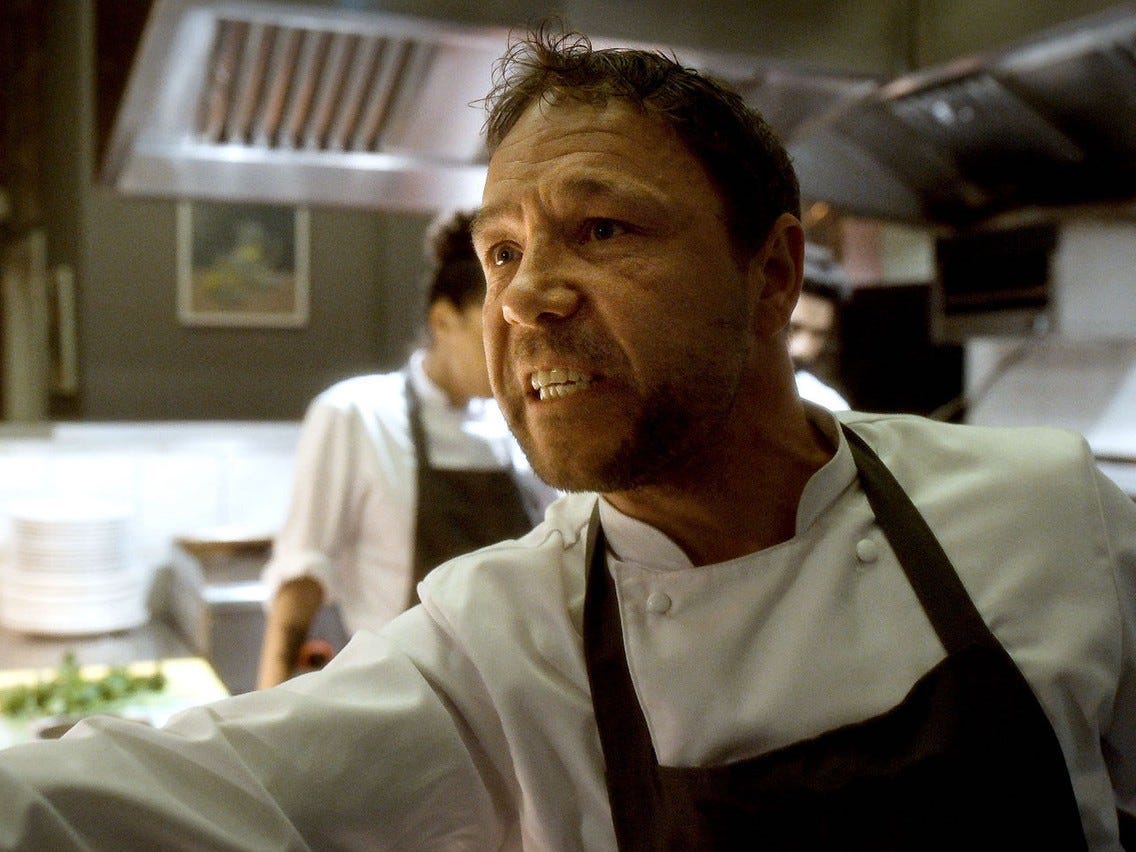
It appears that wasn’t on the mind of director Philip Barantini who adapts his short film, also called “Boiling Point”. This is an in-depth look at a single night at a major restaurant in London, Jones And Sons. Stephen Graham is Andy Jones, just barely keeping it together on a night where he’s dealing with unruly customers, a staff that doesn’t trust him or each other, and a general air of unruliness that threatens to re-activate his consumption problems. At the very start of the night, it is an inspector who has downgraded the restaurant’s hygiene rating due to a number of procedural errors, which may have already given the staff a reason to get one foot out the door. The only problem is they need to get through the night, and “Boiling Point” just happens to occur in real time, giving the viewer no real need to concern themselves with the future of these characters beyond what we’re currently seeing.

This supercharges the conflict, particularly in the kitchen where some workers – including one that is completely wasted – take the environment far less seriously than others. In a place like this, a kitchen with fragile items and dangerous heat, physical injury is just as much of a possibility as aggressive disagreement, particularly with a staff who, throughout the film, repeatedly talk back to Andy, the head chef. Whatever authority he has at the beginning of the night is halved by the disastrous hygiene report, and it will only continue to be halved. These are professionals, but very early on, you can see temperaments fraying. Half the time, you think these customers are going to abuse this power dynamic until a traumatic event has the evening completely shut down. And half the time, you worry the camera will spill into the kitchen and reveal stacks of dead bodies and one of the cooks holding all the knives.
“Boiling Point” carries a cinematic rush, but it will be familiar to anyone who has watched a lot of TV lately. The series “The Bear” trafficks in the same vulgar intensity of a kitchen, with friends at each others’ throats as they try to simply prepare a meal. But you’ll likely be reminded of Barantini’s acclaimed Netflix series “Adolescence”, also with Stephen Graham in the lead. Just like every episode in that series, Barantini leans into an audacious stylistic gamble – “Boiling Point” is captured in one single shot, no cuts. This leads to tension ratcheting up in regards to the divide between customers and the staff. They’re sitting and waiting for their meal, sometimes pleasantly, and sometimes not at all concerned with what’s happening away from their table. Waiters greet them politely and even banter, before returning to the kitchen where everyone is mad at each other and no one is properly working on the right schedule.

The most familiar face in the cast beyond Graham is probably the odious but effective character actor Jason Flemyng, here playing a famous chef who, in all regards, is essentially a critic. So you know that the movie is building towards a confrontation between Andy and Flemyng’s Alastair Skye – great name, by the way. Yes, like “Birdman”, another film ostensibly shot in one take, this is building to a confrontation between an artist and his critic. Metatextually, it does seem like this calls attention to the one-shot gimmick, but that’s hardly a reason to not be impressed by that technical gamble.
“Boiling Point” builds to a third act crescendo that’s a bit excessive, making explicit some ideas we essentially knew, and taking a few confrontations to their ugly, expected ends. This sort of movie is entertaining, but it’s also a bit of an ordeal, particularly to the most optimistic viewers who are going to be expecting something akin to a big climactic group hug. Those who have high pressure jobs and are seeking escapism, well, you’re probably not reading reviews, but this may not be for you. At the same time, there’s a powerful integrity with the one face with which you spend the most time here, Mr. Graham. A skilled and effective character actor, he has a natural tragic hangdog face that suggests defeat and invites sympathy. But his barking mouth also showcases someone willing to punch back, and Andy does plenty of that during the film’s runtime. “Boiling Point” has a few moments of serenity, and they’re largely spent with Graham. And he’s got a face that complicates that serenity, particularly as you know, despite the ovens and stoves present, the title is referring to him.

The Americans With Disabilities Act dates back to 1990, and the intention was to prevent discrimination against those with disabilities to be able to obtain and maintain jobs and lead healthy lives as contributing members of active communities. Given the President’s many reported statements in regards to the disabled, as well as the Department Of Health’s dangerous new policies revolving around eugenics-based ideas about autism and vaccines, you knew something like this, so clearly representative of what was considered “DEI”, would encounter push-back. But it did not seem likely that the answer would be detainment.
It appears that is exactly what is being suggested by proposed new revisions to the Americans With Disabilities Act, allowing for the institutionalization of people with “severe” mental conditions. There is no real impetus to suggest this is an issue, but this overly performative “law and order” administration has been enthusiastically celebrating the sight of people in handcuffs while actively supporting the private prison industry. It seems as if prison is the answer to everything, particularly when it comes to removing “undesirables” from the environment. Shooting people in the streets, another idea President Trump has reportedly floated behind closed doors, may not be the polite solution. But throwing people in an endless series of institutions? That’s the sort of idea even non-MAGA Americans can get behind. These sorts of proposals were seen before, in history. I don’t have to remind you where that went.
No posts
Comments
Nothing yet. Say the first thing.
Sign in to join the conversation.