
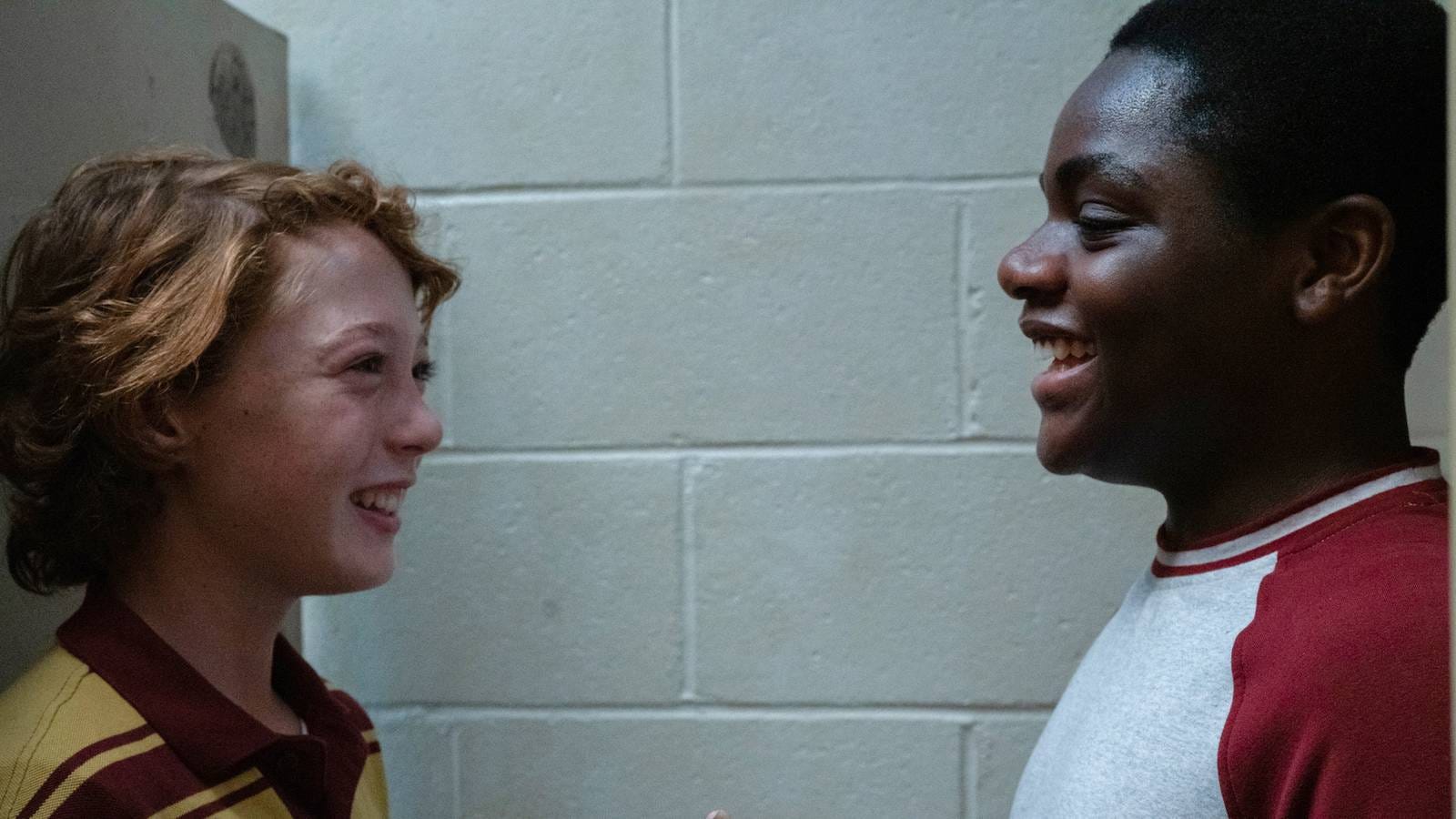
Earlier, I mentioned how prison and school could be interchangeable in certain ways. That’s as true as ever in James Gray’s “Armageddon Time”, which features several scenes that take place in a dark, dimly-lit public school. Just enough shadow for a student to hide if he wants to act out, of course. It’s the early eighties, and preteen student Paul is just another troublemaker, not that different from the other kids. When an uptight teacher needs to be brought down a peg, Paul doesn’t mind. But Paul is just a kid. You’d have to have a pretty ugly agenda to get mad at someone like Paul, a wiseacre who would be happy if he could spend all day doodling and eating dumplings from the local Chinese place.
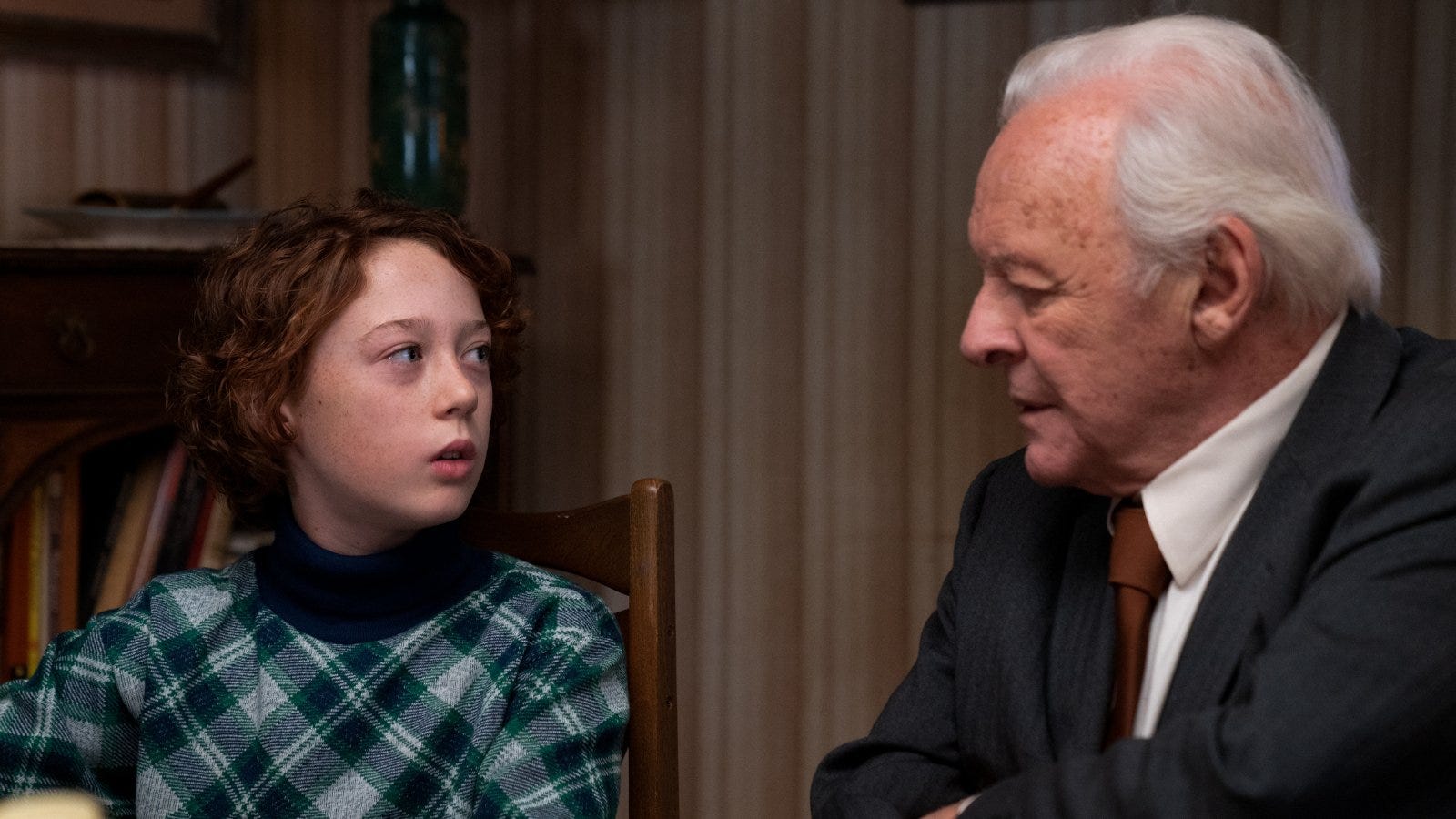
Paul is friends with Johnny, who shares classes with him, but has a very different experience. Johnny is Black, and while this doesn’t at all matter to Paul, these are the suburbs of Queens, the 1980’s. Paul’s time goofing off with his buddy seems like a different world from his time at home, under an overwhelmed mother (Anne Hathaway) and a hectoring, imagination-free father (Jeremy Strong). Paul doesn’t seem to have much concern for the future, as Dad is a champion of industry and Mom is the head of the PTA, which Paul mistakenly assumes is basically President Of The School. Paul’s closest buddy at home is his ailing, charming grandpa (Sir Anthony Hopkins), who always seems to find the right word and locate the exact right moment to be supportive. I once read that Hopkins, known for his acclaimed dramatic performances, especially loved doing action and genre movies, movies with witches and rogue cops and supervillains. He’s so absolutely wonderful in this film as a sweetheart of a man, though it is amusing to think of him searching for his character on a park bench during a pivotal scene even though he’d rather be waving a prop gun around.
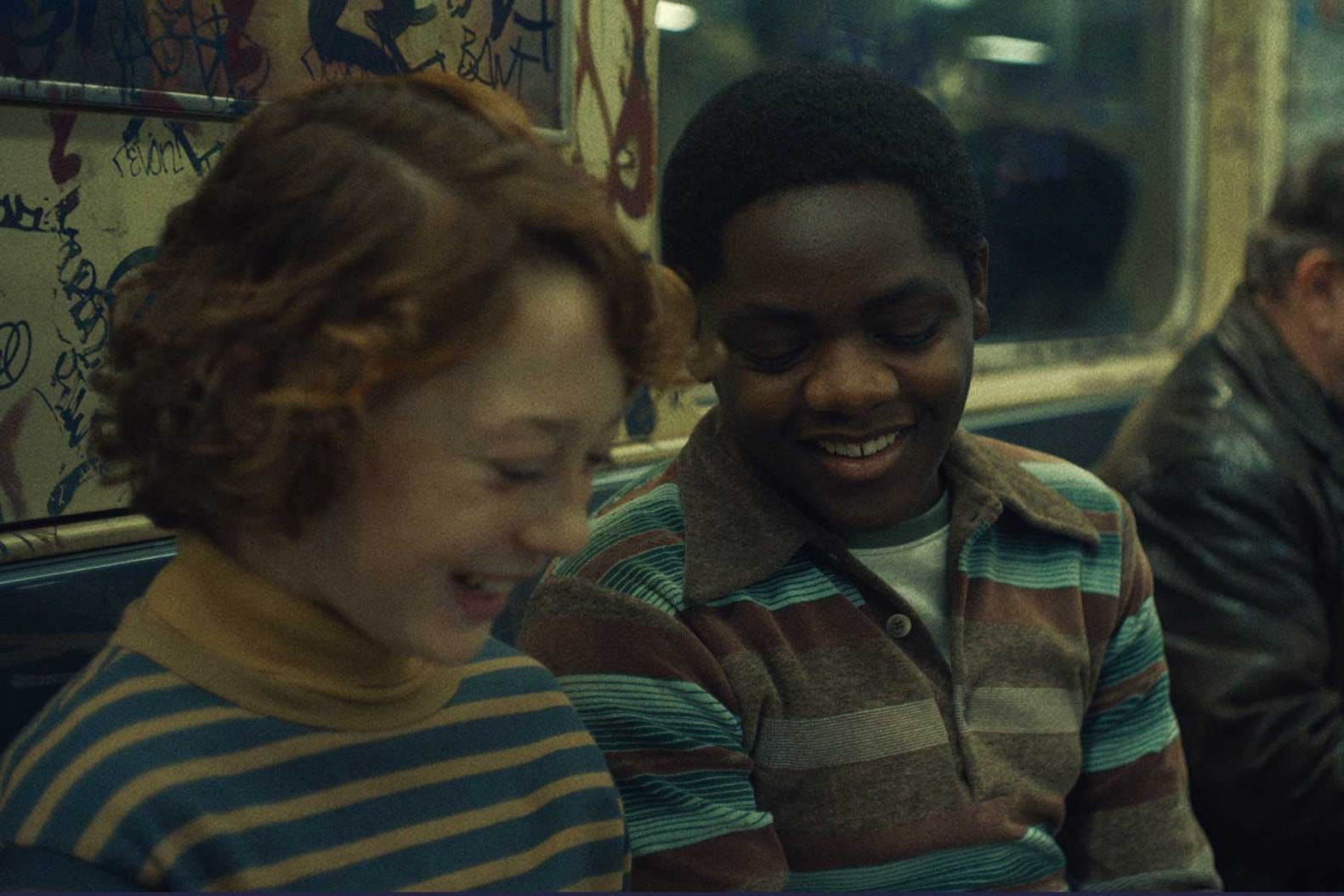
Of course, Paul and Johnny are a terror to this straight-laced school. Not only because they’re pranksters, but because they’re real friends. They have each other’s back. If there’s anything that flummoxes an authority figure, it’s when you can’t divide and conquer against your opposition. There is a notable difference between how the teachers treat Johnny and how they regard Paul, of course. Paul is also unaware of certain cultural signifiers. He thinks it’s totally normal to be the one white kid rapping with his friend to the Sugarhill Gang. He doesn’t get why his territorial parents call Johnny “the Black boy.” And the realization that some families, specifically Johnny’s, might not be as well-off as his own family escapes him.There’s no meaning behind it, it’s just a fluke – that’s my friend Johnny, he’s not like the others, but in ways that I just can’t put a finger on.
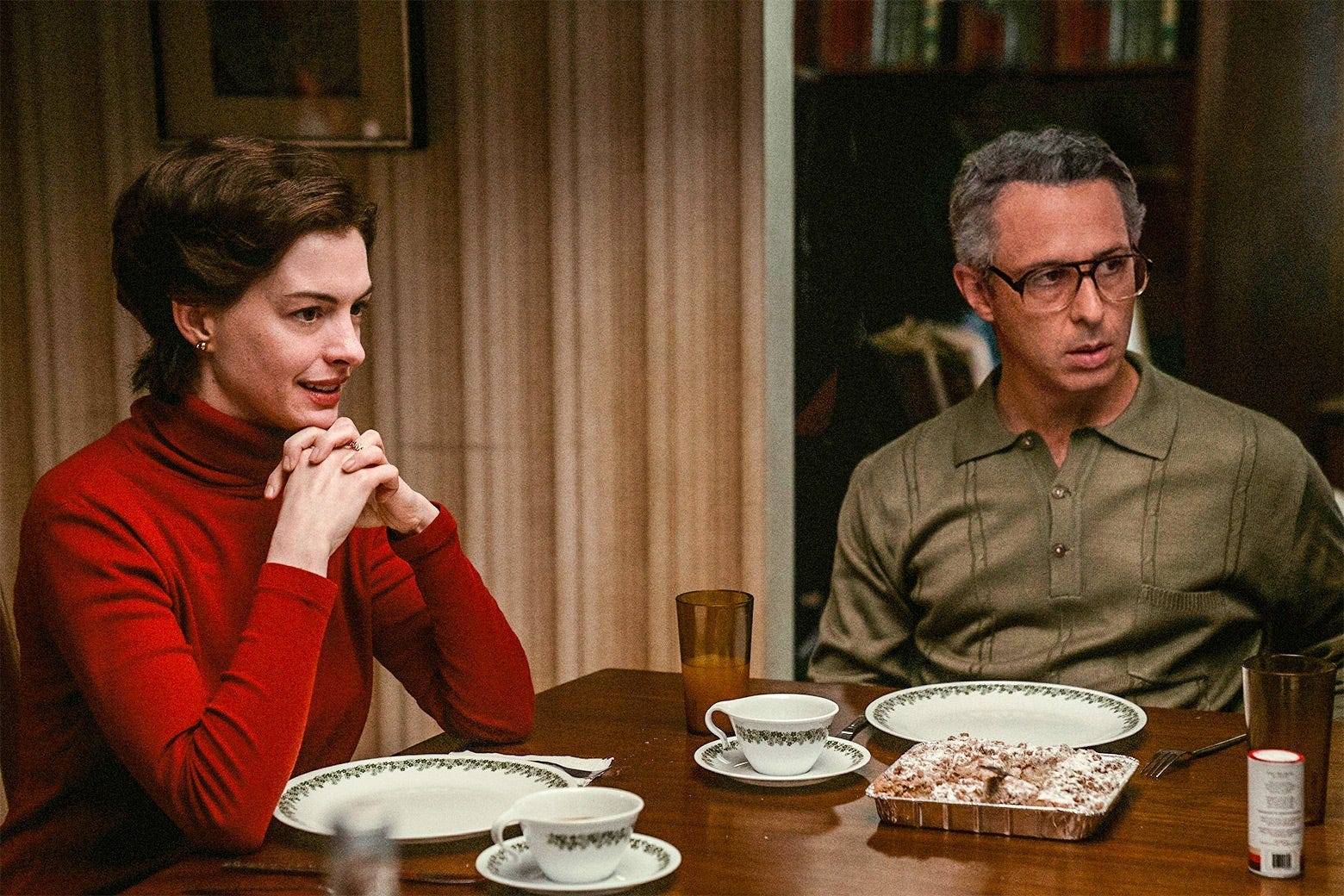
What’s notable is that it’s the eighties, and Paul is too young to register what any history actually is. His is a Jewish household, and he can’t seem to fathom that, perhaps, others have had it worse. Dad is a skinny boring dork who rattles off his favorite bridges at the dinner table, and to Paul he seems miles away from struggle. But the Holocaust, not very long ago, seems like an abstract concept Paul needn’t trouble him with, even though Grandpa is right there, a survivor of those difficult times. There’s a moment when Paul releases a hearty laugh in relation to a mention of the Holocaust. It’s the one time that Grandpa, usually quietly supportive, feels the need to rebuke him. Moments like this remind you of how older generations are trying to help younger ones enjoy a carefree prosperity. Isn’t it a benefit to Paul that he’s so nonplussed? Or should he be concerned about when anti-semitism could come for him?
Paul ends up at a private school when his behavior, and his alien-like aspirations of being an artist, push his conservative parents too far. One of the first faces he encounters is a demonic man played by stern character actor John Diehl. He looks Paul up and down and asks, with loaded intent, “What kind of a name is Graff?” It’s a lead-up to an assembly that reveals this harsh stranger is former KKK supporter Fred Trump, who has helped fund this particular school. His daughter Maryanne is giving the speech, and she mentions how the Trump name means that she’s worked hard and made sacrifices to become independently wealthy. She’s played by Jessica Chastain. If you believe acting is, “Saying a bunch of b.s.,” then it may be one of Chastain’s greatest performances.
Director James Gray (“Ad Astra”) claims this is based on his own personal experience attending this specific school. Of course, that’s just a colorful detail – Gray shoots this school as the widest indoor open space depicted in the film. It also makes Paul, no longer aside his buddy, seem exposed. At first, he’s bothered by the open racism of his largely white classmates, all of whom come from privilege. But ultimately, he can feel the chill of his own ostracizing. Without much in the way of bombasticism, Gray is able to portray a harsh ecosystem where the fear is instilled in you not that you will be hunted, but that you will have to watch over the degradation of your friends and allies.
The question that hangs over most movies about unruly youth is, is the child being punished too much, or not enough? We frequently have to address this question because it challenges our own sense of empathy. While we know that consequences have to be taught at a young age, we also know from our own experiences how some authority figures may have been too hostile or judgmental, and if that proved to be damaging or not. It’s interesting to read where law enforcement stands on this. In 2024, it’s estimated that 6.8% of all arrests were of those under eighteen. This news comes after a number of states are adopting reform in this area. However, while some states are taking more generous steps to avoid criminalizing kids, others are hiking up their punishments.
Those numbers come from this piece, which frames the issue remarkably. Should we prioritize punishment, or rehabilitation? It’s the fundamental bedrock of all criminal justice. I could see the argument for punishment if all of these kids and adults were disappearing permanently. But they’re not. They will go on to rejoin our communities. They’ll be our Uber drivers, they’ll be our cooks and barbers, they might even be our friends. They’re coming back to society. Why are we creating additional problems for us by having us become neighbors with those who have been harmed and demeaned by an unforgiving, dehumanizing system? Are we building character as if we’re some sort of punitive mommy state? If we’re going to continue on this path of performative punishment, we need to find ways to invest in rehabilitation so that these ghosts from earlier formative years do not haunt these grown-up children forever.
No posts
Comments
Nothing yet. Say the first thing.
Sign in to join the conversation.