
We use a lot of important words and terms in the United States of America.
Democracy.
Republic.
Constitution.
Declaration of Independence.
Rights.
Separation of church and state.
God-given liberties.
But I wonder how often we slow down long enough to define them.
If we do not define our words, we end up arguing past each other, assuming everyone means the same thing when they do not. We may ask one founding document to do the work of another. For example, we may treat the Declaration of Independence like it is the Constitution or treat the Constitution as if it cancels out the moral claims of the Declaration.
We may say “democracy” when we really mean “republic.”
We may say “separation of church and state” as if it means God is taken out of our government. Or we may say “Creator-endowed rights” as if that means the federal government should have religious authority over the conscience.
But the American founding was more careful than that.
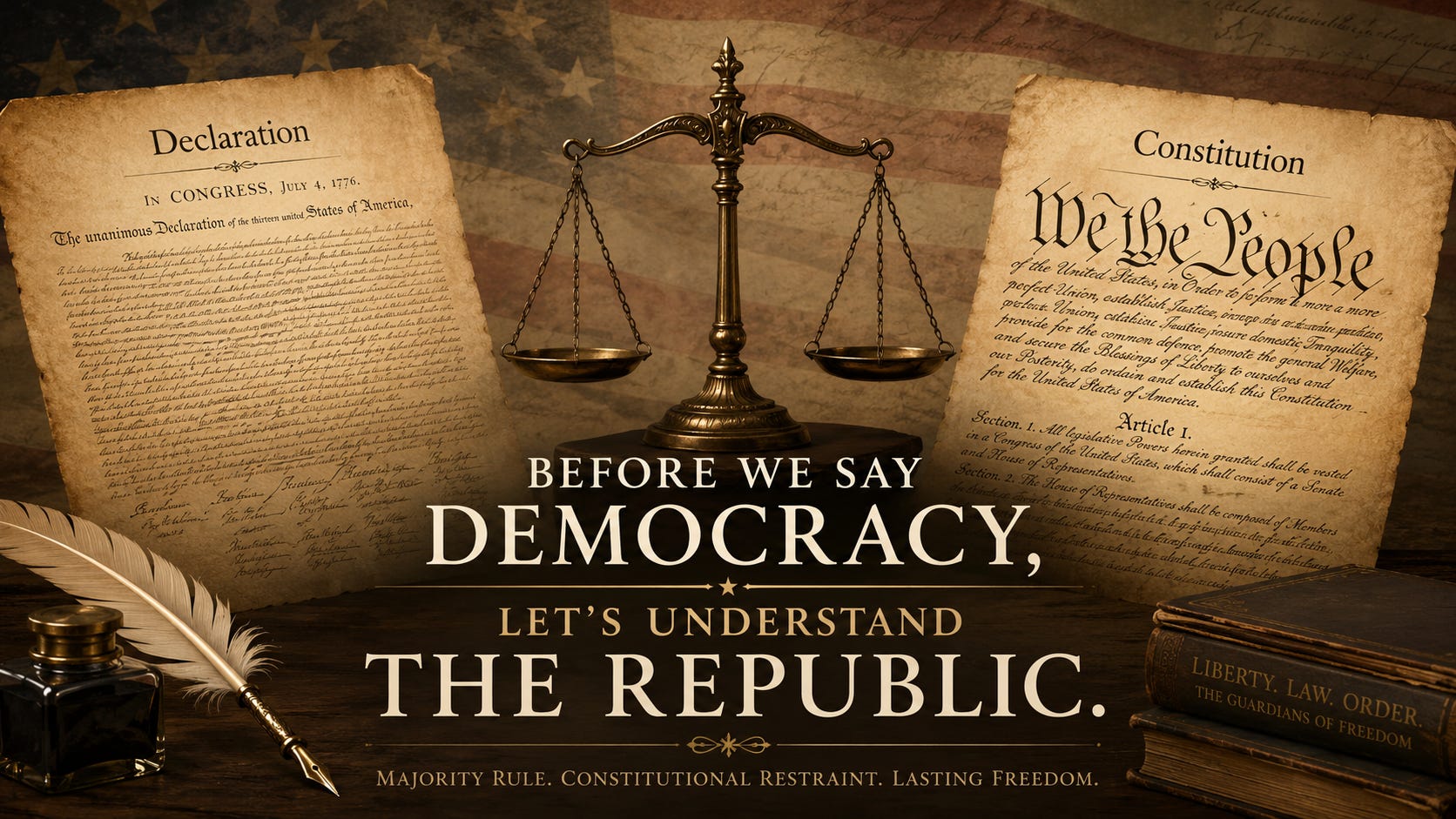
So before we say democracy, let’s understand the republic.
A democracy is the system of rule based on the will of the majority where citizens vote directly on laws. Or where citizens elect representatives to make decisions on their behalf.
A republic is the structural framework of the government commonly with a constitution where citizens elect representatives in a system of checks and balances that protect minority rights and individual liberties. Those representatives are to make decisions while strictly adhering to a constitutional rule of law.
That distinction matters.
The United States was not designed as a pure, unrestricted democracy where the majority can do whatever it wants simply because it has the numbers.
It has democratic elements. The people vote. Representatives are elected. Public consent matters. The government is accountable to the people, and the people have a rightful voice in how they are governed.
In a republic such as the United States, the Constitution gives the people a voice, but it also places limits around power.
This is why Benjamin Franklin’s famous answer still matters. At the close of the Constitutional Convention, the story goes that Elizabeth Willing Powel asked Franklin what kind of government had been created. His answer was, “A republic, if you can keep it.” The Library of Congress notes that the source of this quotation is James McHenry’s journal from the Constitutional Convention. (blogs.loc.gov)
A republic.
Not a monarchy.
Not a dictatorship.
Not an oligarchy.
But also not a pure democracy.
A republic.
That was not an accidental word.
We should understand why that mattered to the founders.
They were deeply concerned about concentrated power. They did not want one man to rule the whole or a small group to rule the whole. And they were also wary of a majority ruling without restraint such as a democracy could turn into.
Because the majority can be wrong.
The majority can be influenced by emotion.
The majority can be pressured by fear.
The majority can be stirred up by resentment.
The majority can violate the rights of those who are outnumbered.
So the question should not only be “Do the people want this?”, but also, “Is this lawful? Is it just? Does it violate protected rights? Does it trample the conscience? Does it give one group too much power over another?”
Their biggest hurdle… How do you make separate states into one functioning union without erasing the states or creating a centralized tyranny?
That is both the genius and the tension of the United States of America design.
That is where a republic matters.
James Madison addressed this concern in Federalist No. 10, where he warned about factions and distinguished a pure democracy from a republic. Madison argued that a pure democracy, where citizens directly assemble and administer government themselves, offers no real cure for the mischiefs of faction. A republic, by contrast, can pass public views through chosen representatives and spread power across a larger system, making it harder for one faction to dominate the whole. (avalon.law.yale.edu)
That does not mean representatives are always wise. We know better than that.
But we should recognize the reasons for their design.
The system was meant to slow things down, diffuse power, and prevent one person, one faction, one state, or one temporary majority from easily controlling everything.
This is how our Congress works. Each part has distinct duties and roles.
The House of Representatives reflects population. Larger states have more representatives because they have more people. Smaller states have fewer representatives because they have fewer people. For example, California, with its massive population, has far more representatives in the House than Wyoming. Wyoming has only one.
But in the Senate, California, and Wyoming each have two senators. Each state is represented equally.
A pure majority-rule mindset may look at that and say, “That is unfair. California has far more people. Why should Wyoming have the same number of senators?”
But that question would require the United States to be one national crowd of individuals instead of separate states.
It is not.
We are the United States of America.
The House says population matters.
The Senate says states matter.
The Constitution says both matter.
That is the design.
The Senate’s own history explains that the Constitutional Convention adopted a dual system of congressional representation: representation by population in the House and equal state representation in the Senate. (senate.gov)
We should understand what that structure protects.
It protects smaller states from being completely swallowed by larger states. It reminds us that the federal government was not designed merely to count heads and declare the largest side the winner as would be more likely in a democracy. It was designed to hold together a union of states, each with its own identity, elections, interests, and people within a republic.
This is not about political party. It is about a structure that protects the states and the populations within those states in two different branches.
And this is why “more democratic” does not automatically mean “more just.”
Sometimes majority rule is proper. Elections matter. Voting matters. The consent of the governed matters.
But majority rule is not the highest good. Justice is higher. Law is higher. Protected rights are higher. The dignity of human beings is higher.
That is why the Bill of Rights matters.
The Bill of Rights is a majority-restraint document.
It places boundaries around government power. It protects speech, religious liberty, the right to assemble and petition, and protects the people from certain forms of government overreach.
The First Amendment begins with a restraint: “Congress shall make no law…” It then places restrictions on federal power regarding religion, speech, press, assembly, and petition. (archives.gov)
That is not raw democracy. That is constitutional restraint.
We should understand that protected rights are not supposed to rise and fall with popularity. Rights that depend on popularity are not truly secure. A right that can be voted away whenever enough people dislike it is not being treated as a right. It is being treated as a temporary permission.
This brings us to another confusion: the Declaration of Independence and the Constitution.
They are both founding documents, but they do not do the same thing.
The Declaration of Independence explains why separation from Britain was justified. It sets forth the moral and political argument that human beings have unalienable rights endowed by the Creator, that government exists to secure those rights, and that government derives its just powers from the consent of the governed. The National Archives describes the Declaration as expressing the ideals on which the United States was founded and the reasons for separation from Great Britain. (archives.gov)
The Constitution creates and orders the government to serve those rights.
It establishes Congress, the presidency, the courts, the relationship between federal and state authority, the amendment process, and the limits under which government must operate. Article VI identifies the Constitution, federal laws made pursuant to it, and treaties as “the supreme Law of the Land.” (archives.gov)
So we should let each document do its own work.
The Declaration gives the moral argument of God-given rights.
The Constitution gives the governing structure to ensure those rights.
The Declaration says rights do not come from government, but from the Creator.
The Constitution gives form to a government that is supposed to secure those rights without becoming master over them.
That distinction is particularly important when we talk about God and government.
The Declaration says all men are created equal and endowed by their Creator with certain unalienable rights. It appeals to the “Laws of Nature and of Nature’s God,” to the “Supreme Judge of the world,” and to “divine Providence.” (archives.gov)
That language matters.
It tells us that human rights are not government inventions. They are not favors handed down by rulers. They are not privileges that exist only as long as the state feels generous.
Rights come from the Creator meaning the government does not create them. Government is supposed to secure them.
But we should also understand what the Constitution does with religious authority.
The Constitution does not turn the federal government into the head of a church. Article VI says that no religious test shall ever be required as a qualification for federal office or public trust under the United States. (constitution.congress.gov)
The First Amendment gives another boundary: Congress shall make no law respecting the establishment of religion or prohibiting the free exercise of religion. (archives.gov)
So here is the balance:
The Declaration keeps government from pretending it created our rights.
The Constitution keeps government from ruling the conscience.
Those are not contradictions. They are boundaries.
The Declaration can acknowledge Creator-endowed rights without the Constitution creating a national church.
The Constitution can prevent government from establishing religion without pretending God has no place in the moral foundation of human rights.
This is where Thomas Jefferson’s letter to the Danbury Baptists is helpful.
In 1802, Jefferson wrote to the Danbury Baptist Association and used the famous phrase “wall of separation between Church & State.” But that phrase was written in the context of religious liberty and the First Amendment. Jefferson spoke of religion as a matter between man and God and connected the First Amendment to the rights of conscience. (loc.gov)
We should understand that separation is not erasure of God.
Separation of church and state does not mean separation of God from truth, morality, public reasoning, or human dignity.
It means the government does not become the church, dictating the moral authority of God.
It means the government does not control worship, doctrine, conscience, church membership, or religious obedience.
It means the church does not need the state’s permission to obey God in the way it sees fit according to its conscience.
Many of the founders understood the danger of entangling civil authority with religious authority that happened before in the countries they left. They did not want the new federal government to become the keeper of anyone’s conscience.
That is a good boundary.
We do not need a government-run church. Or presidents, courts, or legislatures acting as priests. We also do not need the state to decide which religious beliefs are acceptable and which ones are not.
We should remember the Declaration’s appeal to the Creator regarding our rights.
The American balance the founders were creating is we have Creator-given rights, not, “Government controls religion.”
The balance is this: rights come before government, and government is restrained by law.
That balance helps us avoid two opposite errors.
The first error says, “America is a democracy, so the majority should always rule with no regard for the minority.”
America does have democratic elements within a constitutional republic. The majority have a voice, but the majority does not have unlimited authority.
The second error says, “America acknowledges God, so the government should enforce religion.”
The Declaration acknowledges Creator-endowed rights while the Constitution keeps the federal government from becoming a national church. Government is not God over the people, and government is not the church ruling the people.
We should know these categories.
We should know the difference between democracy and republic.
We should know the difference between the Declaration and the Constitution.
We should know the difference between Creator-endowed rights and government-controlled religion.
We should know the difference between protecting conscience and erasing faith.
If we confuse those categories, we will misunderstand the whole design.
We will confuse majority rule with justice.
We will confuse rights with government-granted privileges.
We will confuse separation of church and state with the erasure of God.
We will confuse Creator-endowed rights with state-controlled religion.
We will confuse the Declaration with the Constitution.
And we will confuse democracy with the republic.
We should understand why the Senate does not operate like the House.
We should understand why the Bill of Rights restrains government instead of simply reflecting majority preference.
We should understand why separation of church and state protects conscience from government control.
We should understand why Creator-endowed rights place human dignity beyond the reach of government permission.
The republic is not perfect because no human government is perfect.
But our founding fathers were not careless.
It was designed with limits, checks, balances, representation, federalism, protected rights, and boundaries around power.
That design is worth understanding before we try to tear it down, rewrite it, or use it for something it was never intended to do.
We have democratic elements, but we were given a republic to keep power in check from ruling God-given rights.
And if we want to keep it, we should begin by understanding what it is.
No posts
Comments
Nothing yet. Say the first thing.
Sign in to join the conversation.