
I’ve pondered this comparison over a great many years, and now, with the slaughter in Israel, it seems time to share it.
My dad was born in Berlin in 1928, a time when there was relief and recovery from The Great War, and the future was unclouded by threats or premonitions of war as, of course, they had just come through the “war to end all wars.”
Dad was Lutheran by birth, utterly secular by culture and upbringing, and I imagine that theology and thoughts of God weren’t particularly prominent and yet sort of ever-present, a humming-along of background noise, effecting a kind of basic framework of cultural assumptions.
So what came next in Germany - the rise of Hitler, the take-over of the Government, then the war, the years-long, city- and nation-destroying war, then the aftermath - were experienced by my dad without the extra, surreally horrific genocide of the Holocaust.
And yet, as I learned throughout my life, and as he wrote in his memoirs, even without that Holocaust hell, it was still a hell nevertheless. Being bombed all day, then bombed all night, is not a way for anyone to live, let alone children. Nor is having to lie for fear of your family being disappeared - and becoming accustomed, even as a child, to believing one thing but speaking another in order to protect yourself and your family. Climbing over rubble to get to school, literally starving, literally freezing, because the leader of your country has led your nation into an unwinnable, all-consuming and pointless war, is a nightmarish way to grow up.
Knowing that the man - Adolf Hitler - who had engendered such a zealous following has done this to your country, and believing, as dad did, that not only WOULD your country lose but also SHOULD lose, has always struck me as an incomprehensible way to grow up: loving your country but loathing its leader is something that until recently I couldn’t fathom. Now, of course, too many of us understand exactly how that feels.
Dad came through the war pretty much unscathed, and went on to college, grad school, law school, and became a patent attorney in the US, with a wife, 2 kids, and a lovely home in the Palisades.
As it happens, Elie Wiesel was also born in 1928, in Transylvania. And true confession: the fact that I knew him - I met with him a few times and had a very exclusive seminar course with him at Boston University - is one of the aspects of my life of which I am supremely proud. The course I had with him, “Hope and Despair,” was one of the highlights of my life, and when he walked into the room the first time the course met (I had to leave my house at 5AM to get there on time, which I did joyously), I don’t know how else to say it but the air changed. I’ve met Nobel prize winners before (and of course, Obama having “won” one has utterly demeaned and devalued them), but never have I felt that kind of palpable alteration in the air, the room, the environment generally. There was a power but also a gentleness; an indomitability and yet a kindness; a determination and yet an openness… I don’t know… I’ve never really tried to put it into words but I tell you, what Elie Wiesel radiated was something supremely other-worldly even while it was so fundamentally human that it took one’s breath away.
The course was extraordinary. But also, the ability to meet with this hero, this treasure, this man who stood supreme above all men, quietly, one on one in his office, was even more profound and moving.
And I can’t explain it, but when I left his office after our first meeting, I cried. I sobbed and sobbed and sobbed. I have no idea why, I truly don’t. Nothing of the conversation warranted any such reaction. But I think, perhaps, it was that he was the vessel, the exemplar of such a force that weathered, survived and spoke up against an evil the likes of which we have seldom seen, and being that close to a spirit of such supreme goodness, was just too much to bear. I don’t know. But I will never forget how profoundly emotional it was.
And I met with him several times, each of which was equally profound.
When I took a teaching job, I immediately went to see him. The first thing he said was, “Why have you stayed away so long?” What a marvelously kind and warm thing to say, even if it might have been a sort of general welcome. And when I told him I was going to become a teacher and did he have any suggestions, he said: “Never humiliate.”
Not at all what I expected, but words of advice and wisdom that reflected his utter warmth, caring, and love.
And this, from a man who had lived through the worst that man has doled out to man. His captivity in Auschwitz was truly the most horrific of “man’s inhumanity to man,” and his writing about it in Night offered the first exposure to the public at large of the horror of the Holocaust. And this: “never humiliate” were his words to me about being a teacher.
That he had no rancor, no bitterness, was always astounding to me. And his countless books after Night were testimony to the experience of the Holocaust but also to a deep, deeper-than-deep exploration of loss, despair, Judaic teachings, and profoundly human experiences. One story, “The Watch,” had a singular effect on me: he had received this watch as a Bar Mitzvah gift, and buried it when they knew that their seizure was inevitable. Years later he returned to his town, his former home in Sighet, dug up the watch… and reburied it. I was stunned by this and we spoke of it the last time I saw him. How do you go back to “before?” You can’t. You simply can’t. All the wishing, all the expectations don’t alter the fact that you simply can’t. Too much is lost, too much is gone. The world is no longer the same.
But the point I want to make is this:
Dad grew up in a war zone. His world was turned upside-down. His life, his city, his country, were all uprooted and destroyed. His grandparents’ then-German home became Poland, his nation and city were divided, and his childhood was destroyed by a militarized government bent on domination. He experienced this as a German, just a regular person. He was a kid at Ground Zero and the frontline of a war, a kid whose childhood was destroyed by his own government and by those fighting against the aggression of a megalomaniacal dominance-seeking tyrant. And what he took away was this: God doesn’t exist.
Elie Wiesel’s world was also turned upside down. Nearly every individual of his family was killed by the Hitler Jew-hating machine of the Holocaust; his little sister, his mother, eventually his father all perished. As I recall, only he and his older sister survived.
His time in Auschwitz, and on the train to the camp and the march from it in the final days of the war, are stories told in Night and that defy comprehension.
But unlike my father, Elie Wiesel did not reject the idea of God (or reject God, in fact) but, as he frequently put it, was “angry” with God.
I always found this extraordinary. Elie Wiesel, who experienced the worst of man’s inhumanity to man, was “angry” with God, but my father, whose experience, while horrific, can’t compare to Elie Wiesel’s experience with the genocide and the camps, rejected God. Wiesel maintained a close relationship with God throughout, a relationship that helped him through the Holocaust crafted by the cruelest of the cruel, the most targeted, most specifically evil efforts created. Elie Wiesel clung to God through this, and while “angry,” never doubted His existence.
Dad, however, since that time, rejected the idea of Him throughout his entire life. A God, as described by his Protestant faith or any Christian one, would never have “permitted” such events to occur: the Holocaust to be sure, but also the War itself, World War II with the horrors it inflicted upon the citizenry at large, innocent children, families, just regular people living their lives. Hitler and his dictatorial evil designs and acts would surely not be allowed to exist, if God were real and as omnipotent has He was described as being. This is, of course, one of the classic arguments against the “existence” of God, and dad was a devout adherent of this argument.
And by contrast, Elie Wiesel, the target of the evil, the literal focal point of the energy of Hitler and the holocaust’s efforts towards bringing about the “Final Solution” still, after all of this, never rejected the existence of God but only, in his relationship with The God he knew existed, was only ever “angry” with Him.
And as we watch the current horror unfold in Israel, I am reminded of his experience, his ardent support of the state of Israel, and his exhortation to never be “neutral” as neutrality only ever supports oppressors, or put another way, to not fight evil is to permit evil to flourish, a paraphrase of Burke.
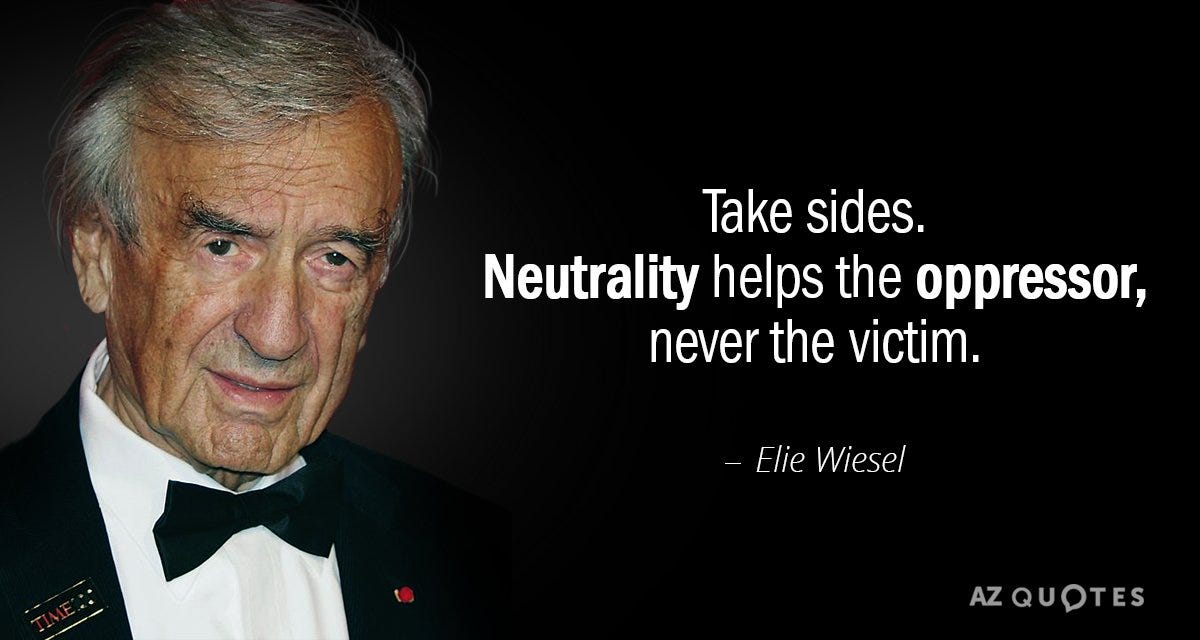
When all is said and done, to my thinking, Elie Wiesel’s faith in God, even though it may bring with it anger and frustration, provides greater sustenance and emotional support for dealing with whatever evil one encounters. A rejection of God, no matter how “justified” one feels it is, offers only an emptiness that must be filled in some other way. A rejection is, in a sense, that same rage, but one step further: I am so angry at you that to me you are nothing; it is an unhealthy nihilism that severs any kind of relationship or growth.
Was it the extreme nature of what Elie Wiesel endured that necessitated his faith? Did he survive, in part, because of it?
A topic way too big for the scope of this “From the Balcony” substack. And there is much much more to “unpack” from all of this, of course.
But I can’t help think of those kids in Israel, what should have been a haven, and yet who are facing an evil that seeks to eradicate them as before. And I hope and pray that they find the strength, the support, the sustenance that they need to carry them through this horrific time.
God bless Israel.
Comments
Nothing yet. Say the first thing.
Sign in to join the conversation.