
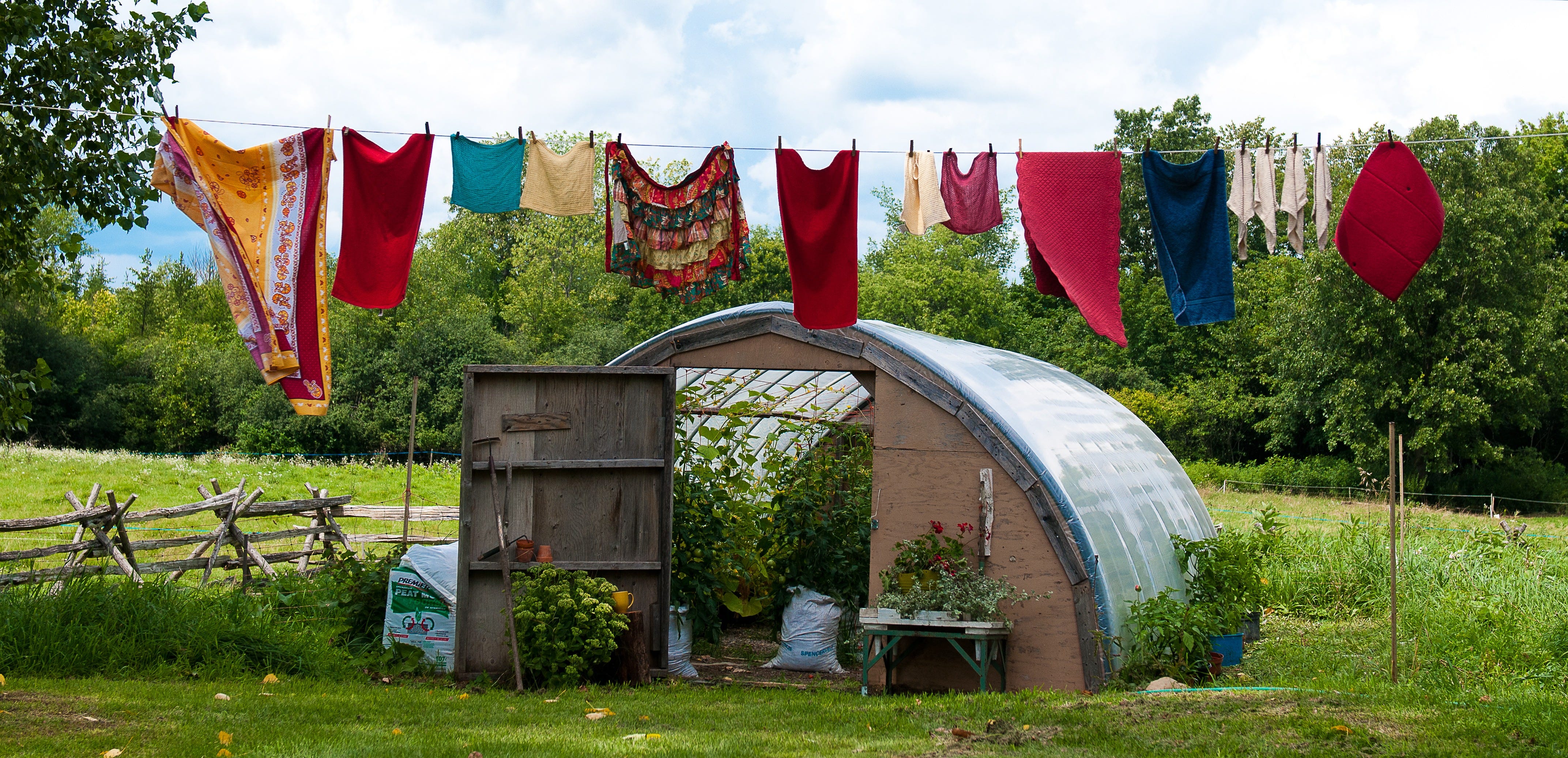
Fall gardening is just around the corner.
And while we now grow in Mexico, where our challenges are the exact opposite with heat rather than cold, today I’m taking you back to Canada’s fall and winter gardening opportunities from our farm there.
Because this is the time of year when gardeners often start thinking about an ending.
The nights get colder.
The first frost appears in the forecast.
We start looking at the garden differently.
The tomatoes that seemed endless a few weeks ago are slowing down. The beans are producing less. The greens are suddenly looking much more valuable.
And eventually we start asking:
How much longer can I keep harvesting?
That question led us to one of the most useful ways we ever extended our growing season.
Not by heating the entire greenhouse.
By creating a greenhouse inside the greenhouse.
The first frost date is useful information.
But it doesn’t mean the garden is finished.
Different crops respond differently to cold. Some are damaged by the first frost. Some tolerate it easily. Some simply slow down. Others can remain alive and harvestable for quite a while if they’re protected from the extremes.
That means fall doesn’t have to be one dramatic transition from growing to finished.
There can be a long middle ground.
And that is where season extension becomes useful.
You don’t necessarily need to keep everything growing.
You need to protect the things that are still worth keeping.
A bed of greens.
Late peas.
Cold-tolerant vegetables.
A crop that was planted a little later than planned.
Something that is still producing and simply needs more time.
The question becomes less about how do I keep the whole garden protected?
And more about:
What can I protect?
Years ago, we had a hoop house.
It already gave us protection from the wind, frost and cold temperatures outside.
At two different times, we tried using wood heat inside it.
It worked.
But it was exhausting.
Someone had to feed the fire through the night, and it began to feel like an enormous amount of effort and resources to heat all that air.
Then I started thinking about where the plants actually were.
Close to the ground.
And heat rises.
So instead of asking how we could heat the entire hoop house, I started asking:
What if we created a smaller protected space around the plants?
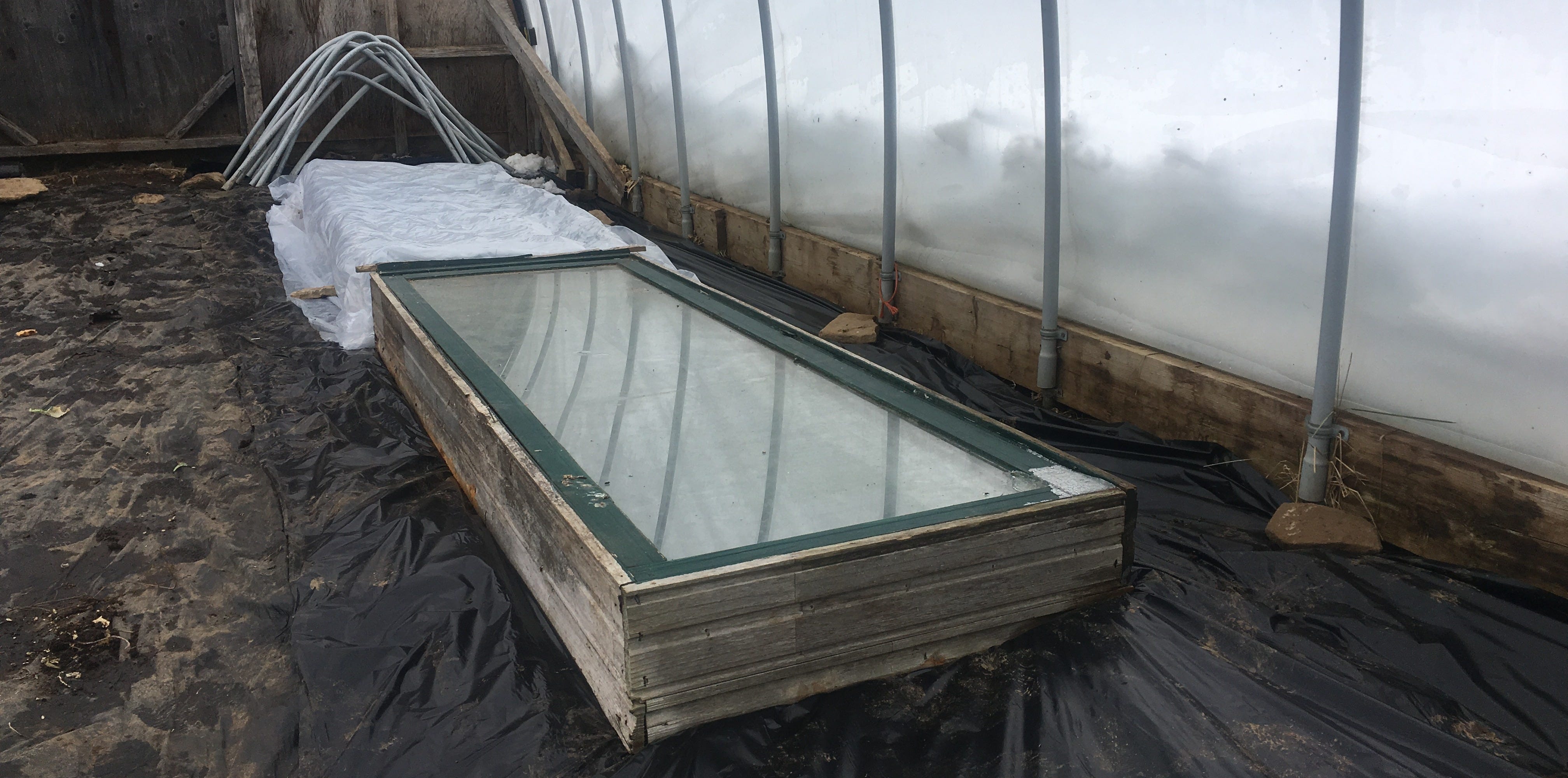
That was when we began putting low tunnels and cold frames inside the hoop house.
And suddenly we had something very different.
A greenhouse inside a greenhouse.
The hoop house became our first layer of protection.
The low tunnel became the second.
And if we needed it, we could add another layer over the plants themselves.
We weren’t making winter warmer.
We were making the space immediately around the plants more protected.
This is one of the biggest advantages of thinking this way.
A greenhouse doesn’t have to be one uniform environment.
And your garden certainly doesn’t.
As fall moves in, some plants can remain completely exposed.
Others might need a little protection.
Some need considerably more.
So instead of trying to maintain the same temperature everywhere, we created small microclimates within the larger protected space.
A cold frame over one crop.
A low tunnel over another.
Row cover directly over the plants inside the low tunnel.
And on a particularly cold night, even an old bed quilt over the top of the low tunnel.
It sounds ridiculously simple.
That’s why it worked so well.
We weren’t trying to engineer a perfect climate.
We were simply giving the plants the amount of protection they needed.
The other piece that made this system work was underneath our feet.
The soil.
We used black bio film, a biodegradable mulch film, both early and late in the season.
In spring, it helped warm the soil.
In fall, that same principle worked in our favour in reverse.
The sun would warm the greenhouse during the day.
The film absorbed that energy and helped warm the soil.
Then, as the air temperature dropped at night, the soil slowly released some of that stored warmth.
Put a low tunnel over that warm soil and you’ve created another protected pocket.
This is why I don’t think of season extension as one particular tool.
It’s a system.
The greenhouse gives you one advantage.
The low tunnel gives you another.
The soil gives you another.
A layer of row cover gives you another.
And none of them has to do all the work.
Our favourite cold frames weren’t purchased as cold frames.
They were two old casement windows.
We found them secondhand. I don’t remember whether it was Facebook Marketplace or Kijiji. I only remember that they cost us nothing.
They already had a six-inch frame built onto them.
We could simply place them over plants and create another protected growing space.
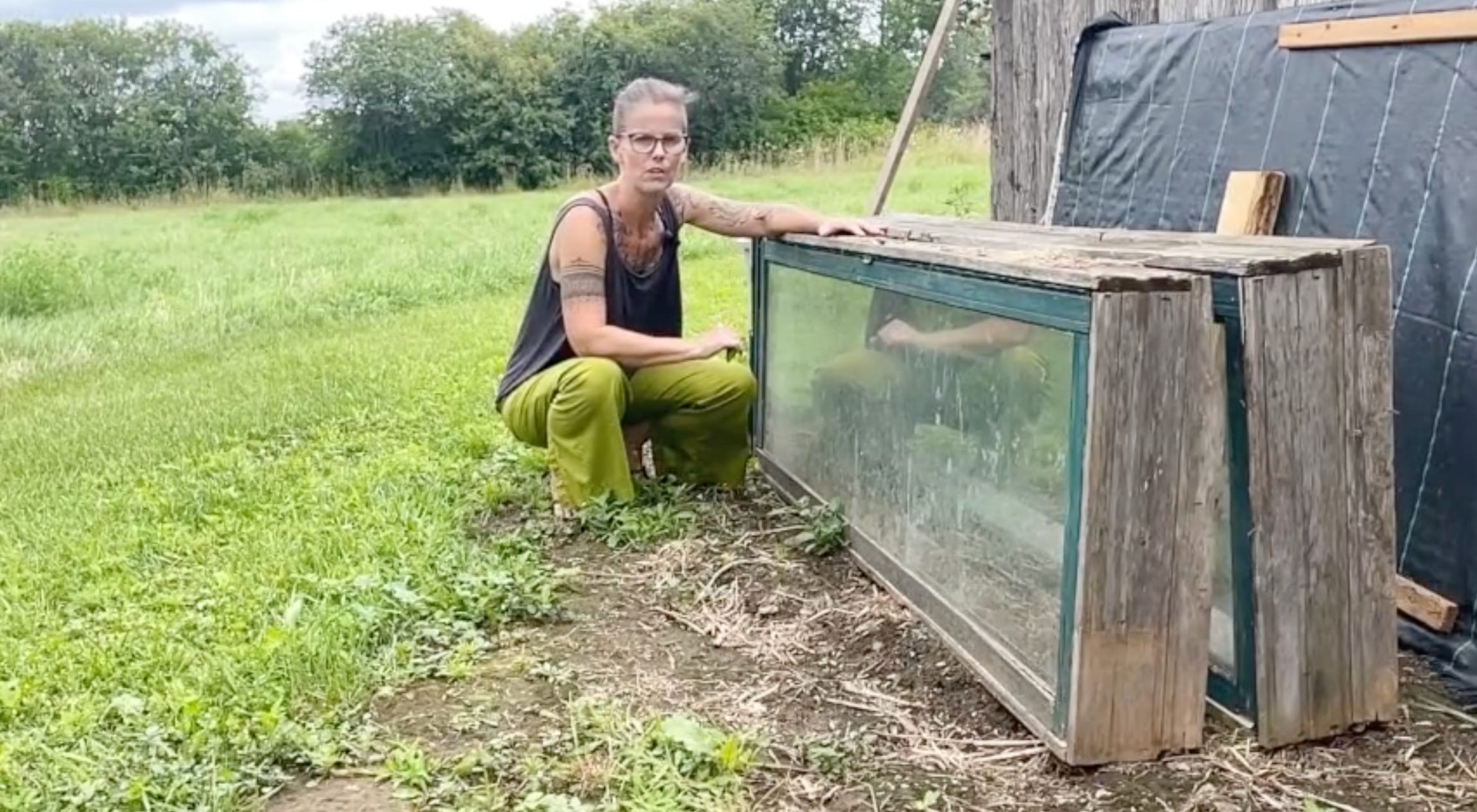
And because they weren’t permanently attached to anything, they could move.
When we didn’t need them inside the greenhouse, we used them in the garden to pre-warm the soil before early spring planting.
The low tunnels worked the same way.
Inside the greenhouse in fall.
Outside in the garden when they were needed there.
Then somewhere else.
They were temporary architecture.
They didn’t need to be beautiful.
They didn’t need to be expensive.
They just needed to solve the problem in front of us.
And that became one of the principles I carried into all of our gardening:
Don’t ask what something was made for. Ask what else it can do.
I wish more people understood this part about fall gardening.
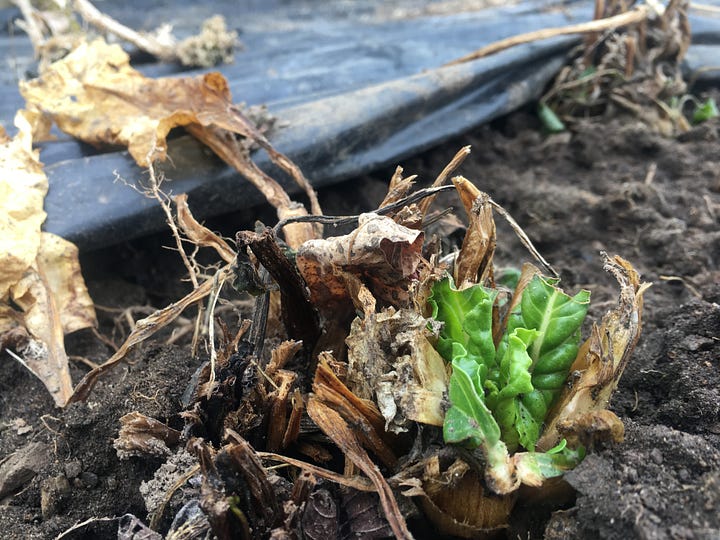
A season extension doesn’t necessarily mean making plants grow through winter.
Sometimes it means keeping them alive and harvestable.
A cold-hardy green might continue growing slowly.
Another crop might stop growing altogether but remain perfectly good to harvest.
A tender crop might give you another week or two simply because you’ve protected it from an early frost.
That is still a season extension.
And when you’re growing a meaningful portion of your own food, another week of harvesting matters.
Another month… matters enormously.
You don’t need every plant to produce more.
You simply need to lose less of what is already there.
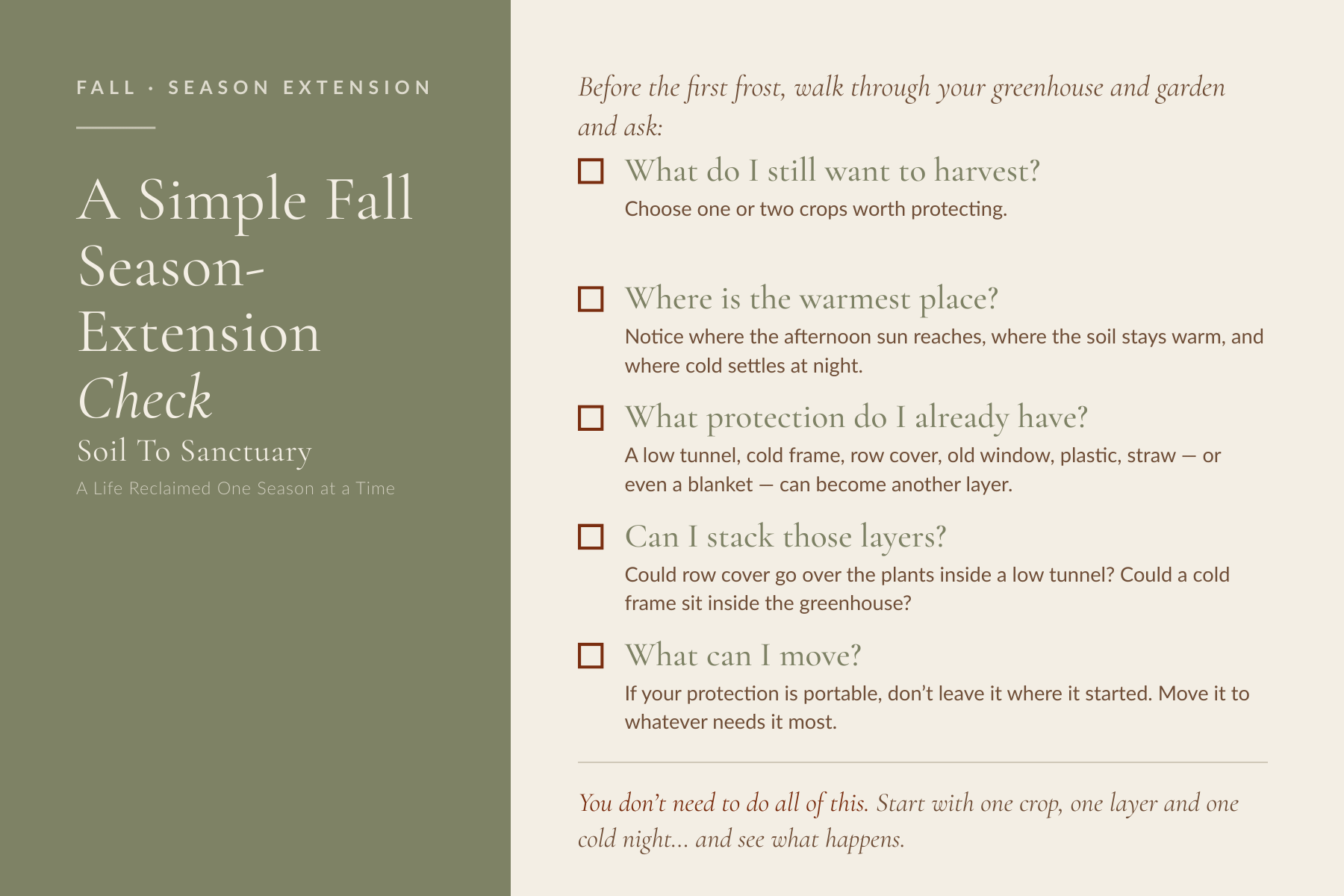
If you have a greenhouse or hoop house going into fall, I would encourage you to walk inside it and look at it differently.
One crop you’d like to keep harvesting longer.
One warm spot inside your greenhouse or garden.
One layer of protection you already own.
One additional layer you could add if temperatures drop.
One portable structure you could move as the season changes.
Consider how many microclimates you can create.
Where is the warmest soil?
Where does the afternoon sun linger?
Which crops are already happy with the temperatures inside?
Which ones need another layer?
Could you put a low tunnel over one bed?
Could row cover go underneath it?
Could an old window become a cold frame?
Could you use thermal mass or dark mulch to help hold daytime warmth?
And perhaps most importantly...
Do you really need to protect everything?
Probably not.
Protect what is worth protecting.
Let the hardier crops experience the season.
Give the vulnerable ones another layer.
Move your portable protection as the garden changes.
That is how we made a greenhouse work harder without making it bigger.



This is the part that makes the whole idea even more useful.
The exact same system works in reverse.
The greenhouse becomes your first layer of protection again.
The low tunnel creates another.
The cold frame creates another.
The soil warms under the sun.
And suddenly you’re not waiting for the calendar to give you permission to begin.
You’re watching the conditions and deciding what they will allow.
That’s how we used the same simple structures at both ends of the year.
In fall, they helped us hold onto the garden.
In spring, they helped us get into it earlier.
But if I’m honest, it’s the fall application that changed the way I looked at the garden.
I stopped seeing the first frost as a finish line.
It became a signal.
Some things were finished.
Some things needed protection.
Some things could stay exactly where they were.
And some things had more time than I thought.
That’s what I would encourage you to look for as you head into fall.
Not a way to defeat winter.
Not another expensive structure.
Just the places where you can create a little more shelter around the food you already have growing.
Because sometimes extending the season doesn’t mean growing more.
It simply means giving what you’ve already grown more time to feed you.
And that, to me, is a much more interesting way to garden.
What are you doing this fall to keep your garden producing a little longer… and is there something you've tried that surprised you with how well it worked?
-Angie
And if you've been thinking about adding a hoop house to your garden, I've already shared how we built ours, from the design through to the materials. You can explore that build here and then start thinking about what you could create inside it.
No posts
Comments
Nothing yet. Say the first thing.
Sign in to join the conversation.