
Imagine you hire a new salesperson. They are very capable, but on their first day, you send them off to meetings with potential buyers — without any training. No background on your company. No positioning. No playbook. No clarity on what “good” looks like in your business. You just hand them a list and say, “Go sell.”
Most likely, they will sell. (Or quit on the spot because they think you lost your marbles…) They will use their experience, their general training, and whatever they vaguely picked up about your product. They will have ten conversations that day, and most of those conversations will sound confident, polished, and professional. Some might even close.
But they will struggle to clearly articulate your value proposition, explain product fit, differentiate your products from other solutions, and so on. Now imagine, every time they don’t know something, they quickly fill in the blanks with what they know from previous sales jobs or just make it up on the spot… They will have a hard time building trust and often even erode it when caught out.
Now imagine that same untrained salesperson drafting every email, writing every proposal section, and sending every follow-up across your entire pipeline. The output is still “fine.” It is just not yours. And the damage compounds. Quietly, daily, across every touchpoint your market sees.
No one would do this when hiring a new salesperson. But most companies do exactly that when they implement a new AI tool! The problem is that AI workflows or agentic systems can scale almost infinitely. So, instead of potentially eroding trust over 10 conversations a day, an AI prospecting agent could reach hundreds of potential buyers in just minutes. AI is very powerful, but sometimes we treat it like this all-knowing black box that will magically transform our business, and when it doesn’t, we tell ourselves that the tool wasn’t good and we just need to find a better one.
But the problem isn’t a tool problem. It’s a lack-of-context problem.
A lot of CEOs I talk to are excited about AI, but they are (often privately) reluctant and hesitant. They will not say it at a board meeting, but they tell me privately: they do not fully trust their AI to represent them accurately.
So they hesitate to scale it further.
Most AI consultants treat that hesitation as a failure of nerve. “You need to adopt AI or your competitors will beat you to it.” That advice is not only wrong but dangerous. There is a reason the CEO is feeling mistrust. (And if you’re feeling this too, I suggest you lean into this gut feel more.) They have seen the generic output. They have watched AI polish off the rough edges that make their business different.
Hesitating to scale that further isn’t avoidance because of nerves. It is good judgment with the wrong frame. You do not have a trust problem. You have a context problem. Once the context is in place, the trust is earned — and scaling becomes obvious.
Boston Consulting Group’s The Widening AI Value Gap: Build for the Future 2025 report surveyed 1,250 senior executives across more than twenty-five sectors. The findings define exactly what is at stake.
Only 5% of companies qualify as “future-built” for AI — systematically generating substantial value across functions. Another 35% are scaling and beginning to see value. The remaining 60% are laggards: minimal returns despite real investment.
The gap is not small. Future-built companies achieve 1.7x revenue growth versus laggards, 3.6x three-year total shareholder return, and 1.6x EBIT margin. In areas where AI is applied, leaders see twice the revenue increase and 40% greater cost reductions.
And BCG is explicit about why the 60% are stuck. It is not budget. Many laggards have significant AI tool budgets. It is not the technology. They are using the same models everyone else is. BCG’s phrase: “they don’t yet have the proper capabilities for scaling AI in place.” What they mean by “capabilities” is the foundational layer — operating model, data foundation, methodology, governance — without which AI cannot compound.
One critical part of that layer is what I call the AI Context Layer, or when I help my clients install their, I call it the Trust Cortex.
The AI Context Layer is an infrastructure layer that provides your AI with the knowledge, background information, standards, guardrails, and other context it needs to not only accurately reflect your company, products, and achieved outcomes, but also your beliefs and values, the things you stand for, etc. It allows the AI to talk like you, sound like you, and act like you.
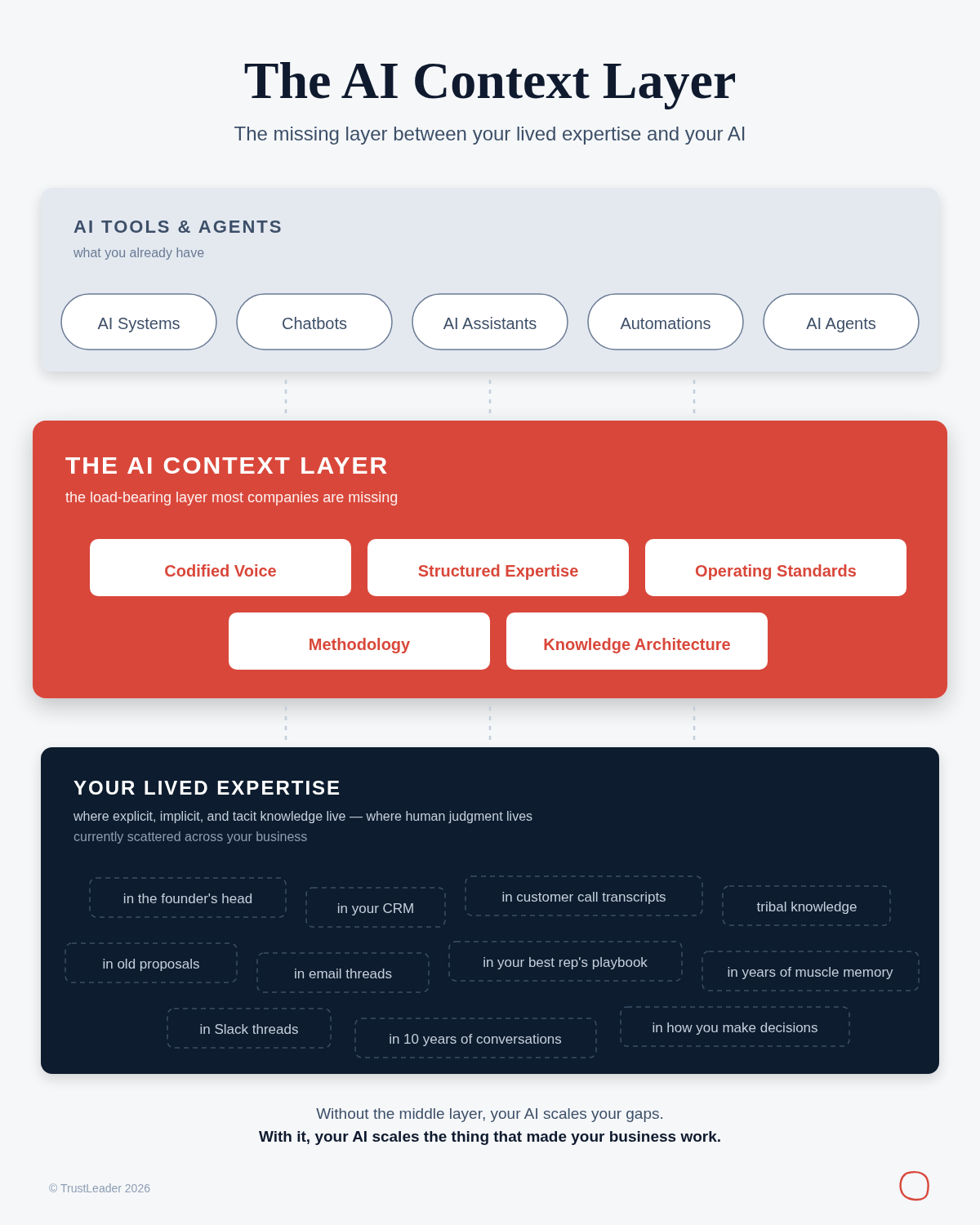
It is not software or a platform. Not a single document or a single tool. Not something you buy. It is a layer your company builds over time (with an initially more intense ramp-up as you build the structural construct and the must-have foundational assets) that makes every AI tool, agent, and workflow you deploy yours reliably.
Thanks for reading From Scattered To Scaled AI! This post is public, so feel free to share it.
It contains a combination of things that make your company’s output recognizably yours: your codified value proposition, your voice and tone, your operating standards, your structured expertise, and your methodology. Everything that currently lives in your head, your founder’s head, your senior salesperson’s head, and the ten years of customer conversations you have never written down.
With it, your tireless, infinitely scalable contributor finally has the briefing your new salesperson never got. The output stops being “fine.” It starts being unmistakably you — across 5000 emails, 500 proposals, every customer touchpoint AI now reaches. AI stops scaling your gaps and starts scaling the thing that made your business work in the first place.
This is the difference between Scattered AI and Scaled AI. Scattered AI runs on tools without context — productive, busy, generic. Scaled AI runs on tools the company has trained. Same models. Different outcomes.
The specific components of the Trust Cortex — what I call the Foundation Five — are the subject of the next article in this series.
The gap between the laggards and those scaling is widening exponentially, not narrowing. The companies building the context layer now are compounding two things at once: their AI advantage and their differentiation. The companies still cycling through tools are compounding neither. The math won't get any more forgiving next year.
You do not have to build this with anyone in particular. You do not even have to call it the Trust Cortex. But if you are a founder-led B2B company sitting somewhere in that 60%, you have to build something that does this job — or you stay in the 60% while your competitors do not.
Foundation first. Scale second.
No posts
Comments
Nothing yet. Say the first thing.
Sign in to join the conversation.