

How humans learned to keep food and themselves cool, from caves and harvested ice to refrigerators and modern air conditioning.
If you’re following me but don’t yet receive these essays by email, you’re missing most of them. Substack doesn’t email articles to followers, only to subscribers. You can get every new essay free in your inbox by subscribing 👉:
Almost everyone knows the misery of a very hot summer day. Many of my readers may be experiencing it right now. You lie awake because the bedroom will not cool down. Cooking makes the kitchen hotter. Work becomes tiring, concentration becomes difficult, and even ordinary chores seem to require more effort.
Today, however, billions of people can respond to oppressive heat by adjusting a thermostat, turning on an air conditioner, opening a refrigerator, or reaching for a cold drink. These technologies are so ordinary that it is easy to forget what remarkable achievements they are.
For most of human history, people had no such option. They could seek shade, build houses that captured breezes, store food underground, or take advantage of cool water. But they could not manufacture cold. Fresh meat, milk, fish, fruits, and vegetables spoiled quickly in warm weather, while people generally had to endure whatever temperatures their local climate provided.
We should therefore have some gratitude for the generations of inventors, engineers, skilled workers, entrepreneurs, and businesses that gradually solved this ancient problem. Their innovations have made food safer, reduced spoilage, improved comfort, protected people from dangerous heat, and made it easier to live and work productively in hot climates. What was once a luxury available only to a small minority has become part of everyday life for billions of people.
This transformation did not result from a single great invention. Humans developed increasingly powerful systems for cooling food and buildings through five major eras:
Natural cooling
Harvested Ice,
Industrial refridgeration (1880s-1930s)
Household refridgeration, (1930s-1960s)
Air conditioning (1950s-present)
Each depended on a combination of new technologies, the skills required to use them, and organizations capable of putting them into widespread use.
Technological Innovation (the series)
·
January 18, 2025

Technology matters, but it’s not enough. This guide gathers my best work on innovation and how it combines with skills, organizations, and energy to produce progress.
If you enjoy this article, you should read my From Poverty to Progress book series.


Cooling is not merely about making a hot summer day more comfortable. Excessive heat affects sleep, health, and people’s ability to work, while the inability to keep food cold limits what people can safely eat, how long food can be stored, and how far it can be transported.
Anyone who has tried to sleep in a hot bedroom knows that heat can make even basic activities unpleasant. Cooking becomes uncomfortable, household chores become more tiring, and falling asleep can become difficult.
The effect on sleep can be measured. One large international study analyzed more than 7 million nighttime sleep records. It found that warmer nighttime temperatures reduced the amount of sleep people received, primarily because they fell asleep later.
Before widespread air conditioning, Americans relied on porches, open windows, electric fans, sleeping porches, and sometimes sleeping outdoors during extreme summer heat. These practices illustrate how much effort people devoted simply to coping with temperatures that most Americans today can escape by going indoors.
Cooling also protects people from unsafe food. Food begins deteriorating from the moment it is harvested or slaughtered. Heat accelerates that process, making cooling especially important for meat, fish, milk, fruits, vegetables, and prepared foods. Refrigeration slows microbial growth and allows highly perishable foods such as meat, milk, fish, and prepared foods to remain safe much longer.
The ability to keep these foods cold reduces waste and greatly increases how long and how far they can travel. Farmers can specialize in producing perishable foods for distant consumers, while consumers can obtain foods that could never have reached them reliably without cooling.
In the United States, refrigeration eventually allowed Chicago meatpackers and California fruit growers to serve consumers thousands of miles away. Household refrigeration later allowed families to store larger quantities of perishable foods for days or weeks.
Extreme heat can cause heat exhaustion, heat stroke, cardiovascular stress, and death. The risks become particularly severe during heat waves and among older people.
The American experience demonstrate the magnitude of this danger. One major study found that the mortality effect of days above 90°F fell by about 80 percent between 1900 to 1959 and 1960 to 2004. The researchers estimated that residential air conditioning explained essentially the entire decline. Without that adaptation, they estimated that extreme heat would have caused about 3,600 premature deaths annually during the later period, rather than about 600.
Heat does not merely make work unpleasant. It can reduce people’s ability to perform both physical and mental tasks.
Controlled experiments with office workers have found that temperature affects performance as well as comfort. The effects can become substantial at very high temperatures. One study of Australian workers found that temperatures above 38°C, or 100°F, increased absenteeism by 15 percent among workers in finance and insurance, the industry most affected in the study.
The consequences are even more obvious for strenuous physical work. Cooling increases the number of hours during which people can work safely and effectively in hot climates. This matters not just for individual comfort, but for the productivity of entire economies.
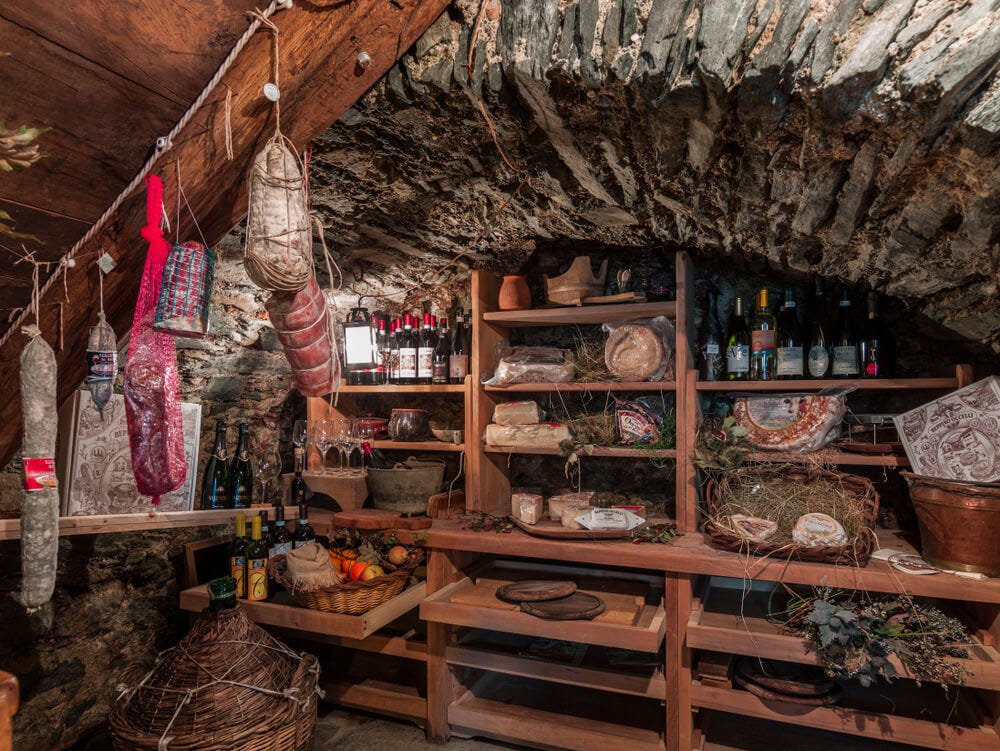
For almost all of human history, people could not create cold. They could only take advantage of places and processes that were naturally cooler than the surrounding environment. Caves, underground storage, cool water, shade, evaporation, and carefully designed buildings provided some protection from heat, while food preservation techniques reduced the need for cooling in the first place.
Going underground was one of the simplest ways to keep food cool. Soil several feet below the surface changes temperature much more slowly than the air above it. Caves, storage pits, and eventually purpose-built cellars therefore provided relatively cool places for storing food during hot weather.
Water provided another source of cooling. Springs and wells brought naturally cool groundwater to the surface. Colonial Americans built spring houses around flowing springs, where milk, butter, and other perishables could be placed in or near cold water. On nineteenth-century American farms, root cellars provided similar temperature control for potatoes, apples, carrots, and other foods.
People also learned to cool themselves and their buildings without refrigeration. Evaporating water absorbs heat, making porous pottery useful for keeping water cooler than the surrounding air in dry climates. Buildings could reduce heat through thick masonry or adobe walls, shade, courtyards, and openings positioned to encourage ventilation. In the American Southwest, thick adobe walls absorbed heat slowly during the day, helping interiors remain cooler than outside temperatures.
These technologies worked because people developed practical knowledge about how to exploit their local environments. Builders learned where to locate cellars, how deeply to excavate them, how to encourage ventilation, and how to design buildings that limited exposure to summer heat. In hot, dry regions, builders learned to use thick earthen walls and shade to moderate indoor temperatures.
Food preservation required another set of skills. Drying removed the moisture microorganisms needed to grow. Smoking, salting, and fermentation extended the useful life of foods that otherwise spoiled quickly. Native Americans developed preservation techniques suited to local foods and climates, while colonial farm families combined inherited European practices with foods and conditions found in North America.
These skills were especially important because natural cooling could only do so much. A cellar could lower and stabilize temperatures, but it could not keep meat at modern refrigerator temperatures during a hot summer. For most families, preserving food therefore meant combining whatever natural cooling was available with techniques that made food less vulnerable to spoilage.
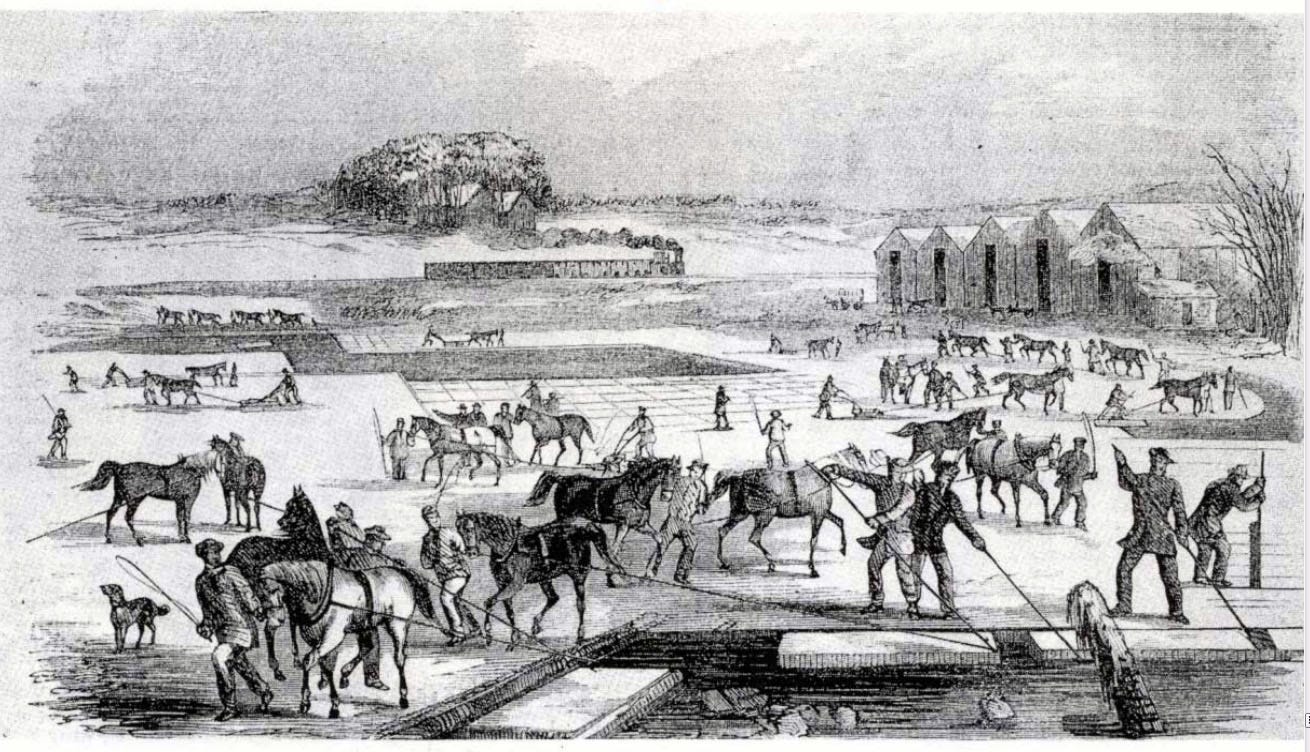
For thousands of years, people living in cold climates had access to an enormous source of cooling every winter: ice. The challenge was preserving that ice through the summer and moving it to where people needed it. By the 19th-Century, New England developed a technological system for harvesting, storing, transporting, and selling natural ice across the nation and around the world.
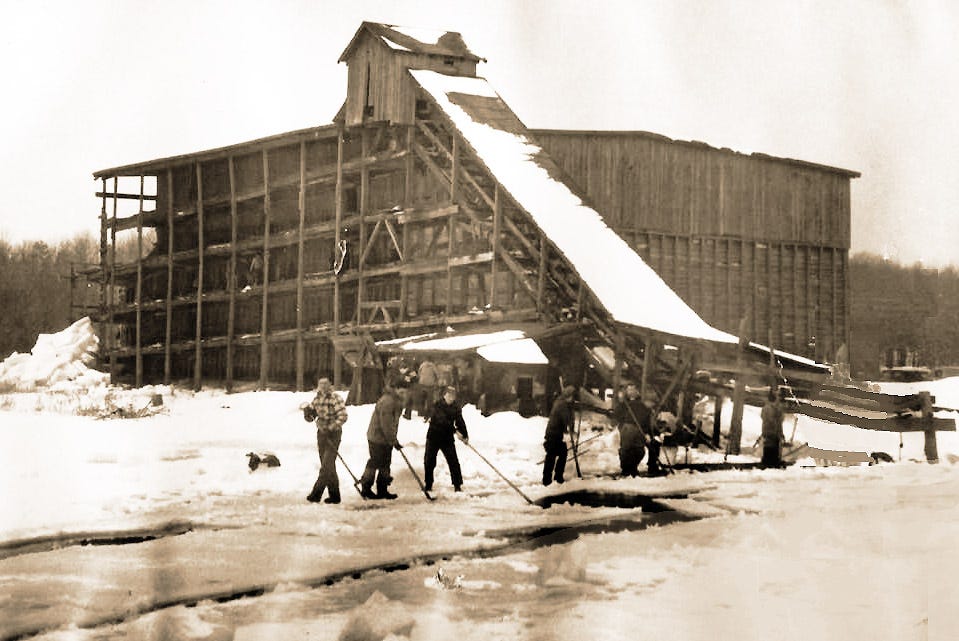
The essential technology was the icehouse (shown above). Large quantities of winter ice could be packed together inside heavily insulated buildings, often partly underground. Sawdust and other insulating materials slowed the transfer of heat, allowing much of the ice to survive well into the summer.
By the nineteenth century, Americans had developed specialized equipment for harvesting ice on a much larger scale. Workers used horse-drawn cutters to score the surface of frozen ponds and lakes into a grid. Ice saws separated the ice into blocks, while hooks, tongs, ramps, and channels helped workers move the heavy blocks into storage.
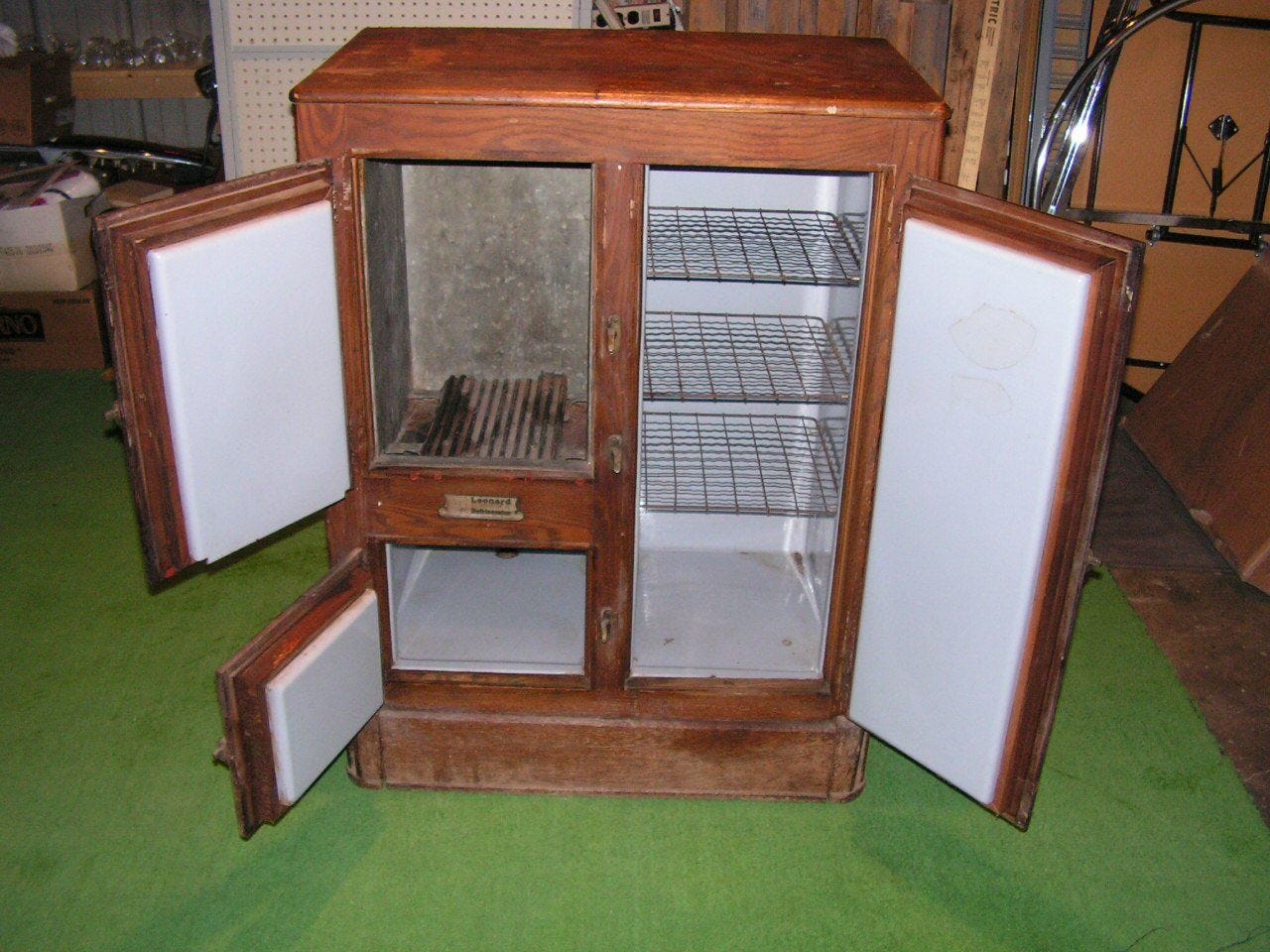
Iceboxes (shown above) brought this cooling system into the home. An icebox was an insulated cabinet containing a compartment for a block of ice. Cold air circulated around the food stored inside. As the ice melted, water drained into a pan or pipe. Urban households could replenish the ice whenever the old block became too small.
Horse-drawn ice wagons completed the system. Instead of requiring households to obtain their own ice, delivery companies brought blocks directly to customers. By the late nineteenth century, the sight of an iceman carrying a block of ice into a home was familiar in American cities.
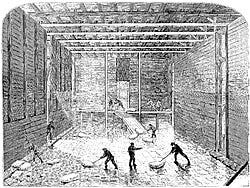
Harvesting ice required considerably more skill and organization than simply cutting blocks from a frozen lake. Workers needed to judge when ice was thick and strong enough to harvest safely, cut blocks into standardized sizes, move them efficiently, and stack them inside icehouses while minimizing melting.
New England became particularly skilled at large-scale ice harvesting. During winter,
crews cleared snow from frozen ponds,
marked grids across the surface,
cut long channels, and
guided floating blocks toward icehouses.
An operation had to move quickly when conditions were right because a period of warmer weather could bring the harvest to an abrupt end.
Icehouse construction required its own specialized knowledge. Builders had to limit exposure to outside air, provide drainage for melting water, and use insulation effectively. Operators also learned how tightly ice should be packed and how much sawdust or other insulation was needed to preserve it through warm weather.
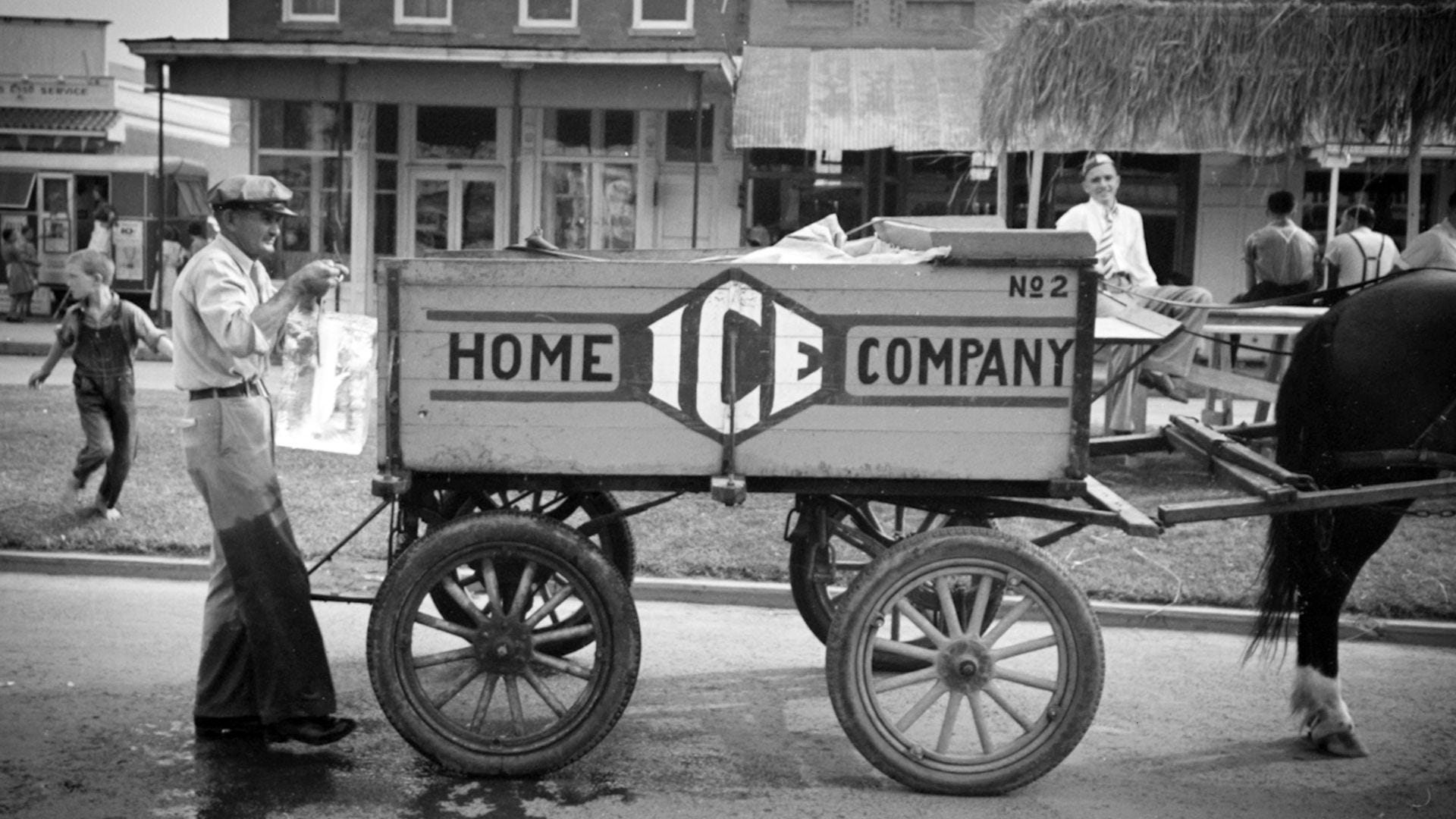
Urban distribution added another set of skills. Ice companies had to estimate household demand, divide cities into delivery routes, cut blocks to the appropriate size, and make regular deliveries before customers’ iceboxes warmed.
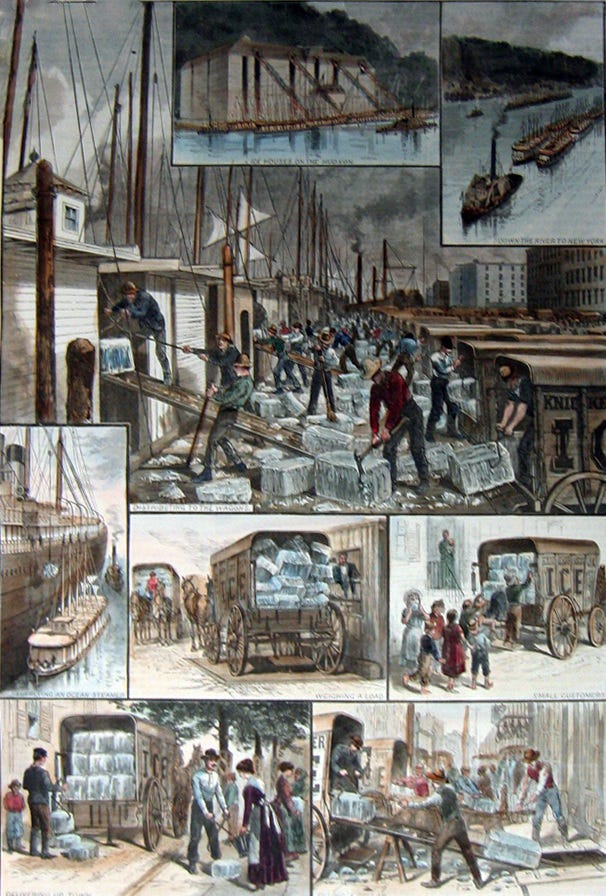
These technologies and skills made possible an entirely new industry. Commercial ice companies harvested ice during the winter, stored it in enormous icehouses, and distributed it throughout the year. Breweries, fisheries, hotels, restaurants, food dealers, and households became regular customers.
The scale became remarkable. A federal investigation of the industry around 1880 estimated that the United States was harvesting 8 to 10 million tons of natural ice each year.
New York City alone consumed close to 1 million tons annually, while
Chicago used about 580,000 tons
Boston and Philadelphia each consumed somewhat less than 400,000 tons.
Ice had become part of the basic infrastructure of large American cities.
The industry required substantial distribution networks. Boston alone retailed about 60,000 tons of ice locally, using 93 wagons and roughly 150 horses. By the middle of the nineteenth century, 135 commercial icehouses stood along the Hudson River between New York City and Albany, storing ice for shipment into the country’s largest urban market.
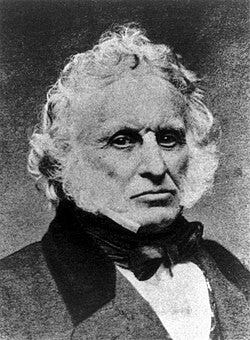
Frederic Tudor (shown above) provided the most famous example of how far these networks could reach. Beginning in 1806, Tudor built a business shipping New England ice to warmer markets. In 1833, a ship left Boston carrying about 180 tons of ice for Calcutta, more than 16,000 miles away! After a voyage of roughly four months, about 100 tons remained. By the 1840s, New England ice was being shipped to destinations including India, Brazil, Hong Kong, and Singapore.
International exports themselves became substantial. Boston exported almost 75,000 tons of ice in 1847 aboard 353 vessels. During the peak decades of the trade, New England generally exported at least 70,000 tons annually, and exports reached as high as about 146,000 tons in one year.
Natural ice had therefore become much more than a luxury for wealthy households. By the late nineteenth century, Americans were harvesting millions of tons every year to cool homes, preserve fish and meat, supply breweries and hotels, and support other businesses. An entire commercial system had emerged around cutting frozen water during a few winter months and keeping it cold enough to serve millions of consumers throughout the year.
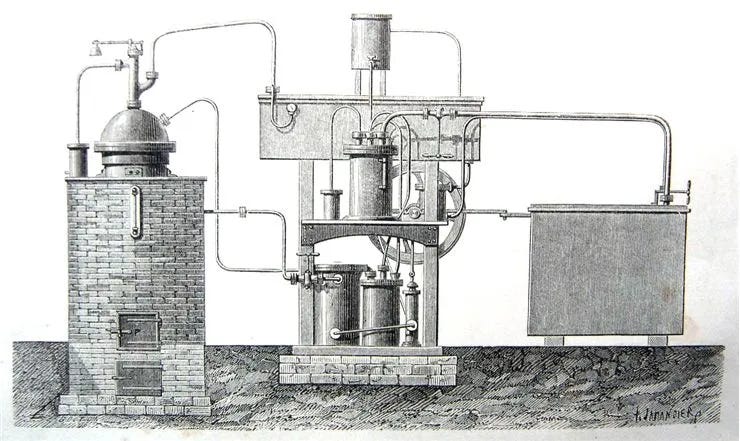
The ice industry could move cold across great distances, but it remained dependent on winter weather. Mechanical refrigeration removed that limitation. During the second half of the nineteenth century, businesses increasingly learned to manufacture cold wherever they had the machinery and power to do so. By the 1880s, mechanical refrigeration was becoming a practical industrial technology. This transformed refrigeration from the harvesting of a natural resource into an industrial process.
At first the technology of refridgeration was only available for industrial and commercial uses, but gradually the refridgerator became a common household appliance.
The basic mechanical refrigeration system worked by circulating a refrigerant through a repeating cycle of compression, condensation, expansion, and evaporation. When the refrigerant evaporated, it absorbed heat from the surrounding space. Compressors and condensers then allowed the refrigerant to be reused continuously.
Ammonia became one of the most important refrigerants for large industrial systems during the late nineteenth century. It was effective and relatively inexpensive, although toxic leaks made careful construction and operation essential. Large compressors, pumps, pipes, insulated rooms, and cooling coils turned refrigeration into substantial pieces of industrial equipment rather than simple storage devices.
Breweries were among the early American adopters. Beginning in the 1870s and especially during the 1880s, large breweries installed mechanical refrigeration because lager beer required cool temperatures during fermentation and storage. By the 1890s, mechanical refrigeration was becoming standard equipment in large American breweries, freeing them from dependence on enormous stocks of winter ice.
Cold-storage warehouses expanded rapidly during the 1880s and 1890s. Instead of merely slowing spoilage during transportation, businesses could hold large quantities of meat, dairy products, fruit, and other perishables under controlled temperatures while they waited for sale or further shipment. Chicago developed extensive cold-storage facilities alongside its enormous meatpacking industry.
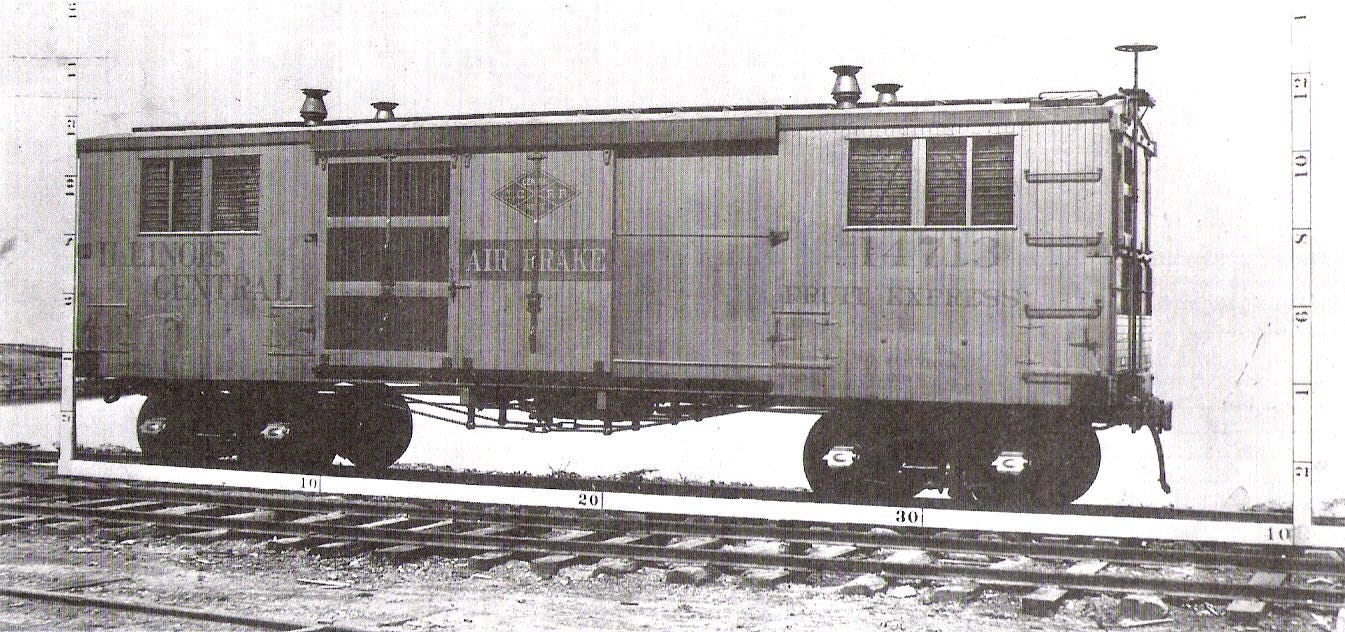
Transportation was even more important. During the late 1870s, Gustavus Swift began experimenting with refrigerated railroad cars that could carry dressed beef from Chicago to eastern markets. In 1881, Swift made the first successful large-scale shipment of refrigerated beef from Chicago to the East. Earlier, cattle often had to be shipped alive, consuming feed and losing weight along the way. Refrigerated cars allowed meatpackers to slaughter cattle in Chicago and ship only the valuable meat.
Refrigerated railcars also transformed American agriculture during the 1880s and 1890s. California growers could increasingly send grapes, citrus fruit, and other perishables across the continent to eastern consumers. The Santa Fe Refrigerator Dispatch, established in 1890, helped develop a specialized refrigerated transportation system linking western agriculture to national markets.
Refrigerated ships extended the same principle across oceans. Successful shipments of mechanically refrigerated meat across the Atlantic began during the 1870s, and by the late nineteenth century refrigerated ocean transportation was making international trade in meat, dairy products, and other perishables increasingly practical.
Industrial refrigeration created demand for skills that the natural ice industry had never required. During the 1880s and 1890s, mechanical engineers increasingly had to design compressors, piping systems, condensers, and insulated facilities capable of operating reliably for long periods.
Refrigeration engineers and mechanics became responsible for operating and maintaining these systems. By the turn of the twentieth century, refrigeration had become a recognizable technical specialty. A failed compressor in a cold-storage warehouse or meatpacking plant could threaten thousands of dollars worth of food. Workers therefore needed to understand machinery, pressure systems, refrigerants, lubrication, valves, and temperature control.
Railroad refrigeration required another body of practical knowledge. As refrigerated traffic expanded during the 1890s and early 1900s, workers had to prepare refrigerated cars, maintain insulation and cooling equipment, monitor temperatures, and ensure that perishable cargo moved quickly through the rail network. Companies transporting California produce had to coordinate growers, packing houses, refrigerator cars, icing stations, railroad schedules, and wholesale markets thousands of miles away.
Meatpacking required similar coordination. By the 1890s, engineers and managers at Chicago packing companies had integrated slaughtering, processing, cooling, storage, and transportation into continuous industrial operations. Cold-storage operators also developed specialized knowledge about how different foods reacted to temperature and humidity and how warehouses could be loaded without disrupting the circulation of cold air.
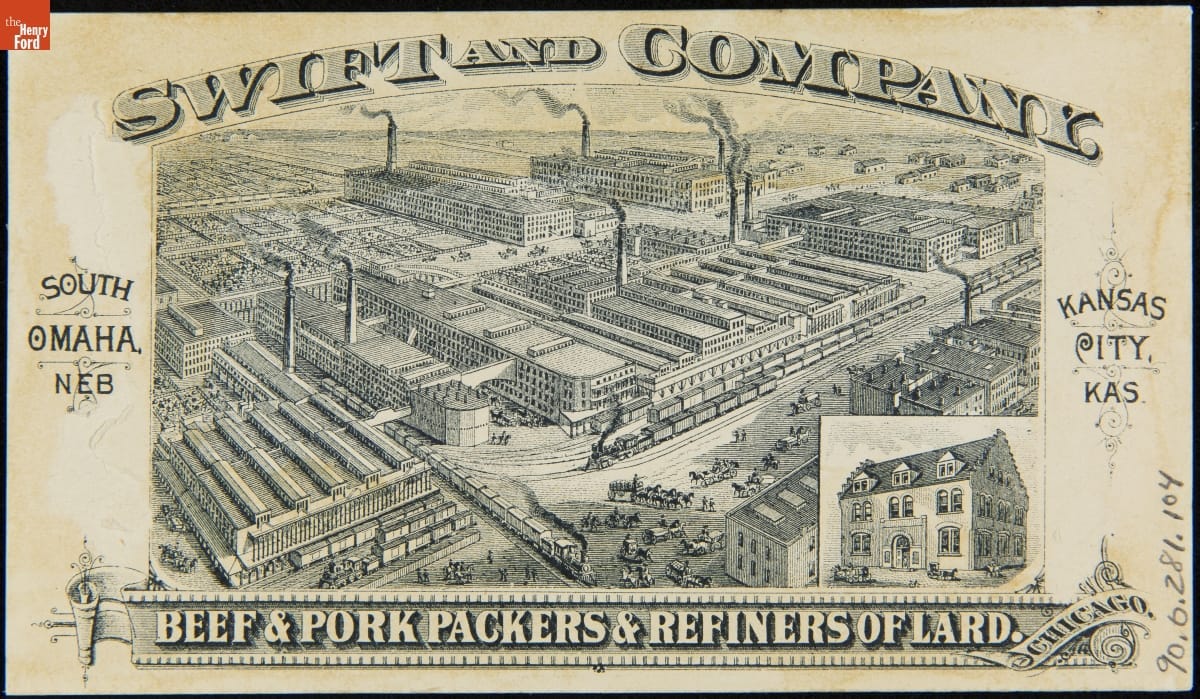
Mechanical refrigeration became powerful because large organizations incorporated it into much broader production and transportation systems. During the 1880s and 1890s, railroads, meatpacking companies, shipping companies, breweries, cold-storage firms, and food processors became interconnected parts of an emerging cold chain.
Swift & Company provides one of the clearest examples. Gustavus Swift began developing his refrigerated distribution system in the late 1870s. After successful shipments in 1881, the company rapidly expanded its refrigerated railcar fleet and distribution network. By combining large Chicago packing plants with refrigerated railcars and distribution facilities in eastern cities, Swift helped create a vertically integrated national meat-distribution system.
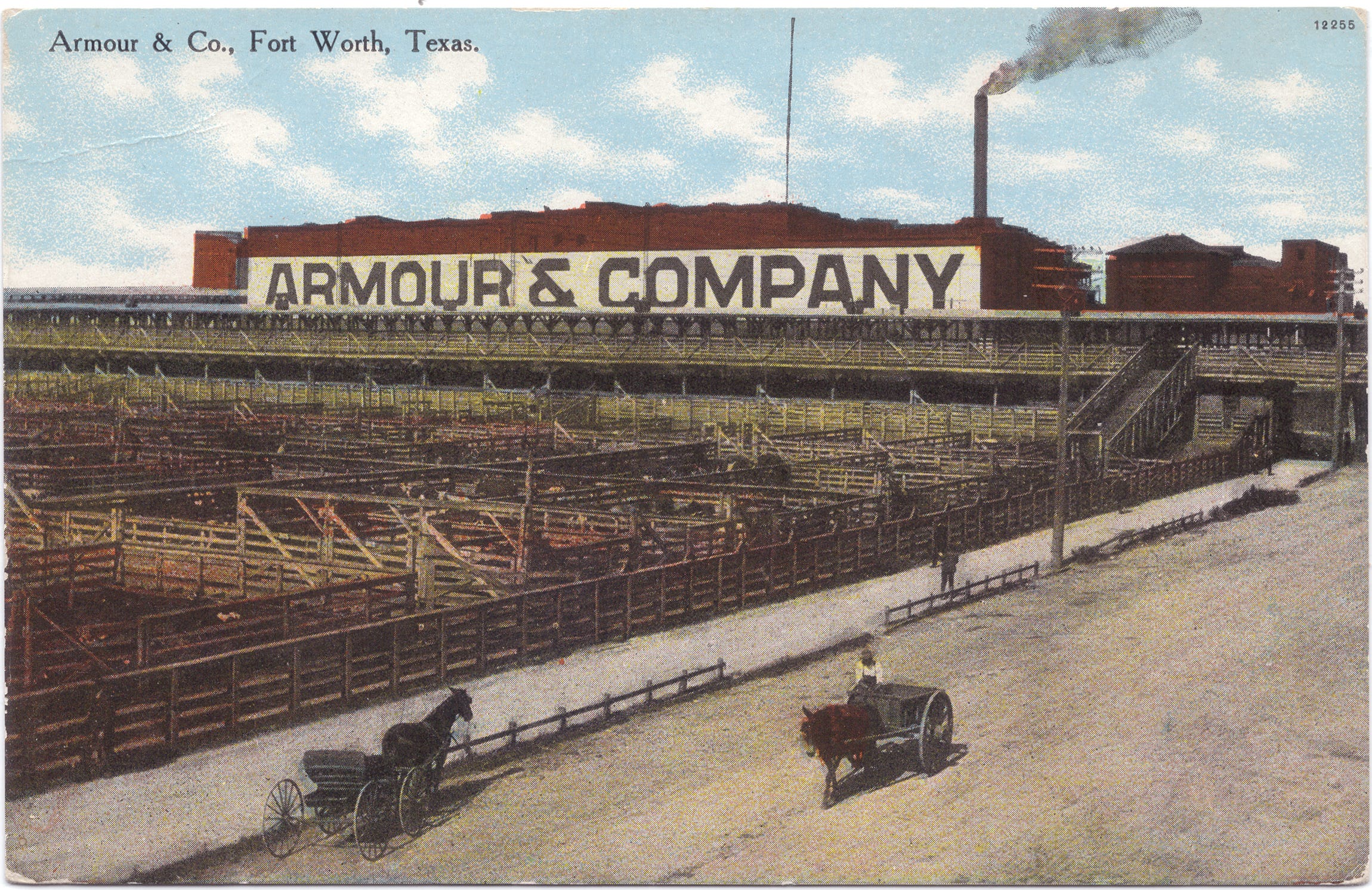
Armour & Company developed a similar system during the 1880s and 1890s. Chicago’s Union Stock Yards, which had opened in 1865, supplied enormous numbers of animals to these packing companies, while railroads carried refrigerated meat outward to consumers across the country. By 1900, Chicago’s stockyards and packing plants were processing millions of animals each year.
The refrigerated railroad network also expanded rapidly. The Santa Fe Refrigerator Dispatch was established in 1890 specifically to move perishable agricultural products from the West. During the 1890s and early 1900s, thousands of refrigerated cars began carrying California fruit and vegetables eastward. Railroads constructed icing stations along major routes so cars could have their ice replenished during long journeys.
By the early twentieth century, these organizations linked farms, slaughterhouses, packing plants, warehouses, railroads, wholesalers, and retailers into an increasingly continuous cold chain. Refrigeration was no longer something that happened at one location. It had become infrastructure connecting producers and consumers across an entire continent.
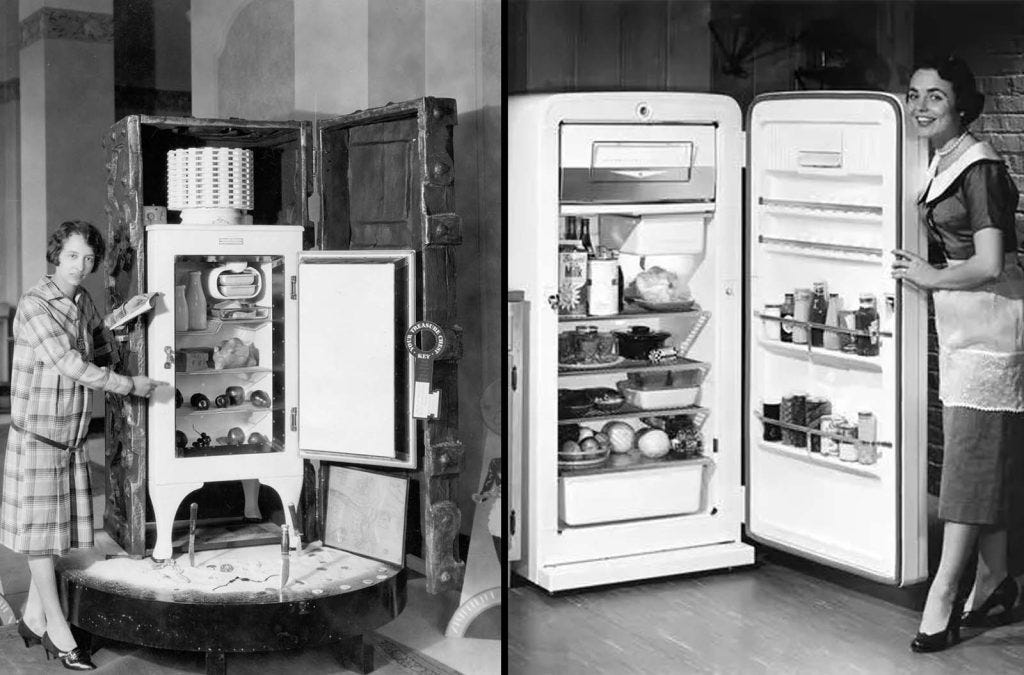
Industrial refrigeration had created a cold chain connecting farms, food processors, railroads, warehouses, and stores. During the early twentieth century, refrigeration began moving into the final link in that chain: the household. By the middle of the century, the electric refrigerator had become one of the standard appliances of American life.
The electric refrigerator was just one of the 20th-Century household appliances that transformed women’s lives.
Early household mechanical refrigerators appeared before World War I, but they were expensive and sometimes unreliable. The market expanded rapidly during the 1920s as manufacturers improved compressors, electric motors, insulation, and temperature controls.
Frigidaire, which General Motors acquired in 1919, became one of the best-known refrigerator brands. General Electric introduced its successful Monitor Top refrigerator in 1927, with the compressor assembly visibly mounted above the cabinet. Competition among manufacturers helped make refrigerators quieter, more reliable, and easier to use.
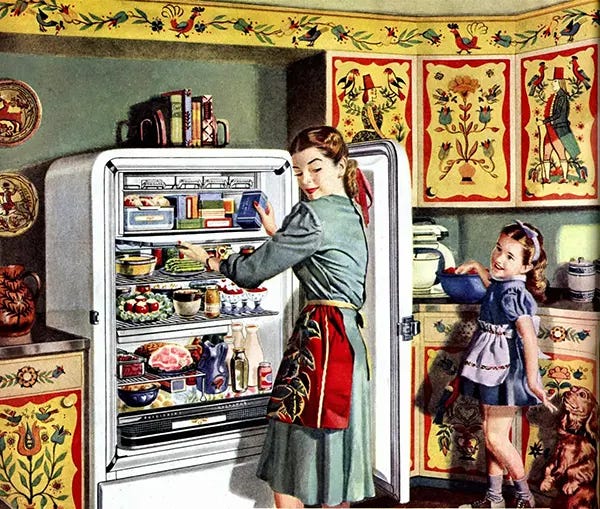
One particularly important improvement was the hermetically sealed refrigeration system. Manufacturers enclosed the compressor and electric motor within a sealed unit, reducing refrigerant leaks and eliminating much of the maintenance required by earlier machines. Better insulation and thermostatic controls further reduced electricity consumption and made refrigerators increasingly practical for ordinary households.
Adoption increased rapidly. In 1930, only about 8 percent of American households had mechanical refrigerators. By 1940, roughly 44 percent did. That is an amazing rate of diffusion considering that this period was the Great Depression.
After civilian appliance production resumed following World War II, refrigerators spread even faster. By 1950, about 80 percent of American households had them, and by 1960 the figure exceeded 90 percent.
The home freezer represented another important development. Small freezer compartments initially appeared inside refrigerators, while separate household freezers became increasingly popular after World War II. Families could now store meat, vegetables, prepared meals, and other foods for months rather than days.
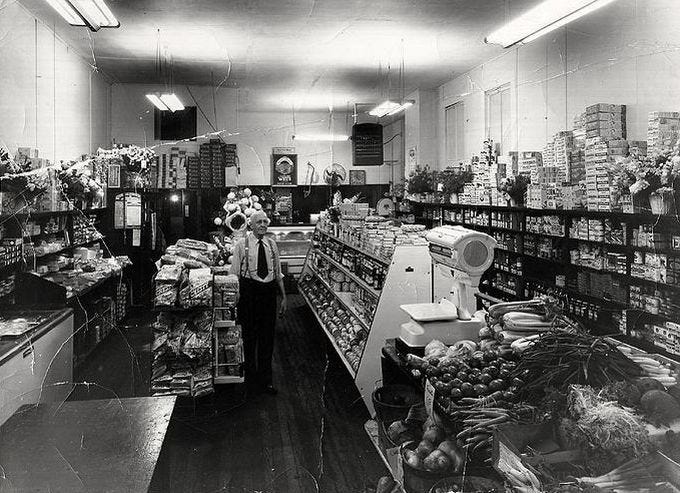
Refrigeration simultaneously transformed food stores. During the 1930s, supermarkets increasingly installed refrigerated display cases for meat, dairy products, and produce. By the 1950s, long refrigerated and frozen-food aisles were becoming characteristic features of the American supermarket.
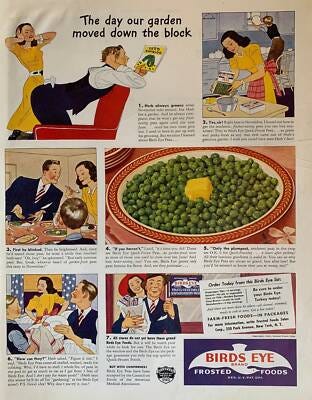
Frozen-food technology developed alongside these appliances. Clarence Birdseye developed techniques for rapidly freezing food during the 1920s. In 1930, Birds Eye began selling a broad line of frozen foods to American consumers. As household freezers and supermarket freezer cases became more common after World War II, frozen vegetables, fish, meat, juices, and prepared meals developed into a mass market.
Household refrigeration required a different set of skills from the large industrial systems used by meatpackers and cold-storage warehouses. Manufacturers needed workers capable of mass-producing compressors, electric motors, thermostats, insulated cabinets, and sealed refrigeration systems at low cost and consistent quality.
A nationwide appliance-service industry also emerged. Refrigerators combined electrical and mechanical components that required specialized diagnosis and repair. Appliance technicians learned to identify electrical failures, service compressors and thermostats, detect refrigerant leaks, and replace worn components.
Frozen foods required another body of specialized knowledge. Food processors had to determine how different foods reacted to freezing, how quickly they should be frozen, how they should be packaged, and what temperatures were necessary to preserve quality during transportation and storage.
Supermarkets likewise needed workers capable of operating and maintaining large networks of refrigerated display cases and freezer cabinets. Refrigeration had become a technical system extending throughout the store rather than a single machine in a back room.
Large appliance manufacturers made household refrigeration possible on a mass scale. General Electric, Frigidaire, Kelvinator, Westinghouse, and other companies manufactured refrigerators by the millions while competing over price, reliability, convenience, and appearance.
Electric utilities were equally important. A refrigerator was useful only where households had reliable electricity. As American electrification expanded during the 1920s and 1930s, and rural electrification accelerated after the Rural Electrification Act of 1936, the potential market for electric refrigerators expanded with it.
Food companies adapted to the new technology. Clarence Birdseye’s freezing techniques were commercialized on a large scale after General Foods acquired his patents and trademarks in 1929. Birds Eye frozen foods reached test markets in 1930 and expanded as supermarkets and households acquired the equipment needed to keep them continuously frozen.
Supermarkets became another critical organization in the new refrigeration system. Chains such as A&P could combine large stores, refrigerated display cases, centralized purchasing, and rapid inventory turnover. Consumers increasingly encountered dozens and eventually hundreds of refrigerated and frozen products in a single store.
Retailers and service organizations completed the system. Department stores, appliance dealers, and companies such as Sears sold refrigerators to households, often using installment credit to make expensive appliances affordable. Local repair businesses kept those refrigerators operating.
By 1960, refrigeration had become an integrated system stretching from the farm and food-processing plant through refrigerated transportation and supermarkets into the household kitchen. Artificial cold was no longer primarily an industrial service or something purchased from the neighborhood iceman. It had become an ordinary capability available continuously inside almost every American home.
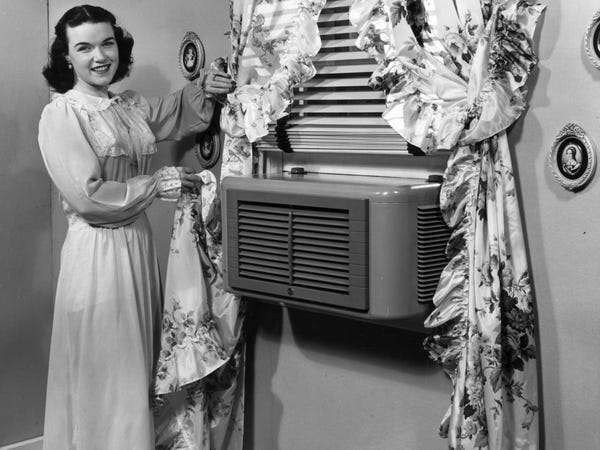
Refrigeration gave people increasing control over the temperature of food. Air conditioning applied the same basic technology to the spaces where people lived and worked. Although mechanical air conditioning appeared early in the twentieth century, it remained concentrated in factories and commercial buildings for decades. Only after World War II did it spread rapidly into American homes, eventually helping reshape the economic and population geography of the country.
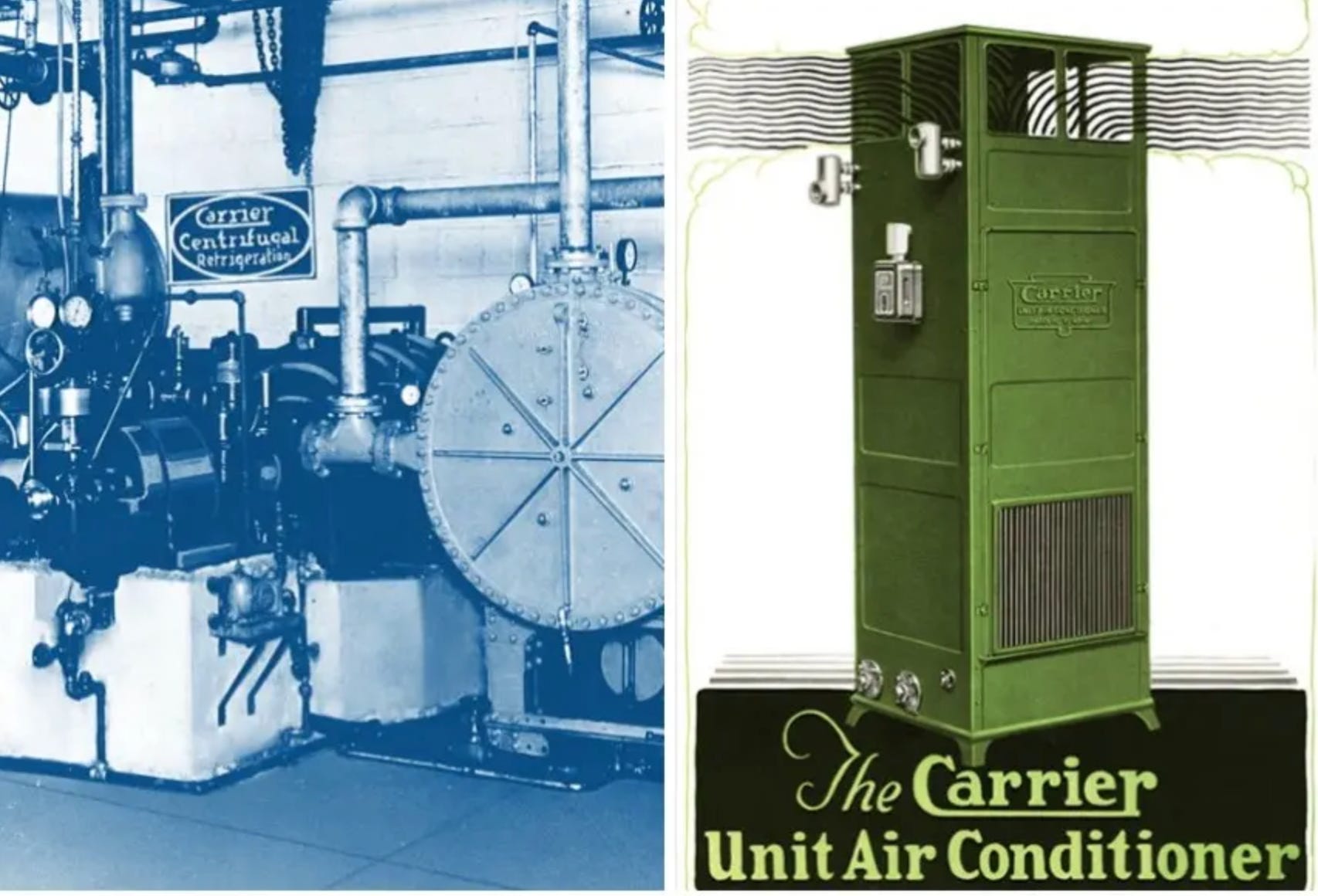
Modern air conditioning began as an industrial technology. In 1902, Willis Carrier designed a system for a printing plant in Brooklyn that used cooling coils to control both temperature and humidity. The original purpose was not worker comfort. Changes in humidity were causing paper to expand and contract, interfering with the printing process.
Similar systems soon found applications in factories where temperature and humidity affected production. Textile mills, tobacco processors, pharmaceutical plants, and other manufacturers discovered that controlling the indoor environment could improve production processes and product quality.
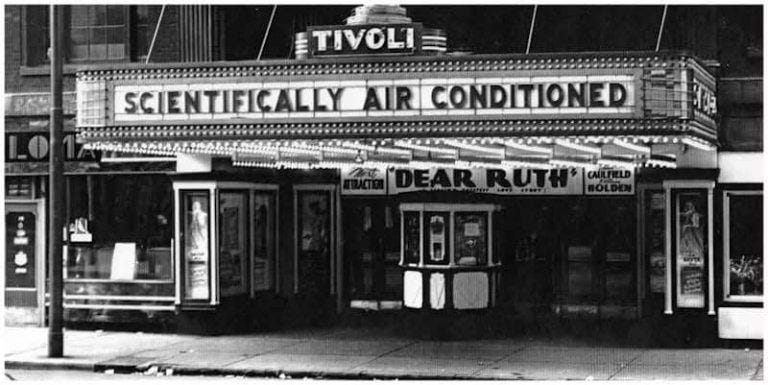
Air conditioning gradually entered public spaces. During the 1920s, department stores and movie theaters began installing large cooling systems. Movie theaters discovered that “refrigerated air” could itself attract customers during hot summers. Going to the movies offered something few Americans could obtain at home: several hours in a comfortably cool room.
Residential air conditioning initially remained expensive. Window air conditioners began appearing before World War II, but mass adoption came later. In 1947, about 43,000 room air conditioners were sold in the United States. By 1953, annual sales had risen above one million.
Central air conditioning spread alongside the postwar construction boom. Builders could design houses around ducts that distributed cooled air from a central unit. Improved compressors, electric motors, thermostats, insulation, and standardized HVAC equipment steadily reduced the cost of maintaining comfortable indoor temperatures.
Commercial architecture changed as well. By the 1950s and 1960s, central HVAC systems made it practical to construct deep office buildings in which many workers were far from an open window. Enclosed shopping malls similarly depended on mechanical climate control to maintain comfortable conditions across enormous interior spaces.
Heat pumps eventually extended the technology further by allowing the same basic system to move heat in either direction, cooling buildings during summer and heating them during winter.

Air conditioning created a large skilled trade devoted to installing and maintaining increasingly complicated HVAC systems. Technicians needed knowledge of compressors, refrigerants, electrical systems, thermostats, airflow, and mechanical controls.
Ductwork created demand for sheet-metal fabrication and installation. A central air-conditioning system depended not simply on producing cold air but on distributing it efficiently throughout a building. Poorly designed ducts could produce uncomfortable rooms while wasting large amounts of energy.
Architects and engineers also had to learn to design buildings around mechanical climate control. Heating and cooling loads had to be calculated according to building size, insulation, windows, occupancy, equipment, and local climate.
Large commercial buildings required another level of expertise. Building engineers operated central cooling plants, maintained pumps and air-handling equipment, balanced ventilation systems, and monitored temperatures throughout offices, hospitals, hotels, schools, and shopping centers.
Residential HVAC contractors brought these skills into millions of American homes. Installing and servicing an air conditioner became a specialized trade practiced by local businesses across the country.

Air conditioning became a mass technology because an entire industry developed around it. Manufacturers such as Carrier, Trane, and Lennox produced increasingly standardized equipment, while construction companies and HVAC contractors incorporated that equipment into new buildings. Electric utilities supplied the enormous quantities of electricity required to operate it.
Commercial organizations became some of the most important adopters. Department stores and movie theaters had demonstrated the attraction of cooled interiors before World War II. After the war, hotels, office buildings, hospitals, schools, restaurants, and shopping centers increasingly treated air conditioning as a normal feature rather than a luxury.
Homebuilders played an especially important role during the postwar housing boom. In 1960, only about 12 percent of American households had air conditioning. By 1980, more than half did. By the early twenty-first century, close to 90 percent of American households had some form of air conditioning.
This expansion had particularly large consequences in the Sun Belt.
Phoenix grew from about 107,000 residents in 1950 to 790,000 in 1980.
Houston increased from about 596,000 to 1.6 million over the same period.
Las Vegas grew from about 24,000 residents to 165,000.
Air conditioning was not the only reason for this growth, but it removed one of the major disadvantages of living and working in extremely hot climates.
Businesses could operate air-conditioned factories, offices, stores, and hotels through the hottest months of the year. Developers could build enormous enclosed shopping malls and office complexes without relying on natural ventilation. Millions of households could maintain comfortable indoor temperatures despite summer heat outside.
By turning indoor temperature into something that could be controlled almost independently of outdoor climate, air conditioning removed an environmental constraint that had shaped human settlement and economic activity throughout history.

The ability to produce cold is one of those technological achievements that becomes almost invisible once it succeeds. Most Americans rarely think about the machinery that keeps milk cold, freezes food, cools a supermarket, or maintains a comfortable bedroom on a hot summer night. We notice these systems mainly when they stop working.
Yet humanity spent most of its history without them. People first exploited naturally cool caves, water, soil, shade, and evaporation. They then learned to harvest winter ice and preserve it through the summer. Mechanical refrigeration made it possible to manufacture cold, while electric refrigerators brought that capability into ordinary homes. Air conditioning finally allowed people to control the temperature of entire buildings.
None of these transformations depended on inventions alone. Each required people with the skills to build, operate, repair, and improve new technologies. Each also required organizations capable of producing equipment, training workers, supplying energy, transporting food, maintaining machinery, and delivering cooling to millions of customers.
The results extend far beyond personal comfort. Cooling has made food safer, reduced spoilage, expanded the variety of foods people can eat, increased productivity during hot weather, and protected millions of people from dangerous heat. It has also allowed farms and businesses to specialize for distant markets and helped make large modern cities practical in some of the world’s hottest climates.
The next time you walk into an air-conditioned room on a sweltering summer day or open a refrigerator filled with fresh food, it is worth appreciating what made that simple act possible. Billions of people now enjoy capabilities that even the wealthiest people in history could not reliably obtain. They are the accumulated product of generations of technological innovation, specialized skills, and organizations that learned how to put those innovations to work.
Oscar Edward Anderson, Refrigeration in America: A History of a New Technology and Its Impact
Jonathan Rees, Refrigeration Nation: A History of Ice, Appliances, and Enterprise in America
Jonathan Rees, Before the Refrigerator: How We Used to Get Ice
Gail Cooper, Air-Conditioning America: Engineers and the Controlled Environment, 1900–1960
Salvatore Basile, Cool: How Air Conditioning Changed Everything
If you’ve been enjoying these essays but only follow me here, you’re not getting them by email. Followers see Notes; subscribers receive every new piece on the history and future of progress.
Subscribe free here 👉:
See also my other articles on:
Technological Innovation (the series)
·
January 18, 2025
Technology matters, but it’s not enough. This guide gathers my best work on innovation and how it combines with skills, organizations, and energy to produce progress.
If you enjoyed this article, you should read my From Poverty to Progress book series.
Comments
Nothing yet. Say the first thing.
Sign in to join the conversation.