
This week, writer and model Emily Ratajkowski wrote an essay for The Cut titled “Sex As a Single Mom”. She describes going from being a “good girl”, which meant trying not to have too much sex, to a “praying mantis” maneater.
The photo accompanying the article, showing her smoldering while breastfeeding a fake baby, has sparked fierce debate online.
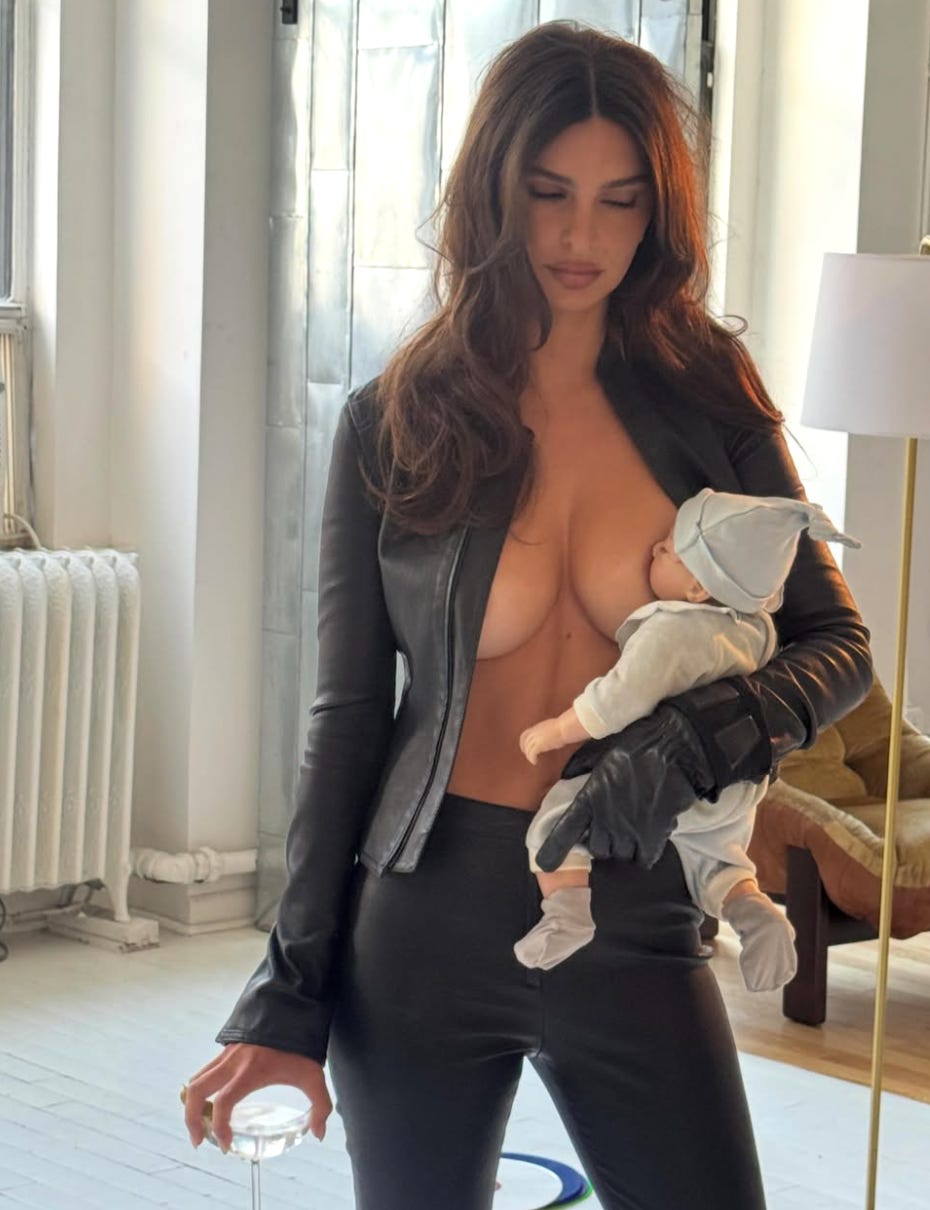
The comments say the photo is “genuinely disturbing”, “uncomfortable”, and ask “why are we sexualizing breastfeeding?”. Some have said it’s so “disgusting” that it could not be considered art.
The purpose of art is not always to elicit positive emotions. If our reaction to art is powerful, especially on a large scale, then perhaps we can admit the art is also powerful.
Maybe I’ve seen too many goddess figurines to bat an eye at someone breastfeeding a baby looking “sexy,” but like what’s the big fucking deal? If she were hunched over, looking exhausted, would that be more palatable? Should every depiction of a breastfeeding mother be shrouded in a Virgin Mary-esque halo of selfless nurturing? Are we regressing so hard as a society that we cannot accept “mother” and “sexual being” in the same frame?
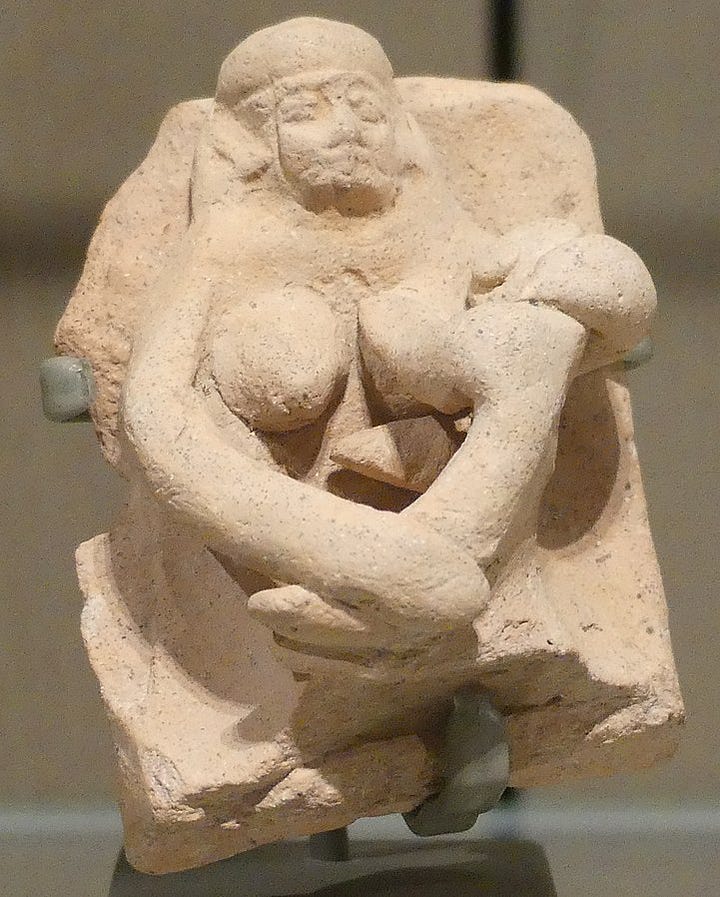
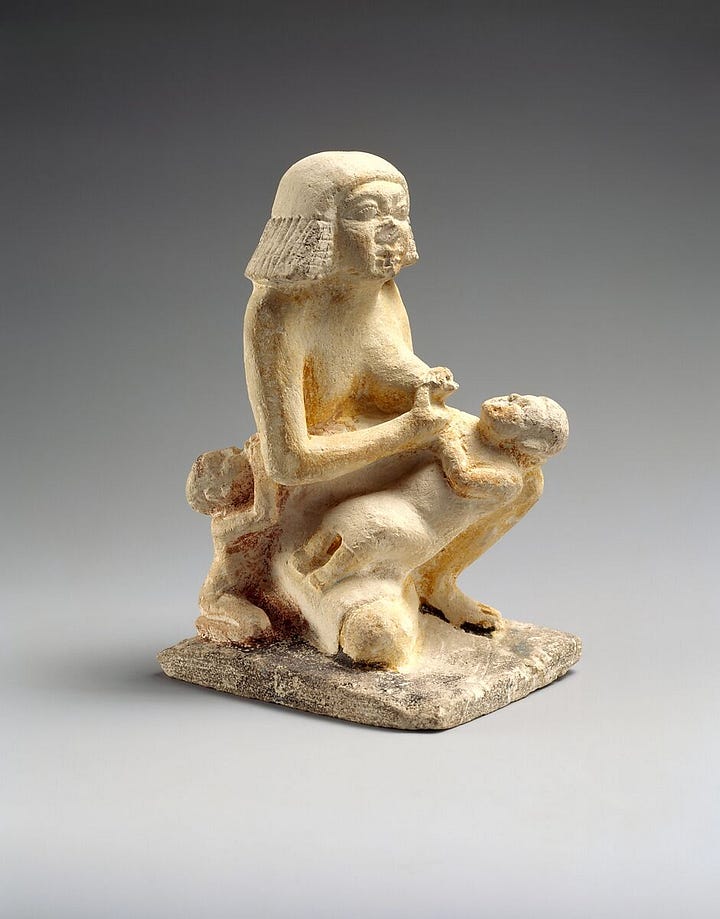
I am fascinated by the cultural conditions that made this piece possible and the public reaction so intense.
Emily Ratajkowski, or EmRata, has built her career within a purely patriarchal framework. She has openly admitted to using her body and her beauty as a commodity to earn as much money as she could. It’s the central thesis in her 2021 book My Body.
Her writing and way of life are very clearly not a struggle to break free from patriarchy. She gains enough rewards from the system that she is actually trapped in it. You can sense this in her writing: it has a resigned quality, like she’s accepted her lot in life.
In her piece for The Cut, she describes being in her “villain” era post-divorce, purposely wanting to have sex with a lot of guys. But by the end, there is no resolution. She objectifies herself, and she derives only a fleeting kick of power from it.
She tells us how one guy said she looked like Cleopatra while she was going down on him. Cleopatra, a powerful strategist and monarch, a woman who survived multiple exiles, sieges, civil wars, and assassinations, reduced to a common male sexual fantasy. It’s telling that she included this anecdote, though she didn’t share how she felt about it.
This is someone who, by all accounts, has everything a patriarchal system could offer a woman. Beauty, wealth, status. We’re told that these things will give us long-lasting satisfaction and even liberation. But any power we may gain is ultimately an illusion because these forms of power are contingent on others, and on the system itself. They can also be lost easily.
There has been a lot of discourse around whether Emily’s writing qualifies as feminist or a danger to the feminist cause. I don’t think it’s either. Her expression is a route for us to examine ourselves and the society we have accepted as normal. The collective’s reactions to her are a lens through which to view our culture.
Objectively speaking, EmRata is practically the pinnacle of the patriarchal hierarchy of woman, and even she is beholden to the system, worried about whether or not men will find her attractive after motherhood, policing herself out of and into her desire.
I can sense that her desire does not come from a sovereign place. Because this culture does not want sexual sovereignty in women, and especially not in mothers, single or partnered.

In Emily’s story, I recognize my own, but inverted. Before motherhood, I absolutely loved dating. I was like catnip to men, and I enjoyed it. But when my daughter was born, I lost my desire for a long time, and have only been with one man since my breakup over a year ago. If you’re family and reading this, you might want to stop now.
When we started kissing, I hadn’t yet told him I was a mother. I broke him the news when he found his way to my breasts, and though he paused to ask a few questions, he didn’t seem bothered at all. If anything, he was more excited. My milk would spray at certain points, and he said later that he liked it.
The few times I was up for sex with my ex, he avoided my breasts completely. It was like he had split my body up into fragments. My breasts were the Madonna, off limits. My vulva was the whore.
When our daughter was six months old, he discarded the fragments of me and sought to fuck someone else in secret.
The collective reaction to the cover image of the article echoed my ex’s rejection of my milky breasts. As a still-breastfeeding mother, I struggle to empathize with the public disgust and outrage.
Breastfeeding is the hardest and most rewarding activity (is it an activity?) I’ve ever done. It’s my daughter’s nourishment, her safe space. It’s how we connect in a quiet way, how we relax together. At times I admit I feel I am being sucked dry, and I am, in so many ways, because like all mothers under patriarchy, I have been largely abandoned by society.
I am still a person, and I still want to feel sexy and be sexual. It’s been one year and two months since the last time I was held and touched tenderly. My desire is fully intact, but there is no room for play in my life.
Before motherhood, I played the purely receptive “feminine” role I was told by the culture that women needed to be. Men would approach me, and I would bask in their validation. Now, with the responsibilities of single motherhood and an independent writing career, I don’t have the privilege of endless time to socialize or sit at a cocktail bar to wait for a man. To increase my chances of meeting someone, I’ve had to be a bit of a hunter.
I notice since stepping into this role, I feel a compulsion to keep my desire hidden, especially if it’s not immediately reciprocated. A couple of weeks ago, I approached a guy in the library who told me he already had a girlfriend. I felt a huge sense of shame walking away, even though it was nothing personal, just a logistical mismatch.
Patriarchal culture had conditioned me to be a still, receptive container for someone else to pour their desire into. Never to be my own source, never to openly want or yearn. But if my desire only hinges on someone else wanting me back, then how much power do I really have?
When the searing shame eventually burned away, I felt free. Because the story was more complex than I approached a guy and he had a girlfriend. It was that I was connected enough to my own source to honor the need I had. I don’t want to “survive” single motherhood like an exhausted warrior. I want to feel the electricity of connection and the satisfaction of sacred pleasure.
We are still incredibly deep in sexual shame culture, and we have a long way to go. Through this lens, EmRata’s piece reads incredibly honest. Are her choices wise and nourishing? That’s for her to judge. But given how deeply women, let alone mothers, are shamed for sexual desire, it’s refreshing to hear a single mother tell the unvarnished truth about her sexuality.
For our ancestors, a “single mother” did not even exist. Most human mothers and their children would stay in their maternal family for their whole lives. Only since patriarchy’s global takeover 6,000 years ago has it become normalized for women to leave their families to start another with a man.
For a patriarchal system to work, liberated female sexual desire has to be suppressed. Patriarchy started as a system of patrilineal inheritance, which means female sexuality had to be guarded fiercely. Before blood tests, only the mother truly knew who the father of her child was.
In a society that does not need to determine the paternity of a child, a woman can have endless lovers if she so chooses. Though the original reason for suppressing female sexuality has become irrelevant, it is now deeply culturally embedded.
We have to examine and abandon these patriarchal beliefs if we are going to dismantle patriarchy. The EmRata piece proves that patriarchy offers zero real power to women, even if you’re at the top of the hierarchy. This is why it is so urgent that we spread the knowledge of matriarchy to women everywhere.
So many of us are still caught up in trying to win within the patriarchal system: become prettier, richer, skinnier, so that we can have some shred of power and dignity. But the game is rigged. You can never truly feel powerful when you play by patriarchy’s rules.
The power that matriarchal living offers can never be taken away. It’s derived from your connection to life itself. From caring for yourself like you would a garden. From connecting with others in trust and vulnerability. From immersing yourself in the pleasure life offers, sexual or otherwise. From alchemizing death into rebirth.
I have been determined to learn all I can about this system, to practice it every day as best I can, to be a healthy root system for my daughter. I have discovered power in the most unexpected places, the very places patriarchy told me I had none.
My sensitivity gives me the power of discernment. My compassion gives me the power of connection. My vulnerabilities give me the power to set boundaries. My spiritual intimacy with all forms and ingredients of life gives me access to wisdom and abundance beyond the confines of patriarchy.
The wider culture has yet to catch up. In reaction to EmRata’s piece, the New York Post published the perspective of another single mom. The writer’s overarching message is that self-sacrifice as a mother is a virtue, and that “the goal isn’t to fill your cup with more men, but to build an unbreakable bond with your child, and hopefully raise one who ends up just a little better off than you were”.
This seems to imply that having sex with a man competes with the bond you can create with your child. That wanting to have sex as a mother might make you a “selfish mom”, which is practically a slur at this point.
I have regularly been shell-shocked by the interactions I have had since becoming a mother. Specifically, the sudden entitlement people feel to judge my choices, to determine what I should or should not be doing.
This is part of a wider patriarchal control tactic of condensing the role of mother into the body of one person. When you study and understand matriarchal societies, you know that the person who created the child in their womb is one part of the tapestry of “mother”. The aunties and uncles are mother, the Earth is mother. When the role of mother is spread out, biological mothers are free to be humans with needs.
In comparison, patriarchal culture is incredibly punishing of mothers. The consensus seems to be that because I had sex and “let a man” come inside me, I have to deal with a lifetime of disproportionate, endless caregiving, and obey societal expectations that say I should endure this all quietly and preferably with a smile. I should leave everything that made me a unique individual behind, and serve the patriarchal mother archetype: pure, receptive, self-sacrificing. I hope you’ll join me in a resounding FUCK that.
We continually set mothers up to fail, and this is on purpose to diminish their power. The rich single mom exercising her sexual agency is relentlessly shamed. The self-sacrificing single mom who follows all the rules can only hope for a better life for her child. She is publicly celebrated, but at the cost of her sovereignty and human needs. These cannot be (and thankfully are not) the only two available choices.
Last year, I wrote an essay titled “You’re not a single mother, you’re a matriarch”. The language we use perpetuates the idea that single mothers are failures, that a mother without a man is somehow lacking. It’s part of a wider societal policing mechanism that keeps male domination intact. The idea that we’re “too sexual”, or that it’s morally superior to sacrifice ourselves in favor of our children are all included in this script.
In reality, single mothers, when connected to their inner power and fully supported and resourced, can be matriarchal leaders.
As a thought experiment, I think about what would happen if the three of us - EmRata, the New York Post writer, and me, all single mothers with small children - teamed up and created our own little matriarchal family.
I imagine that Emily, with her wealth, could get us a nice cottage an hour’s commute from NYC. We could take turns watching each other’s children, who would come to see the other two women as mother figures. We could start a permaculture garden in the backyard, where we could share evenings talking and hosting guests. We could share harvests with our neighbors, who would be an extended village. The children could have each other to play with rather than staring at screens or being overscheduled with activities. We would have the time to connect and create a shared container of trust and self-exploration.
It’s this one tiny switch: seeing the possibility of creating family with each other, rather than with one man. This is the power of matriarchy: it opens up an entirely new array of possibilities rather than the rigid scripts society hands us.
The piece and its reactions prove that we are at a hinge point in our culture. Until recently, it seemed like liberation movements would continue linearly. The intersectional feminist, queer, and sexual liberation movements of the late 20th century pushed the boundaries, but the patriarchal system persists. It does not have a container to hold and nurture the growth of these shifts into society. It does only what a society based on domination logic does: conquer and consume. We are breaching the very lines that will dismantle patriarchal logic, and the system (meaning those most deeply conditioned by it) is responding as such.
There is another way. There is another container that can easily hold “mother” and “sexual being” in the same body. I know because I have been living according to the worldview of this system already. It does not require me to self-sacrifice to be considered worthy. It does not require me to gain any kind of validation from a man, institutionally or romantically.
It is matriarchy, and it’s time to create it now.
Thanks for reading From a Young Matriarch! This post is public. Feel free to share it so we can spread the knowledge of matriarchy.
No posts
Comments
Nothing yet. Say the first thing.
Sign in to join the conversation.