
Soon after we arrived on vacation in Hilton Head last Saturday, Harriet and Bea and I went to find a charging station for the Ioniq. There was a free station (but occupied) at a local park, so as I wrote a note to the owner of the car that was currently charging (people will usually text you when they’re done), Harriet busied herself arranging bark, flower petals, leaves, and Spanish moss in a rosemary bush:
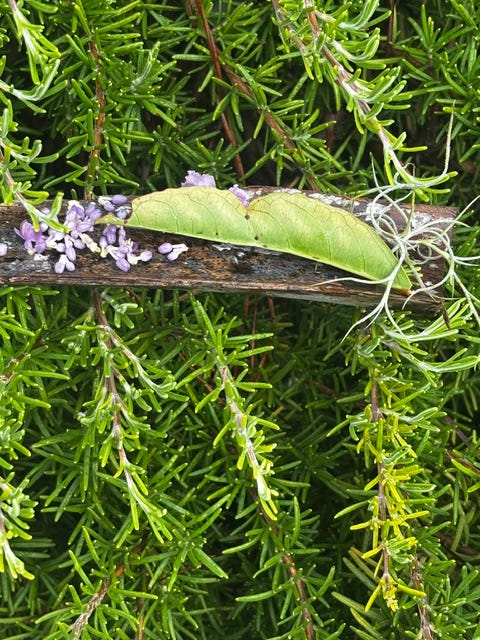
“It’s a fairy reading nook,” she explained. All week, she and her cousin and BFF left fairy nooks and houses all over the island:
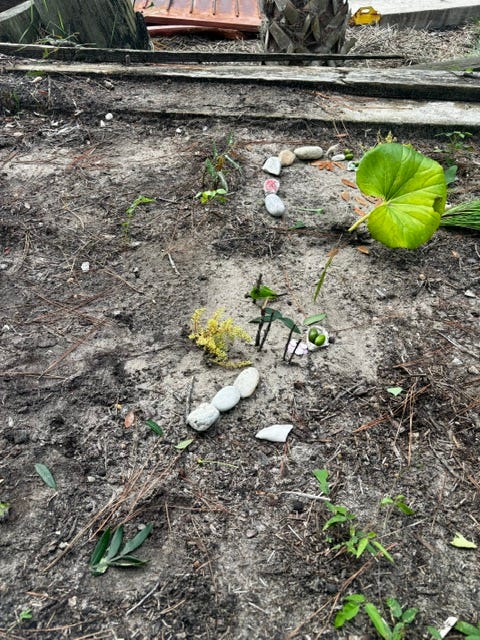
I love watching kids make fairy houses—the concentration and creativity, the exclusion of the rest of the world. The belief, wholehearted or hopeful, that fairies will arrive and dance and eat and sleep and read and take baths.
At Clapping Hands Farm, a counselor and expert crafter named Jupiter often helps in the fairy forest. How do you help in the fairy forest? Harriet told me that another camper, a boy, liked to tell her and her friends that fairies weren’t real. “He said he was going to go home and Google are fairies real,” she said. “And I told him, Google isn’t real.” (Harriet believes that things that live only on screens and devices are not real in the same way that sticks and leaves and rosemary bushes are real.)
Their difference of opinion could have devolved into arguing or fighting or tears, but Jupiter kindly but firmly intervened. “You can’t be here if you’re going to say that,” Harriet remembers her telling the boy. I imagine she redirected him to some other activity—on the farm, there are so many things to do and places to do them! Did he leave? I asked Harriet. Of course! she said, surprised that I would imagine anyone disobeying Jupiter.
I am not sure how old Jupiter is—teenager? college-age?—but I can see her becoming a teacher, professionally. She’s a teacher now, of course, by being a camp counselor. But her creativity, talent, and calm intelligence would be welcome in many kinds of public school classrooms.
Tomorrow, many teachers will return to their classrooms to clean and organize and write lessons and meet with colleagues and prepare for the new school year. It’s always been an arduous week, but usually filled with the kind of hope and creativity that animates the construction of a fairy forest. It is the creation of a protected space, even a sacred space, for the teacher and her students.
This year, at least in North Carolina, teachers are returning to their work with a new set of laws around our work. At my university, we received an infographic (below) that confusingly outlines what counts as a “divisive concept.” “Divisive concepts” connected to diversity, equity, and inclusion are prohibited.
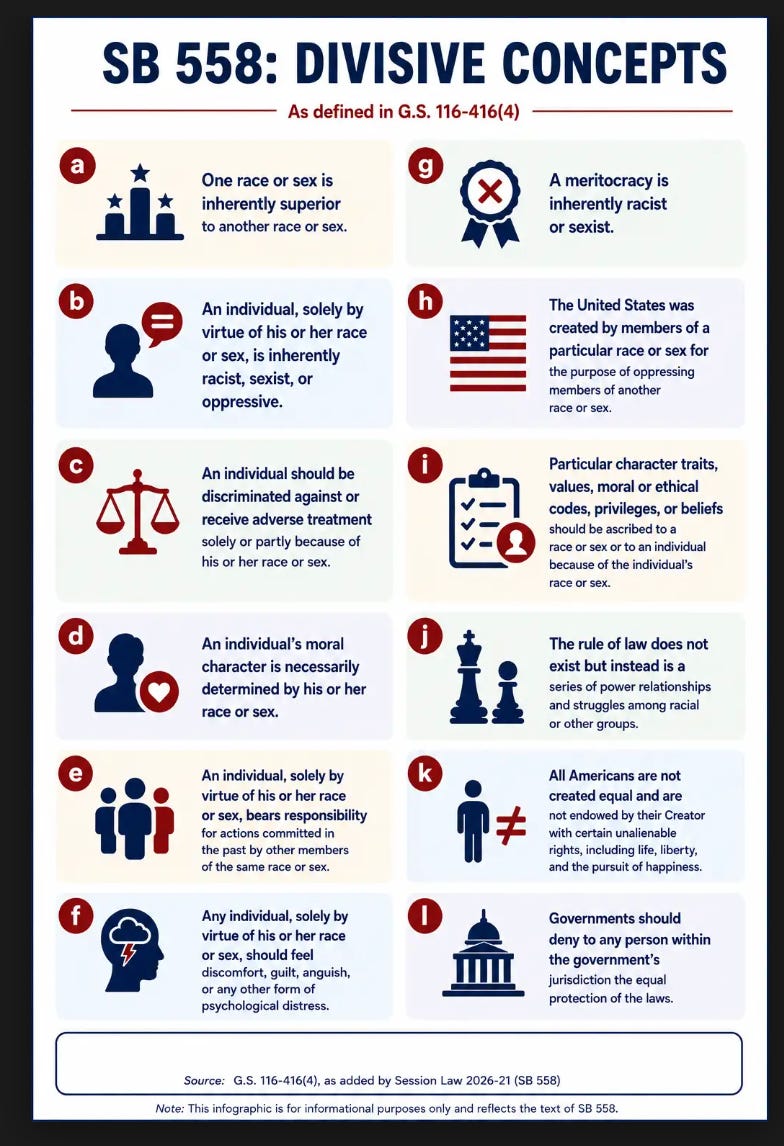
In all my years of teaching, I’ve never heard a teacher tell a classroom that one sex or race was superior, or maintain that anyone should be discriminated against because of sex or race.
I have heard, instead, teachers work hard to protect children being bullied—for their race or sex, for their beliefs, for the clothes they wear or don’t wear, for the places they come from. It might mean protecting a trans student so she can learn without harassment or self-loathing. It might mean protecting a Muslim student’s right to excuse himself to pray. Or, as they do at Clapping Hands Farm, asking a class on a child’s birthday, “How many languages do we know for singing Happy Birthday?” and then allowing each language-speaker to lead the singing.
This protection falls apart when teachers—many so underpaid that they work second jobs—believe that they are being scrutinized for the promotion of a divisive concept like “diversity,” “inclusion,” “equity,” and even “belonging.” When they fear that they can be fired if someone records them standing up for a child’s rights, or their own right, to exist in the same space as a child from a dominant culture. When they are second-guessed for the books in their classroom, or the routines they maintain, or the discussions they lead or allow.
This week, my own second-year graduate students, who make $20,000 a year to teach writing to undergraduates (more than $2000 in student fees are deducted from their annual pay), were so flummoxed by the chart above that some of them missed the welcome-back party and mocktail hour our department arranged for them.
They recovered later! And read stories, poems, and novel excerpts beautifully and bravely at So and So Books. Many of the excerpts they read would be considered divisive (certainly as direct challenges to the idea of a pure, fair meritocracy). Many of the stories and poems and conversations they will guide students through will challenge their students’ existing ideas because that is what learning is supposed to do—make your world bigger, not smaller.
Tomorrow they will teach, some of them for the first time alone. I know they’ve got this, and I’m going to message them today to tell them. I’m going to message other teachers to tell them thank you, they carved out a safe, protected space and made a difference in my children’s lives. (Thank you, Jen! Thank you, Louise! Thank you, Jupiter!)
Sylvester and I have an event for The Legend of Wyatt Outlaw in Sanford this afternoon, and otherwise the girls and I are swimming, reading, and making things (syllabus for me, fairy house for Harriet, plans to get a dog for Bea).
How about you, Frog Troublers? How are you spending your Sunday? Do you have plans to thank a teacher?
Lots of love from us.
No posts
Comments
Nothing yet. Say the first thing.
Sign in to join the conversation.