
I admit it. I took an instant dislike to Sanae Takaichi when she was named our new PM.
It is less her risible right-wing politics and more that phony grin she cannot seem to erase. I deeply distrust it.
I know I’m being superficial. It’s one of my weak points. But I said to Toru once when PM Takaichi was doing the smirk on an evening news broadcast, “She looks like the Joker. I think it’s the mouth.” To my surprise, he immediately agreed.
“Yes, the Jack Nicholson one!”

Anyway, the other day I was reading the Financial Times and there was a piece reporting that PM Takaichi rebuffs the “advice and guidance” of several Ministries as well as the all-powerful and centenarian-stacked business federation, Keidanren.
The FT explains that Japanese PMs are normally lock step with the old mandarins. They receive marching orders, they play ball, they even kowtow when expected.
I was intrigued. First, it was clear the Very Old Boys themselves were griping to the FT off record that Takaichi and her people weren’t coming to them for thoughts. (Take it from me, Japanese mandarins doing their anonymous grousing to the Financial Times, rather than any number of domestic gazettes, is a true mark of desperation.)
“She doesn’t do late night drinks or even lunches,” one pathetically said.
The FT then went to Takaichi’s people for some off-record reactions. And a comment really stuck with me…so much so I can’t stop thinking about it these past several weeks.
One aide said, “Her attitude comes down to this: if these guys were so brilliant, and in possession of such invaluable advice, why has Japan been such a mess for the past 30 years?”
Fucking ouch.
Tell me you think Keidanren exhausted its last interesting idea in 1961 without telling me you think Keidanren…
I may have found something I like about the new PM. Her uncreative mirroring of Everything Shinzo Abe will always drive me nuts, but yes, I do believe she’s onto something with her dismissal of the crusties’ “input.”
Everyone knows Japanese are insatiable and incurable foodies. Name me another country that can devote an entire neighborhood of the national capital to hand-forged kitchen knives. (The finest forks are in another prefecture entirely.) Or a culture that not only makes, but actually discusses, hour-long TV documentaries on the correct creams to add to soufflés that hark from the Normandy region.
The Japanese have proven time again they can outgun the world’s finest cuisines when they set their obsessive-compulsive minds to it.
But it’s Japanese soul food that I would argue gets not nearly enough applause.
Mind you, I’m not talking about fast food—the Americans will always win that grease battle. Rather, these are the highly tasty dishes and nibbles, largely consisting of few ingredients, that are thrown together by actual chefs, not teenagers. They are delicious and meticulously made, yet lacking in any nutritional value whatsoever.
Think things like karaage (fried chicken so good, so perfectly juicy and crispy, it should condemn Colonel Sanders to 20 years hard labor), or korokke, the Japanese potato or cream-filled croquet.
One rapidly disappearing dish you may have not heard of was born from post WWII deprivation in the early 1950s. Let me introduce Naporitan.
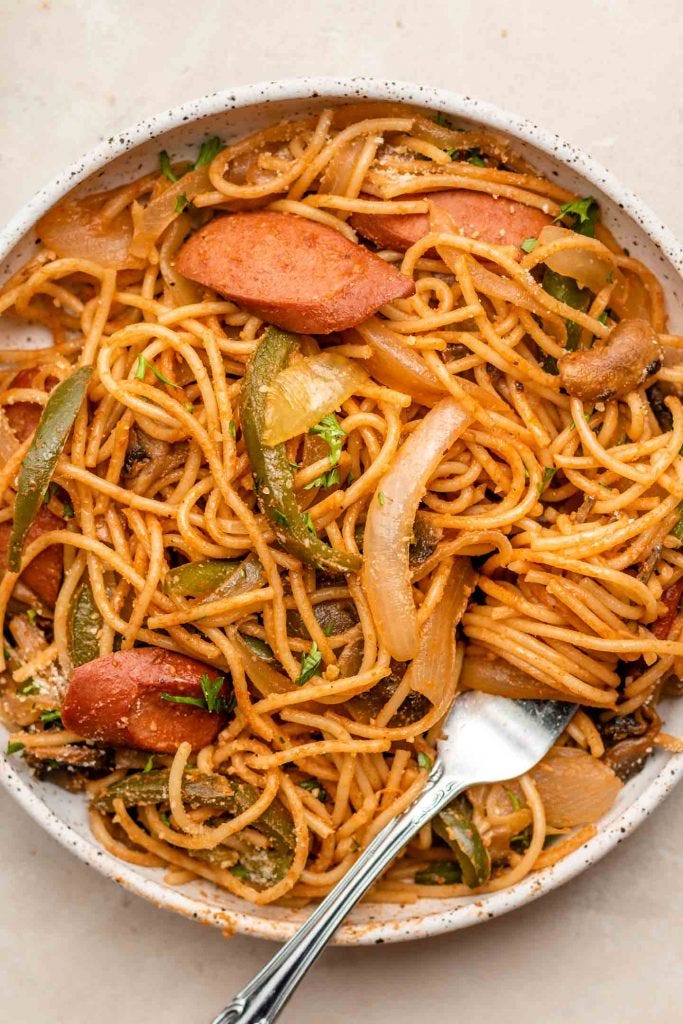
When I got here in the late 1980s, Naporitan was everywhere. Any kissa coffee shop from Hokkaido to Okinawa would have this on the menu. Bars also served it late at night, whipped up fresh for customers about to head for last train. In its heyday, Naporitan even appeared on the menus of top hotels and restaurants.
Naporitan is the Japanese spelling of Napolitan. Yet I assure you any chef in Naples would stroke if he or she knew this was being attributed to their city.
It is an (intentionally) overcooked pile of spaghetti drenched in tomato sauce and garnished typically with green peppers, onions, and “sausage,” which are really chopped up hot dog wieners. A small bottle of Tabasco Sauce is often offered alongside, for those who like a bit of heat with their red pile.
It is tangy, bursting with umami, and surprisingly satisfying.
I first learned how Naporitan was made by watching Kan-san, the 70-year-old master of Iwan Bar on the dark edge of Koenji, whip it up for his customers.
Here’s all you need—a fry pan, a shit ton of margarine, and about five or six hefty squirts of ketchup from a Kagome squeeze bottle.
No need for anything like real tomatoes, slow-cooked sauce, herbs, garlic, or any other…time wasters.
The first time I peeked over that bar counter to watch tiny Kan-san assemble plates of Naporitan in his one burner tin-and-foil kitchen I was appalled. The softball-size clump of margarine, the long squirts of ketchup.
But I could never quit it. The soul was too deep with this one. I ordered Naporitan from him time and time again.
The Grand Hotel in Yokohama says that in about 1952 its head chef invented Naporitan. General MacArthur was staying there, but the kitchen had very few ingredients to work with. The chef grabbed ketchup and over-boiled noodles and never looked back.
Not a dumb man. This was after all an Arkansas-born GI he was cooking for.

I however call a bit of bullshit on this story. Like so much in crazy postwar Japan, the truth likely lies a few layers down, with a number of nobodies left out. Given its ingredients and dead simplicity, it is my guess that Naporitan was born under the train tracks or by a pedestrian bridge somewhere between let’s say Ameyoko and Yurakucho. The real inventor of Naporitan, for me at least, was a hungry soul with not much more than an oily fry pan heated by a stick or two of hard-to-come-by coal.
By the late 1990s, Naporitan was on its way out. Young Japanese had by then dispatched themselves to the kitchens of top Italian and French restaurants the world over and were now returning to Japan with Michelin-level cuisine and wine pairing skills.
You can still today find Naporitan, but it’s confined to yellowed kissa coffee shops somehow still independently run or what the Japanese call youshoku-ya, ostensibly “western food” restaurants which serve nothing actually found in the West.
There are other Japanese creations that have disappeared. Like Pizza Toast (no), neon green Cream Soda (big no), and Cheese Doria (if starving, maybe try). I miss none of them.
I would however to this day plop down some yen to once again try a piping hot plate of Naporitan. Where’s Kan-san when I need him?
Thanks for reading Frog's Glen. Sharing, liking, restacking, and thumbs-upping is caring!
Comments
Nothing yet. Say the first thing.
Sign in to join the conversation.