
The other day I was on a routine visit to the Frog’s Glen hospital to pick up a prescription.
It’s not a small place—there are many old people in the Japanese countryside. I noticed that on the first floor in the back corner our hospital even has a modest Chemotherapy Department.
I had to look twice, but on a sign detailing the various treatments and doctors in residence, there was a “mascot character.” A cheery looking red and blue bear with small floppy ears. He was chubby and cute.
He was skipping and making a peace sign. He seemed happy.
After a few reverse Google image searches, I found that this was not some random cartoon bear used for decoration. I was looking at Japan’s national Cancer Bear.
A cancer bear? Was he saying to these patients, “I’ve got cancer too, let’s get better together,” or “While I don’t have cancer, you do, but buck up Mr. Sato we got this”?
I went hmmmm, put my phone back in my pocket, and started to walk away.
It hit me then—I’ve been in Japan decades too long. I have become used to this incessant mascot stuff. I had just been introduced to a national Cancer Bear that looked like Yogi going on a picnic, and I was going hmmmm and putting my phone back in my pocket.
Then it got worse. A twisted voice in my head—he shows up time to time—whispered:
“He is cute though. I wonder if the gift shop has him in a fridge magnet…”
Japan, can we talk? This really has gone too far. As they say, the first step toward recovery is admitting you have a problem. And you have a deeply unhealthy obsession with “mascot characters.”
Live a week in Japan and it will hit you. The mascot’ing never really stops. We have cute beepity-boop “charas” telling us to fasten our seatbelts, visit Tottori Prefecture, use solar power, eat our peas, drink Chai, file taxes on time, be kind to old people, rat out our neighbors for illegal building extensions, use crosswalks, trust the police, finish our studies, stand to the left…and yeah, now, get chemotherapy.
I’m aware that other societies use mascots too. Berlin must have a racoon or a deer in lederhosen and a felt hat who suggests visiting for Oktoberfest. My own country loves Smokey Bear admonishing us that only we can prevent forest fires. (He never mentions lightning strikes.)
Japan however seems unable to communicate without furries.
You would think that “Drunk Driving is Illegal” is straightforward. It could be written out on a poster. But we have a dizzy looking purple alligator, cocktail glass in hand, who tells us “Drunk Driving is Illegal.”
I’m not a Mascot Hater straight down the line. Some in Japan have grown on me. My favorite has to be Pee-Po. He is the adorable (rodent?) character of the Tokyo Metropolitan Police Department.
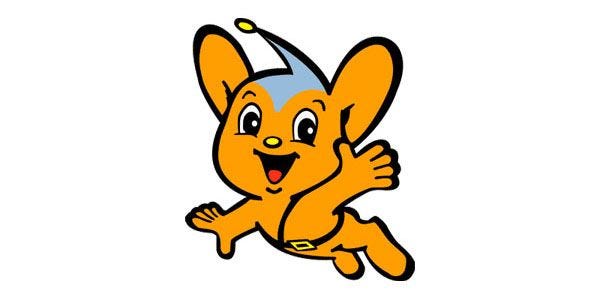
Soon after I arrived here, I inquired to a local who the blue and yellow mouse was. A neighbor said he’s Pee-Po, and he is “the cops.” I thought, now that’s almost refreshing. In America, we think more of swine and the last thing any of our police forces would do is adopt a squee character to encourage obedience.
Pee-Po is everywhere. A decal on people’s living room windows, on their car bumpers, at festivals, in television commercials. Anywhere the cops want to gently remind you that “we exist…and are watching.”
Pee-Po (that’s the onomatopoeic sound of a cop car siren btw) tells us most importantly to respect the law. But he’s also an endorsement stamp. If say a property line is marked “No entrance” and has Pee-Po pointing to the message, we know the police will enforce this demarcation. If a Pee-Po sticker is on someone’s car, we can guess the owner gave a donation to last year’s police station holiday party…and hopes to be let off his next speeding infraction with a verbal warning.
Japanese are no fools. They know that in developing these characters, they need to get the public’s ‘skin in the game’, if you will. So rather than handing down a Renewable Energy green panda from on high, the authorities often hold a contest among school children to develop the next needed mascot.
It’s sweet to get kids involved, but this is also how we have wound up with some true graphic arts monstrosities. Exhibit A would be “Myaku Myaku Chan,” Osaka’s mascot for the just-concluded World Expo.
I’ll just say it. Myaku looks like a rapidly replicating bubonic plague virus.
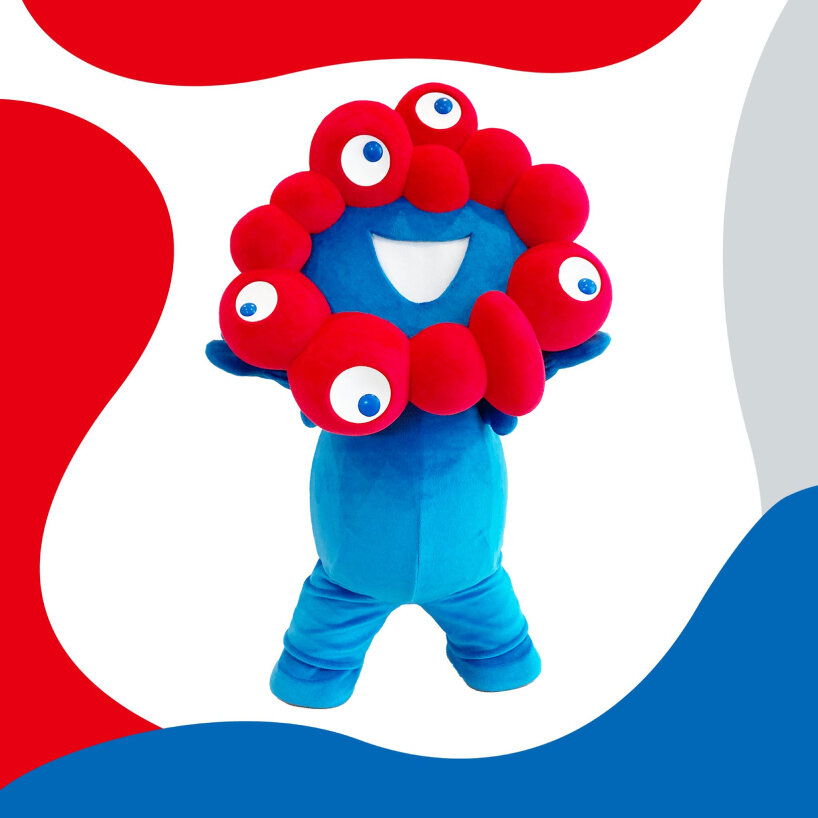
They got thousands of kids’ entries from across the nation— I’m sure plenty of delightful possums, rabbits, and squirrels—but somehow Expo decided to green light Little Miss Bubonic.
And while I predicted its quick demise based purely on ugliness, I was wrong. Myaku Myaku Chan took over the nation. Even with the Expo now months in the past, just last night I saw the Mayor of Osaka on the news still wearing his Myaku lapel pin.
The twistiest figment of some disturbed child’s imagination is now adored by every Japanese on the planet.
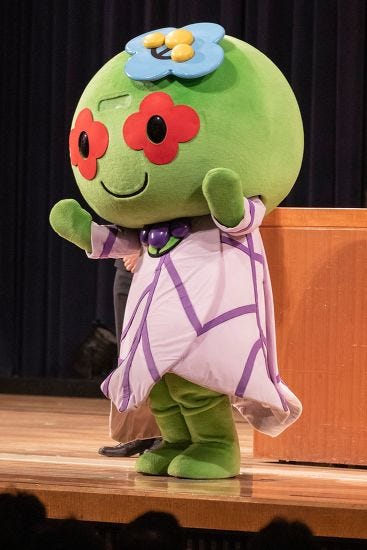
Similar vein. About five years ago, Shibuya-ku, a major ward of Tokyo, unveiled Airissun. We are told she was drawn by a 9-year old (I believe this), represents irises, and that she lives in Yoyogi Park.
She looks like a green girl with, if not a communicable disease, more than a month of sleep deprivation. Yet Shibuya-ku insists on slapping ugly little Airissun on everything.
Look I didn’t set out for this to be a rant. And certainly not a slapdown of everything kawaii and squee about Japan—asking Japan to tone down the cute is like asking Americans to be quiet in elevators. Ain’t gonna happen.
By all means, Pee-Po can stay. At least he aims to instill respect for the law from an early age. Let’s however put down a few guardrails: mascots can promote potato chips and brushing your teeth. But can we leave adult subjects like ratting out your neighbors and filing taxes to words and phrases?
Comments
Nothing yet. Say the first thing.
Sign in to join the conversation.