

New York is a city of beautiful contradictions.
Brutal and generous.
Expensive, impossible, filthy, glamorous, lonely, crowded, and somehow still the place people come to become more themselves.
Keith Haring understood that.
He arrived in New York in 1978 and connected with the streets, the subways, the nights, the people, and the urgency to create.
He let the city mark him, then created a language the world still reads.
We still wear it on our chests, hang it on our walls, and recognize it before we even know the full story.
That is why we still hold Keith up. Not only as an artist, but as proof of what can happen when someone meets New York to infinity.
When they find their people. When they make work for the streets. When they give back to the city instead of only taking from it.
Our Book Salon at Housing Works in Soho, is about gathering around those kinds of New York stories.
The people living and loving the city to the fullest. The artists, writers, night people, and believers who keep adding to its mythology in the now.
In Radiant: The Life and Line of Keith Haring, Brad Gooch brings us closer to Keith’s life, his work, and the downtown scene that made him possible.
On July 21st, we’ll gather at Housing Works to talk about Keith, hear Brad read, buy a signed book, and get closer to the story behind one of the most recognizable artists of our time.
You’ll be supporting a beloved local bookstore and nonprofit whose mission continues the fight for dignity, care, and social justice that Keith Haring believed in too.
Get tickets to the Housing Works x FFNY Book Salon on July 21st.
Thank you for showing up for the stories, the rooms, and the people who keep New York worth believing in.
You can’t entirely get Haring’s work without getting his life and his times.
Brad Gooch, author of Radiant: The Life and Line of Keith Haring
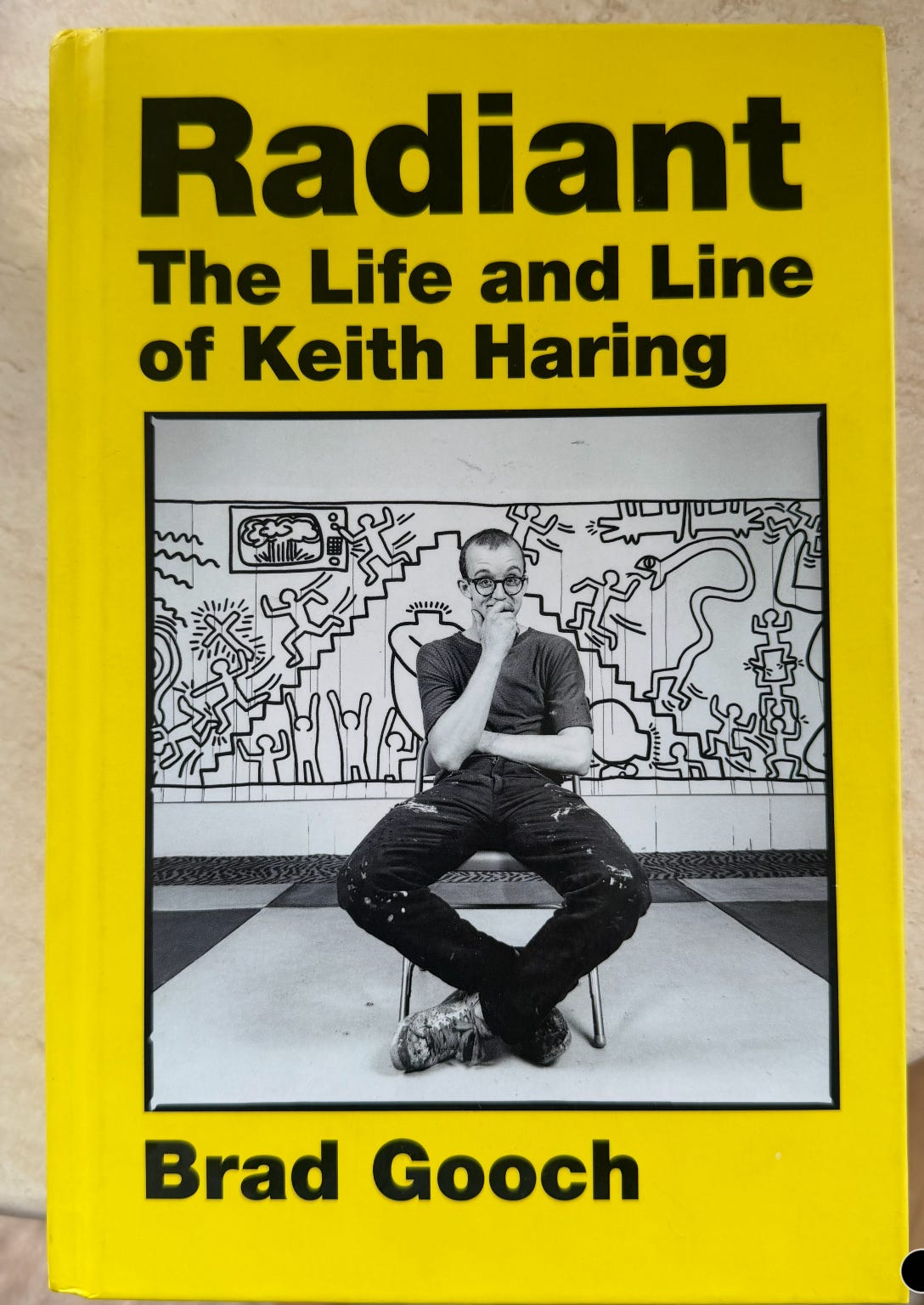
The book is called Radiant: The Life and Line of Keith Haring. What does “radiant” mean to you when you think about Keith?
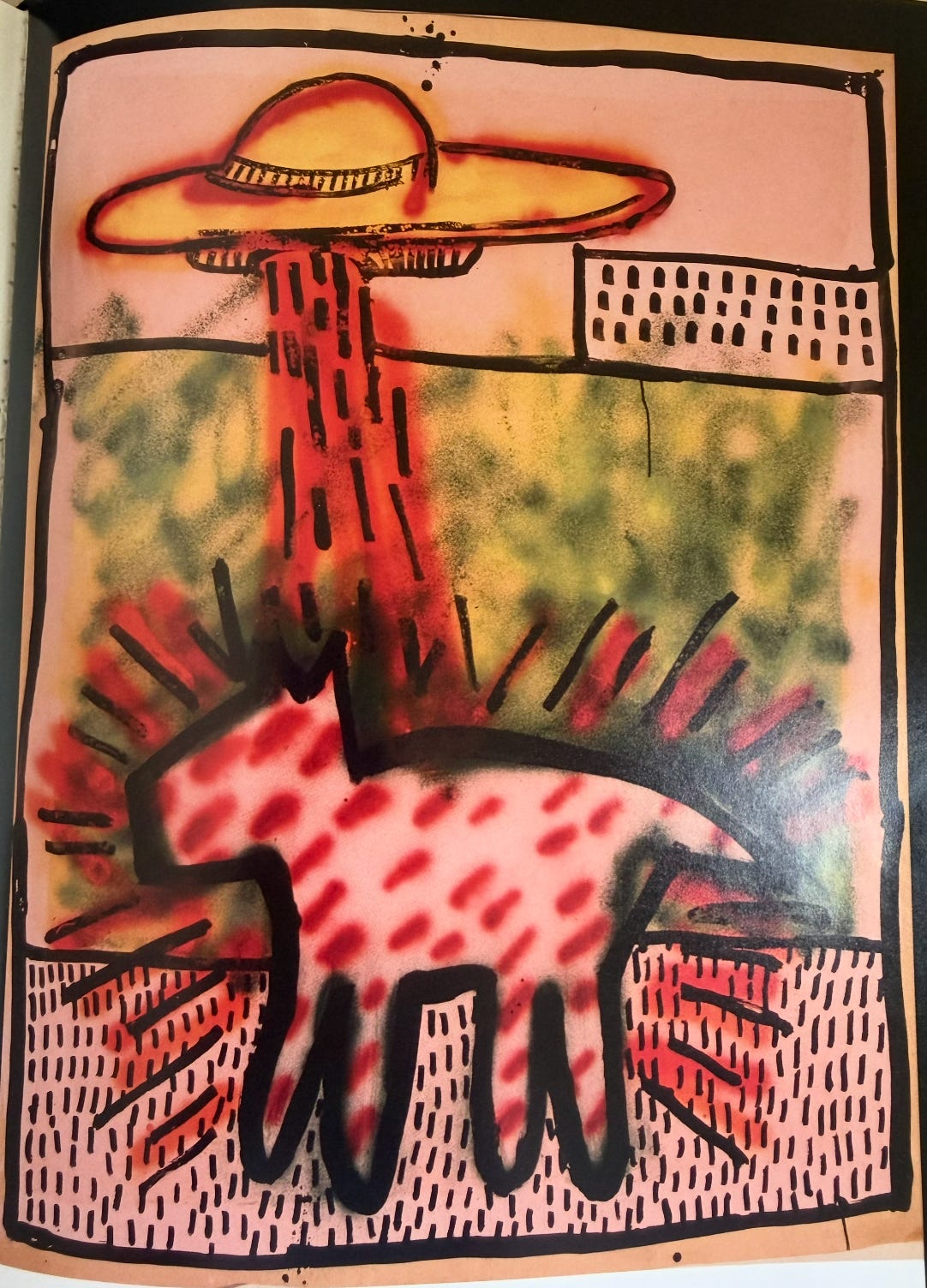
Radiating lines around many of Haring’s figures are a feature of his work, borrowed from comics where they might indicate motion, fright, energy, ecstasy.
His signature crawling baby image usually emanates these rays. Since babies for Haring were the purest symbol of the life force, one critic wrote of his radioactive lines as “the first believable twentieth-century halo.”
In life, too, Haring exhibited a lot of (manic, at times) life force. His doctor told me that during the AIDS crisis Keith would bring a hopeful spirit into a crowded waiting room simply by his personal buoyant energy, his kinetic presence, which, his doctor said, was “radiant, for want of a better word.”
Biographies of artists explore the intersections of art and life. The word “radiant” feels defining in both areas.
Keith’s work is recognized all over the world, even by people who don’t know the full story. Why does his line still speak so directly?
The subtitle of my book is “The Life and Line of Keith Haring.” Its epigraph is his statement, “Your line is your personality.” He was fascinated by Japanese calligraphy and the reflection of artists’ different personalities palpable and visible in their drawings of the same letters and symbols.
Certainly, the Haring line is continuously alive and identifiable. Likewise, his alphabet of recurring images came out of his own imagination.
If the 80s was the age of appropriation in its borrowing and recontextualizing of imagery from popular culture, his own semiotics was mostly personal: the crawling babies, barking dogs, nuclear reactors, demon sperm, flying phalluses, falling angels, ziggurats.
Keith arrived in New York as a young artist still becoming himself. What did the city give him permission to become?
First off, the city gave him permission--or at least more opportunities--to be openly gay. He arrived in New York City to go to the School of Visual Arts in 1978, the glory days of gay liberation that expressed itself in politics, art, and a downtown culture that was heated with sexual experimentation.
At SVA, Haring was at first obsessively making penis drawings as a way, in part, to come out to (and shock) fellow art students. As the poet John Giorno told me, Keith used gay content at a time when being an openly gay artist was “the kiss of death.” His gay identity and exploding art evolved in tandem.
Keith absorbed the subway, clubs, graffiti, music, friendship, activism, and street life around him. How did those worlds enter the work?
Keith came to New York when graffiti art was at a high pitch of excellence.
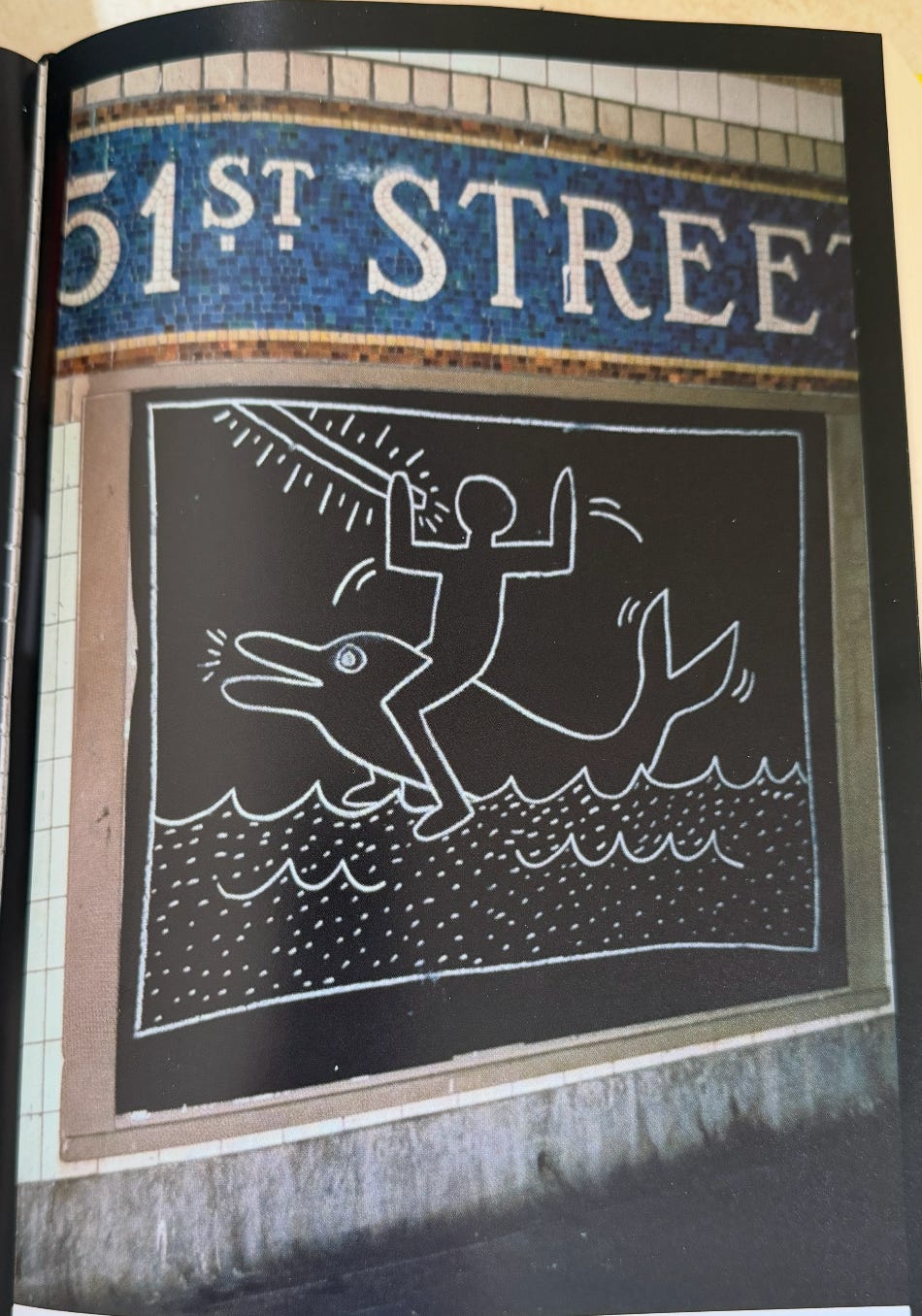
In fine wine terms, 1978 was “a very good year.” In his first months, he would go down into the subways, not to catch a train, but to sit on a bench as if at an art gallery and watch the graffiti-covered trains go by.
He would eventually turn that inspiration into his project of making thousands of chalk drawings over five years on vacant black ad panels in subway stations that could be seen by anyone taking a train, one of the largest public art projects ever executed.
He was likewise excited by the street art of Basquiat and Jenny Holzer; by breakdancing; and by curating art shows featuring his friends at Club 57 or The Mudd Club.
Perhaps no better caption exists for Haring’s entire art career than his dedication to creating “Art for Everybody.” Public street art and artivism in the 80s was just that.
Keith’s images are known everywhere, but the life behind them is tied to a very specific New York moment. Why is it important to know the life behind the art?
Keith was never a classic studio artist. As his dealer Tony Shafrazi said to me, “Keith was a sponge.” He would paint with his boom box playing cassettes of hip hop music. He made sculptures inspired by the flips and backbends of breakdancers.
He was always sending political messages in his work from his early protest drawings around nuclear disarmament, environmentalism, and apartheid, through to his later “Silence = Death” canvases in support of ACT UP.
He was ever collaborating with his community of friends, such as Madonna, Fab 5 Fred, Jean-Michel Basquiat, Kenny Scharf.
Hung now in museums worldwide, his art remains both an 80s’ time capsule and freshly contemporary.
You’ve written about so many remarkable lives. What keeps drawing you back to biography, and how do you know when a story is one you need to follow?
When I wrote my first biography, “City Poet,” I kept telling interested publishers that I wasn’t interested in becoming a biographer, I just wanted to write this book about Frank O’Hara.
Yet I became seduced by the genre, as it brought together so many aspects of writing: the telling of a life-to-death story in the manner of a 19th century novel; lots of revealing facts that we all love in the information age; the poetics of long-form prose.
My one rule has been to only write a biography if I’ve been coming back to a possible subject for a bio portrait for at least a decade. Biographies are too labor-intensive for misfires.
For someone coming to the FFNY Book Salon who knows Keith’s images but not the full story, what do you hope they walk away understanding about him?
When people asked me while I was working on “Radiant” what I’d discovered that I didn’t know, I’d answer, often to disappointed looks: “What a serious artist he was.” Yet I was fascinated to learn how dedicated he was to become an artist from at least fourth grade.
When he arrived in New York City, the perfect meeting of a prepared instrument and a score needing to be played took place.
Haring’s work is universal, yet he is unthinkable outside of a time and place, in the same way as Michelangelo (no status comparison implied) was unthinkable outside the Renaissance.
His daily (and nightly) life on the downtown scene left its mark on his work. Art critic Ingrid Sischy wrote that Keith’s discovery of Paradise Garage was akin to Gaugin discovering Tahiti.
You can’t entirely get Haring’s work without getting his life and his times.
Tickets to Housing Works x FFNY Book Salon
P.S.
Check out the latest podcast episode with our FFNY Hesta Prynn:
Comments
Nothing yet. Say the first thing.
Sign in to join the conversation.