
There’s a Harvard Business Review study from March that’s been sitting with me. Honestly, this study deserves more attention than it’s getting.
Researchers studied 1,488 workers and found that a significant number of them, especially in marketing, were experiencing what the study calls “AI brain fry.” It’s a cognitive exhaustion from using and overseeing too many AI tools at once. The symptom that stuck with me most was a buzzing feeling, a kind of mental fog which stems from work management. One engineer described ending every day “exhausted — not from the work, but from the managing of it.”
That landed for me because I’ve felt it. There have been moments in my work where I’m moving fast between software, references, research, edits, messages, and ideas for hours at a time. Eventually I stop feeling like I’m creatively immersed and start feeling mentally fragmented. It’s less about one task being difficult and more about the accumulation of constant input and context-switching throughout the day. I’ve noticed that when I’m not intentional about slowing down or organizing my focus, that pace can turn into a kind of brain fry.
That distinction matters. We’ve spent years talking about burnout as a consequence of doing too much. What this study points to is something different, a type of fatigue that comes from coordinating too much. From the cognitive overhead of switching between tools, monitoring outputs, second-guessing automations, and staying on top of systems that were supposed to make things easier.
It’s the paradox of the efficiency era. The more we optimize for speed, the more mental bandwidth we spend maintaining the machinery of speed.
The study found something else, though, and this is the part I think about more. Workers who used AI specifically to offload repetitive tasks (meaning not to manage more, but to do less), showed lower burnout than those who didn’t. It wasn’t a language learning model or an AI tool that caused the fatigue. In fact, it was the constant oversight, the task-stacking, and the sense that there’s always another tool to check. Too many tools and too little time contribute to overload.
And to be frank, these tools are helpful but often point the user in too many directions without enough intention behind them.
The antidote isn’t no tools at all or ever. It’s the right tool used with intention. And sometimes, the right tool is completely analog.
This month: Cyanotypes
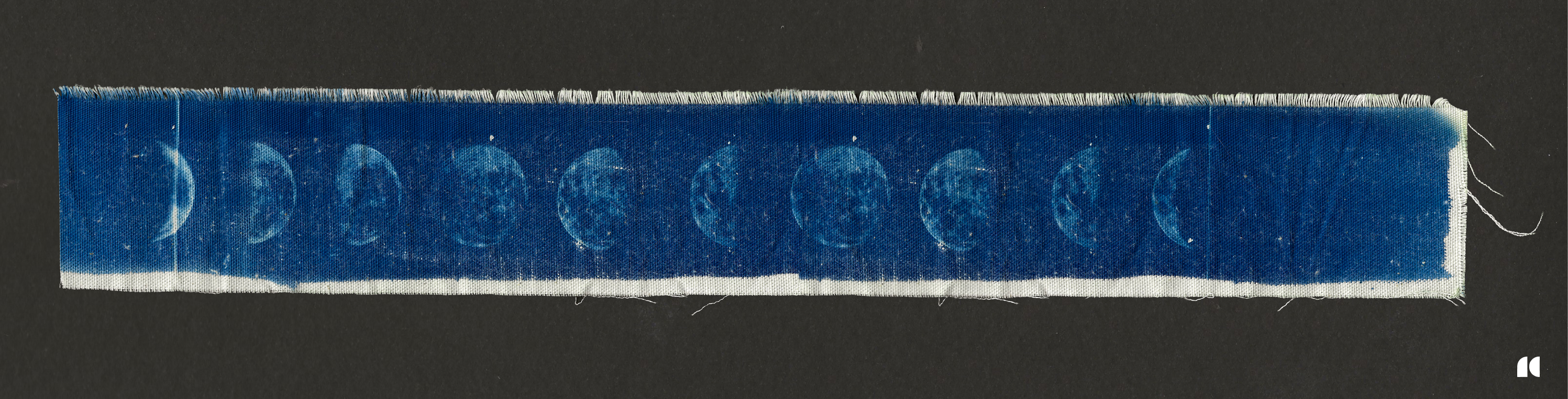
Cyanotype is one of the oldest photographic printing processes, and it’s from the 1840s. You coat a surface with a light-sensitive solution, place an object on top of it, expose it to UV light, and rinse it in water. What emerges is a photogram: the object’s shadow, rendered in Prussian blue.
I’ve been doing this with animations.
I first discovered cyanotypes in college, I think during my junior year. I’ve always loved finding analog methods for image making… anything that allows me to step away from the computer and reconnect with the physical world again. What draws me to cyanotypes is that they’re imperfect by nature. The medium feels delicate and unpredictable. Sometimes my negative shifts during exposure, sometimes the paper smudges, sometimes the image accidentally double exposes. But those imperfections are what make the work feel alive.
Lately, I’ve been experimenting with printed animations, stitching images together frame by frame, and I recently started incorporating cyanotype frames into that process. I’m drawn to the patience the medium requires. Mixing the chemicals, coating the paper, exposing it to light, rinsing it, drying it, and watching the image slowly reveal itself through each stage. It feels less like forcing an outcome and more like collaborating with the material itself.
I’ve also been incorporating more nature-based imagery into the work: rocks, stars, plants, moon phases, textures from the physical world. I think I’ve been craving a return to things in their simplest form. Human beings are naturally responsive creatures. At our core, we listen, observe, feel, and react to the world around us. Life has become increasingly layered with noise, stimulation, and systems, so there’s something grounding about returning to materials and imagery that simply exist as they are.
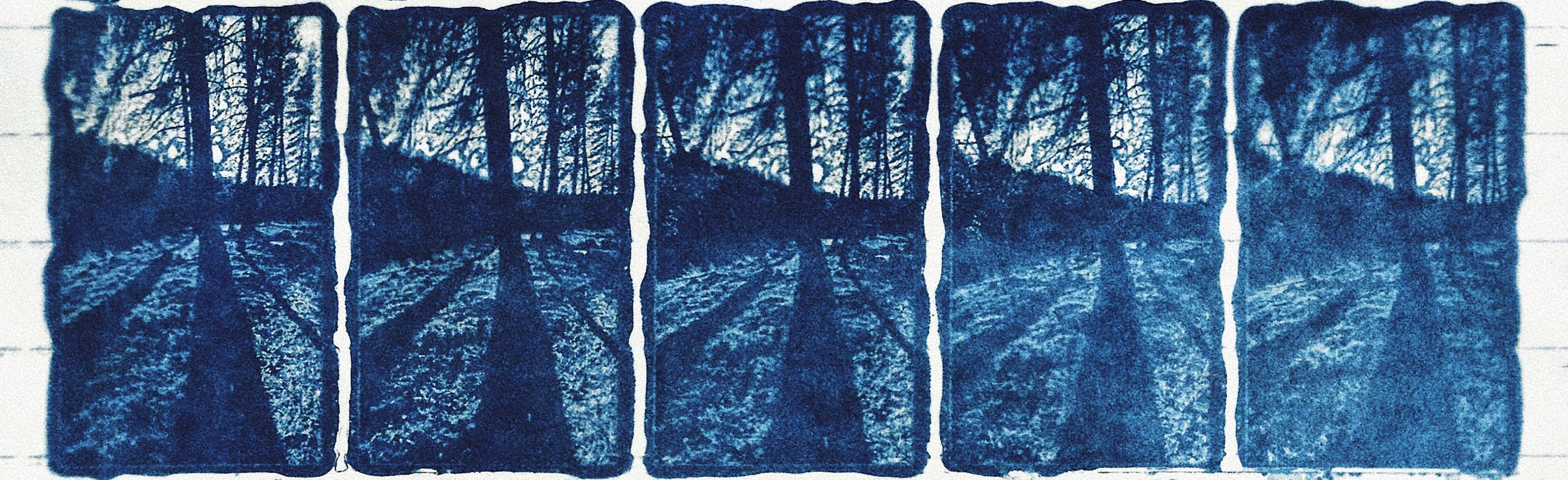
What surprises me most about this practice is that it produces something far deeper than a physical image. It awakens a more instinctual part of my brain, the part that responds intuitively rather than analytically. The work starts to feel less manufactured and more discovered. It starts to tap into something natural and sensory. Not just because of the analog quality of cyanotypes, but because the imagery itself is rooted in nature, texture, light and physical presence.
What it gives me
What I’ve noticed is that when I’m working with cyanotypes, something in my brain quiets. Not in a meditative, zone-out way because I’m still thinking and considering the world around me. But the decisions are simpler. I place the object, then I expose the light, and I wait. It’s a dance.
The process has its own logic and I can’t override it. That constraint is a relief, honestly.
Analog practices engage parts of my brain that digital work simply can’t access in the same way. Working physically with materials activates multiple senses at once: touch, movement, light, timing, texture, and I think there’s something deeply human about that. It reconnects me to a slower and more embodied way of thinking.
I come back with a different kind of clarity. My thinking feels less fragmented and more intuitive. It’s kind of like the static has been cleared out. I notice I’m better at connecting ideas, seeing patterns, and approaching creative problems with more openness instead of force. That reset feeds directly back into my strategic and creative work at Friends Everywhere because it reminds me that creativity isn’t just about output — it’s also about maintaining the mental conditions that allow good ideas to emerge in the first place.
The broader point
At Friends Everywhere, we talk a lot about creativity as a condition rather than just an output. If that’s true, then the conditions have to be actively maintained. You can’t just open more tabs and expect the thinking to get better.
I think that’s really what Methods and Experiments is about for us. Not perfection or optimization, but curiosity. Creating space to explore processes that feel human, tactile, imperfect, and alive. I wanted to share this because I think a lot of us are feeling mentally overloaded right now and sometimes the answer isn’t necessarily finding a better tool. Sometimes it’s reconnecting with the physical world again (even briefly) and allowing ourselves to create in a way that feels slower, stranger and more instinctive.
So, what’s your version of the analog reset? I’m genuinely curious. Reply below and let me know.
No posts
Comments
Nothing yet. Say the first thing.
Sign in to join the conversation.