
At 800 pages, simply holding Leo Tolstoy’s Anna Karenina in your hands can feel hard (especially if you have a four-legged friend who likes to sit on your lap and read as I do).
But, as a reader like Rory Gilmore who has read the books on Gilmore Girls since 2021, I’m here to tell you that her favorite book is actually a highly readable and enjoyable soap-opera-level drama1 about complex human relationships that remain as relatable as your favorite family saga or love triangle.2
In the middle, you’ll learn a thing or two about Russian farming you never thought you would, but more about that later.
In focusing on Anna Karenina as we read books set in Europe for our Rory Gilmore reading challenge, my goal here is to make it feel approachable for those who haven’t read it yet. And for those who have, you’ll find some extras in which you can further immerse yourself. Perhaps it will even inspire you to refer to it in a speech as Rory did!
Let’s ditch all the academic jargon and dive headfirst into one of the most iconic books on Gilmore Girls through my reading tips.
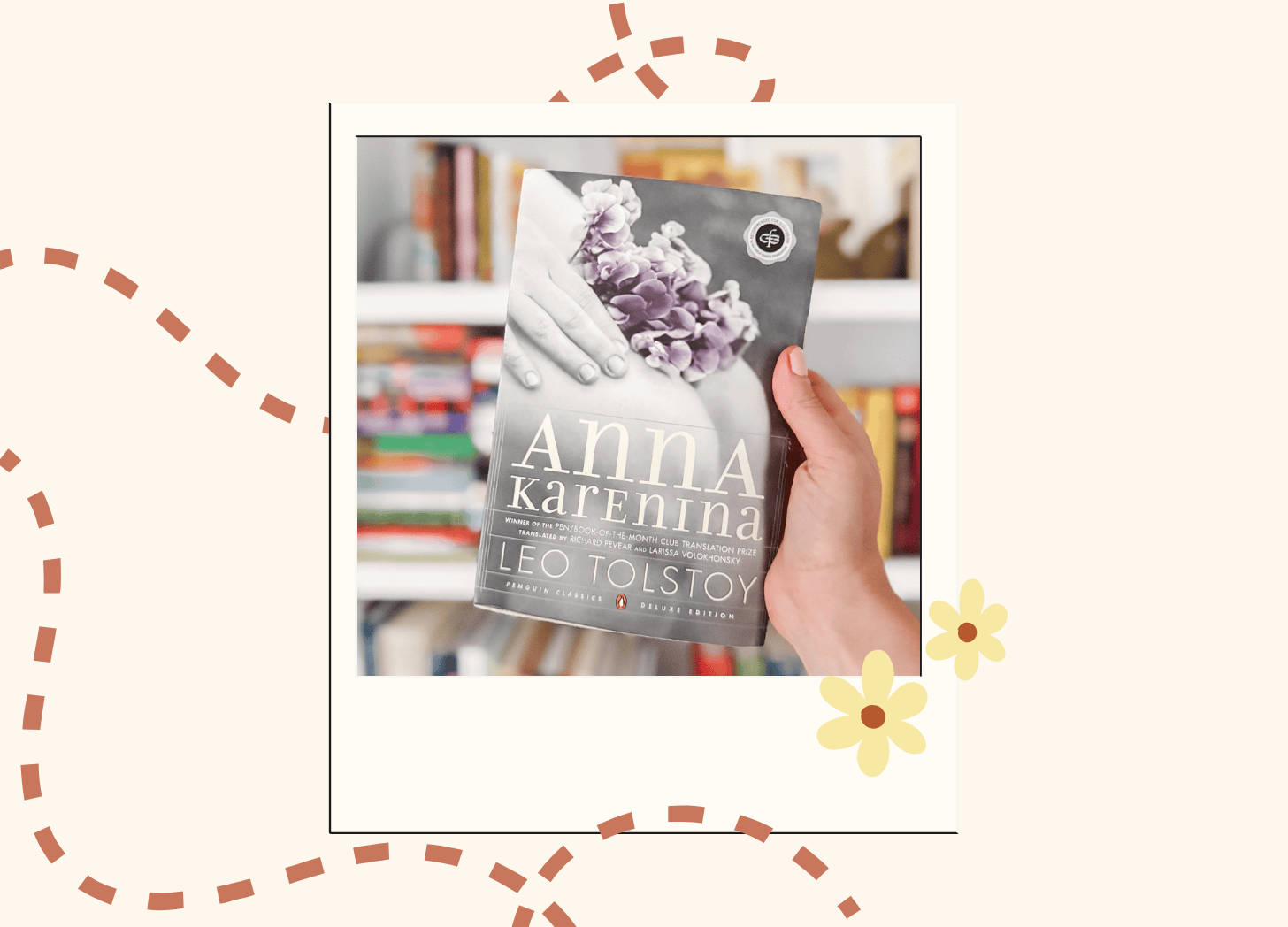
First, new readers should accept that Anna Karenina by Leo Tolstoy is old and long, and just think about whether the rest of these basic details feel like a match for you.
Page count: 800-900
Publication date: first published as a book in 1878
Age rating: best for adults 18+ due to dense text
Genres: family drama, romance
Romance tropes: love triangle, forbidden romance, love at first sight
Readability: medium (not easy, but not as hard as you may think)
Pacing: fast and slow parts (75% soap-opera level drama / 25% agricultural and social philosophy)
Who it’s for: fans of dark family sagas, high society narratives, and character-driven novels, as well as classic books heavy on literary devices like symbolism
Final rating: ★★★★☆


Now that you know the basics, let’s talk about how to get the most out of your reading experience.
Anna Karenina was written in Russian, and I’m guessing most readers here aren’t fluent.
I read and recommend the Oprah’s Book Club edition, which won the PEN/Book of the Month Translation Prize.
Buy the Oprah's Book Club Edition
The Audible exclusive audiobook is narrated by actress Maggie Gyllenhaal and won Audible’s Best of 2016 for classics. While I didn’t read this edition, Audible exclusives narrated by famous actors are not so secretly one of my favorite ways to tackle the classics because these skilled narrators bring them to life so well.
I tackled Anna Karenina in my favorite way of tackling old, long classic books: I committed to reading just 10 pages per day. Yes, it took several months, but who cares?!
I also followed each chapter with a visit to SparkNotes for historical context, which especially helped for this book because it’s so heavy in Russian history themes.
Perhaps you’ll pick the audio instead or in addition. Maybe you’ll pair it with an adaptation or retelling (see below). You may even read the full SparkNotes guide before turning the first page.
No matter your strategy, it’s having one that works for you that matters.
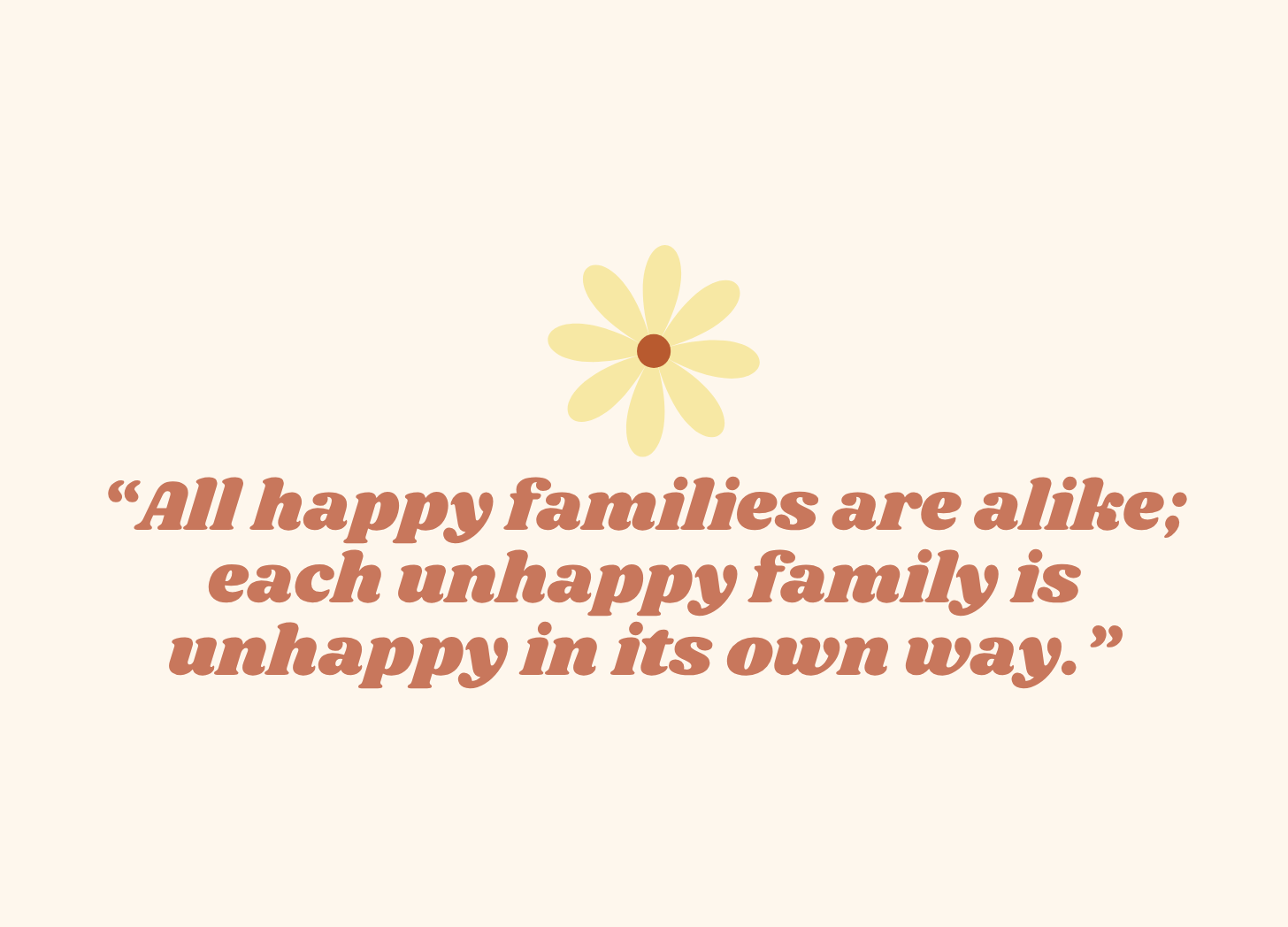
Unlike Luke Danes (IYKYK; see below), you should definitely keep in mind the famous opening line, in which Tolstoy references the unique unhappiness each family may experience. Wrapped up in it are societal notions of love and marriage at the time and place of Anna Karenina. This line drives the plot:
“All happy families are alike; each unhappy family is unhappy in its own way.”
The characters’ names aren’t as hard as, say, One Hundred Years of Solitude (a Jess Mariano book), but they are interrelated:
Anna Karenina: an unhappily married socialite in 19th-century Russia
Count Vronsky: a wealthy military officer with whom Anna has an extra-marital affair
Alexei Karenin: Anna’s husband, a St. Petersburg statesman
Levin: a philosophical countryside landowner
Kitty: a distant relative of Anna; a young and kind woman who is the object of Levin’s love
Stiva: Anna’s unfaithful brother
Dolly: Stiva’s faithful wife and Kitty’s older sister
Anna Karenina begins with the extramarital affair of the titular character’s brother, Stiva, who is married to Dolly. This foreshadows Anna’s future.
The main plot of Anna Karenina follows the love affair of the married titular character, a socialite in 19th-century Russia. She falls in love with the wealthy Count Vronsky, who wishes for her to leave her husband, Alexei Karenin, a senior statesman in St. Petersburg. They face life-changing societal and personal struggles as a result of this affair.
Secondary is another plot about a wealthy landowner named Konstantin Levin, through whom the reader learns a lot about Russian culture, particularly farming. He seeks to marry Kitty, Anna's distant relative. The novel also explores the struggles of their relationship.
I watched the 2012 Keira Knightley adaptation after reading the book, though I personally think you can also watch it beforehand as long as you don’t mind spoilers. I thought it was very good. It primarily follows Anna’s love story and leaves out much of the book’s more meaty context, making it more universally likable.
Don’t want spoilers? Just watch the trailer above for a hint of added context.
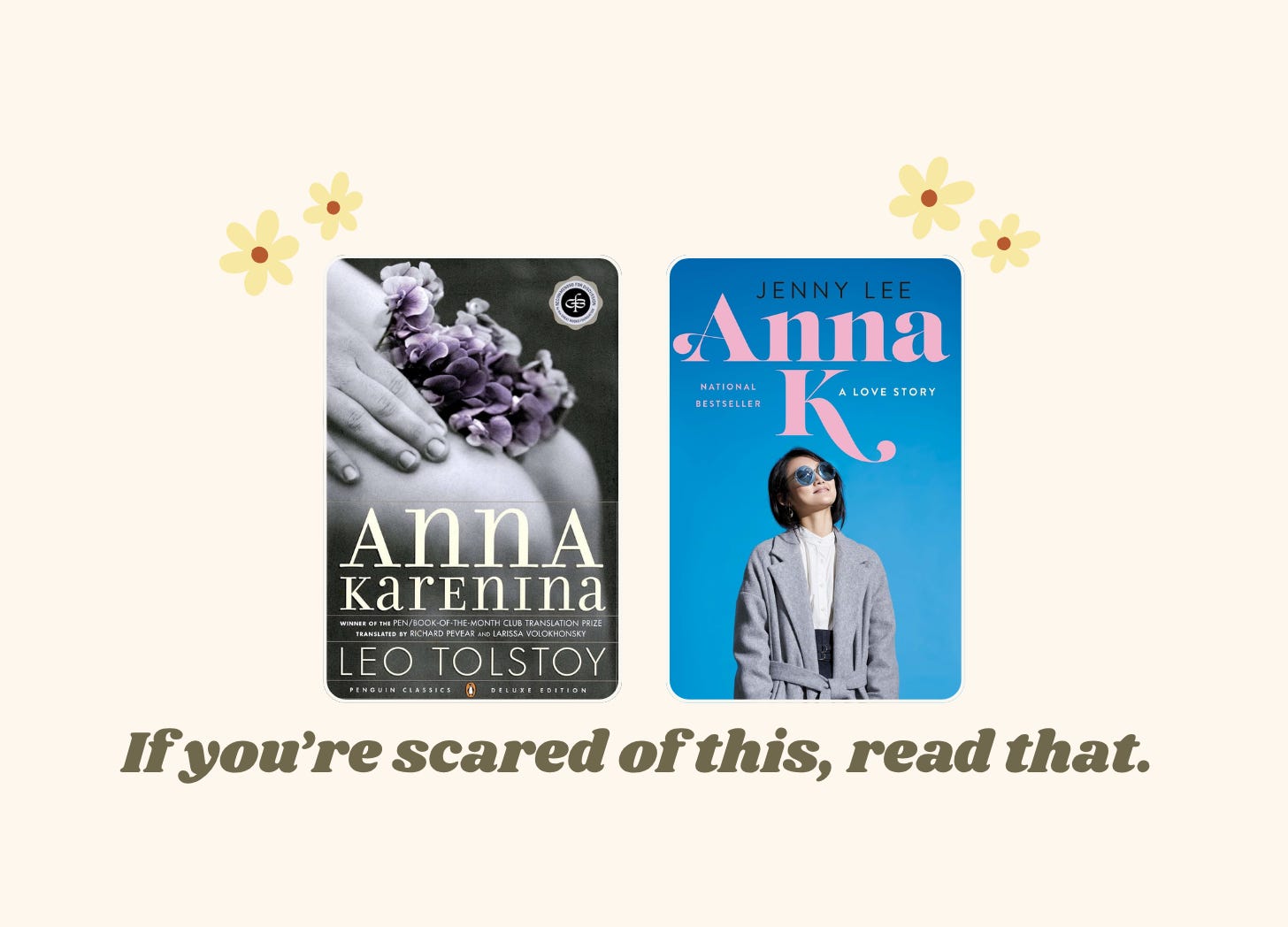
I read Anna K by Jenny Lee, a modern retelling that feels like Gossip Girl, before reading the book. I preferred this sequence, as I got the framework of Anna Karenina without spoiling the entire plot of the original text. However, you can certainly read it afterward, too. Here’s the plot:
Set in the elite modern Manhattan society, seventeen-year-old Anna seems to have it all: social standing, a boyfriend named Alexander, and a strong relationship with her father.
Meanwhile, her brother Steven and his girlfriend Lolly deal with a sexting scandal, Lolly’s sister Kimmie recovers from a career-ending ice dancing injury, and Steven’s best friend Dustin pines after Kimmie.
Everything changes when Anna meets Alexia “Count” Vronsky, a playboy who falls in love with her. As they are drawn into an intense romance, Anna must decide what she is willing to sacrifice to be with him. A shocking revelation threatens their relationship and forces Anna to question everything she thought she knew about herself.
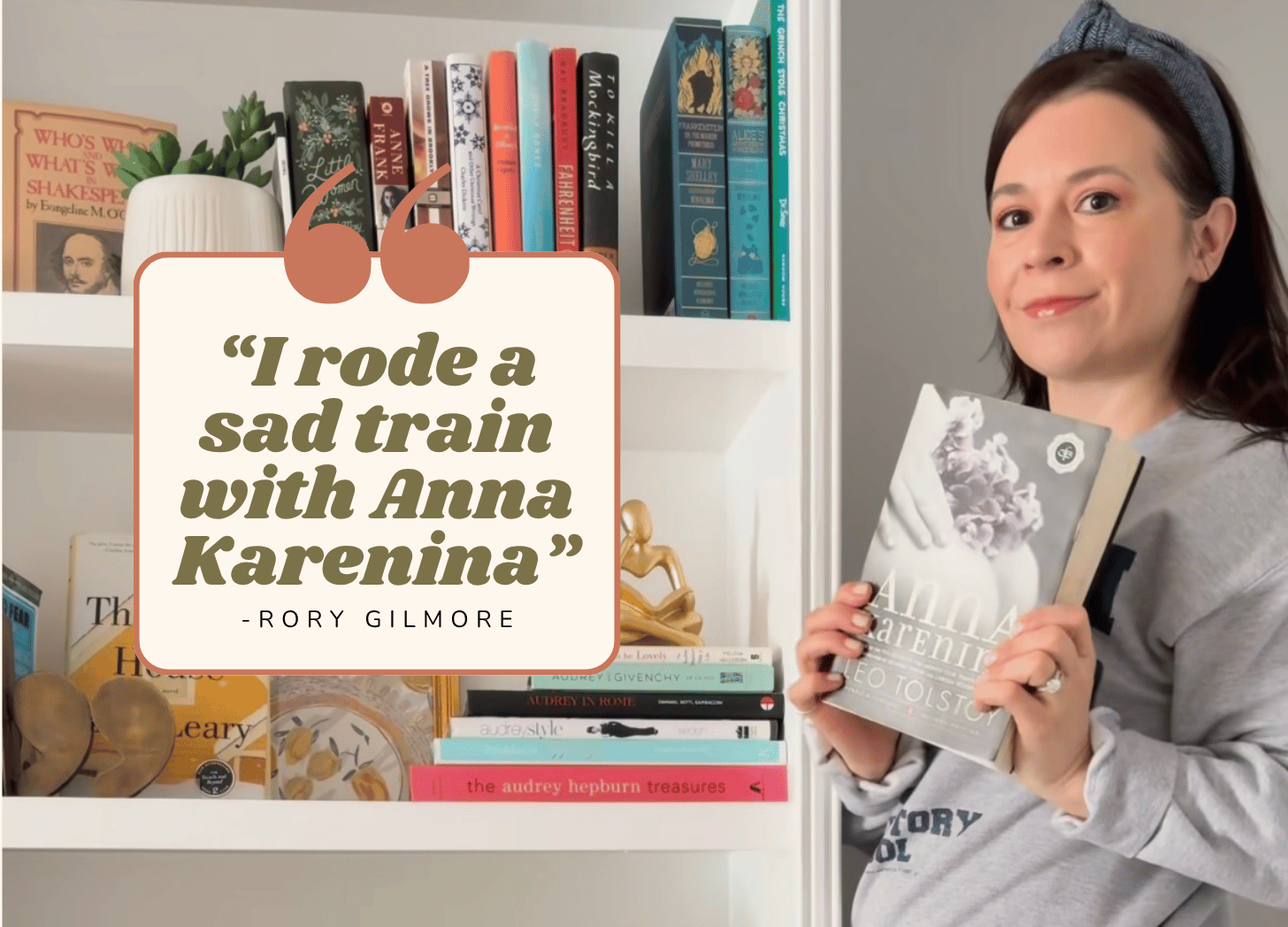
Pairing books with Gilmore Girls is exactly what we do around here. It makes reading and rewatching more fun, and it gives more context to the girls’ fast talk.
Most notably, Dean calls Anna Karenina “depressing,” and Rory calls it “beautiful.”
Here are all of the show’s many references to Anna Karenina to guide your reading:
Season 1, Episode 2 (“The Lorelais’ First Day at Chilton”): referenced at Chilton.
Season 1, Episode 16 (“Star-Crossed Lovers and Other Strangers”): Dean reads Anna Karenina and calls it depressing. Rory calls it beautiful and one of her favorite books.
Season 2, Episode 5 (“Nick & Nora/Sid & Nancy”): on Max Medina’s desk.
Season 2, Episode 15 (“Lost and Found”): Rory buys it at the book sale.
Season 3, Episode 22 (“Those Are Strings, Pinocchio”): in Rory’s Chilton speech, she says she “rode a sad train with Anna Karenina.”
Season 4, Episode 12 (“A Family Matter”): Luke misquotes the famous opening line (above).3
A Year in the Life: Summer: Rory reads it on a pool chair.
At its core, Anna Karenina explores love and family, and the consequences of straying from social norms in these personal areas of life.
From the famous opening line of this book, Tolstoy refers to the unique unhappiness each family may experience. Then, across 800+ pages, he conveys that these families share common ideals of love and happiness, but that each character takes a unique path in striving to achieve them, with varying results.
Ultimately, the point of Anna Karenina is that happiness and fulfillment are deeply intertwined with societal norms and personal choices.
Anna Karenina’s sections on Russian farming do densen the overall plot, but the characters’ intensely passionate, all-or-nothing love affairs set against this backdrop raise the stakes and make it well worth the read.
Literary readers like Rory and me will also appreciate devices like symbols. For example, the saga begins as an unhappily married Anna meets Count Vronsky at a train station, where a drunken guard is killed by a train. (How’s that for an ominous “meet cute”?!)
This symbolizes Russia’s shift toward a more industrial, capitalist system, and Anna’s move from an unhappy marriage to a passionate love affair with Vronsky. It also foreshadows a life-changing event involving a train.
Anna Karenina herself also remains one of the most memorable flawed characters in all of literature, and what reader doesn’t love a woman of complexity?!
The TL;DR? Anna Karenina is a book I continue to think about years after reading it, and I will continue thinking about it for years to come. To me, that’s what reading is all about. So thanks for the recommendation, Rory!
Friday Night Readers helps you read, live, and write like the Gilmore Girls. Subscribe now, and you’ll instantly receive a printable PDF checklist of the 475+ books on the show—each one personally verified by me, your real-life Rory Gilmore. Upgrade to get the checklist with episodes, plus exclusive posts and full community access. Founding members get exclusive access to the “Room to Write” section: my creative business tips and behind-the-scenes of my writing life.
Other Ways to Support:
❤️Like, comment, share, or restack
➕Follow: Instagram, Threads, Facebook, GoodReads, YouTube, TikTok, Pinterest, X, Reddit, LinkedIn
🎙️Listen: Podcast
📙Buy my book: Unofficial Guide to the Books on Gilmore Girls
Disclosure: This email may contain affiliate links through which I earn commissions on purchases made through my links at no extra cost to you. As an Amazon Associate I earn from qualifying purchases.
Just recently, I compared Shakespearean tragedies to reality TV shows. This is similar, but heavier than what happens on reality TV.
“Families. I mean, they're just messes. It's like this spilled drink that just keeps spilling, and ya gotta keep cleaning it up, and you scrub and you scrub and you just can't get the stain up. Show me a happy family-- just one. Didn't that Tolstoy guy say something about families?”
Comments
Nothing yet. Say the first thing.
Sign in to join the conversation.