
There’s something uniquely dispiriting about watching from outside the United States as President Donald Trump fires off his latest barrage of foreign policy pronouncements. Even by Trump’s standards, the past few days have been especially disconcerting -- and damaging.
World leaders and everyday citizens in countries allied with the U.S. are watching and wondering what the future holds for their security and the world order. In countries where most people used to like and trust the U.S., one sees eye-rolling and head-shaking about the leader of a country that, on paper at least, is still their ally.
In recent days, Trump has threatened, in vulgar language, to bomb Oman. He disparaged South Korea while praising its mortal enemy, the nuclear-armed North Korean dictator, and he declared that the Strait of Hormuz is now a U.S. territory. At the same time, he is demanding that NATO allies prove their loyalty to him in order to decide where the U.S. will cut its presence in Europe.
Trump is making America weaker. His strategy, if we can call it that, has no tradeoff. This is no transactional diplomacy. He gives up American prestige, power, influence and credibility without getting anything in return. There is no deal, no art; it’s a self-inflicted erosion of American power.
Trump and his team, especially Defense Secretary Pete Hegseth, don’t seem to understand the value of alliances.
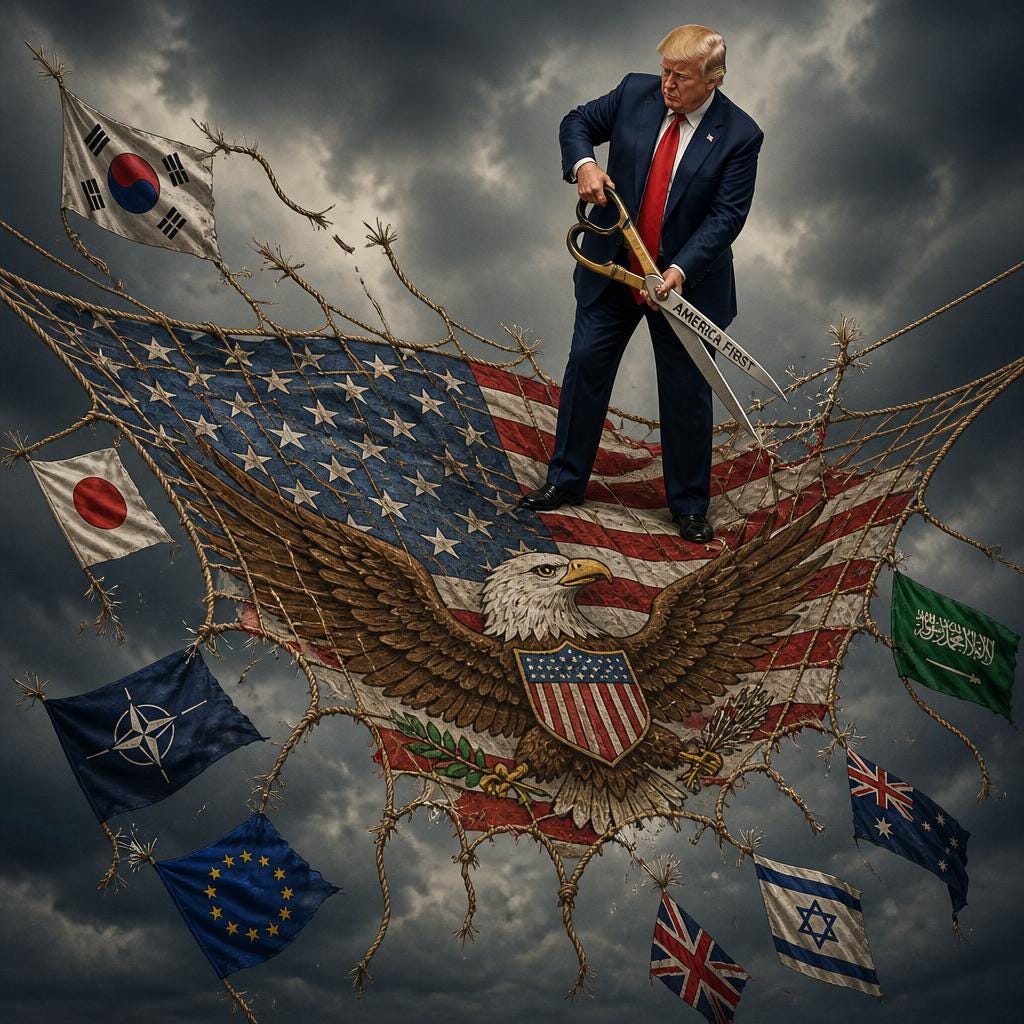
The United States became the world’s most powerful country in part because its worldwide reach was supported and bolstered by an intricate network of military and diplomatic alliances. Since World War II, those links have given Washington extraordinary global influence, helped keep the United States and its friends secure, and provided a measure of stability to the world.
Now, Trump is steadily unraveling that carefully woven security tapestry.
Decisions of great consequence are now made on the basis of perceived personal slights or loyalty.
While U.S. allies are alarmed and perplexed, America’s rivals are delighted, jumping at the opportunity to benefit as Trump weakens his country. Just after Trump said he would pull back on military exercises with South Korea, China’s foreign minister announced he is traveling to Seoul, his first trip there in five years. Washington’s retrenchment is creating a vacuum and Beijing is wasting no time trying to fill it. If successful, it would alter the balance of power in the entire region.
Then there’s Oman.
On Monday, Trump told Fox News that he would “bomb the shit out of Oman” if it interferes with U.S. objectives with Iran. The language, while common in many settings, is jarring when spoken publicly by the president of the United States. But the words are less important than the message. Disagreements between countries that have had decades-long strong relations are not normally resolved by threatening to bomb a friendly nation. If Washington wants Oman’s cooperation, why would publicly threatening its government make that cooperation more likely?
Of course, Trump’s threats to bomb, to destroy a civilization, have become almost routine. It’s a humiliating situation for the U.S. when the words of its president are dismissed as empty bravado.
His claim that the Strait of Hormuz is now part of the U.S. makes some people laugh around the world. But those who used to rely on the U.S. grow more despondent by the day.
A few weeks ago, Saudi Arabia joined with Turkey and Pakistan in a new alliance. I explored the implications of this new alliance in a separate article for INSIGHT paid subscribers, noting how the new Mecca mutual defense deal brings quite a gathering.
“Consider the combination: nuclear weapons (Pakistan), one of the world’s biggest, best-armed military forces (Turkey), and an oil-rich, influential Arab powerhouse (Saudi Arabia).”
The fact that Saudi Arabia sought a new alliance is significant and of concern to Israel, India and the UAE, but above all, it is the strongest evidence yet that U.S. partners like Saudi Arabia are losing trust in its role as the region’s security guarantor. “The new bloc,” I noted, “gives no role to Washington, unlike multiple other regional deals in which the U.S. helps drive policy.”
If the situation in the Middle East is in flux, consider the Asia Pacific region, the center of gravity of the U.S.-China rivalry. Over the weekend, Trump announced that, “Based on my very good relationship with Kim Jong Un of North Korea,” and because in his telling South Korea refused to help in Iran, he has ordered the Pentagon to “substantially reduce” planned military exercises.
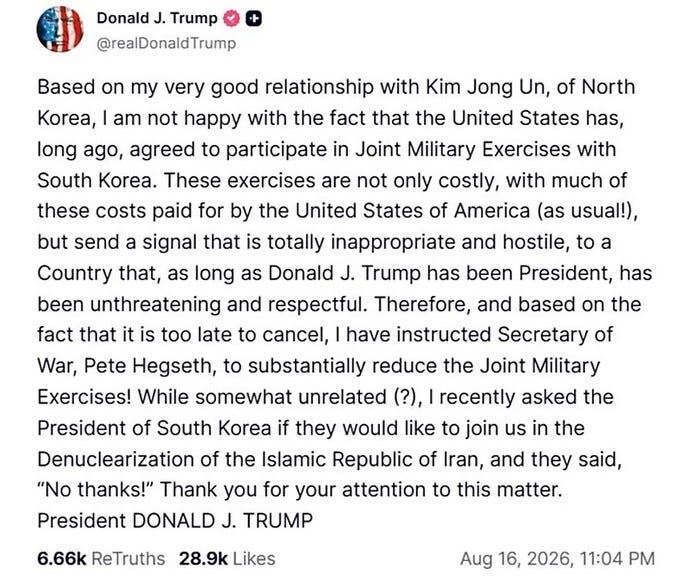
This gift to the ruthless North Korean dictator could upend relations with Washington’s Asian allies and it is so harmful to U.S. interests that foreign policy experts from Republican and Democratic administrations are calling it mind-boggling.
Dan Fried, who served in the George W. Bush administration said,
“…it makes no sense. It undermines the South Koreans, undermines the Japanese, frightens the Taiwanese, unnerves NATO and emboldens the Chinese, not to mention the North Koreans.”
Danny Russel, of the Obama administration, called it,
“…firmly in the ‘hard-to see-how-it-could-be-worse’ category. It is tragically upside-down. Trump is punishing an ally while encouraging an adversary.”
Even the conservative Wall Street Journal excoriated Trump, warning that the move will boost calls for South Korea to develop nuclear weapons.
Then there’s the latest potentially devastating move on NATO.
Bloomberg News discovered that the Pentagon has sent all NATO members a document asking that they spell out their loyalty to Trump to help the administration decide where the U.S. will cut its forces.
This is foreign policy based on personal loyalty rather than the national interest.
Among other things, the documents asks each country if it has “been publicly supportive” of U.S. foreign policy. Former U.S. ambassador to NATO Ivo Daalder notes that the question “isn’t about troop levels or spending targets. It’s about loyalty.”
The questionnaire, he warns sharply,
“…puts fealty above common interests, divides the allies among themselves, weakens collective defense, and ultimately could destroy NATO.”
This is the opposite of transactional diplomacy. A transaction requires something to be gained. Here, the U.S. is weakening the alliance that has multiplied American power for generations, while giving its allies a new reason to prepare for a future in which they United States is no longer reliable.
Watching Trump from inside the United States, one can grow jaded by the relentless barrage: the shocking statements, the crass insults against journalists and political adversaries, the relentless violations of basic ethical norms and government rules. But watching from overseas the shock of it all comes jarringly back into perspective. This is not just embarrassing. It is strategically dangerous. Trump is making America weaker, less respected, less prepared for the challenges ahead.
The tragedy is that Trump appears to be giving away one of America’s greatest sources of power without even realizing that he is giving anything away.
No posts
Comments
Nothing yet. Say the first thing.
Sign in to join the conversation.