
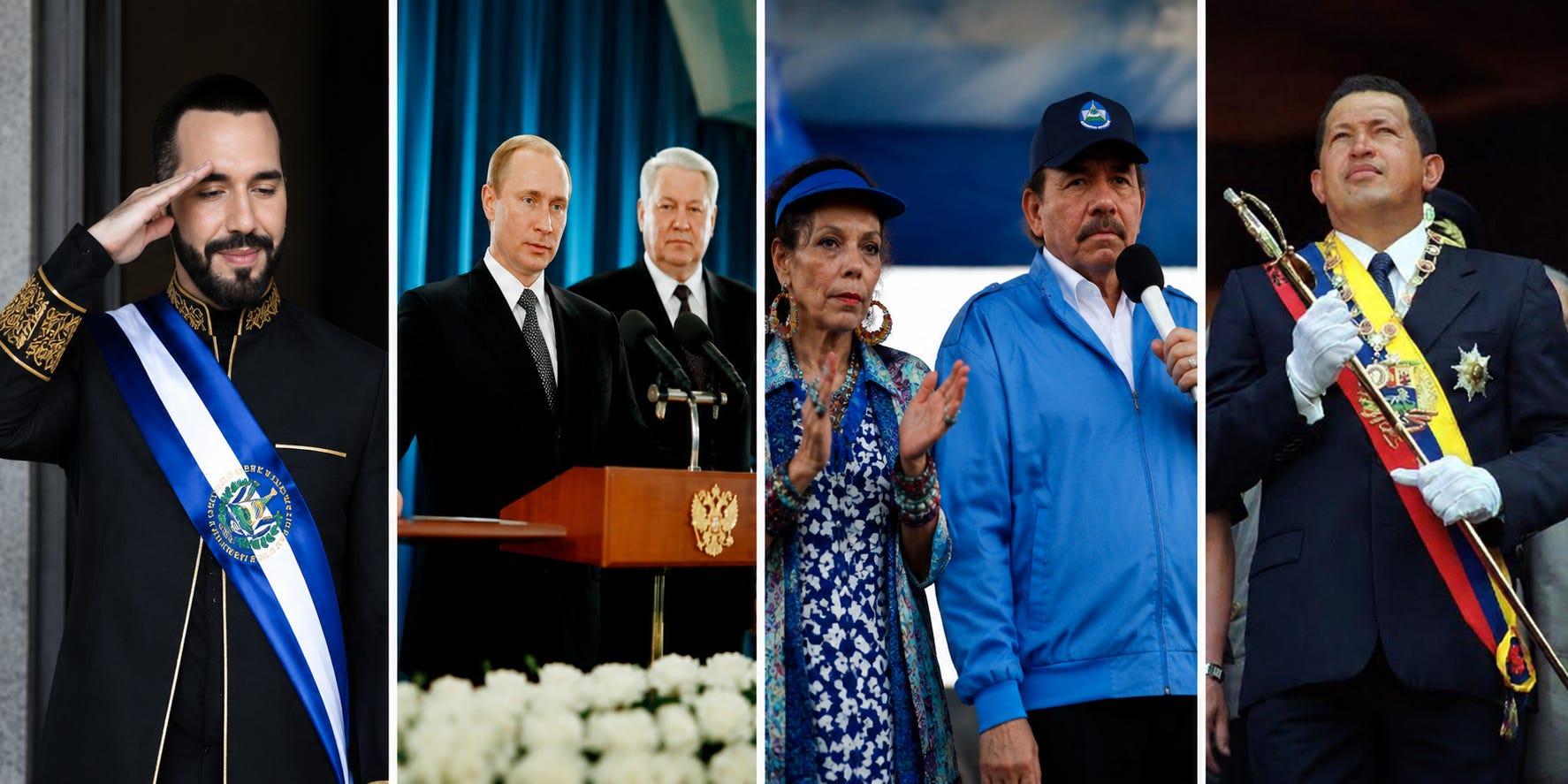
When the former leftist guerrilla Gustavo Petro ran for president of Colombia in 2022, a common refrain could be heard among his critics. If Petro wins, they warned, it would be Colombia’s last democratic election. As a cautionary tale, they pointed to neighboring Venezuela, which became a hard-left dictatorship under Hugo Chávez and his successors.
Petro won, but the pessimists were wrong: Colombia inaugurated a new president last week. And despite Petro’s rejection of the recent election results and his efforts to have it annulled, claiming that his protégé was the real winner, there’s no evidence he intended to stay in office. Colombia’s democracy survived.
[The new president, the rightist Abelardo de la Espriella, suddenly faces a trial by fire. Three days after he was sworn in Cali, the country’s third largest city, a violent earthquake struck the country, killing hundreds and leaving parts of western Colombia, including Cali, in dire need of government assistance. The challenge will be enormous and a divided country will not be gentle in its judgement. But that’s a topic for a future column.]
Colombia’s peaceful, if acrimonious, transition, doesn’t mean that concerns about Petro were entirely groundless. Old-fashioned coups have become rare in Latin America in recent decades, but dictatorships have not. The new wave of authoritarian rulers gains power initially by campaigning for it, securing it at the ballot box and then manipulating the levers of government to perpetuate their rule.
A dramatic recent example is Nicaraguan President Daniel Ortega. By appointing loyalists to key positions in the judiciary, coopting the legislature and rigging elections, he has stayed in the top office for nearly 20 years. Last month, he finally got tired of pretending to have democratic legitimacy and declared the country would not hold any more elections lest “coup-mongers” and “traitors” from the opposition come to power. His aim is to have his wife and co-president, Rosario Murillo, succeed him.
The practice of elected leaders eroding the very democratic institutions that brought them to the presidency is not new, nor is it limited to Latin America. Look no further than Russia’s Vladimir Putin, who was elected in 2000 during the early post-Soviet days, when enthusiasm for democracy permeated the country.
In 2008, he pretended to respect the country’s two-term presidential term limit, stepping down and becoming prime minister under President Dmitry Medvedev. But no one doubted who was really pulling the strings. Putin returned to the presidency in 2012, and since then, through a series of maneuvers, he has ruled without interruption. As his stay in office continued, the Russian government became increasingly repressive and the patina of democratic legitimacy steadily eroded. Now, the country’s amended constitution allows him to stay in office until 2036, with no genuine chance that elections will be free or fair as long as he remains there.
Contemporary autocrats often employ similar tactics as Putin to scrap or indefinitely extend limits on their time in office. The problem was documented in a recent report by Freedom House, “Overstaying Their Welcome: The Problem of Presidential Term Limit Evasion.”
Many of the worst offenders in the report hail from sub-Saharan Africa, but tyrants across the Western Hemisphere have also proven adept at staying in office well past the expiration of their original mandate.
In Venezuela, Chávez initially came to power by winning the 1998 election, widely deemed free and fair by observers. But soon after taking office in 1999, he organized a constitutional referendum that removed a previous ban on presidents serving consecutive terms. Ten years later, as his two-term limit approached, he engineered a second referendum that scrapped term limits entirely, clearing the way for him to be president for life.
Increasingly, democracy dies not when elections are abolished, but when elected leaders ensure they can never truly lose one again.
Shortly before his death in 2013, Chávez designated Nicolás Maduro as successor, ensuring the system survived him, and Maduro crushed what little was left of Venezuela’s democracy. While Maduro was seized and renditioned by US. forces in January, the interim government that replaced him, led by former Vice President Delcy Rodriguez, has continued to govern in a similarly repressive manner.
Once an autocrat becomes entrenched, removing them can be difficult.
That’s what Bolivians found with Evo Morales, the country’s first Indigenous leader, who was elected president in 2005 when the “pink tide” was washing across the region. In 2009, Bolivia wrote a new constitution that limited presidents to two consecutive terms. Morales won a second term, and then successfully ran for a third, arguing that his first term didn’t count because it was under the old constitution. Bolivia’s Constitutional Court, which critics alleged was stacked with Morales loyalists, agreed with the president.
In 2016, partway through his third term, Morales held a referendum for another constitutional change that would allow him to run yet again. This time, voters narrowly rejected the proposal. Ignoring the referendum results, his party took the matter to the Constitutional Court, which sided with Morales again, ruling that term limits constituted a violation of human rights. He stood for a controversial fourth term in 2019.
What happened next was messy. Electoral authorities released official results that showed Morales eking out a win, but not before they halted the vote-counting process for a full day, triggering allegations of vote-rigging. Mass protests erupted, and after weeks of unrest, the military turned on Morales, who resigned and fled the country. Independent researchers later concluded there was no evidence of irregularities in the election, fueling a debate about whether Morales had been ousted in a coup.
In Morales’ case, his legacy of democratic backsliding is complicated by the fact that he was enormously popular, at least during his early years in office. The same goes for El Salvador’s Nayib Bukele, the millennial president who calls himself “the world’s coolest dictator.”
Bukele, a darling of the far right for his no-holds-barred campaign against the country’s violent criminal gangs, is likely the world’s most popular president, with consistently stratospheric approval ratings despite his disregard for legal due process and human rights. Since being elected in 2019, he has steadily moved to dismantle checks and balances, gaining control of essentially all the country’s institutions, including the judiciary, and sweeping away any limits on his power.
The culmination of that process came last year, when the legislature, controlled by Bukele’s allies, approved a constitutional amendment abolishing all term limits. As it stands now, Bukele could follow in Chavez’s footsteps and stay in office until the end of his natural life.
The classic military coup has not disappeared. But increasingly, democracy dies not when elections are abolished, but when elected leaders ensure they can never truly lose one again. Autocratic leaders, elected by democratic means, are following the 21st century playbook and inventing new maneuvers to stay in power.
World Politics Review, where a version of this article appeared, is welcoming readers of INSIGHT by Frida Ghitis with a special rate.
No posts
Comments
Nothing yet. Say the first thing.
Sign in to join the conversation.